 Log in
Srinivas Sista
Google Chrome



Welcome to Voice Chapter 11 🎉, our long-running series where we share all the key developments in Open Voice. In this chapter, we will tell you how our assistant can now control more things in the home, in multiple languages at the same time, all while not talking your ear off. What’s more, our list of supported languages has grown again with several languages that big tech’s voice assistants won’t support. Join us for a deeper look at this voice chapter in our livestream on Wednesday, October 29. It’s been a couple of months, we’ve been building up our voice, and now have a lot to say, so let’s get to it!
Our original goal for the Year of Voice back in 2023 was to “let users control Home Assistant in their own language”. We’ve come a long way towards that goal, and really broadened our language support. We’ve also provided options that allow users to customize voice assistant pipelines with the services that best support their language, whether run locally or in the cloud of their choice. But what if you speak two languages within your home?
For some time, users have been able to create Assist voice assistant pipelines for different languages in Home Assistant, but interacting with the different pipelines has either required multiple voice satellite devices (one per language) or some kind of automation trigger to switch languages.
Since even the tiniest voice satellite hardware we support is capable of running multiple wake words now, we’ve added support in 2025.10 for configuring up to two wake words and voice assistant pipelines on each Assist satellite! This makes it straightforward to support dual language households by assigning different wake words to different languages. For example, “Okay Nabu” could run an English voice assistant pipeline while “Hey Jarvis” is used for French.
Multiple wake words and pipelines can be used for other purposes as well. Want to keep your local and cloud-based voice assistants separate? Easy! Assign a wake word like “Okay Nabu” to a fully local pipeline using our own Speech-to-Phrase and Piper. This pipeline would be limited to basic voice commands, but would not require anything to run outside of your Home Assistant server. Alongside this, “Hey Jarvis” could be assigned to a different pipeline that uses external services like Home Assistant Cloud and an LLM to answer questions or perform complex actions.
We’d love to hear feedback on how you plan to use multiple wake words and voice assistants in your home!
The whole world is engulfed in hype about AI and adding it to all the things — we’re not exactly quiet about the cool stuff we’re doing with AI. While powering your voice assistants with AI/LLMs makes them much more flexible and powerful, it comes at a cost: paying to use cloud-based services like OpenAI and Google, or pricey hardware and energy to run local models via systems like Ollama. We started building our voice assistant before AI was a thing, and thus it was designed without requiring it. We continue to make great progress towards delivering a solid voice experience to users who want to keep their home AI free — keeping AI opt-in only and not required are guidelines we follow.
Assist, our built-in voice assistant, can do a lot of cool things without the need for AI! This includes a ton of voice commands in dozens of languages for:
Want to include your own voice commands? You can quickly add custom sentences to an automation, allowing you to take any action and tailor the response.
The easiest way to get started is with Home Assistant Voice Preview Edition, our small and easy-to-start with Voice Assistant hardware. This, combined with a Home Assistant Cloud subscription, allows any Home Assistant system to quickly handle voice commands, as our privacy-focused cloud processes the speech-to-text (turning your voice into text for Home Assistant) and text-to-speech (turning Home Assistant’s response back into voice). This is all without the use of LLMs, and supports the development of Home Assistant 😎.
For users wanting to keep all voice processing local, we offer add-ons for both speech-to-text and text-to-speech:
All of this together shows just how much can be done without needing to include AI, even though it can do some pretty amazing things. And we’re continuing to close the gap with the features highlighted in this blog post, including multilingual assistants, improved sentence matching, and the ability to ask questions from automations.
Intents are what connect a voice command to the right actions in Home Assistant to get something done. While the end result is often simple, such as turning on a light, intents are designed as a “do what I mean” layer above the level of basic actions. In the previous section, we listed the sorts of voice commands that intents enable, from turning on lights to adding items to your to-do list. Over the last three years, we’ve been progressively adding new and more complex intents.
Recently, we’ve added three new intents to make Assist even better. To control media players, you can now set the relative volume with voice commands like “turn up the volume” or “decrease TV volume by 25%”. This adds to the existing volume intent, which allows you to set the absolute volume level like “set TV volume to 50%”.
Next, it’s now possible to set the speed of a fan by percentage. For example, “set desk fan speed to 50%” or even “set fans to 50%” to target all fans in the current area. Make sure you expose the fans you want Assist to be able to control.
Lastly, you can now tell the kids to “get off your lawn” because your robot is going to mow it! Making use of the lawn_mower integration, your voice assistant can now understand commands like “mow the lawn” and “stop the mower”. Paired with the existing smart vacuum commands, you may never need to lift a finger again to keep things clean and tidy.
Picture this: you come home from work and, as you enter the living room, your voice assistant asks what type of music you’d like to hear while preparing dinner. As the music starts to play, it mentions you left the garage door open and wants to know if you’d like it closed. After dinner, as you’re hanging out on the couch, your voice assistant informs you that the temperature outside is lower than your AC setting and asks for confirmation to turn it off and open the windows.
Surely you’d need a powerful LLM to perform such wizardry, right? With the Ask Question action, this can all be done locally using Assist and a few automations!

Within an automation, the Ask Question action allows you to announce a message on a voice satellite, match the response against a list of possible answers, and take an action depending on the user’s answer. While answers can be open-ended, such as a musical artist or genre, limiting the possible answers allows you to use the fully local Speech-to-Phrase for recognizing speech without an internet connection.
Assist was designed to run fast and fully offline on hardware like the Raspberry Pi 4 for many different languages. It works by matching the text of your voice commands against sentence templates, such as “turn on the {name}” or “turn off lights in the {area}”. While this is very fast and straightforward to translate to many languages, it can also be inflexible, resulting in the dreaded “Sorry, I couldn’t understand that” or other errors.

Starting in Home Assistant 2025.9, we’ve included an improved “fuzzy matcher” that is much better at handling extra words or alternative phrasings of our supported voice commands.

The fuzzy matcher is pre-trained on the existing sentence templates, so we will be able to use it for all of our supported languages. However, this is initially only available for the English language and we’re working to determine the best way to enable this for other languages.
After a voice command, Assist responds with a short confirmation like “Turned on the lights” or “Brightness set”. This lets you know it understood your command and took the appropriate actions. However, if you’re in the same room as the voice assistant, this confirmation is redundant; you can see or hear that appropriate actions were taken.
Starting with Home Assistant 2025.10, Assist will detect if the voice command’s actions all took place within the same area as the satellite device. If so, a short confirmation “beep” will be played instead of the full verbal response. Besides being less verbose, this also serves as a reminder that your voice command only affected the current area.
Non-verbal confirmations will not be used in voice assistant pipelines with LLMs, since the user may have specific instructions in their prompt, such as “respond like a pirate”, and we wouldn’t want to deprive you of a fun response, me mateys 🏴☠️.
Large language models (LLMs) can be especially verbose in their responses, and we quickly realized that this exposed a weakness in Home Assistant’s text-to-speech (TTS) implementation. For most of its life, TTS in Home Assistant has required the full response to be generated before any audio can be played. This meant a lot of waiting for multi-paragraph LLM responses, especially with local TTS systems like Piper.
Fixing this required an overhaul of the TTS architecture to allow for streaming. Instead of waiting for the entire audio message to be synthesized before playing, we enabled TTS services within Home Assistant to work with chunks of text (input) and audio (output). As chunks of text are streamed in from an LLM, the TTS service can synthesize audio chunks and send them out to be played immediately.
To demonstrate the benefit of streaming, we asked an LLM to “tell me a long story about a frog” and timed how long it took to start speaking the (multi-paragraph) response. Without streaming, both Home Assistant Cloud and Piper took more than five seconds to respond! This is long enough to make you wonder if your voice assistant heard you 😄 With streaming enabled, both TTS services took about half a second to start talking back. A 10x improvement in latency!
Piper, our homegrown text-to-speech tool, continues to grow with support for several new languages! These new voices were trained from publicly available voice datasets, and are available now in the Piper add-on:
Want to know what the new voices sound like? You can listen to samples of every available Piper voice or even run Piper entirely within your web browser for free.
If your language is missing from Piper, or you don’t like the existing voices for your language, we’re always looking for volunteers to contribute their voices! Please contact us at voice@openhomefoundation.org
In the past three years, we’ve made great strides with Home Assistant Voice on both the hardware and software fronts. Users today have a wide variety of choices when it comes to voice: from fully local to using the latest and greatest AI to power their smart homes. The great thing about our experimentation with AI is that there are no investors looking for returns, fake money, or “rug-pulls”. We do everything for you, our community. We’re in this for the long haul, and want this all to be your choice, keeping you in full control of whether you want to use this technology or avoid the hype completely.
Much of the advanced work done on voice is only possible with the support of our community, especially those who subscribe to Home Assistant Cloud or anyone who has purchased our Home Assistant Voice Preview Edition (both great ways to get started with voice).
The Stable channel has been updated to 141.0.7390.122/.123 for Windows and Mac and 141.0.7390.122 for Linux, which will roll out over the coming days/weeks. A full list of changes in this build is available in the Log.
This update does not include any security fixes.
Note that a previous version of these notes incorrectly indicated that V8 Bug 452296415 with CVE-2025-12036 had been fixed in this release. It will be included in Chrome 142
Interested in switching release channels? Find out how here. If you find a new issue, please let us know by filing a bug. The community help forum is also a great place to reach out for help or learn about common issues.
LANIPScanner is a new tool for Windows that scans your network and displays the list of all computers and devices that are currently connected to your network. LANIPScanner uses multiple network protocols to scan your network, including ICMP (ping), ARP, mDNS, DNS, NBNS, SSDP.
For every computer or device that is connected to your network, the following information is displayed (Only if it’s available): IP Address, MAC Address, MAC Address Company, Device Name, Workgroup, Device String, Ping Time, Ping TTL, Device Type, Protocols List, IPv6 Address, IPv6 Link Local Address.
When a device responses to SSDP or mDNS protocol, you can also view the raw data received from the device in the lower pane, by selecting the device in the upper pane.
The LANIPScanner tool works on any version of Windows starting from Windows XP and up to Windows 11. Both 32-bit and 64-bit systems are supported.
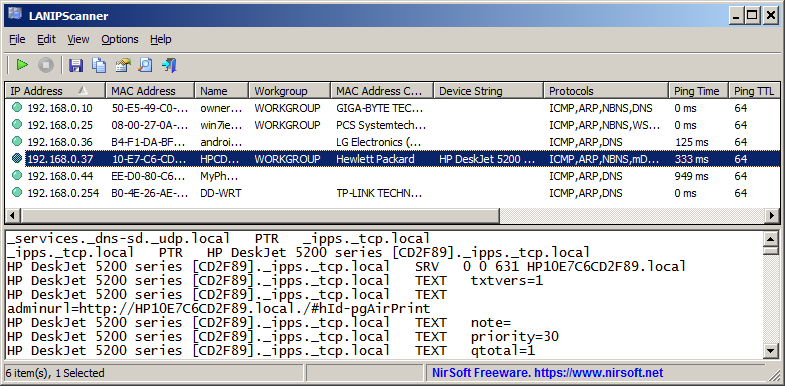
You can download the new LANIPScanner tool from this Web page.
FullUpdatesHistoryView is a new tool for Windows 11 that displays the history of Windows updates on your system. For every Windows update history record, the following information is displayed: Update Time, Title, Description, Information URL, Category, KB Number, Update ID, Provider ID, and more…
This tool uses a new database available only on Windows 11 and the latest versions of Windows 10 ( C:\ProgramData\USOPrivate\UpdateStore\store.db ), so you cannot use it for previous versions of Windows.
For viewing the Windows updates history on older versions of Windows you can use this tool: Windows Updates History Viewer.
The previous tool for viewing the Windows updates history ( Windows Updates History Viewer ) reads the updates by using Windows API or by reading the database file directly from C:\Windows\SoftwareDistribution\DataStore\DataStore.edb, depending on what you choose in the ‘Advanced Options’ window.
However, every time that a major update of Windows 11 is installed (e.g: 23H2, 24H2), all previous updates are deleted from the database by Windows operating system, so the previous tool cannot display the updates installed on your system before the last major update of Windows.
The FullUpdatesHistoryView tool uses the new updates history database (C:\ProgramData\USOPrivate\UpdateStore\store.db ) which keeps all updates history records, without deleting the history on every major update.
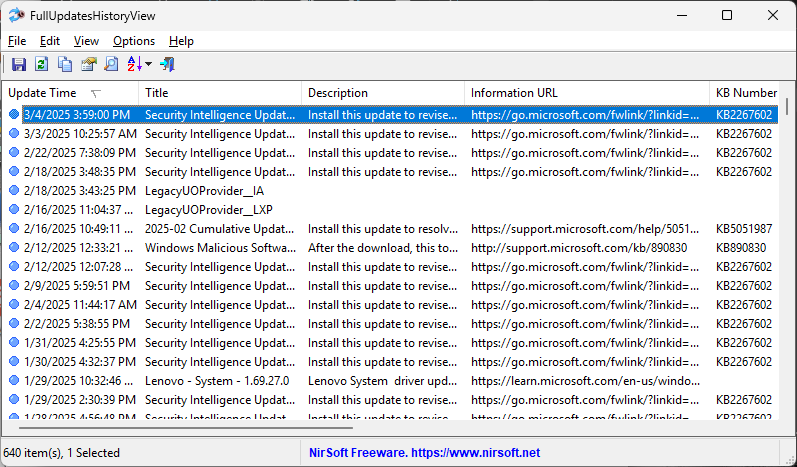
You can download the FullUpdatesHistoryView tool from this Web page.
The new version of MultiMonitorTool (version 2.20) allows you to easily set the display scaling of specific monitor from command-line, by using the /SetScale command.
The first parameter of the /SetScale command is the name of the monitor (For example: \\.\DISPLAY1). Like in other commands of MultiMonitorTool, you can also specify the monitor ID or the serial number of the monitor, or ‘Primary’ string for the primary monitor.
The second parameter specifies the scaling value. You can specify the absolute scale value in percent, for example: 100,125,150,175,200,225, and so on…
You can also specify a relative value. In this case – you have to specify ‘0’ to set the recommended display scaling, a positive number (1, 2, 3, …) to set display scaling larger than recommended, or a negative number (-1, -2, -3, …) to set display scaling smaller than recommended.
Here’s some examples for the /SetScale command:
MultiMonitorTool.exe /SetScale “\\.\DISPLAY2” 150
MultiMonitorTool.exe /SetScale “Primary” 125
MultiMonitorTool.exe /SetScale “GSM5B54” 1
You can download the new version of MultiMonitorTool from this Web page.
DHCPLogView is a new tool for Windows that monitors the DHCP requests sent by every device connects to your network and displays the information on the main window.
For every device that connects your network the following information is displayed:
MAC Address, MAC Address Company, DHCP Request Time, Requested IP Address, Host Name, Vendor Class ID, Parameter Request List,
and the operating system of the device (For common versions of Windows and Android)
You can also use DHCPLogView in system tray mode and get notification every time that a device sends a DHCP request to connect your network.
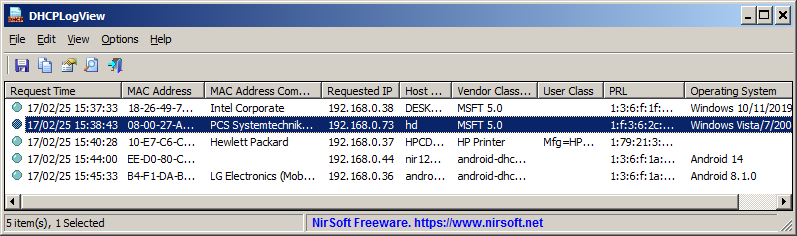
You can get more information about the new DHCPLogView tool in this Web page.
BluetoothLEView is a new tool for Windows 10 and Windows 11 that monitors and displays the activity of Bluetooth Low Energy devices around you.
For every device detected by BluetoothLEView, the following information is displayed (if it’s available): MAC Address, Device Name, Signal Strength In dBm (RSSI), Manufacturer ID, Manufacturer Name, Service ID, Service Name, first and last time that the device was detected, number of times that the device was detected, and more…
In order to run and use the BluetoothLEView tool, you need a computer with Windows 10 or Windows 11, and a Bluetooth dongle or internal Bluetooth adapter that supports Bluetooth Low Energy.
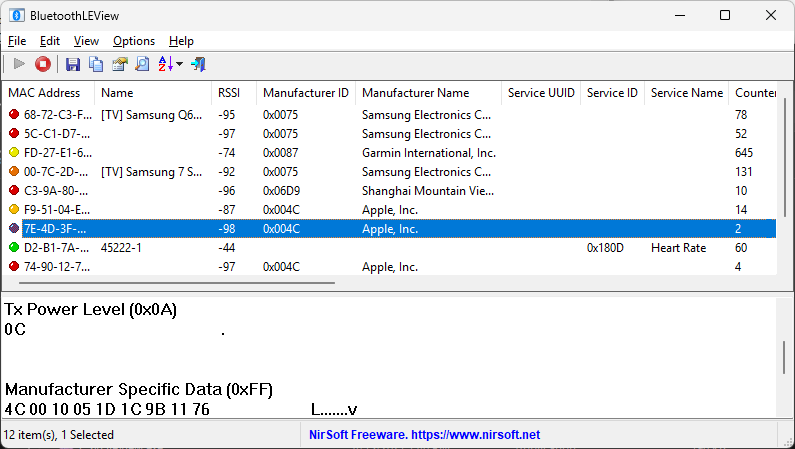
You can download the BluetoothLEView tool from this Web page.
The new version of WifiInfoView (v2.90) allows you to easily export the information of one or more access points into a .pcap capture file.
For every access point that you select, a single beacon frame with all information elements is added to the .pcap file.
After generating the .pcap with WifiInfoView, you can open and analyze the access point information by using the Wireshark software.
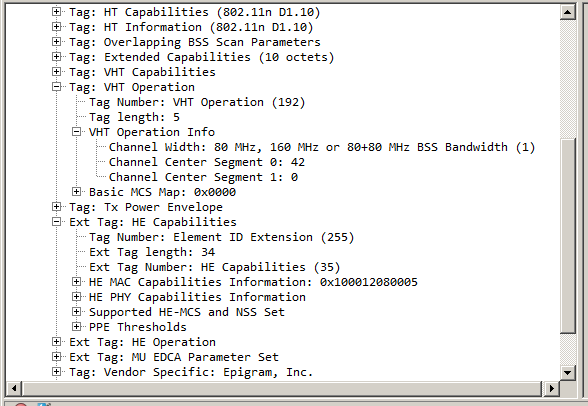
Here’s an example for .pcap file generated by WifiInfoView, and then opened in Wireshark:
You can download the new version of WifiInfoView from this Web page.
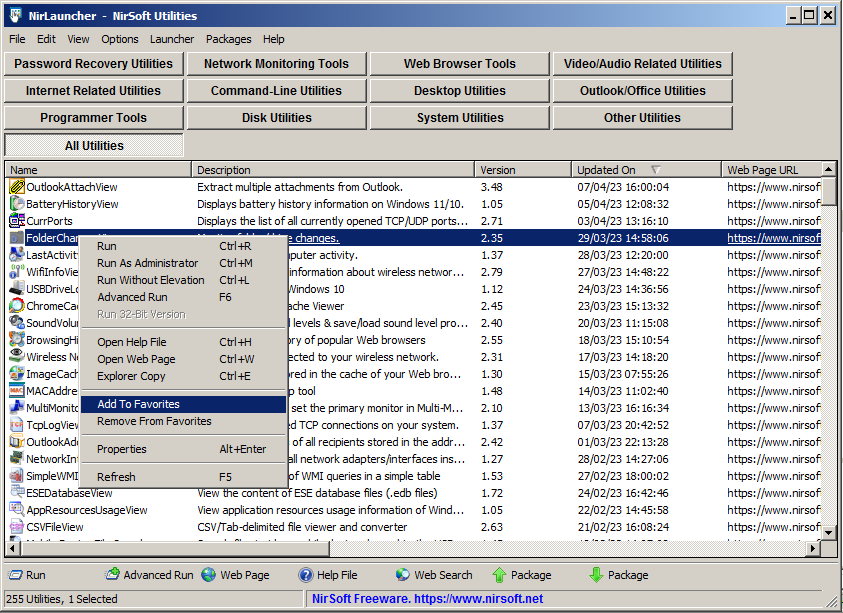
The new version of NirLauncher package (1.30) allows you to easily add tools into your favorites list, and then view only your favorite tools instead of the entire tools collection.
In order to use this feature, simply select one or more tools in the main window of NirLauncher, and then from the right-click context menu choose ‘Add To Favorites’ to add the selected tools into your favorites list, or ‘Remove From Favorites’ to remove the selected tools from your favorites list.
When you want to view only your favorite tools, go to View -> Show Only Favorites or simply press F2.
There are also a few more new features in version 1.30 of NirLauncher package. You can find more information about them in the About Window (Help -> About).
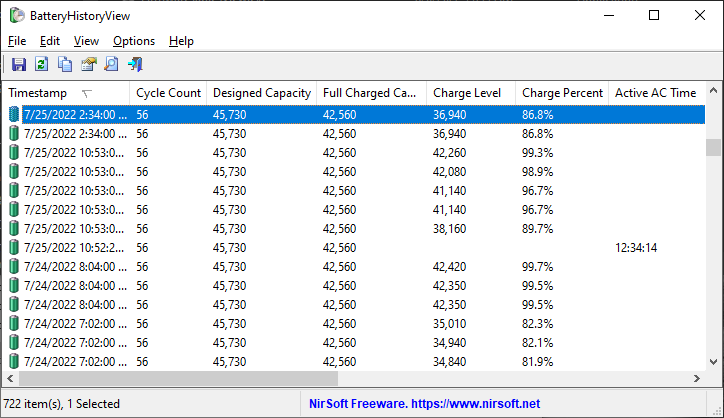
BatteryHistoryView is a new tool for Windows 11 and Windows 10 that extracts and displays the battery history information stored in the SRUDB.dat database of Windows.
The battery history includes the following information: Timestamp, Cycle Count, Designed Capacity, Full Charged Capacity, Charge Level, Charge Percent, Active AC Time, CS AC Time, Active DC Time, CS DC Time, Active Discharge Time, CS Discharge Time, Active Energy, CS Energy.
You can extract the battery history from your local computer, from remote computer on your network, and from external drive plugged to your computer.
The BatteryHistoryView tool is available to download from this Web page.
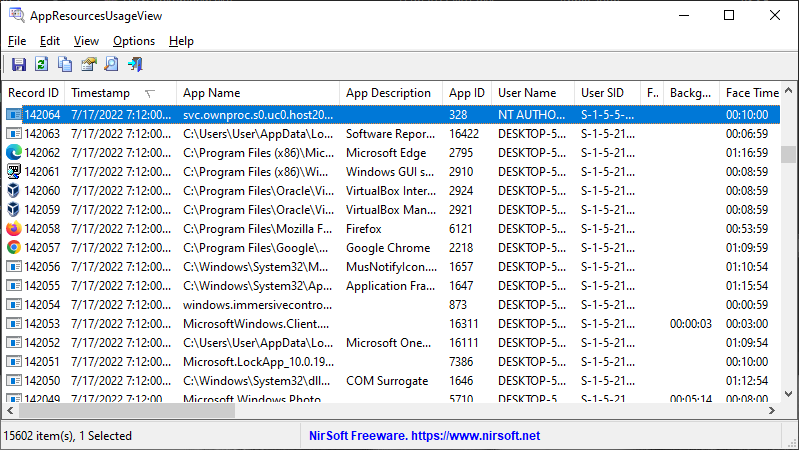
AppResourcesUsageView is a new tool that extracts and displays the application resources usage information stored in the SRUDB.dat database of Windows 10 and Windows 11.
For every record of application resources usage, the following information is displayed: Record ID, Timestamp, Application, User, Face Time, Cycle Time (Foreground/Background), Context Switches (Foreground/Background), Bytes Read/Written (Foreground/Background), Read/Write Operations Count (Foreground/Background).
You can extract the application resources usage records from your local computer, from remote computer on your network, and from external drive plugged to your computer.
The AppResourcesUsageView tool is available to download from this Web page.
The new version of SearchMyFiles tool (3.20) allows you to easily search files that their filename length or path length is longer than the specified number of characters.
In order to use this feature, simply open the Search Options window, choose one of the following option in the filename length filter combo-box:
‘Find filename longer than X characters’ or ‘Find path longer than X characters’, and then type the desired length value.
After starting the search, SearchMyFiles will display all filenames/paths with length longer than the number you specified.
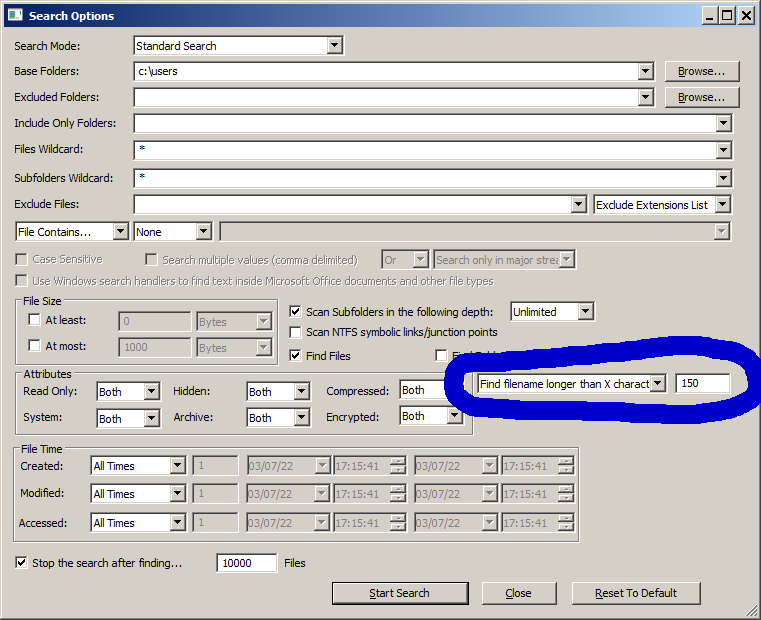
You can download the SearchMyFiles tool from this Web page.
The Stable channel has been updated to 141.0.7390.107/.108 for Windows and Mac and 141.0.7390.107 for Linux, which will roll out over the coming days/weeks. A full list of changes in this build is available in the Log.
Security Fixes and Rewards
Note: Access to bug details and links may be kept restricted until a majority of users are updated with a fix. We will also retain restrictions if the bug exists in a third party library that other projects similarly depend on, but haven’t yet fixed.
This update includes 1 security fix. Below, we highlight fixes that were contributed by external researchers. Please see the Chrome Security Page for more information.
Interested in switching release channels? Find out how here. If you find a new issue, please let us know by filing a bug. The community help forum is also a great place to reach out for help or learn about common issues.
The Extended Stable channel has been updated to 140.0.7339.249 for Windows and Mac which will roll out over the coming days/weeks.
The Stable channel has been updated to 141.0.7390.76/.77 for Windows and Mac and 141.0.7390.76 for Linux, which will roll out over the coming days/weeks. A full list of changes in this build is available in the Log.
Interested in switching release channels? Find out how here. If you find a new issue, please let us know by filing a bug. The community help forum is also a great place to reach out for help or learn about common issues.
The Stable channel has been updated to 141.0.7390.65/.66 for Windows and Mac and 141.0.7390.65 for Linux, which will roll out over the coming days/weeks. A full list of changes in this build is available in the Log.
Security Fixes and Rewards
Note: Access to bug details and links may be kept restricted until a majority of users are updated with a fix. We will also retain restrictions if the bug exists in a third party library that other projects similarly depend on, but haven’t yet fixed.
Interested in switching release channels? Find out how here. If you find a new issue, please let us know by filing a bug. The community help forum is also a great place to reach out for help or learn about common issues.
The Extended Stable channel has been updated to 140.0.7339.240 for Windows and Mac which will roll out over the coming days/weeks.
We are pleased to announce the latest stable release of Jellyfin, version 10.11.0!
This major release brings many new features, improvements, and bugfixes to improve your Jellyfin experience.
As always, please ensure you stop your Jellyfin server and take a full backup before upgrading!
WARNING: There are very important release notes to review before upgrading! Please find all the details in our blog post on the release.
You can find more details about and discuss this release on our forums.

Note
If someone is asking you to pay money for access to UpSnap binaries, source code, or licenses, you are being scammed.
The official and only trusted source for UpSnap is this repository (and its linked releases).
Do not pay third parties for something that is provided here for free.

Important
If you are using Part-DB it would be helpful if you fill out this short survey on your usage of Part-DB (Google Forms): https://forms.gle/Q15twx3YYq3qCNfe8
Tip
You can help to translate Part-DB to other languages. See this post for more info.
% (#1075)Full Changelog: v2.2.0...v2.2.1


there is a discord server with an @everyone in case of future important updates, such as vulnerabilities (most recently 2025-09-07)
*,-@acct hides a volume from everyone who's logged inxm hooks can see the selected files (thx @carson-coder!) 6c024db 3364448?doc= suffix with just the g permission dbb7870nodupem to prevent dupes from being moved into a volume; the stronger alternative to nodupe which only prevents uploads f55d834?stack 677fd8e

This is the final beta before the stable release of v0.19.0. The main change in this beta is, once again, handling of HDR/DoVi formats.
If you appreciate my work, you can show your support with a donation through Buy Me a Coffee or GitHub sponsors. Your support helps me continue improving and growing the app. Thank you!
Beta versions are not guaranteed to work as expected. We encourage users to create detailed bug reports if any problems arise. Read our blog post for more information about our Android beta programs.

