 Log in


Srinivas Sista
Google Chrome


Updates:
Changes/improvements:
Fixes:

New
Bug Fixes
Enhancements:
Security

VIENNA, Austria – December 04, 2025 –Enterprise software developer Proxmox Server Solutions GmbH (henceforth “Proxmox”) today announced the immediate availability of the stable version 1.0 of Proxmox Datacenter Manager. This new product directly addresses the increasing complexity of operating distributed and large-scaled Proxmox-based environments. Proxmox Datacenter Manager offers a holistic single pane of glass view for the administration, monitoring, and scaling of Proxmox VE and Proxmox Backup Server, with the primary goal of providing administrators with comprehensive and seamless control.
Managing growing data centers, distributed across multiple locations or clusters, consistently presents major challenges for enterprises and teams. A lack of global oversight, fragmented metrics, and the need to perform complex operations manually across various environments can quickly lead to inefficiencies and increased error susceptibility.
Proxmox Datacenter Manager was developed as the strategic answer to this scaling challenge. It bridges the gap between individual Proxmox-based nodes and clusters, providing a unified view of the entire infrastructure. This not only simplifies routine tasks but also enables advanced functionalities that were previously difficult to achieve.
Proxmox Datacenter Manager delivers a set of core functions specifically designed for managing complex, enterprise-grade environments:
"The modern infrastructure landscape demands adaptability, from data centers to edge locations. Organizations need tools that evolve alongside their business. Proxmox Datacenter Manager is designed as a key building block within our expanding ecosystem, empowering customers with the right solution for every stage of their journey", says Tim Marx, COO at Proxmox. "By choosing the Proxmox ecosystem, organizations unlock a wide range of deployment options. From high-performance setups at hyperscalers to distributed branch offices that maintain data sovereignty. Our consistent commitment to openness ensures long-term interoperability and real freedom of choice for customers and partners."
Proxmox Datacenter Manager 1.0 is immediately available for download. Users can obtain a complete installation image via ISO download, which contains the full feature-set of the solution and can be installed quickly on bare-metal systems using an intuitive installation wizard.
Seamless distribution upgrades from older versions of Proxmox Datacenter Manager are possible using the standard APT package management system. Furthermore, it is also possible to install Proxmox Datacenter Manager on top of an existing Debian installation. As Free/Libre and Open Source Software (FLOSS), the entire solution is published under the GNU AGPLv3.
For enterprise users, Proxmox Server Solutions GmbH offers professional support through subscription plans. A subscription provides access to the stable Enterprise Repository with timely updates via the web interface, as well as to certified technical support and is recommended for production use. Customers with active Enterprise Support for their Proxmox remotes also gain access to Proxmox Datacenter Manager updates and support.
Resources:
###
About Proxmox Server Solutions
Proxmox provides powerful and user-friendly open-source server software. Enterprises of all sizes and industries use the Proxmox solutions to deploy efficient and simplified IT infrastructures, minimize total cost of ownership, and avoid vendor lock-in. Proxmox also offers commercial support, training services, and an extensive partner ecosystem to ensure business continuity for its customers. Proxmox Server Solutions GmbH was established in 2005 and is headquartered in Vienna, Austria.
Contact: Daniela Häsler, Proxmox Server Solutions GmbH, marketing@proxmox.com
Home Assistant 2025.12! 🎄
As the year winds down and the holidays approach, we’re closing out 2025 with a release that’s all about giving you more control and a little bit of magic. ✨
This month, we’re unveiling Home Assistant Labs, a brand-new space where you can preview features before they go mainstream. And what better way to kick it off than with Winter mode? ❄️ Enable it and watch snowflakes drift across your dashboard. It’s completely unnecessary, utterly delightful, and exactly the kind of thing we love to build. ❄️
But that’s just the beginning. We’ve been working on making automationsAutomations in Home Assistant allow you to automatically respond to things that happen in and around your home. [Learn more] more intuitive over the past releases, and this release finally delivers purpose-specific triggers and conditions. Instead of thinking in (numeric) states, you can now simply say “When a light turns on” or “If the climate is heating”. It’s automation building the way our mind works, as it should be. 🧠
Oh, and if you’re looking to level up your Zigbee or Thread network, check out the Home Assistant Connect ZBT-2 we released last month. It’s four times faster and has a gorgeous new antenna design that you’ll actually want to display on your desk. 📡
From all of us working on Home Assistant:
Thank you for an amazing 2025! ❤️
Happy holidays, and enjoy the release!
../Frenck
Jingle Labs by Frenck and Darren
Dashing through the code,
With a brand-new Labs to show,
Snowflakes start to fall,
Watch the dashboard glow!
Triggers now make sense,
Conditions feel just right,
What fun it is to automate,
Your smart home every night!
Chorus
Jingle Labs, jingle Labs,
Features on the way!
Oh what fun it is to run,
Home Assistant every day, hey!
Jingle Labs, jingle Labs,
Winter mode is here!
Turn your lights on with a thought,
And spread some holiday cheer!
Power graphs are live,
Water meters too,
Dashboards you can set,
For every user’s view!
Xbox got some love,
Shelly’s platinum now,
Contributors came through this year,
Take a final bow!
Chorus
Jingle Labs, jingle Labs,
Triggers for the win!
Climate, lights, and fans galore,
Let the automations spin!
Jingle Labs, jingle Labs,
Thank you all so much!
Happy holidays from us,
Now go and automate stuff!
A huge thank you to all the contributors who made this release possible! And a special shout-out to @TimoPtr, @laupalombi, @jlpouffier, and @MindFreeze who helped write these release notes. Also, @edenhaus, @tr4nt0r, @jpbede, @RaHehl, @bieniu, @arturpragacz, and @piitaya for putting effort into tweaking its contents. Thanks to them, these release notes are in great shape. ❤️
When we develop new features for Home Assistant, we often find ourselves in a tricky spot. A feature might be fully built and tested, but we’re not entirely sure if it’s the right fit for everyone just yet. Maybe we want to gather some real-world feedback first, or perhaps we want to see how the community uses it before committing to keeping it around forever.
That’s where Home Assistant Labs comes in! 🧪
Labs is a brand-new place in Home Assistant that gives you a sneak peek at features we’re working on. These are not unfinished experiments or unstable beta features. They are fully functional and tested, but they might change or even disappear based on feedback. We are committed to building in the open, and we want to give more people the choice to hop into the lab with us. By joining us, your feedback will directly help refine these features for the entire community.
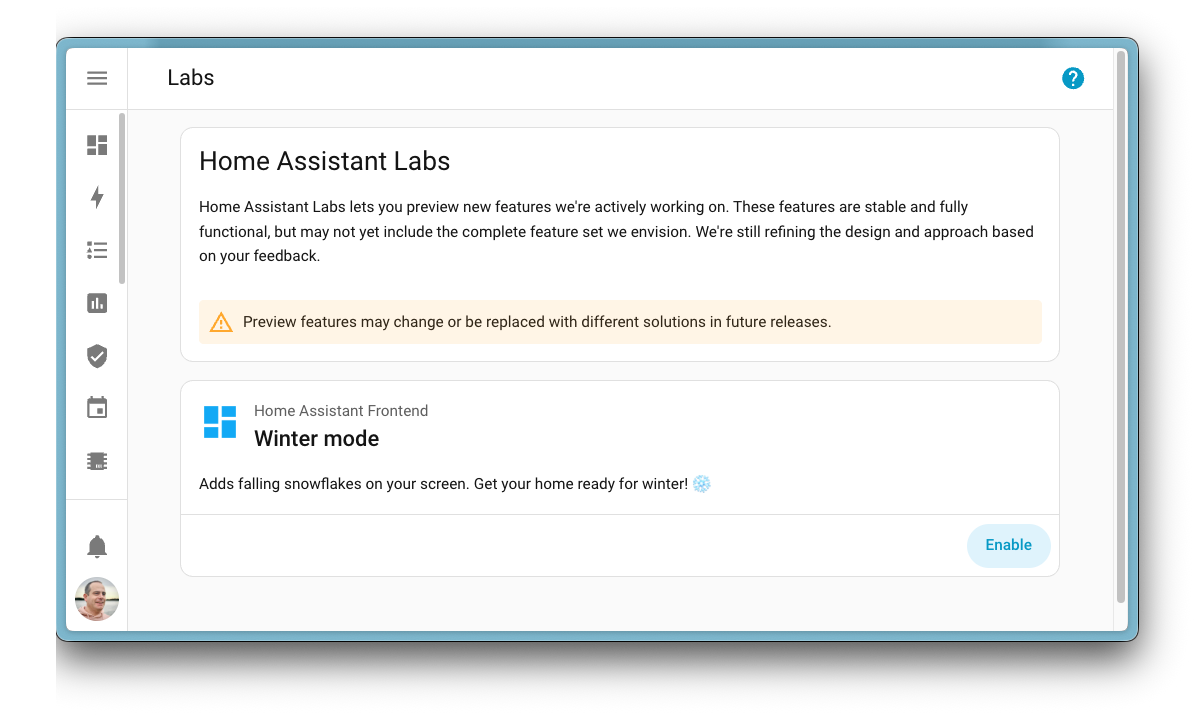
The very first preview feature available in Labs is Winter mode ❄️, inspired by a community post on Reddit originally created by u/Possible-Week-5815. Enable it, and watch your Home Assistant interface transform into a winter wonderland with falling snow. A fun way to get into the holiday spirit!
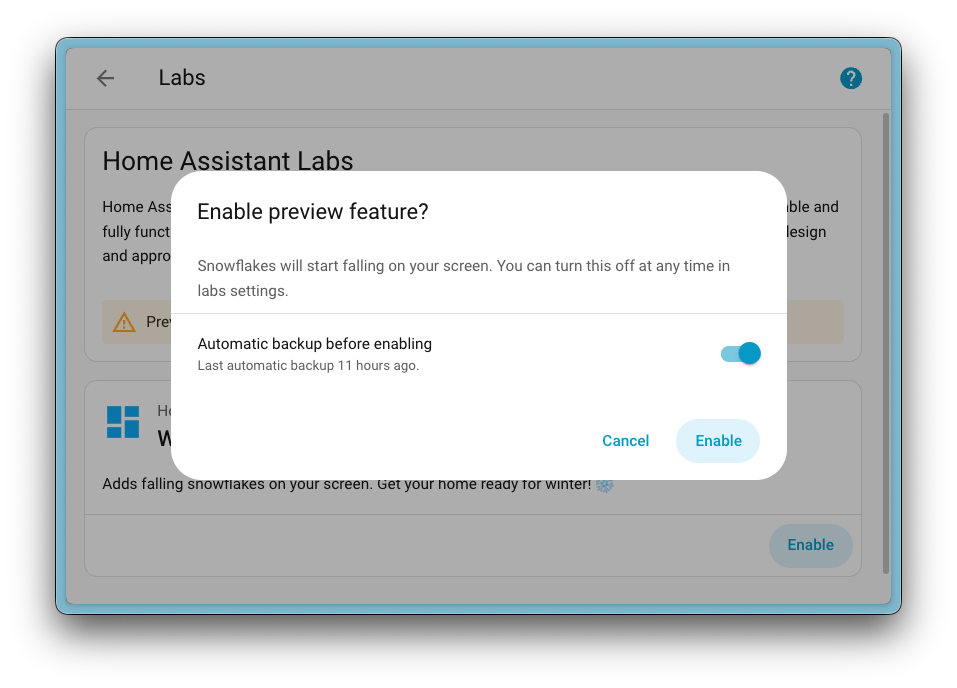
When you enable a preview feature, you can also choose to create a backup first, just to be safe. And if you change your mind? Simply disable it again. No restart required!
Preview features are off by default, and enabling them won’t affect your existing setup. It’s completely optional, so if you prefer to stick with the battle-proven experience, that’s totally fine. But if you’re curious and want to explore what’s coming next, Labs is the place to be.
But what was the first Labs preview feature we put in there? Well, it’s a big one…

Almost two years ago, we released a new automationAutomations in Home Assistant allow you to automatically respond to things that happen in and around your home. [Learn more] editor that unwrapped all our actionsActions are used in several places in Home Assistant. As part of a script or automation, actions define what is going to happen once a trigger is activated. In scripts, an action is called sequence. [Learn more] and made them easier to understand. Instead of a single, obscure “Call service” action, you now see clear options like “Light: Turn on” or “Media Player: Set Volume”.
Ever since, we’ve been wondering: could we do the same for triggersA trigger is a set of values or conditions of a platform that are defined to cause an automation to run. [Learn more] and conditionsConditions are an optional part of an automation that will prevent an action from firing if they are not met. [Learn more]? Instead of relying on technical, state-based options, what if we could offer intuitive alternatives that just make sense? Options like “When a light turns on” or “If a light is on”.
That idea set a two-year plan in motion, and today it’s finally becoming a reality.
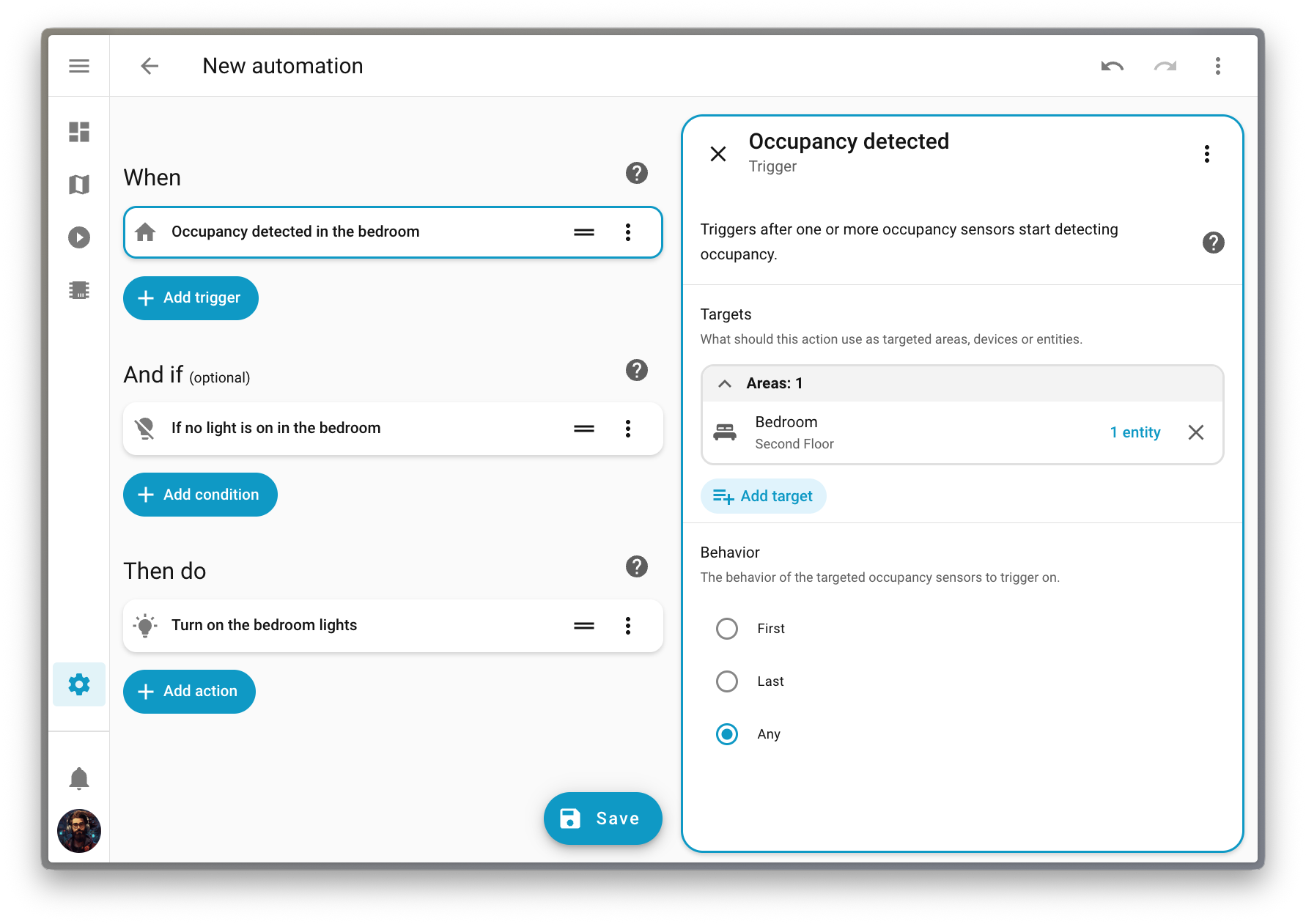
Along the way, we discovered something interesting: many of you take a “target-first” approach when building automationsAutomations in Home Assistant allow you to automatically respond to things that happen in and around your home. [Learn more]. You think about what you want to automate (a deviceA device is a model representing a physical or logical unit that contains entities., an entityAn entity represents a sensor, actor, or function in Home Assistant. Entities are used to monitor physical properties or to control other entities. An entity is usually part of a device or a service. [Learn more], or an areaAn area in Home Assistant is a logical grouping of devices and entities that are meant to match areas (or rooms) in the physical world: your home. For example, the living room area groups devices and entities in your living room. [Learn more]) before thinking about how to automate it (which action to perform or which trigger to use). This release embraces that mindset with a completely new way to build automations.
Purpose-specific triggers and conditions are now provided directly by domainsEach integration in Home Assistant has a unique identifier: The domain. It is often shown as the first part (before the dot) of entity IDs. like Light, Climate, Fan, and others, covering the most common automation use cases.
These new triggers and conditions fully support targeting. This means you can trigger an automation when any light in your living room turns on, without having to list them one by one or create a group beforehand. Targeting an area keeps things simple: it’s always aligned with how your home is organized, and you don’t have to update anything when you add or remove devices.
LabelsLabels in Home Assistant allow grouping elements irrespective of their physical location or type. Labels can be assigned to areas, devices, entities, automations, scenes, scripts, and helpers. Labels can be used in automations and scripts as a target for actions. Labels can also be used to filter data. [Learn more] are supported too! You can now check if any of your Christmas lights are on. Perfect timing for the holidays! 🎄
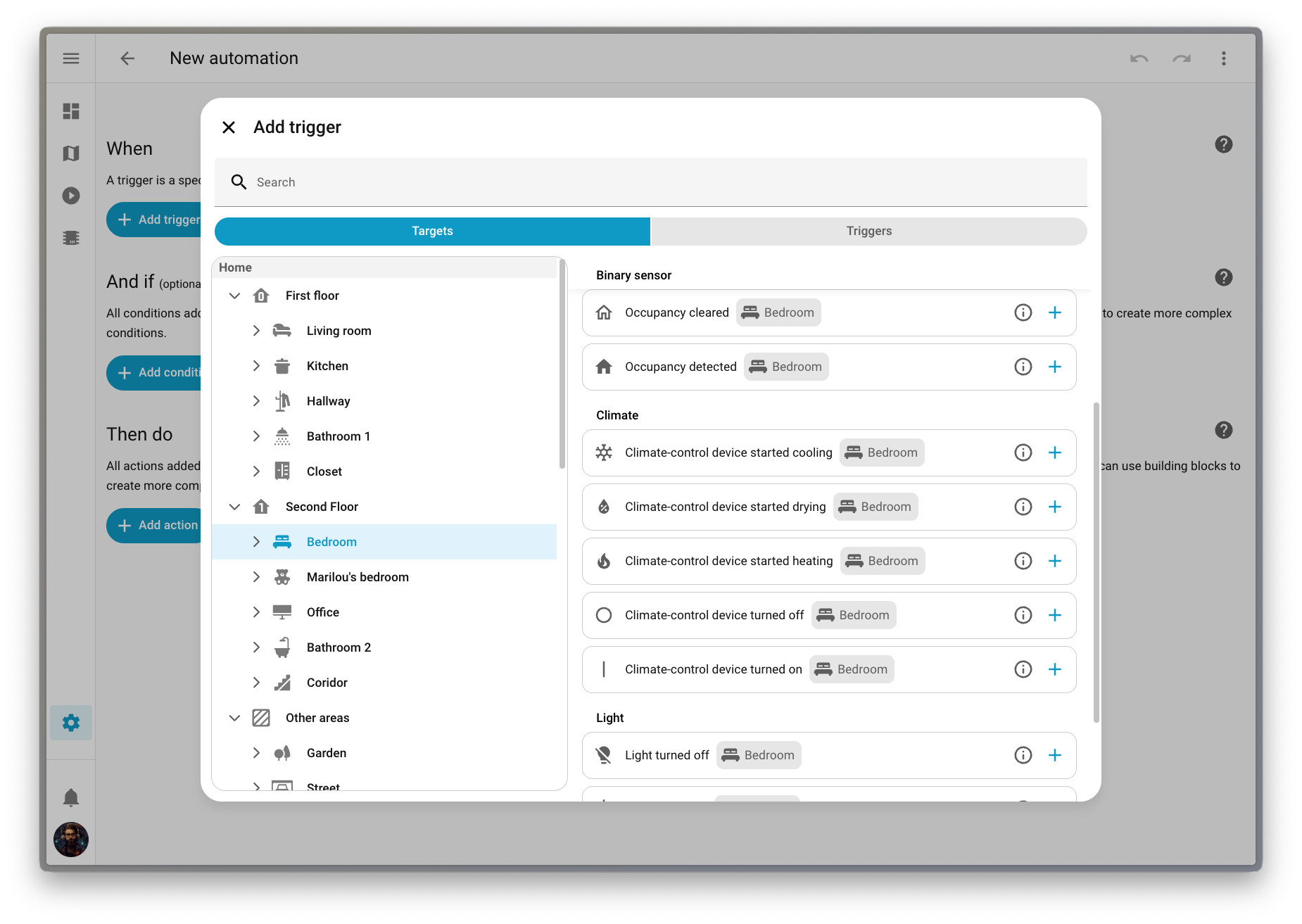
We’ve also introduced a new way to pick triggers, conditions, and actions that fits this target-first approach. You can navigate your home by floorA floor in Home Assistant is a logical grouping of areas that are meant to match the physical floors in your home. Devices & entities are not assigned to floors but to areas. Floors can be used in automations and scripts as a target for actions. For example, to turn off all the lights on the downstairs floor when you go to bed. [Learn more], then area, then device, and see exactly which options are available for each target. It’s a much more intuitive way to build automationsAutomations in Home Assistant allow you to automatically respond to things that happen in and around your home. [Learn more].
This feature is still being refined, so we’ve made it available as a preview feature in Labs. Head over to Settings > System > Labs to enable it and help us shape the future of automation building!
We have a lot of dashboard improvements to share in this release! From better default dashboard management to an improved Home dashboard, we have been busy making your Home Assistant experience even better.
Picking a default dashboard is now a system-level setting that takes effect instantly for all users on your Home Assistant installation. The dashboard you choose will appear at the top of the sidebar, replacing the current default.
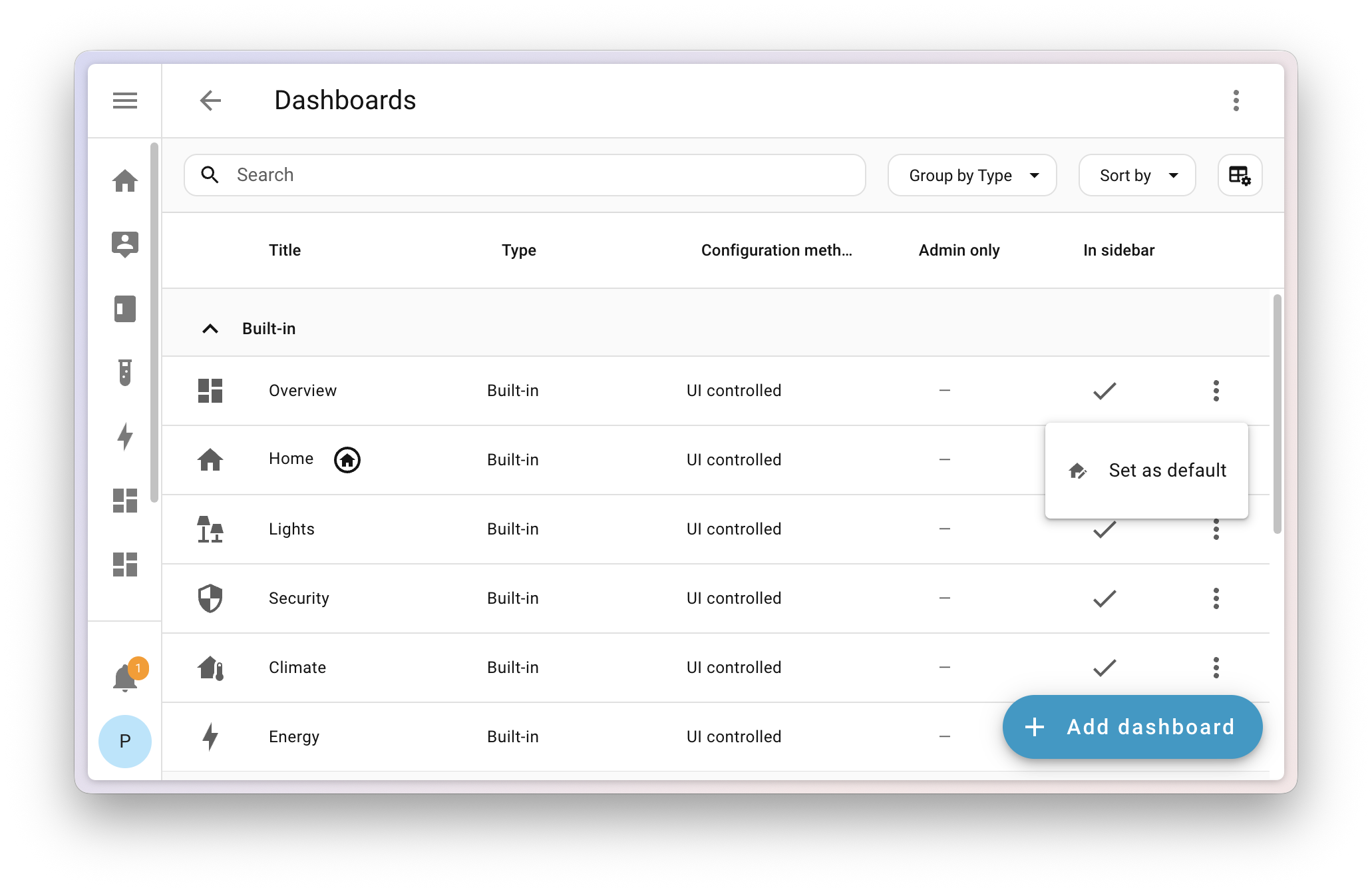
But don’t worry, personal preferences still matter! We added a new setting in your User profile where you can override the system default and set your own preferred dashboard.
If you set your phone to one dashboard and your wall tablet to another, they’ll now both revert to the default dashboard. If you want your wall tablet to use a different dashboard than your other devices, we recommend giving it a separate user profile that you can customize however you want.
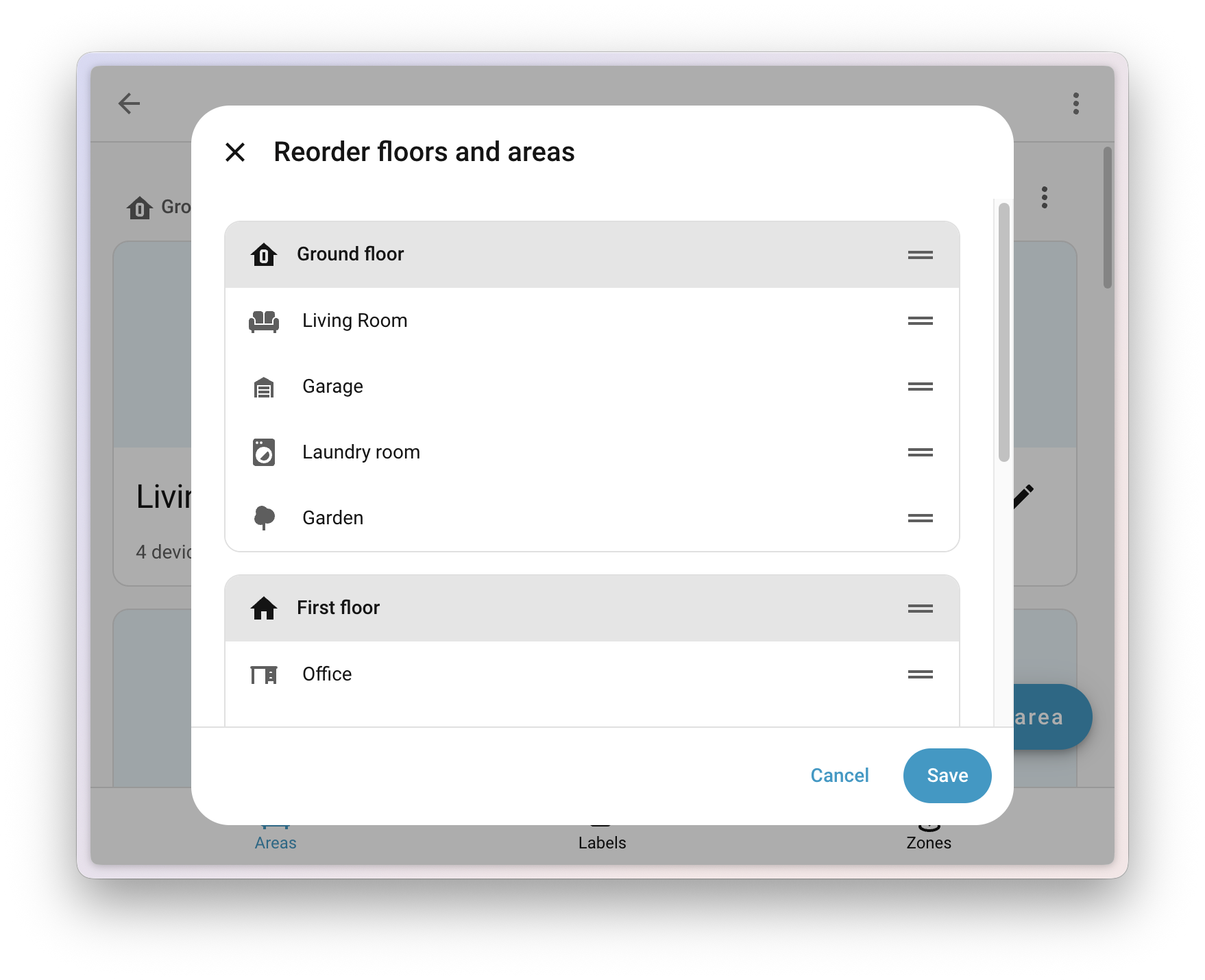
When using the built-in dashboard experiences (Home, Lights, Security, and others), one of the main pain points was the strict ordering of areasAn area in Home Assistant is a logical grouping of devices and entities that are meant to match areas (or rooms) in the physical world: your home. For example, the living room area groups devices and entities in your living room. [Learn more] (alphabetically) and floorsA floor in Home Assistant is a logical grouping of areas that are meant to match the physical floors in your home. Devices & entities are not assigned to floors but to areas. Floors can be used in automations and scripts as a target for actions. For example, to turn off all the lights on the downstairs floor when you go to bed. [Learn more] (numerically by level). This often didn’t make sense in a real home, where your guest bathroom shouldn’t appear before your living room, and the attic is rarely more relevant than the main floor.
Now you can go to Settings > Areas, labels & zones and use the new Reorder floors and areas menu to manually drag and drop any area or floor to reorder them. Your changes will instantly apply to all built-in dashboards that show areas and floors.
With the launch of Labs, we retired the experimental flag from the dashboard creation list. The Home dashboard can now be found in the dashboard list (still not visible by default), and the Areas dashboard has evolved into Home, so we’ve removed it for now. If you’re using the Areas dashboard, it will continue to work; you just won’t be able to create another.
Note
We want to keep hearing your voice! Share your experience with us in the Home dashboard survey and help us improve every step of the way. And of course join us on Discord to work together on the future of dashboards.
We added a new sidebar to the Home dashboard that gathers quick access links we think are useful for you. There’s also a nicer area and floor layout that uses space more efficiently. On a more technical level, the Home dashboard is now a proper built-in dashboard and shows up in the dashboard list.
Important
There is a chance your current favorites might disappear in this release and need to be re-added. This is due to the migration of this dashboard from a strategy to a built-in dashboard.
The dashboard editor now includes the undo and redo feature that we added in 2025.10 to the automationAutomations in Home Assistant allow you to automatically respond to things that happen in and around your home. [Learn more] and scriptScripts are components that allow you to specify a sequence of actions to be executed by Home Assistant when turned on. [Learn more] editor. This allows you to experiment safely while editing your dashboards. You can undo up to 75 changes or restore them with a single click, making editing dashboards faster and less stressful.
Thanks to @jpbede for implementing this handy feature!
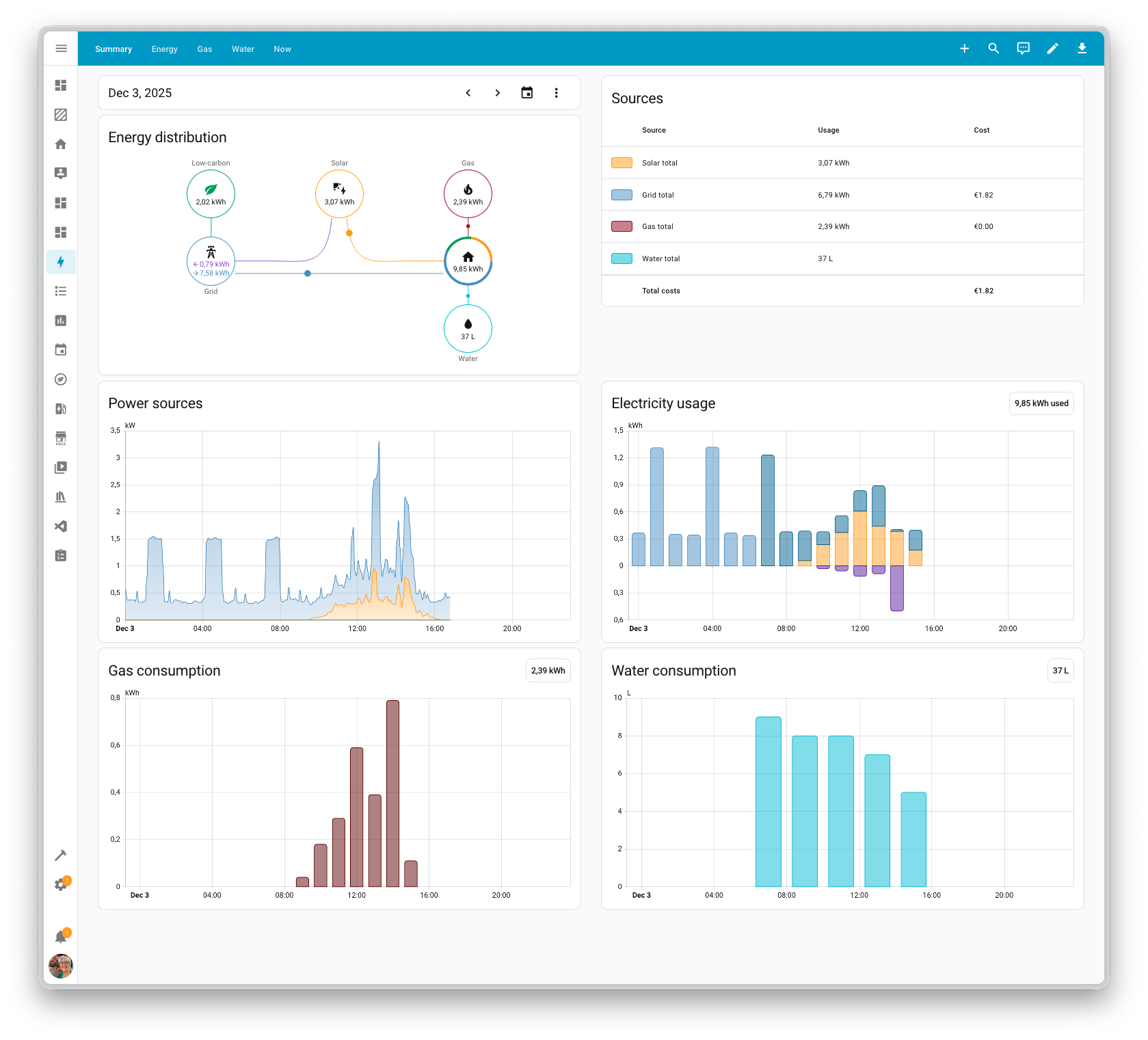
The Energy dashboard has been helping you track your energy and gas usage for years now, and this release brings two great additions: real-time power monitoring and downstream water tracking.
Until now, the Energy dashboard was all about energy: the cumulative kWh you’ve consumed or produced over time. But sometimes you want to know what’s happening right now. How much power is that appliance actually drawing? Is your solar system producing at this very moment?
With this release, you can now configure power sensors alongside your energy sensors. Track your real-time grid consumption, see how much you’re exporting back to the grid, and watch those watts flow in real-time. The power configuration options now appear alongside energy settings for each source or device, and new power graphs let you see your power consumption throughout the day.
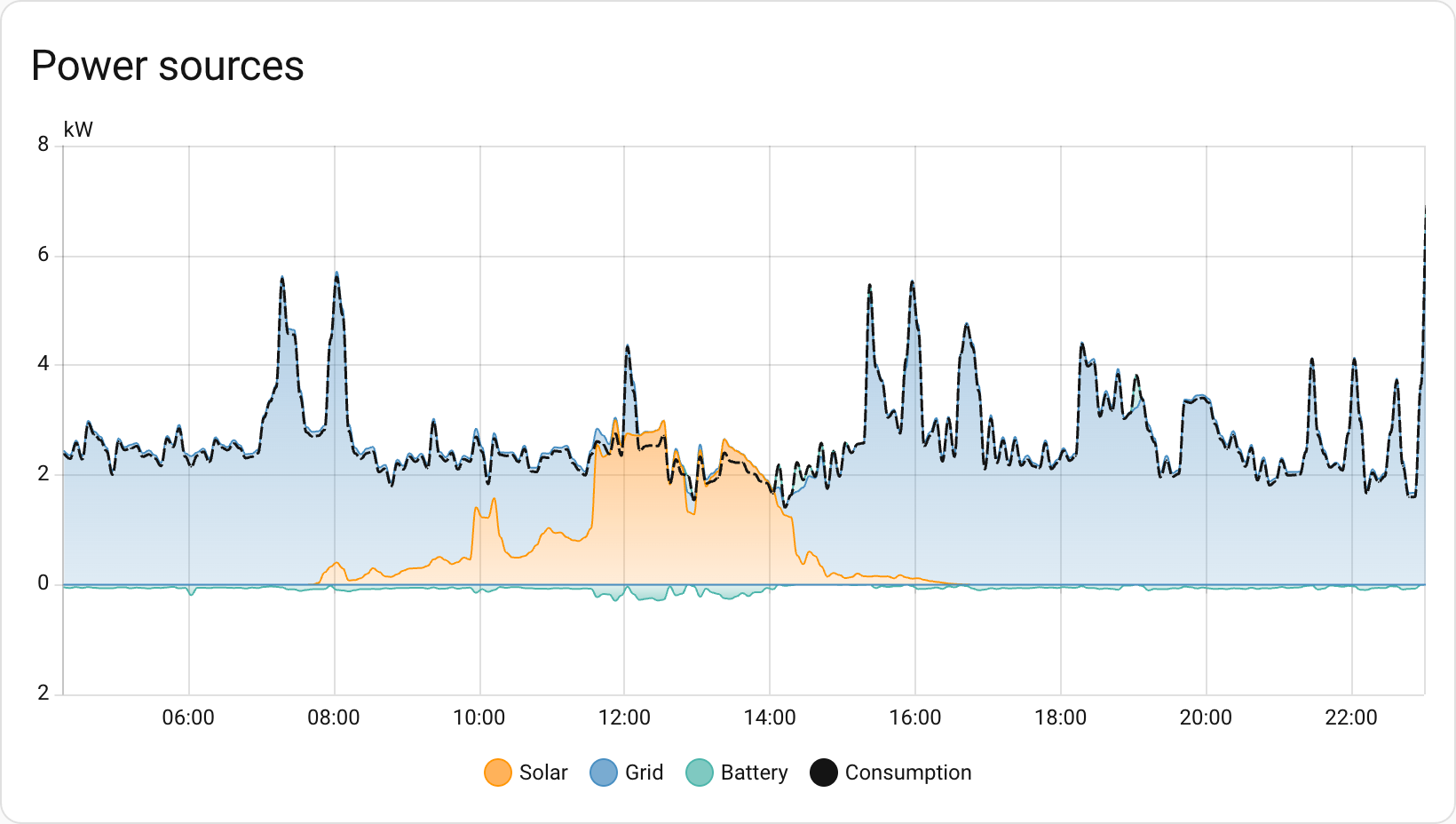

The Energy dashboard has been tracking your water consumption for a while now, but it was missing something: the ability to see where all that water is actually going. Just like you can track individual devices for energy consumption, you can now add downstream water meters to break down your water usage.
Got a smart irrigation controller? A water softener with a flow meter? A separate meter for your pool? Now you can track them all and see exactly how your water consumption is distributed across different uses.
There’s also a brand-new water sankey card that visualizes your water flow, just like the energy sankey diagram you already know. It’s a great way to see where your water is going at a glance.
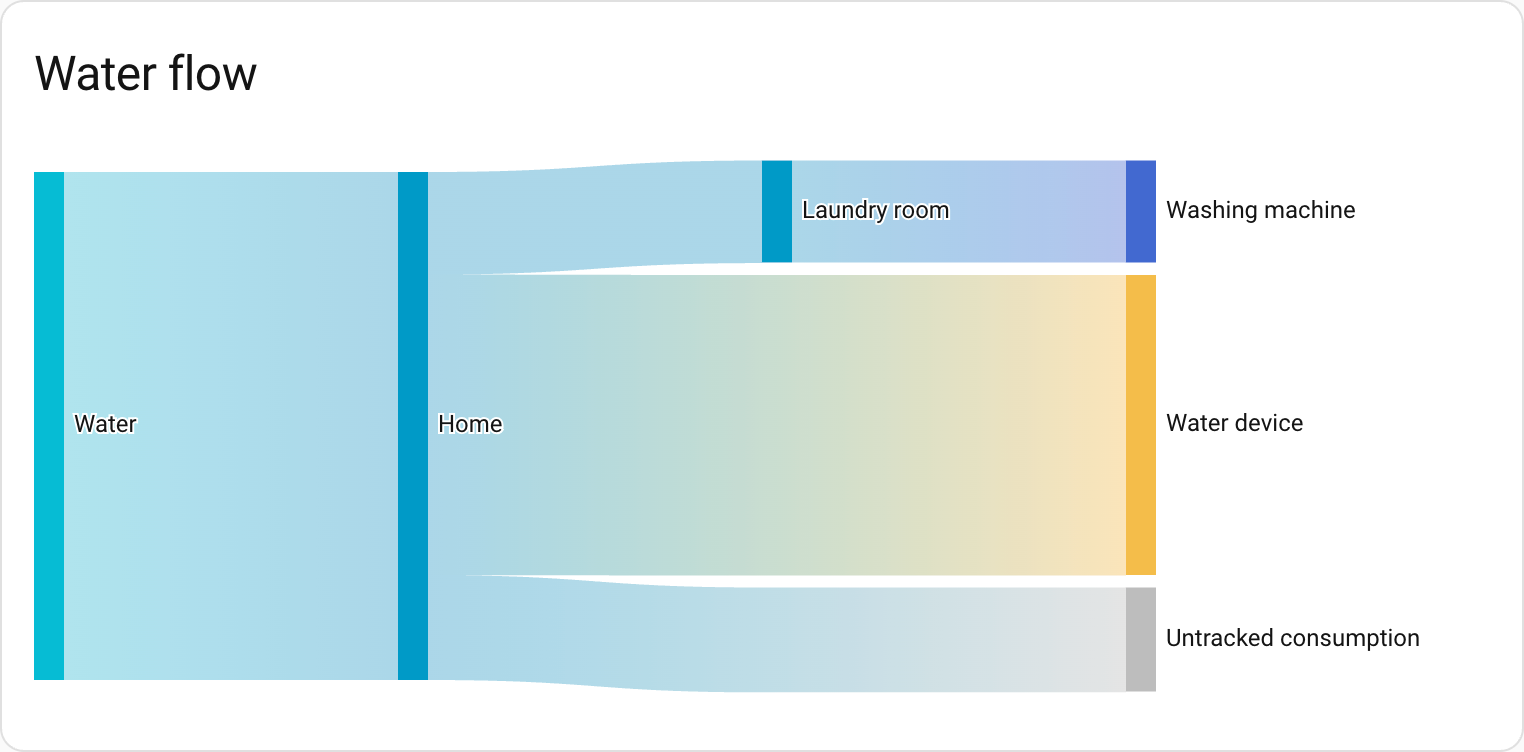 The new water sankey card shows where your water is going at a glance.
To make room for this new functionality, the Energy dashboard has been reorganized. Don’t worry: if you only have energy configured, you’ll still see the same dashboard. But if you add water, gas, or power, the dashboard will be split into several tabs.
Thanks to our community for keeping pace with the new integrationsIntegrations connect and integrate Home Assistant with your devices, services, and more. [Learn more] and improvements to existing ones! You’re all awesome 🥰
We welcome the following new integrations in this release:
This release also has new virtual integrations. Virtual integrations are stubs that are handled by other (existing) integrations to help with findability. These ones are new:
It is not just new integrationsIntegrations connect and integrate Home Assistant with your devices, services, and more. [Learn more] that have been added; existing ones are also being constantly improved. Here are some of the noteworthy changes to existing integrations:
water_heater domain.One thing we are incredibly proud of in Home Assistant is our integration quality scale. This scale helps us and our contributors to ensure integrations are of high quality, maintainable, and provide the best possible user experience.
This release, we celebrate several integrationsIntegrations connect and integrate Home Assistant with your devices, services, and more. [Learn more] that have improved their quality scale:
2 integrations reached platinum 🏆
1 integration reached gold 🥇
2 integrations reached silver 🥈
2 integrations reached bronze 🥉
This is a huge achievement for these integrations and their maintainers. The effort and dedication required to reach these quality levels is significant, as it involves extensive testing, documentation, error handling, and often complete rewrites of parts of the integration.
A big thank you to all the contributors involved! 👏
While most integrationsIntegrations connect and integrate Home Assistant with your devices, services, and more. [Learn more] can be set up directly from the Home Assistant user interface, some were only available using YAML configuration. We keep moving more integrations to the UI, making them more accessible for everyone to set up and use.
The following integration is now available via the Home Assistant UI:
The following integrationsIntegrations connect and integrate Home Assistant with your devices, services, and more. [Learn more] are no longer available as of this release:
There are many more improvements in this release; here are some of the other noteworthy changes:
clamp, wrap, and remap to manipulate numbers in your templates. Awesome!min and max options to the bar gauge feature for tile cards, giving you more control over the gauge range.Ever played around with AI in Home Assistant and wondered what data is actually being sent?
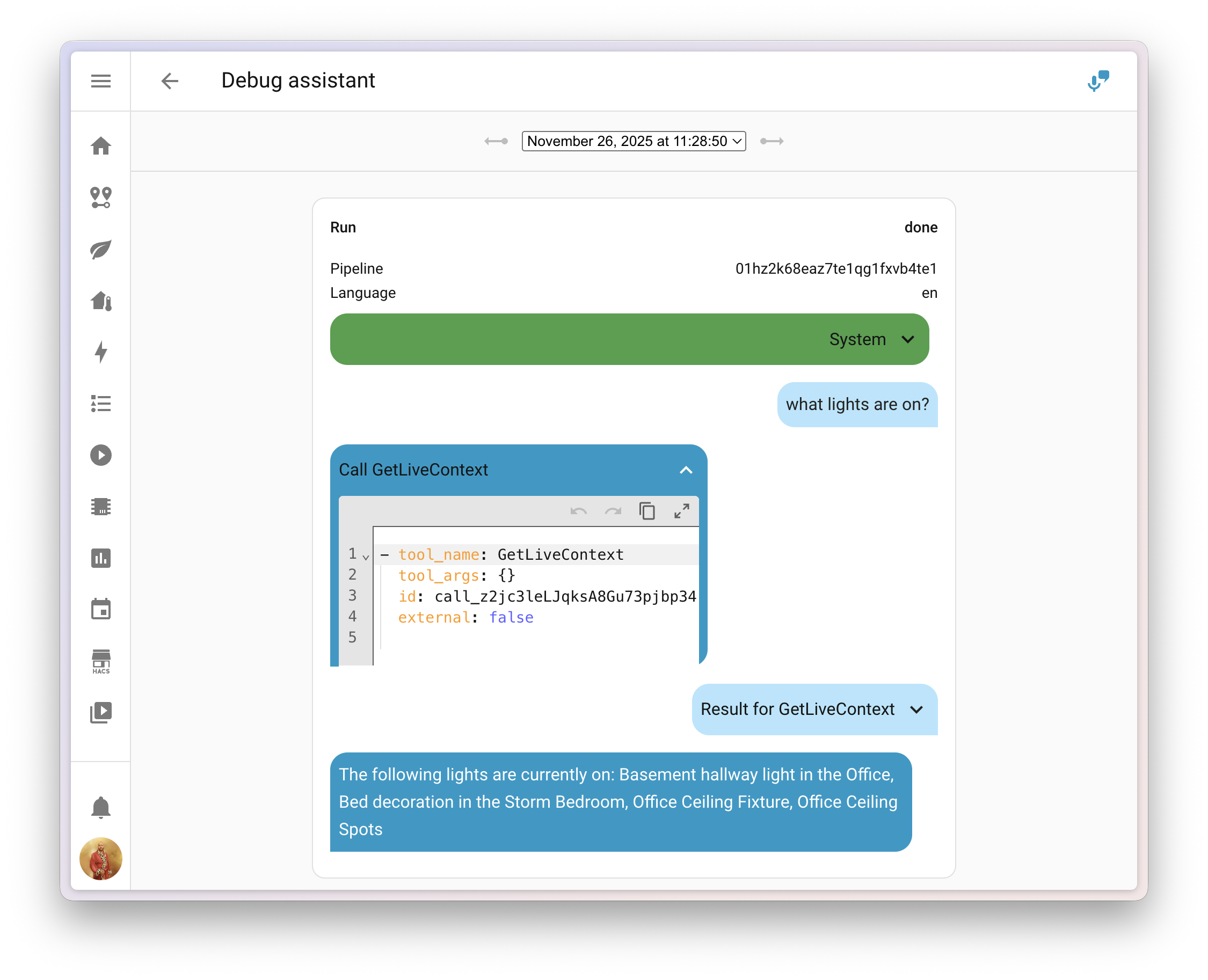
@balloob upgraded the voice assistant debug interface, and you can now inspect the system prompt that tells the AI how to behave, along with any tool calls it made to generate your answer.
This makes it much easier to figure out why the AI decided to skip over that one entityAn entity represents a sensor, actor, or function in Home Assistant. Entities are used to monitor physical properties or to control other entities. An entity is usually part of a device or a service. [Learn more], or why it called a specific tool. You can find the debug interface in the voice assistant configuration panel.
If you’re using the Home Assistant Companion app for Android, there’s a handy new feature waiting for you! Starting with app version 2025.11, you can now add entitiesAn entity represents a sensor, actor, or function in Home Assistant. Entities are used to monitor physical properties or to control other entities. An entity is usually part of a device or a service. [Learn more] to widgets and Android Auto favorites directly from the entity’s more info dialog.
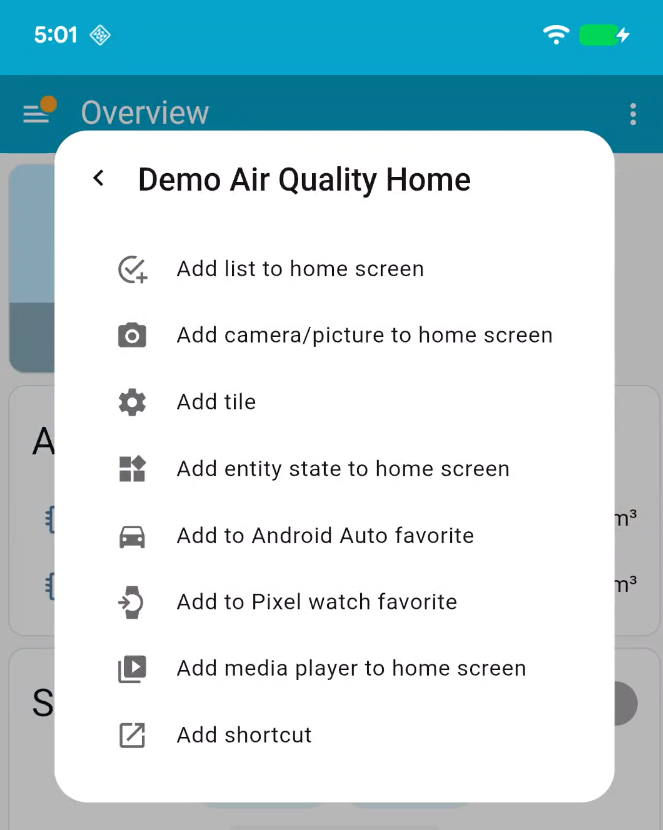
With just a few taps, you can:
No more deep-diving into app settings! The Add to option appears in the more info dialog with options tailored to the entity you’re viewing. For example, adding a media player widget is only available for media players.
This is a first step in integrating native mobile features directly into the Home Assistant interface. Future releases will expand this with support for creating shortcuts, tiles, and watch favorites.
Thanks for this great addition, @TimoPtr! 🙏
We will also release patch releases for Home Assistant 2025.12 in December. 🎄 These patch releases only contain bug fixes. Our goal is to release a patch release once a week, aiming for Friday.
v1.5.0 ([@funkybunch] - #158015)restart button for sleeping gen2+ Shelly devices (@bieniu - #158047)Home Assistant has a great community of users who are all more than willing to help each other out. So, join us!
Our very active Discord chat server is an excellent place to be, and don’t forget to join our amazing forums.
Found a bug or issue? Please report it in our issue tracker to get it fixed! Or check our help page for guidance on more places you can go.
Are you more into email? Sign up for the Open Home Foundation Newsletter to get the latest news about features, things happening in our community, and other projects that support the Open Home straight into your inbox.
We do our best to avoid making changes to existing functionality that might unexpectedly impact your Home Assistant installation. Unfortunately, sometimes it is inevitable.
We always make sure to document these changes to make the transition as easy as possible for you. This release has the following backward-incompatible changes:
After a 6-month deprecation period, support for the Home Assistant Core and Home Assistant Supervised installation methods, as well as all 32-bit system architectures (i386, armhf, and armv7), has now been fully removed.
These installation methods and architectures will no longer receive updates, including security updates. If you are still using one of these installation methods or architectures, please migrate to a supported installation method and architecture as soon as possible to continue receiving updates and support.
For more information on this change, read the Deprecating Core and Supervised installation methods, and 32-bit systems blog post.
It is now required to set a username and password when enabling the debug UI.
(@edenhaus - #157008) (go2rtc docs)
The legacy license plate event sensor has been removed from the UniFi Protect integration, as it no longer functions with Protect 6 and newer. The UniFi Protect integration has not been compatible with Protect versions older than 6 for quite some time.
This sensor has been replaced with a new Vehicle Detection Event entity that provides significantly more functionality, including license plate recognition, vehicle type detection, color detection, and confidence scores. The new event entity fires with a 3-second delay to ensure optimal thumbnail and LPR data quality.
For more information and automation examples, see the Vehicle Detection Event documentation.
The Xbox media browser has been completely overhauled to support multiple accounts and introduce a range of other improvements. As part of this update, the format of the media-source identifiers has been changed as well.
The following and followers sensors introduced in the last release previously included friends in their counts. After a recent API update, friends are no longer included.
If you are a custom integration developer and want to learn about changes and new features available for your integration: Be sure to follow our developer blog. The following changes are the most notable for this release:
Of course, there is a lot more in this release. You can find a list of all changes made here: Full changelog for Home Assistant Core 2025.12.
This release contains the following fixes and changes:


there is a discord server with an @everyone in case of future important updates, such as vulnerabilities (most recently 2025-09-07)
0 will run the next hook (if any), and let the initiating action proceed if no other hooks object100 will stop processing successive hooks, but return success, letting the initiating action proceedstats-u to grant access to prometheus-metrics based on username, not just permissions b427d78mt button (webworkers) was enabled in the settings tabgrid volflag is applied during navigation if user has not set a preference a9378a8-j is usually a bad idea cad15fb

The Extended Stable channel has been updated to 142.0.7499.226 for Windows and Mac which will roll out over the coming days/weeks.
The Chrome team is delighted to announce the promotion of Chrome 143 to the stable channel for Windows, Mac and Linux. This will roll out over the coming days/weeks.
Chrome 143.0.7499.40 (Linux) 143.0.7499.40/41 Windows/Mac contains a number of fixes and improvements -- a list of changes is available in the log. Watch out for upcoming Chrome and Chromium blog posts about new features and big efforts delivered in 143.
Security Fixes and Rewards
Note: Access to bug details and links may be kept restricted until a majority of users are updated with a fix. We will also retain restrictions if the bug exists in a third party library that other projects similarly depend on, but haven’t yet fixed.
This update includes 13 security fixes. Below, we highlight fixes that were contributed by external researchers. Please see the Chrome Security Page for more information.
[$11000][456547591] High CVE-2025-13630: Type Confusion in V8. Reported by Shreyas Penkar (@streypaws) on 2025-10-31
[$3000][448113221] High CVE-2025-13631: Inappropriate implementation in Google Updater. Reported by Jota Domingos on 2025-09-29
[TBD][439058242] High CVE-2025-13632: Inappropriate implementation in DevTools. Reported by Leandro Teles on 2025-08-16
[N/A][458082926] High CVE-2025-13633: Use after free in Digital Credentials. Reported by Chrome on 2025-11-05
[TBD][429140219] Medium CVE-2025-13634: Inappropriate implementation in Downloads. Reported by Eric Lawrence of Microsoft on 2025-07-02
[N/A][457818670] Medium CVE-2025-13720: Bad cast in Loader. Reported by Chrome on 2025-11-04
[N/A][355120682] Medium CVE-2025-13721: Race in v8. Reported by Chrome on 2024-07-23
[$3000][405727341] Low CVE-2025-13635: Inappropriate implementation in Downloads. Reported by Hafiizh on 2025-03-24
[$1000][446181124] Low CVE-2025-13636: Inappropriate implementation in Split View. Reported by Khalil Zhani on 2025-09-20
[TBD][392375329] Low CVE-2025-13637: Inappropriate implementation in Downloads. Reported by Hafiizh on 2025-01-27
[TBD][448046109] Low CVE-2025-13638: Use after free in Media Stream. Reported by sherkito on 2025-09-29
[TBD][448408148] Low CVE-2025-13639: Inappropriate implementation in WebRTC. Reported by Philipp Hancke on 2025-10-01
[TBD][452071826] Low CVE-2025-13640: Inappropriate implementation in Passwords. Reported by Anonymous on 2025-10-14
We would also like to thank all security researchers that worked with us during the development cycle to prevent security bugs from ever reaching the stable channel.
Many of our security bugs are detected using AddressSanitizer, MemorySanitizer, UndefinedBehaviorSanitizer, Control Flow Integrity, libFuzzer, or AFL.
Interested in switching release channels? Find out how here. If you find a new issue, please let us know by filing a bug. The community help forum is also a great place to reach out for help or learn about common issues.
Srinivas Sista
Google Chrome
We are pleased to announce the latest stable release of Jellyfin, version 10.11.4! This minor release brings several bugfixes to improve your Jellyfin experience. As always, please ensure you take a full backup before upgrading!
You can find more details about and discuss this release on our forums.

Full Changelog: v4.1.4...v4.1.5

Below are development builds for testing purposes.
Latest development build: 2.5.5.30 (November 27th 2025)
Latest stable release build: 2.5.5.0
https://github.com/clsid2/mpc-hc/releases/tag/2.5.5
VIENNA, Austria – November 26, 2025 – Leading open-source server solutions provider Proxmox Server Solutions GmbH (henceforth "Proxmox"), today announced the release of Proxmox Backup Server 4.1. This update is based on Debian 13.2 “Trixie”, bringing the latest Debian release with refreshed packages, better hardware support, and enhanced security. Proxmox Backup Server 4.1 ships with Linux kernel 6.17 as the new stable default and includes ZFS 2.3 for reliable, enterprise-grade storage. The release also delivers major improvements in traffic control, verification performance, and S3-based backup operations.
User-based traffic limiting for optimized bandwidth control
Proxmox Backup Server 4.1 extends the existing traffic control capabilities, which already allow administrators to limit backup and restore traffic for specific client networks. With this release, traffic control can additionally take the authenticated Proxmox Backup Server user into account. This enables more convenient and fine-grained prioritization of backup and restore workloads, for example by assigning higher backup bandwidth to business-critical services or separating production and test environments at the user level.
Configurable parallelism for verify jobs
Backup snapshot verification is both I/O- and CPU-intensive, as it reads backup data chunks from disk and validates their checksums. With version 4.1, administrators can configure the number of threads used for disk reads and checksum verification in verify jobs. Depending on the hardware and workload, this can significantly reduce verify runtimes and helps balance verification tasks against other resource-intensive operations.
Bandwidth rate limiting for S3 endpoints
Building on the native support for S3-compatible object storage introduced in Proxmox Backup Server 4.0, version 4.1 adds bandwidth rate limiting for S3 endpoints. Administrators can now cap the bandwidth used by backup and restore operations to and from S3 object stores. This helps prevent network congestion between Proxmox Backup Server instances and the object storage infrastructure, especially in shared or bandwidth-constrained environments.
Proxmox Backup Server 4.1 is immediately available for download. Users can obtain a complete installation image via ISO download, which contains the full feature set of the solution and can be installed quickly on bare-metal systems using an intuitive installation wizard.
Seamless distribution upgrades from older versions of Proxmox Backup Server are possible using the standard APT package management system. Furthermore, it is also possible to install Proxmox Backup Server on top of an existing Debian installation. As Free/Libre and Open Source Software (FLOSS), the entire solution is published under the GNU AGPLv3.
For enterprise users, Proxmox Server Solutions GmbH offers professional support through subscription plans. Pricing for these subscriptions starts at EUR 540 per server per year, including unlimited backup storage and unlimited backup-clients. A subscription provides access to the stable Enterprise Repository with timely updates via the web interface, as well as to certified technical support. It is recommended for production use.
Resources:
###
About Proxmox Backup Server
Proxmox Backup Server is an enterprise backup solution for backing up and restoring virtual machines, containers, and physical hosts. The open-source client-server software supports incremental backups, deduplication, Zstandard compression, and authenticated encryption. To increase productivity, the easy-to-use Proxmox Backup Server allows you to back up your data in a space-efficient manner, restore VMs, archives or single objects in a flash. With the web-based user interface, you can effectively reduce work hours thanks to simplified management. Proxmox Backup Server is licensed under the GNU AGPLv3. Enterprise support subscriptions are available from Proxmox.
About Proxmox Server Solutions
Proxmox provides powerful and user-friendly open-source server software. Enterprises of all sizes and industries use the Proxmox solutions to deploy efficient and simplified IT infrastructures, minimize total cost of ownership, and avoid vendor lock-in. Proxmox also offers commercial support, training services, and an extensive partner ecosystem to ensure business continuity for its customers. Proxmox Server Solutions GmbH was established in 2005 and is headquartered in Vienna, Austria.
Contact: Daniela Häsler, Proxmox Server Solutions GmbH, marketing@proxmox.com
Note: This was originally accidentally published as v24.11.4, so this is essential a re-publish with the correct version.
The wrong version number commit/history has been retained though to prevent any breakages for git-managed environments.
This release contains the following fixes and changes:
fre:ac version 1.1.7 has been released on 5th March 2023.
This release adds a tool for splitting the output into multiple files based on various parameters like duration, number of files or metadata. The update also adds support for dithering, a matrix surround decoder and a volume adjustment filter.
Additionally, fre:ac 1.1.7 comes with various minor improvements, updated third party codecs and fixes for several issues found in fre:ac v1.1.6 and earlier versions:
Upgrading to fre:ac v1.1.7 is strongly recommended for users of earlier releases.
The new release is available in the downloads section. Please report issues on the GitHub issue tracker or by email to support@freac.org.
fre:ac's discussion forums are moving to GitHub. Please post new questions and ideas in the new Discussions area and feel free to start discussions about anything releated to fre:ac and digital audio conversion over there.
The old discussion forums on SourceForge will be kept online for reference, but please use the GitHub Discussions page to start new topics from now on.
fre:ac version 1.1.6 has been released on 22nd January 2022.
This update adds native support for Windows on the ARM64 architecture which greatly improves the user experience on devices like the Surface Pro X, HP Elite Folio or certain Samsung Galaxy Book models. Most notably, conversions can be up to six times faster on many devices with ARM cores.
Besides this, the 1.1.6 update adds support for editing lyrics in the tag editor and creating cue sheets and playlists with freaccmd, fre:ac's command line interface. It also comes with minor workflow and performance optimizations, tagging improvements, updated codecs and the usual bug fixes:
Upgrading to fre:ac v1.1.6 is strongly recommended for users of earlier releases.
The new release is available in the downloads section. Please report issues on the GitHub issue tracker or by email to support@freac.org.
