 Log in
29.6.1
Releases Notes for 29.6.1
Windows Installer
Windows No Installer (zip)
macOS - Universal
Linux - deb, AppImage or rpm
Windows intel x32 releases are marked -ia32-
ChangeLog:
- Uses electron 39.8.0
- #2248
- Updates to draw.io core 29.6.1.


Windows Installer
Windows No Installer (zip)
macOS - Universal
Linux - deb, AppImage or rpm
Windows intel x32 releases are marked -ia32-
ChangeLog:
OBS-Studio-32.1.0-rc4-Sources.tar.gz: d87e203586b63ec6a85f07a9b8712c4fe6c0be76cc70c0a23dcfcb5f1ca4106f
OBS-Studio-32.1.0-rc4-Ubuntu-24.04-x86_64-dbsym.ddeb: 7d01b6ac8e806db1580a2333e5e7c3b388a839b4bc40dd8cf0650f52ca39496c
OBS-Studio-32.1.0-rc4-Ubuntu-24.04-x86_64.deb: 0432d9d97ec1516c289173ae1a8787ae5325c9e822ce6e4390875020b6b46ee3
OBS-Studio-32.1.0-rc4-Windows-arm64-PDBs.zip: d2c1fedf8484dbb40932be97f39d15324cfe5c503661dae7ffd17e80782e4b14
OBS-Studio-32.1.0-rc4-Windows-arm64.zip: 43037e66dd8bb6b276fc6d720acabfe2b02d7721085b886e58fcd0b247fb89ba
OBS-Studio-32.1.0-rc4-Windows-x64-Installer.exe: daeb4136de7e5201e8d765c22c67c36a55205c59d8d6a96841a3ce894c042de8
OBS-Studio-32.1.0-rc4-Windows-x64-PDBs.zip: 09b22d2114c1dcf59fcaac9b85227b4c9b49ebf3d2c8fdd2a435b79bdc884e0a
OBS-Studio-32.1.0-rc4-Windows-x64.zip: f67d337d7609778c414eb92339b4dd310651ec3ddb724026b334540cb626ffa9
OBS-Studio-32.1.0-rc4-macOS-Apple-dSYMs.tar.xz: 55c6ccbf6642a52d17be676f20659f8ae9231ac4017c810770c65a5f2029be5e
OBS-Studio-32.1.0-rc4-macOS-Apple.dmg: 129597da2c4184ae26acf54ee5afc4fa80bce913c61135fab6e035d8e945bc3a
OBS-Studio-32.1.0-rc4-macOS-Intel-dSYMs.tar.xz: 1f46ee862ee3dd330f3c79e8046ade177aae351d9bd5959cb46c413f809e0de5
OBS-Studio-32.1.0-rc4-macOS-Intel.dmg: e2bce0c859694ac9968316d1844f1a0ce76fe5ac1197363496db2f3d52cf7260
The Stable channel has been updated to 146.0.7680.65/.66 for Windows and Mac as part of our early stable release to a small percentage of users. A full list of changes in this build is available in the log.
You can find more details about early Stable releases here.
Interested in switching release channels? Find out how here. If you find a new issue, please let us know by filing a bug. The community help forum is also a great place to reach out for help or learn about common issues.
Srinivas Sista
Google Chrome
[A hyperlinked version of this announcement will be available at https://www.postfix.org/announcements/postfix-3.11.0.html]
Postfix stable release 3.11.0 is available. Postfix 3.7 - 3.10 were updated a few weeks ago; after that, Postfix 3.7 will no longer be updated.
The main changes are below. See the RELEASE_NOTES file for further details.
Berkeley DB migration:
Some (Linux) distributions are removing support for BerkeleyDB databases (In Postfix, this means we lose support for the hash: and btree: lookup tables). See NON_BERKELEYDB_README for manual and partially automatic migration from btree: to lmdb:, and from hash: to lmdb: or cdb:.
The loss of BerkeleyDB affects Mailman versions that want to execute commands like "postmap hash:/path/to/file" when a mailing list is added or removed. Postfix provides a way to redirect such commands to a supported database type.
You don't have to wait until BerkeleyDB support is removed. It can make sense to migrate while BerkeleyDB support is still available (mainly, less downtime).
Changes in TLS support:
Default TLS security. The Postfix SMTP client smtp_tls_security_level default value is "may" if Postfix was built with TLS support, and the compatibility_level is 3.11 or higher.
Support for the RFC 8689 "REQUIRETLS" verb in ESMTP. This requires that every SMTP (and LMTP) server in the forward path is strongly authenticated with DANE, STS, or equivalent, and that every server announces REQUIRETLS support.
See REQUIRETLS_README for suggestions to carefully enforce REQUIRETLS without causing massive mail delivery problems.
Logging the TLS security level. This shows the desired and actual TLS security level enforcement status and, if a message requests REQUIRETLS, the REQUIRETLS policy enforcement status. For a list of examples see smtp_log_tls_feature_status
Workaround for an interface mismatch between the Postfix SMTP client and MTA-STS policy plugins. This introduces a new parameter smtp_tls_enforce_sts_mx_patterns (default: "yes"). The MTA-STS plugin configuration needs to enable TLSRPT support, so that it forwards STS policy attributes to Postfix. Both postfix-tlspol and postfix-mta-sts-resolver have been updated accordingly.
With this, the Postfix SMTP client will connect to an MX host only if its name matches any STS policy MX host pattern, and will match a server certificate against the MX hostname. Otherwise, the old behavior stays in effect: connect to any MX host listed in DNS, and match a server certificate against any STS policy MX host pattern.
Post-quantum cryptography support. With OpenSSL 3.5 and later, change the tls_eecdh_auto_curves default value to avoid problems with network infrastructure that mishandles TLS hello messages larger than one (Ethernet) TCP segment. This problem is more generally known as "protocol ossification".
Miscellaneous changes:
Deprecation of obsolete parameters. Postfix programs log a warning that these parameters will be removed. See DEPRECATION_README for a list of deprecated parameters.
JSON output support with "postconf -j|-jM|-jF|-jP", "postalias -jq|-js", "postmap -jq|-js", and "postmulti -jl". No support is planned for JSON input support.
Milter support: improved Milter error handling for messages that arrive over a long-lived SMTP connection, by changing the default milter_default_action from "tempfail" to the new "shutdown" action (i.e. disconnect the remote SMTP client). This was already back-ported to earlier stable releases.
There are more changes; see RELEASE_NOTES for those.
You can find the Postfix source code at the mirrors listed at https://www.postfix.org/.
Below are development builds for testing purposes.
Latest development build: 2.6.3.22 (March 16th 2026)
Latest stable release build: 2.6.3
https://github.com/clsid2/mpc-hc/releases/tag/2.6.3

Tip
If you like Part-DB, consider donating to support the development. Press the sponsor button on the main github page, for more info.
Important
If you are using Part-DB it would be helpful if you fill out this short survey on your usage of Part-DB (Google Forms): https://forms.gle/Q15twx3YYq3qCNfe8
cache:pool:clear --all for more thorough cache clearing in update processcache:clear (prevents #1279)Full Changelog: v2.8.0...v2.8.1

OBS-Studio-32.1.0-rc3-Sources.tar.gz: 1163e665e7c0a359c5f0ec0379ebb63f985450021dfaa0993c95bd89e2ae21f1
OBS-Studio-32.1.0-rc3-Ubuntu-24.04-x86_64-dbsym.ddeb: c94ae2c4e62c18c9f7b10abcbe0e1b0061d60c5cacf1b3629ac28cdd43734283
OBS-Studio-32.1.0-rc3-Ubuntu-24.04-x86_64.deb: 24660b39b13e6010b92f8bf16c5b0e616d1156318dc345d874f73959176b326f
OBS-Studio-32.1.0-rc3-Windows-arm64-PDBs.zip: f5922f1fdfaed3cb19d14217748882f502f12d4ab28ddfb92df7be51ad9538a8
OBS-Studio-32.1.0-rc3-Windows-arm64.zip: 0186c383511164264ee62114dc37f0e82b72303922574883126c8d8bfddfdc28
OBS-Studio-32.1.0-rc3-Windows-x64-Installer.exe: f3ac27783ebfa8dc827add30af2857abd11fedce1c812f8bfaf6f1558735f01c
OBS-Studio-32.1.0-rc3-Windows-x64-PDBs.zip: be932b16d384840b79cc7be7ef244ccdfb100e1c17d6f6249d7ce19aa1d93bb6
OBS-Studio-32.1.0-rc3-Windows-x64.zip: 2762d28c326bbe5627293f802ca02872d267698f08f955b1700275eeb6daa76b
OBS-Studio-32.1.0-rc3-macOS-Apple-dSYMs.tar.xz: ba6f5ccd86c737ea656230dfa144e5262071e51d273d9a870921c05ec8855b77
OBS-Studio-32.1.0-rc3-macOS-Apple.dmg: 1ba12f51674955ce86830f44eff30b83ac6a94fc88c6b11b440e81addca2d8c0
OBS-Studio-32.1.0-rc3-macOS-Intel-dSYMs.tar.xz: 47a57bfe7b8399ded54ad4dfe02917ac54b39b32c19b205e7a5533acd0a873b3
OBS-Studio-32.1.0-rc3-macOS-Intel.dmg: 2052d5db8decdf58e4e460266779e64053c04eabdd2de96875a2fd4b6a422bb3
Added support for a global draft version that is automatically available for all items when versioning is enabled (#26772)
Backward Compatibility: If you have an existing version with the key draft and a custom name other than “Draft”, the display name will be standardized to “Draft” (i.e. transformed) to support the new global versioning feature. The version content and functionality remain unchanged.
Added field permission and version access checks to Visual Editor (#26772)
The field access checks require an update of the @directus/visual-editing library to v2.0.0.
Fixed password reset sending emails to external auth provider users (#26627)
requestPasswordReset now throws a Forbidden error for external auth provider users.
lower_case_table_names support for mysql (#26736 by @licitdev)lower_case_table_names support for mysql (#26736 by @licitdev)insightsStore.saveChanges to send requests only when the corresponding action array is non-empty (#26753 by @deepDiverPaul)null for trigger and accountability fields in flow input validation. (#26763 by @rijkvanzanten)Fixed password reset sending emails to external auth provider users (#26627 by @dstockton)
:::notice
requestPasswordReset now throws a Forbidden error for external auth provider users.
:::
QUERYSTRING_ARRAY_LIMIT from 100 to 500 (#26737 by @AlexGaillard)@directus/app@15.5.0@directus/api@34.0.0@directus/ai@1.2.0@directus/composables@11.2.14@directus/constants@14.2.0create-directus-extension@11.0.30@directus/env@5.6.0@directus/extensions@3.0.20@directus/extensions-registry@3.0.20@directus/extensions-sdk@17.0.10@directus/memory@3.1.3@directus/pressure@3.0.18@directus/schema-builder@0.0.15@directus/specs@12.0.1@directus/storage-driver-azure@12.0.18@directus/storage-driver-cloudinary@12.0.18@directus/storage-driver-gcs@12.0.18@directus/storage-driver-s3@12.1.4@directus/storage-driver-supabase@3.0.18@directus/system-data@4.2.0@directus/themes@1.2.5@directus/types@14.3.0@directus/utils@13.3.0@directus/validation@2.0.18@directus/sdk@21.2.0
Home Assistant 2026.3! 🎉
After last month’s massive release, this one is a nice and relaxed one. We took a step back from the big headline features and fully focused on something equally important: getting the amazing contributions from our community reviewed, polished, and merged. 💚
And did our community deliver! This release is packed with tons of new integrationsIntegrations connect and integrate Home Assistant with your devices, services, and more. [Learn more], lots of noteworthy improvements to the ones you already use, boatloads of bug fixes, and a really nice list of integrations that climbed up the integration quality scale. 📈
It’s releases like these that really show the strength of our open-source community. Every single contribution matters, and this month that shows more than ever. Thank you all! 🙏
My personal favorite this month? The automation editor change: Continue on error has finally landed in the UI. I actually wrote this feature years ago, but it was only available through YAML. Seeing it now land in the visual editor (making it accessible to everyone) is just awesome. It’s one of those small things that make a big difference in everyday use. 🤩
Oh, and before I forget: have you seen our brand new merch store? The Open Home Foundation store is live! I have to be honest: the quality is really great. The hoodie is so darn comfy it’s ridiculous. I’ve been wearing mine non-stop. Go check it out! 🏃
Also, mark your calendars: State of the Open Home 2026 is happening on April 8 in Utrecht, the Netherlands! Join us live in the audience for a celebration of everything we’ve built together, a look at what’s ahead, and your chance to help shape the future of the Open Home. Tickets are limited, so grab yours while you can! 🎟️
Enjoy the release!
../Frenck
A huge thank you to all the contributors who made this release possible! And a special shout-out to @TimoPtr, @arturpragacz, and @MindFreeze who helped write the release notes this release. Also, @CoMPaTech, @balloob, @OnFreund, and @silamon for putting effort into tweaking its contents. Thanks to them, these release notes are in great shape. ❤️
Got a robot vacuum? You can now tell it exactly which areas to clean! This release introduces the clean area action, which lets you send your vacuum to clean one or more specific areas on demand, right from Home Assistant. In this release, it’s supported by Matter, Ecovacs, and Roborock.
The best part? The action uses your existing Home Assistant areas, not some obscure vendor-specific identifiers. You simply map the segments your vacuum knows about to the areas you’ve already set up in Home Assistant, and that’s all there is to it.
When your vacuum supports area cleaning, you can set up the mapping through the vacuum’s entity settings. Open the vacuum entity, select the settings icon, and look for the Map vacuum segments to areas section. From there, you can match the segments your vacuum has detected to your Home Assistant areas.
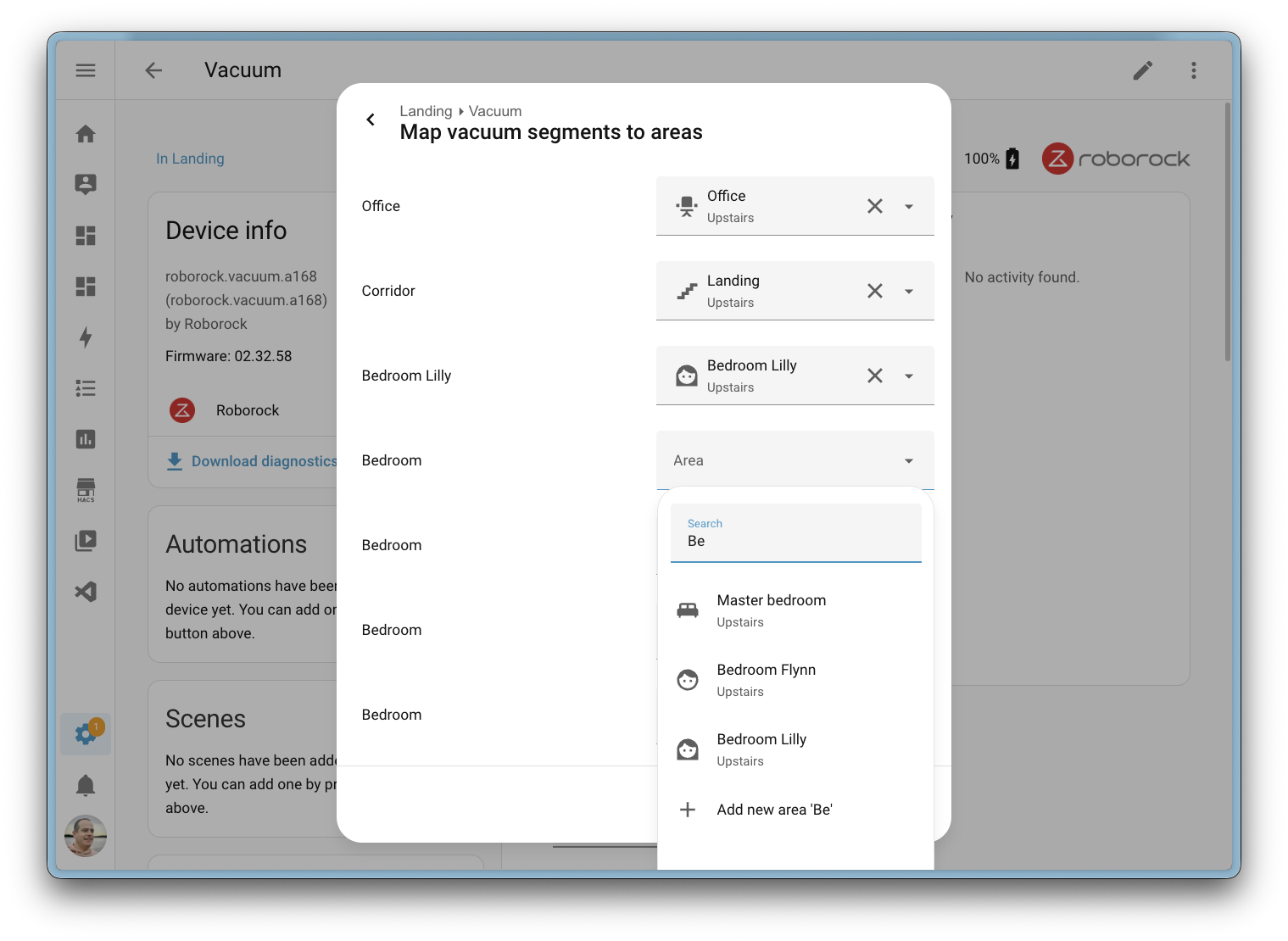
If your vacuum’s internal segment layout ever changes (for example, after remapping in the manufacturer’s app or the vacuum rediscovering its environment), Home Assistant will notice. A repair issue will alert you that the segments have changed, so you can update your mapping and make sure everything stays in sync.
Because the mapping uses native Home Assistant areas, this feature lays the groundwork for future voice assistant support. Imagine simply saying “clean the kitchen” and having your vacuum head to the right area. That’s not available just yet, but the foundation is now in place to make it happen.
The Energy dashboard received a nice batch of improvements this release.
The Now view gained badges that show real-time power consumption, gas flow rate, and water flow rate at a glance. Water also gets its own Sankey chart in the Now view, giving you a visual breakdown of water usage across your home, just like the existing power Sankey chart.

To reduce ambiguity, the second tab on the Energy dashboard has been renamed from Energy to Electricity, since the dashboard covers electricity, gas, and water. On the configuration side, the energy settings page is now split into three tabs: Electricity, Gas, and Water, making it easier to find and manage your energy sources.
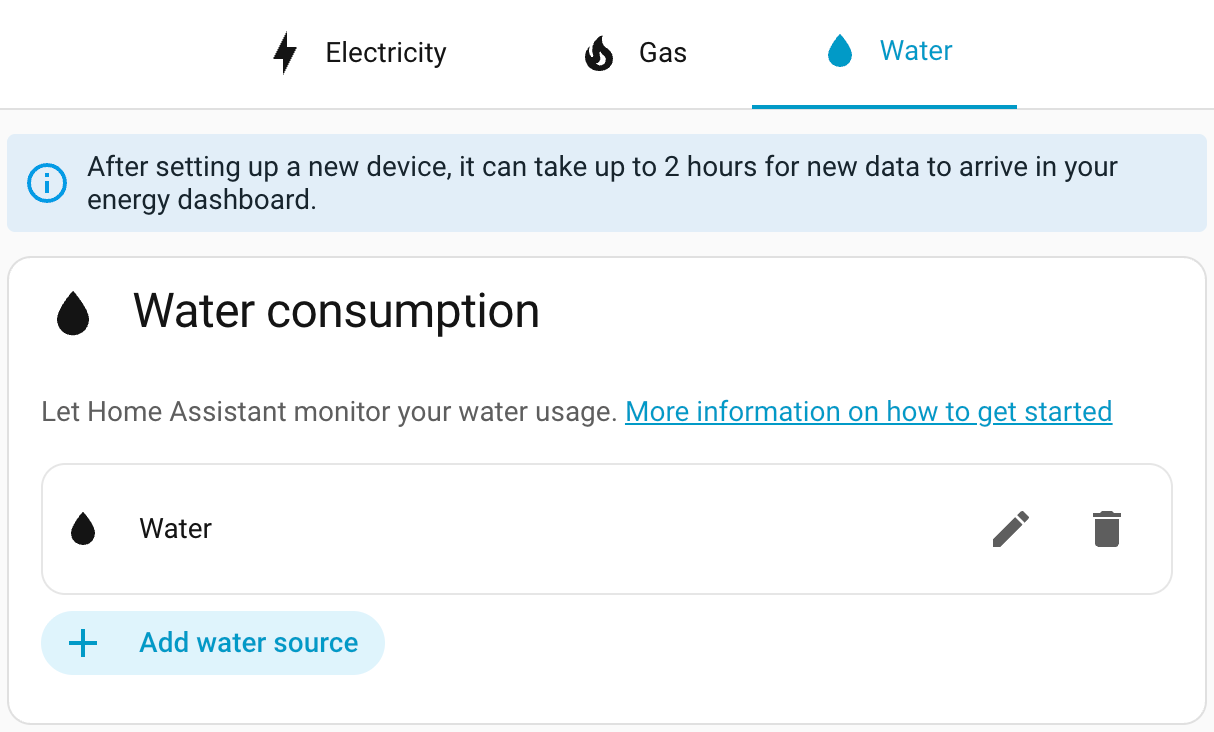
Finally, energy bar chart tooltips now include the day of the week, helping you quickly spot usage patterns.
Thanks, @MindFreeze, @NoRi2909, and @gpoitch! 🎉
The automation editor now has a Continue on error option for actions, directly accessible from the visual editor. Previously, this setting was only available through YAML.
You can find it in the three-dots menu of any action. When enabled, a visual indicator appears on the action row, so you can quickly see which actions will continue running even if they encounter an error.
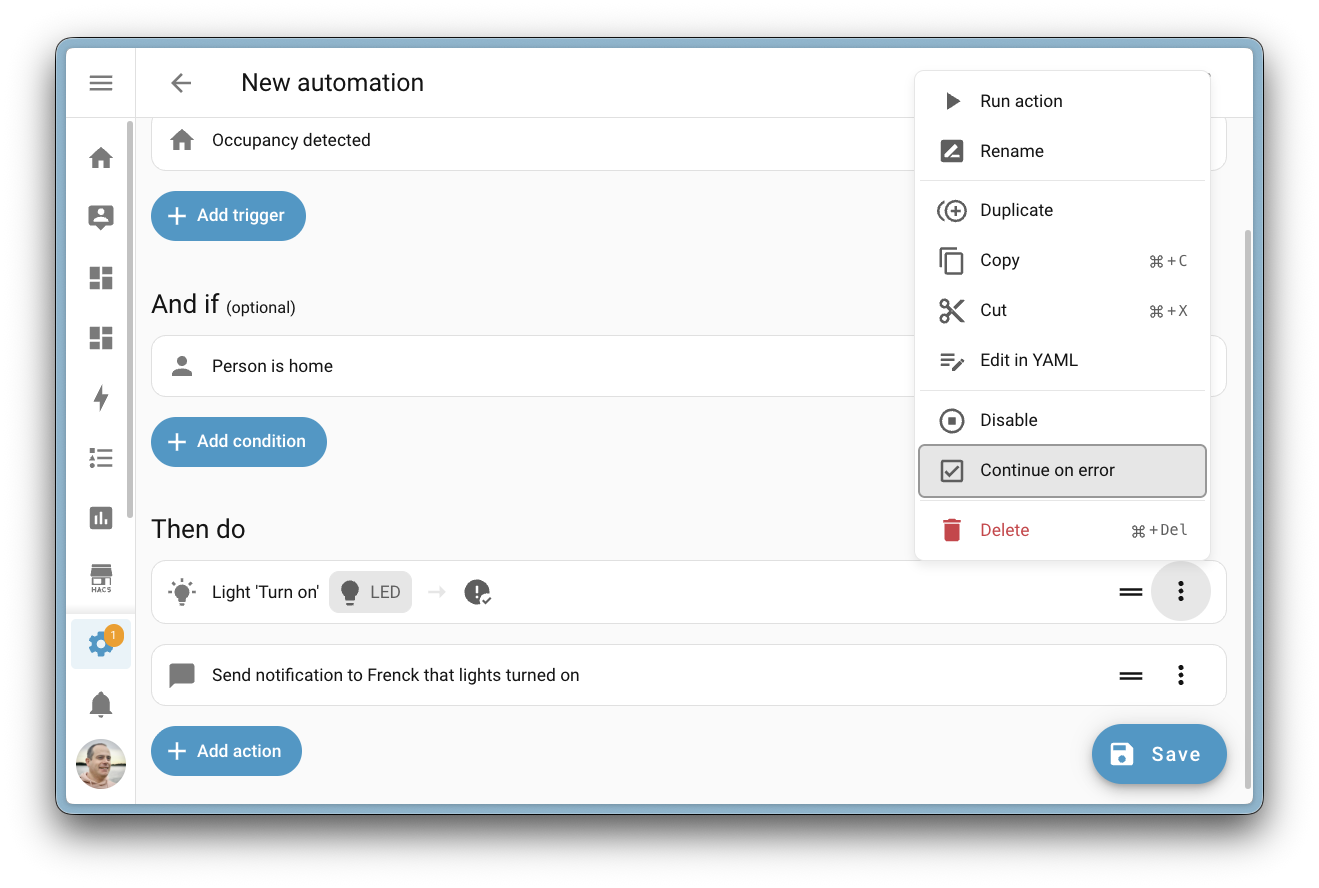
This is especially handy for automations where a single failing action shouldn’t stop the rest from running. For example, if one of several notification actions fails, the remaining ones will still be sent.
Thanks, @wendevlin! 🎉
Your phone just became a voice satellite! The Home Assistant Companion app for Android now supports on-device wake word detection, allowing you to open Assist from anywhere; even when your phone is locked.
Inspired from the great work from @brownard in Ava.
This feature uses microWakeWord, the same lightweight wake word engine that powers the Home Assistant Voice Preview Edition. All processing happens locally on your device, no audio is sent to the cloud, and no server-side processing is needed. Your voice stays on your phone.
You can choose between three wake words:
To enable wake word detection, open your Android device’s Settings > Companion App > Assist for Android, and enable the Enable wake word detection toggle. Once enabled, simply say your chosen wake word and the Assist pipeline will open, ready to take your command.
Watch the video to see wake word detection in action on an Android device.
It already integrates with your voice equipment at home, and if another satellite is nearby, only the fastest one will respond. This also applies to multiple Android devices.
Because wake word detection requires continuous microphone access and CPU usage, this feature does have a noticeable impact on battery life. To help manage this, you can use automations to start and stop wake word detection based on your context, for example, only enabling it when you’re connected to your home Wi-Fi or within a specific zone. This way, you get hands-free voice control when it matters most, without draining your battery all day.
Note
Battery usage could be drastically reduced if Google opened their API for hardware hotword detection. Unfortunately, this is hidden behind a system API that only phone manufacturers have access to. Maybe one day they will open it up to improve the experience.
Thanks, @TimoPtr! 🎉
Thanks to our community for keeping pace with the new integrationsIntegrations connect and integrate Home Assistant with your devices, services, and more. [Learn more] and improvements to existing ones! You’re all awesome 🥰
We welcome the following new integrations in this release:
Ghost, added by @JohnONolan
Monitor your Ghost publication metrics, including member counts, revenue, post statistics, and email newsletter performance, right from your Home Assistant dashboard.
Hegel Amplifier, added by @boazca - launching at 🥈 silver quality
Control your Hegel Music Systems amplifiers locally over your network. Manage power, volume, input selection, and mute with real-time push updates for instant feedback.
Homevolt, added by @Danielhiversen - launching at 🥈 silver quality
Read local data from your Homevolt battery over your network, no cloud required. Monitor power, energy, voltage, temperature, and battery status.
Hypontech Cloud, added by @jcisio
Monitor your Hypontech solar inverter system through the Hypontech Cloud platform. Track power production, energy yields, and system status.
IDrive e2, added by @patrickvorgers
Back up your Home Assistant to an IDrive e2 bucket. IDrive e2 offers affordable S3-compatible cloud storage with flexible access controls for keeping your backups safe.
Indevolt, added by @Xirt
Communicate directly with your Indevolt energy storage devices over the local network. Monitor energy production, consumption, and battery status.
IntelliClima, added by @dvdinth
Integrate your Fantini Cosmi Ecocomfort 2.0 ventilation devices. Control fan modes and speeds of your mechanical ventilation with heat recovery system.
Liebherr, added by @mettolen - launching at 🥈 silver quality
Control and monitor your Liebherr SmartDevice refrigerators and freezers via the cloud. Monitor temperatures, adjust cooling settings, and automate food safety alerts.
MTA New York City Transit, added by @OnFreund - launching at 🥈 silver quality
Get real-time arrival predictions for all NYC subway and bus lines using data from the Metropolitan Transportation Authority (MTA).
MyNeomitis, added by @l-pr
Connect your Axenco MyNeomitis heating and energy management devices, such as electric radiators, towel rails, and underfloor heating, to Home Assistant.
OneDrive for Business, added by @zweckj - launching at 🏆 platinum quality
Use OneDrive for Business as a backup location for your Home Assistant backups. Great for users with a Microsoft 365 business subscription.
Powerfox Local, added by @klaasnicolaas - launching at 🏆 platinum quality
Gather data from your Powerfox Poweropti device directly over your local network, offering faster updates with no cloud dependency.
Redgtech, added by @Jonhsady
Connect your Redgtech smart switches to Home Assistant. Control and monitor your cloud-connected switches and relays from this Brazilian smart home brand.
System Nexa 2, added by @konsulten - launching at 🥈 silver quality
Integrate your System Nexa 2 smart home devices locally. Control lights, switches, and smart plugs with support for dimmers and outdoor plugs.
Teltonika, added by @karlbeecken - launching at 🥈 silver quality
Monitor your Teltonika Networks routers running RutOS. Track cellular signal quality, modem temperature, and network connectivity.
Trane Local, added by @bdraco
Locally control Trane and American Standard thermostats over your network using a direct mTLS connection. No cloud required.
Zinvolt, added by @joostlek
Monitor your Zinvolt batteries in Home Assistant, including state of charge and other battery metrics.
This release also has new virtual integrations. Virtual integrations are stubs that are handled by other (existing) integrations to help with findability. These ones are new:
It is not just new integrationsIntegrations connect and integrate Home Assistant with your devices, services, and more. [Learn more] that have been added; existing ones are also being constantly improved. Here are some of the noteworthy changes to existing integrations:
gpt-image-1.5 image generation model for AI Tasks, offering cheaper and faster image generation. Thanks, @Shulyaka!ptz_goto_preset action for triggering presets and a PTZ patrol select entity with live state updates. Thanks, @RaHehl!aionanoleaf2, fixing authorization errors that prevented newer Nanoleaf Essentials devices from connecting. Thanks, @loebi-ch!radarr.get_movies and radarr.get_queue, returning detailed information about movies in your library and the current download queue. Thanks, @Liquidmasl!get_shopping_list_items action that returns structured shopping list data, useful for automations that need more detail than the to-do entity provides. Thanks, @andrew-codechimp!prune_images action to clean up unused Docker images. Thanks, @erwindouna!start_session action, letting you start a sauna session with custom duration, target temperature, and fan duration in a single call. Thanks, @mettolen!One thing we are incredibly proud of in Home Assistant is our integration quality scale. This scale helps us and our contributors to ensure integrations are of high quality, maintainable, and provide the best possible user experience.
This release, we celebrate several integrationsIntegrations connect and integrate Home Assistant with your devices, services, and more. [Learn more] that have improved their quality scale:
9 integrations reached platinum 🏆
1 integration reached gold 🥇
6 integrations reached silver 🥈
7 integrations reached bronze 🥉
This is a huge achievement for these integrations and their maintainers. The effort and dedication required to reach these quality levels is significant, as it involves extensive testing, documentation, error handling, and often complete rewrites of parts of the integration.
A big thank you to all the contributors involved! 👏
While most integrationsIntegrations connect and integrate Home Assistant with your devices, services, and more. [Learn more] can be set up directly from the Home Assistant user interface, some were only available using YAML configuration. We keep moving more integrations to the UI, making them more accessible for everyone to set up and use.
The following integrations are now available via the Home Assistant UI:
There are many more improvements in this release; here are some of the other noteworthy changes:
This release ships running on Python 3.14! In case you are wondering what that means: Python is the programming language Home Assistant is built with.
So, why does it matter to you? Python 3.14 brings performance improvements to the foundation that Home Assistant is built on. The new version includes a faster interpreter, improved startup times, and better memory usage, all of which contribute to a snappier Home Assistant experience. 🚀
Don’t worry! We handle the upgrade to Python 3.14 automatically for you on all officially supported installation methods. Just upgrade Home Assistant as you normally would, and you are good to go! 😎
We will also release patch releases for Home Assistant 2026.3 in March. These patch releases only contain bug fixes. Our goal is to release a patch release once a week, aiming for Friday.
async_join_players (@mill1000 - #165020)Home Assistant has a great community of users who are all more than willing to help each other out. So, join us!
Our very active Discord chat server is an excellent place to be, and don’t forget to join our amazing forums.
Found a bug or issue? Please report it in our issue tracker to get it fixed! Or check our help page for guidance on more places you can go.
Are you more into email? Sign up for the Open Home Foundation Newsletter to get the latest news about features, things happening in our community, and other projects that support the Open Home straight into your inbox.
We do our best to avoid making changes to existing functionality that might unexpectedly impact your Home Assistant installation. Unfortunately, sometimes it is inevitable.
We always make sure to document these changes to make the transition as easy as possible for you. This release has the following backward-incompatible changes:
The water heater operation mode state on has been changed to performance for the BSB-Lan water heater. If you use this state in your automations or scripts, you will need to update them to use the new state value.
Home Assistant container images are now compressed with zstd instead of gzip. This change is supported on Docker 23.0.0 and later, and containerd 1.5.0 and later, so it is not expected to break installations that meet these minimum versions. If your environment uses an older Docker or containerd version, make sure your container runtime supports zstd before updating.
Passing the color_temp parameter (in mireds) to the lifx.effect_pulse action is no longer allowed. Use the color_temp_kelvin parameter instead.
Using color_temp (in mireds) to set a light’s color temperature is no longer supported. Use color_temp_kelvin instead.
Additionally, the color_temp, kelvin, min_mireds, and max_mireds light entity state attributes have been removed. Use color_temp_kelvin, min_color_temp_kelvin, and max_color_temp_kelvin instead.
Binary sensors and switches now have an initial state of unknown while the alarm panel is still reporting all states during startup. Previously, the default state was off, which was incorrect, as no data had been received from the panel yet.
The chance that you are impacted is low, as most states are reported before Home Assistant fully finishes setup; but this might occur on larger installations and slower connections.
Media player entities for Snapcast groups have been removed. Additionally, the Snapcast-specific grouping actions have been removed. If you use these entities or actions in your automations or scripts, you will need to update them.
The ignition and autostart state attributes of the engine switch have been removed. Two new binary sensors have been introduced to replace them. If you reference these attributes in your automations or scripts, update them to use the new binary sensor entities instead.
Mobile device tracking has been removed from the Tado integration. Mobile devices and their associated device tracker entities are no longer available. This change resolves re-authentication issues and reduces unnecessary load on the Tado API.
The behavior of template fans has changed:
unavailable if the state template encounters a syntax error. Previously, a template error would show the fan’s state as off.percentage attribute will be None if the percentage template encounters a syntax error. Previously, it would be 0.unknown state. A state template that returns None will render the entity as unknown instead of off.Percentage speeds reported by Z-Wave fans have been corrected to align with other integrations. As a result, values may differ slightly. For example, a value previously reported as 67% may now appear as 66%. If you have automations that trigger on exact percentage values, you may need to adjust them.
If you are a custom integration developer and want to learn about changes and new features available for your integration: Be sure to follow our developer blog. The following changes are the most notable for this release:
Of course, there is a lot more in this release. You can find a list of all changes made here: Full changelog for Home Assistant Core 2026.3.
VIENNA, Austria – March 04, 2026 – Enterprise software developer Proxmox Server Solutions (henceforth "Proxmox"), today announced that NAKIVO is offering native, agentless backup support for Proxmox Virtual Environment (VE) and is now officially a Proxmox solution provider. This strategic partnership provides a seamless, enterprise-grade data protection path for organizations transitioning to open-source infrastructure.
NAKIVO Backup & Replication is a comprehensive data protection solution that provides backup, instant recovery, ransomware protection and disaster recovery for a wide range of physical, virtual, cloud, SaaS and hybrid environments via a single web-based interface. This all-in-one approach helps organizations centrally manage protection tasks, maintain visibility across platforms and quickly recover workloads during outages or ransomware incidents.
Short Quote NAKIVO:
“Our integration with Proxmox VE is a direct response to the community’s need for a reliable, enterprise-grade data protection solution that matches the flexibility of their hypervisor. Our focus, as always, remains on delivering a reliable backup solution that streamlines data protection and helps achieve robust cyber resilience and rapid recovery for all environments,” Bruce Talley, CEO of NAKIVO.
Short Quote Proxmox:
“Our goal is to provide a virtualization platform that is both powerful and inherently open,” said Tim Marx, COO of Proxmox. “By fostering native integrations with leaders like NAKIVO, we give our customers the flexibility to choose the best-in-class tools they need to secure their data. This collaboration reinforces Proxmox VE as a mature, enterprise-grade ecosystem that is ready for the most demanding environments.”
The NAKIVO Backup & Replication integration is available immediately for all Proxmox VE users. For more information, please visit https://www.nakivo.com/proxmox-backup/
###
About NAKIVO
NAKIVO is a US-based software vendor dedicated to delivering a reliable backup, ransomware protection and disaster recovery solution for virtual, physical, cloud, SaaS and mixed environments. Over 16,000 customers in 191 countries trust NAKIVO with protecting their data, including major companies like Coca-Cola, Honda, Siemens and Cisco. Learn more: https://www.nakivo.com
About Proxmox Server Solutions
Proxmox provides powerful and user-friendly open-source server software. Enterprises of all sizes and industries use the Proxmox solutions to deploy efficient and simplified IT infrastructures, minimize total cost of ownership, and avoid vendor lock-in. Proxmox also offers commercial support, training services, and an extensive partner ecosystem to ensure business continuity for its customers. Proxmox Server Solutions GmbH was established in 2005 and is headquartered in Vienna, Austria. Learn more: https://www.proxmox.com
Contact: Daniela Häsler, Proxmox Server Solutions GmbH, marketing@proxmox.com
Full Changelog: v4.2.4...v4.2.5

The Extended Stable channel has been updated to 144.0.7559.236 for Windows and Mac which will roll out over the coming days/weeks.
The Stable channel has been updated to 145.0.7632.159/160 for Windows/Mac and 145.0.7632.159 for Linux, which will roll out over the coming days/weeks. A full list of changes in this build is available in the Log
Security Fixes and Rewards
Note: Access to bug details and links may be kept restricted until a majority of users are updated with a fix. We will also retain restrictions if the bug exists in a third party library that other projects similarly depend on, but haven’t yet fixed.
This update includes 10 security fixes. Please see the Chrome Security Page for more information.
[$33,000][485622239] Critical CVE-2026-3536: Integer overflow in ANGLE. Reported by cinzinga on 2026-02-18
[$32,000][474266014] Critical CVE-2026-3537: Object lifecycle issue in PowerVR. Reported by Zhihua Yao of KunLun Lab on 2026-01-08
[TBD][484983991] Critical CVE-2026-3538: Integer overflow in Skia. Reported by Symeon Paraschoudis on 2026-02-17
[TBD][483853098] High CVE-2026-3539: Object lifecycle issue in DevTools. Reported by Zhenpeng (Leo) Lin at depthfirst on 2026-02-12
[TBD][484088917] High CVE-2026-3540: Inappropriate implementation in WebAudio. Reported by Davi Antônio Cruz on 2026-02-14
[TBD][484811719] High CVE-2026-3541: Inappropriate implementation in CSS. Reported by Syn4pse on 2026-02-16
[TBD][485152421] High CVE-2026-3542: Inappropriate implementation in WebAssembly. Reported by qymag1c on 2026-02-17
[TBD][485267831] High CVE-2026-3543: Inappropriate implementation in V8. Reported by qymag1c on 2026-02-18
[TBD][485683110] High CVE-2026-3544: Heap buffer overflow in WebCodecs. Reported by c6eed09fc8b174b0f3eebedcceb1e792 on 2026-02-19
[TBD][487383169] High CVE-2026-3545: Insufficient data validation in Navigation. Reported by Google on 2026-02-24
We would also like to thank all security researchers that worked with us during the development cycle to prevent security bugs from ever reaching the stable channel.
Many of our security bugs are detected using AddressSanitizer, MemorySanitizer, UndefinedBehaviorSanitizer, Control Flow Integrity, libFuzzer, or AFL.
Interested in switching release channels? Find out how here. If you find a new issue, please let us know by filing a bug. The community help forum is also a great place to reach out for help or learn about common issues.
Srinivas Sista

Co-authored-by: github-actions[bot] <41898282+github-actions[bot]@users.noreply.github.com>

Co-authored-by: github-actions[bot] <41898282+github-actions[bot]@users.noreply.github.com>
Co-authored-by: github-actions[bot] <41898282+github-actions[bot]@users.noreply.github.com>
Hi,
The OpenWrt community is proud to announce the first stable release of the OpenWrt 25.12 stable series.
Download firmware images using the OpenWrt Firmware Selector:
Download firmware images directly from our download servers:
OpenWrt 25.12.0 incorporates over 4700 commits since branching the previous OpenWrt 24.10 release and has been under development for over one year.
Only the main changes are listed below. See changelog-25.12.0 for the full changelog.
OpenWrt 25.12 is named Dave's Guitar to honor Dave Täht, who sadly passed away on April 1, 2025.
Dave played a key role in reducing bufferbloat and improving network latency in OpenWrt and across the wider internet. His work made networks faster, more responsive, and more reliable for millions of users.
This release is dedicated to his memory and lasting impact on the networking community.
The hardware requirements did not change significantly. Most devices supported by OpenWrt 24.10 are also supported in OpenWrt 25.12.
OpenWrt has transitioned from the traditional opkg package manager to apk (Alpine Package Keeper).
This change brings several advantages:
apk supports most features of opkg. Only very few package names changed. The command line arguments of apk are different from the command line arguments of opkg.
For users migrating existing systems, an official opkg to apk cheatsheet is available to ease the transition and map common workflows.
The attended sysupgrade LuCI application is now installed by default.
owut is included by default in images for devices with larger flash storage.
ASU allows devices to:
This dramatically simplifies upgrades: with just a few clicks in LuCI and a short wait, a custom firmware image is built and installed without manual intervention.
Shell command history is now preserved across sessions by storing it in a RAM-backed filesystem.
Benefits:
For users who prefer persistent history storage, this behavior can be changed by editing: ''/etc/profile.d/busybox-history-file.sh''
⚠️ Note: Storing history on flash will increase write cycles and may impact flash endurance over time.
The OpenWrt video feed with Qt5 and UI applications is integrated by default.
The Wi-Fi scripts were rewritten in ucode.
This is part of the rewrite of the management scripts from shell scripts to ucode.
uCode is used for system scripts because it is faster and safer than shell scripts, and integrates directly with ubus and UCI.
Wi-Fi and network management scripts rewritten in uCode run faster, have fewer errors, and are easier to maintain.
OpenWrt 25.12 supports over 2200 devices. Support for over 180 new devices was added in addition to the devices already supported in OpenWrt 24.10.
Most devices already supported by OpenWrt 24.10 are still supported.
Core components have the following versions in 25.12.0:
In addition to the listed applications, many others were also updated.
With the release of OpenWrt 25.12 stable series, the OpenWrt 24.10 stable series will go end of life in 6 months. We will not provide security updates for OpenWrt 24.10 after September 2026. We encourage everyone to upgrade to OpenWrt 25.12 before September 2026.
Upgrading from 24.10 to 25.12 should be transparent on most devices, as most configuration data has either remained the same or will be translated correctly on first boot by the package init scripts.
Sysupgrade from 23.05 to 25.12 is not officially supported.
Cron log level was fixed in busybox. system.@system[0].cronloglevel should be set to 7 for normal logging. 7 is the default now. If this option is not set, the default is used and no manual action is needed.
Bananapi BPI-R4: Interfaces ''eth1'' was renamed to ''sfp-lan'' or ''lan4'', and interface ''eth2'' was renamed to ''sfp-wan'' to match the labels. You have to upgrade without saving the configuration.
If you wish to start from scratch (always the safest, but also the most work), simply download the pre-built image from the downloads site or from the Firmware Selector to your device. Make sure to create and save a backup, then install the image using sysupgrade -n /tmp/firmware.bin or the LuCI Backup/Flash Firmware, being sure to set "Keep settings and retain the current configuration" to its off position. Restore or reconstruct your configuration using the contents of the backup as a template.
Attended Sysupgrade (ASU) allows you to build a custom image that retains all of your installed packages and their configuration transparently. You need to use one of the three ASU clients that interface with the ASU server to produce this custom image:
Both the LuCI ASU app and owut are optional packages in 24.10, so if you have not installed them, they won't be there by default. Use either the LuCI Package Manager to install them, or you can do it from the command line with opkg:
$ opkg update
$ opkg install luci-app-attendedsysupgrade
$ opkg install owut
Note that you can install one or the other, or both together, they are completely independent packages.
The Firmware Selector does an excellent job of searching through the thousands of available device configurations and getting you to the right place. But, some devices have several variants and possibly different image formats, so if you're unsure about which one you need or which device you're dealing with or anything else, go to the |Firmware Selector support thread and ask away.
The LuCI web interface is fairly self-explanatory. If anything is unclear, please refer to the LuCI Attended Sysupgrade support thread for guidance.
If you choose to use owut, the fact that it's a command line program means you'll need a little more explanation regarding best practices. In any situation, it's always safe to do a check to see what's going on.
$ owut check --verbose --version-to 25.12
... a lot of output ...
This check should show you all the details of what this upgrade entails with regards to the packages available, and will point out any issues with package versions and so on.
Assuming the results of the check look good, you can simply do an upgrade next.
$ owut upgrade --verbose --version-to 25.12
... even more output ...
If you are unsure of anything you see in the check, during the upgrade, or simply have questions, jump on over to the owut support thread on the forum and ask.
eth1 to wan.Full release notes and upgrade instructions are available at
https://openwrt.org/releases/25.12/notes-25.12.0
In particular, make sure to read the regressions and known issues before upgrading:
https://openwrt.org/releases/25.12/notes-25.12.0#known_issues
For a detailed list of all changes since branching of 24.10, refer to
https://openwrt.org/releases/25.12/changelog-25.12.0
To download the 25.12.0 images, navigate to:
https://downloads.openwrt.org/releases/25.12.0/targets/
Use OpenWrt Firmware Selector to download:
https://firmware-selector.openwrt.org?version=25.12.0
As always, a big thank you goes to all our active package maintainers, testers, documenters and supporters.
Have fun!
The OpenWrt Community
To stay informed of new OpenWrt releases and security advisories, there
are new channels available:
a low-volume mailing list for important announcements:
https://lists.openwrt.org/mailman/listinfo/openwrt-announce
a dedicated "announcements" section in the forum:
https://forum.openwrt.org/c/announcements/14
other announcement channels (such as RSS feeds) might be added in the
future, they will be listed at https://openwrt.org/contact

