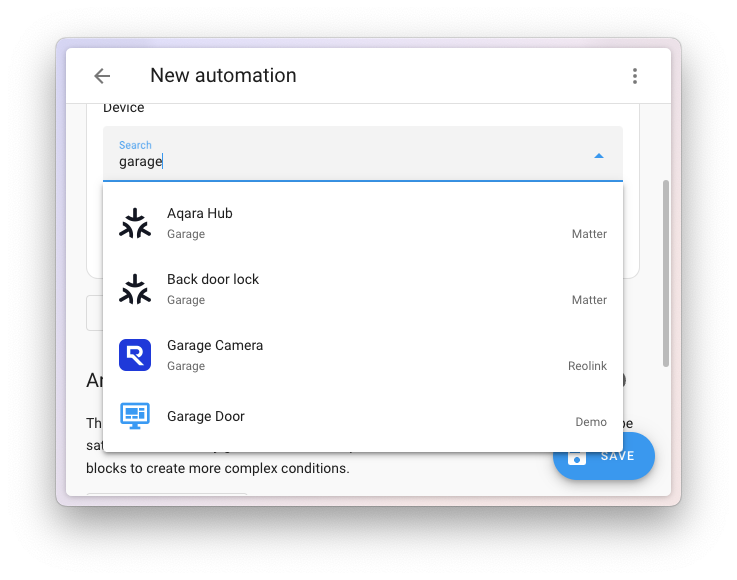
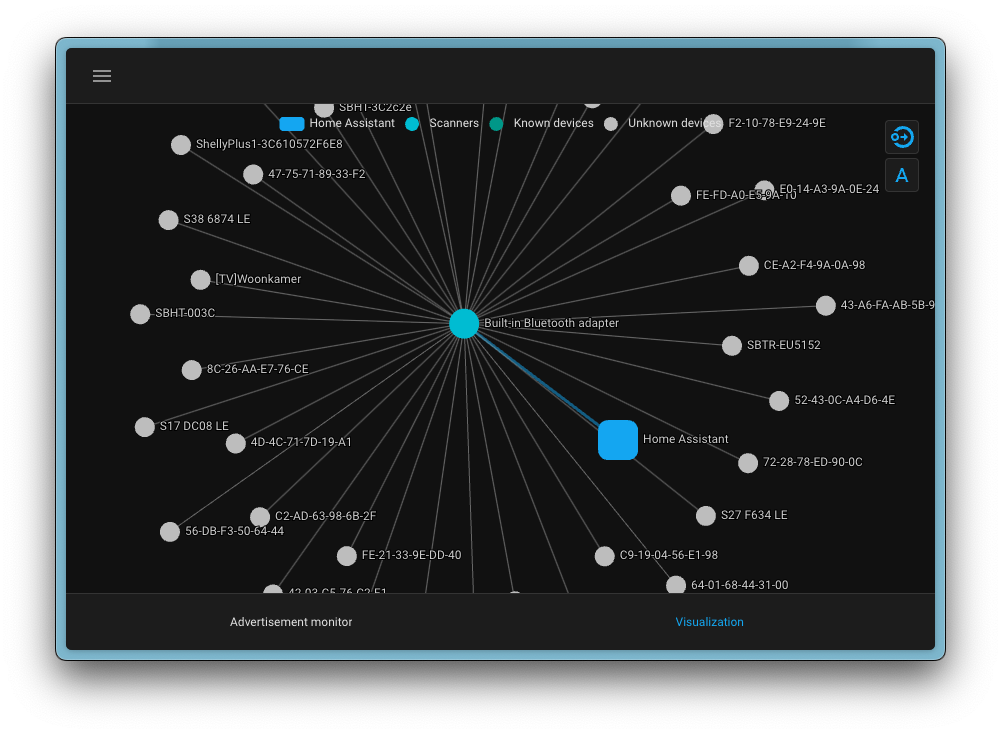
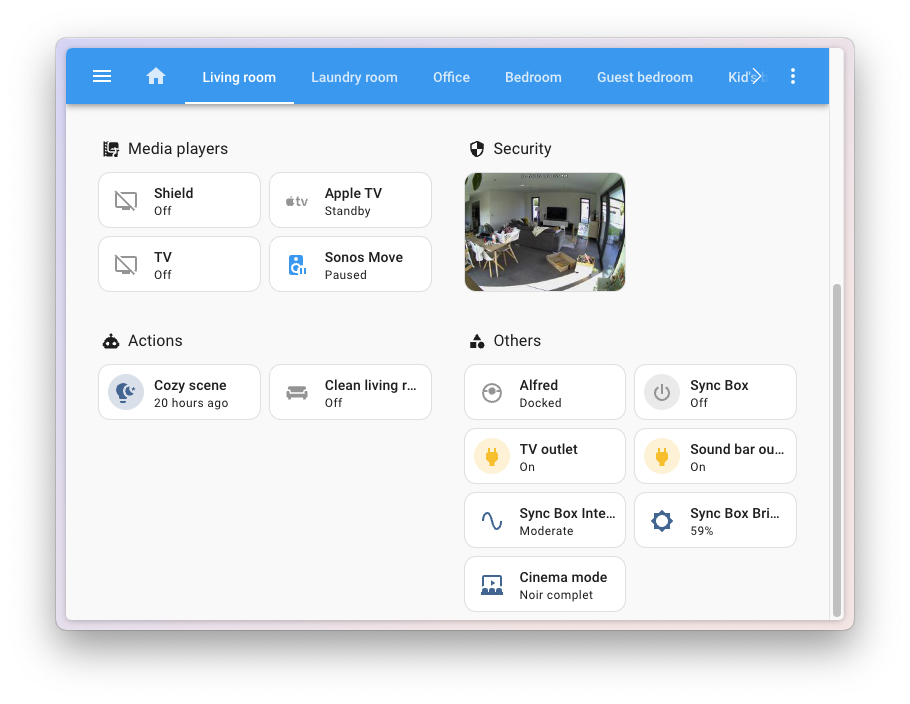
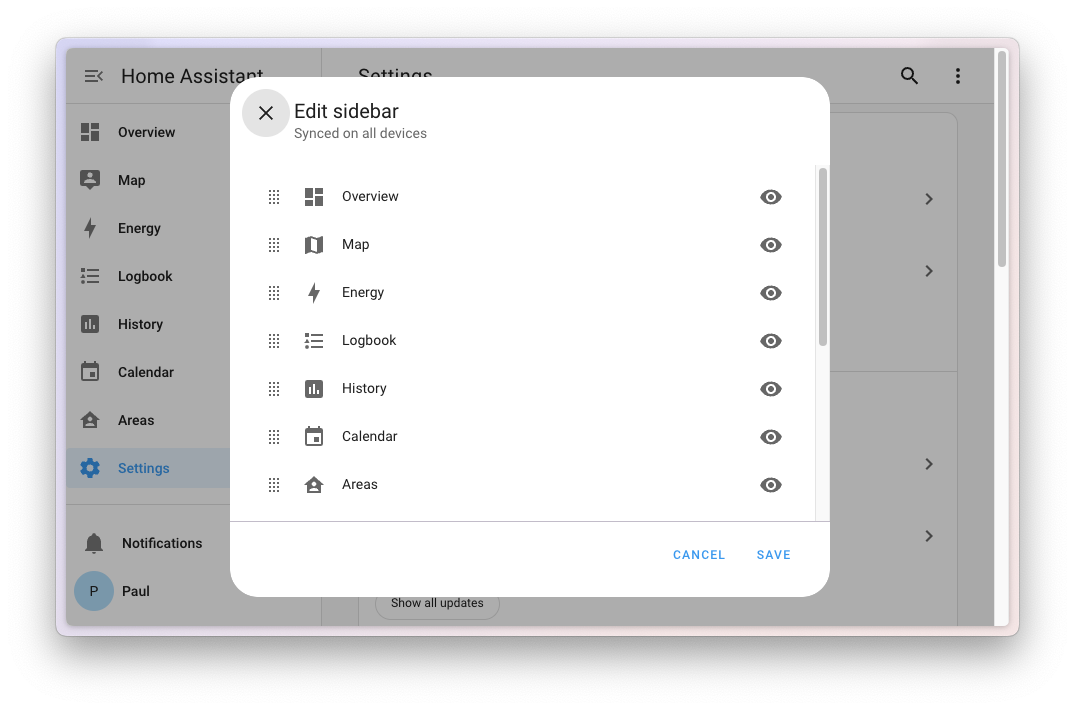
Lees weergave

Konnected joins Works with Home Assistant

Konnected joins Works with Home Assistant

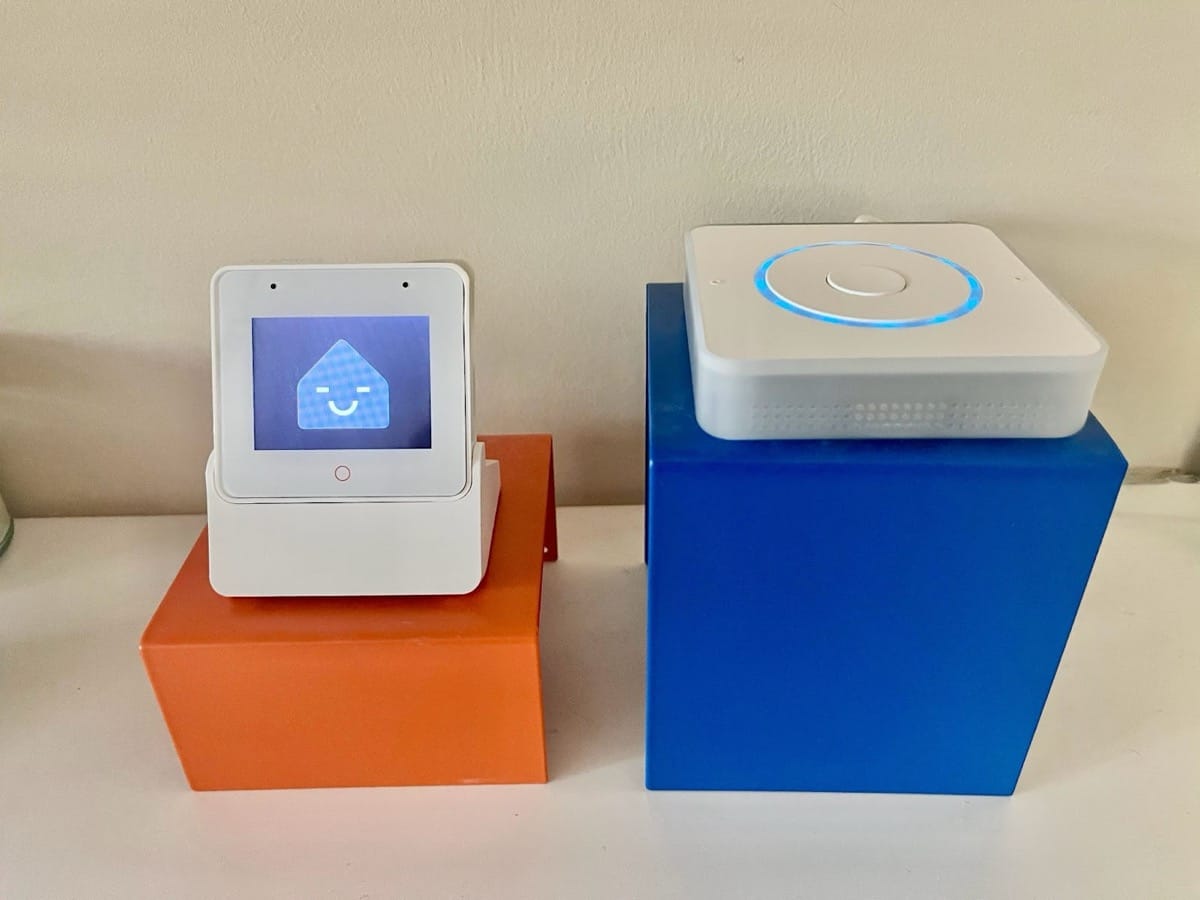
Works with Home Assistant is opening its doors to another new partner who is bringing the first Garage Door Openers and Alarm Panel to the program, all of which are using ESPHome under the hood. Konnected are well known for their devices that let you retrofit new smarts into the devices you already have, allowing you to use them in Home Assistant and keep them working longer.

Getting Konnected

Konnected have been well-known in the Home Assistant community, as they’ve been active members for years. As members of the community, they know how hard it can be to connect the devices that are already built into your home, whether they’re smart or not. That’s why Konnected’s first product was their drop-in replacement alarm panel boards, which allow you to take decades-old wired alarm systems and add them into Home Assistant.

Another challenge the community was facing was garage door openers (GDOs), especially cloud-based openers. In the early days of Home Assistant, the community figured out the APIs for these providers and controlled them that way. Some manufacturers noticed this and put barriers up blocking people from controlling the devices they own, claiming it as “unauthorized usage” 🙄.

The community was naturally incensed, and did what tinkerers tend to do when a cloud gets in their way — they began tinkering with hardware. A community emerged to take back control of these devices, starting with projects like ratgdo, which Konnected used as a base for their work. Today, because of these projects, there are multiple great open source tools to control a large number of these GDOs, ranging from DIY schematics to finished controllers. Konnected has an open source solution which works locally, as well as having the form factor and safety standards to match. Even better, Konnected devices are available in over 60 countries.

For anyone who has used Konnected for quite some time, you’ll notice that they had their own integration, which has now been deprecated in favor of the ESPHome firmware, so that it’s always straightforward to find (or build) the firmware you need. They even publish all their code on GitHub 👏, which allows the community to help them fix issues and add features.

"We've been users of Home Assistant ourselves since 2018 and thrilled to finally be officially part of the Works with Home Assistant program. Konnected shares many of the same founding principles as Home Assistant, including our commitment to 100% local control, open-source firmware, and high-quality hardware that makes your home smarter, safer and accessible to everyone."

- Nate Clark, Founder / CEO at Konnected

Konnected is another example of ESPHome (a project from the Open Home Foundation) fostering an entirely new ecosystem of Open Home projects. It works fully locally, and it’s perfect for tinkerers, allowing you to build DIY smart home devices yourself (get started with one of our ready-made projects). Konnected also have a thriving community of their own if you have questions or comments.

Creators can also use it to make pre-built, plug-and-play products that give users a really seamless experience. Devices are easily discovered and added to your Wi-Fi network and Home Assistant, along with a one-click update within Home Assistant. To learn more about how Konnected uses ESPHome, look out for Nate on the next ESPHome live stream on October 14!

Remember, the development of projects like ESPHome from the Open Home Foundation is supported by Home Assistant Cloud subscribers and anyone who purchases Home Assistant hardware. While all of Konnected’s devices work locally, if you’re interested in remote access, allowing you to keep tabs on your home’s security when you’re out and about, check out Home Assistant Cloud.

Devices

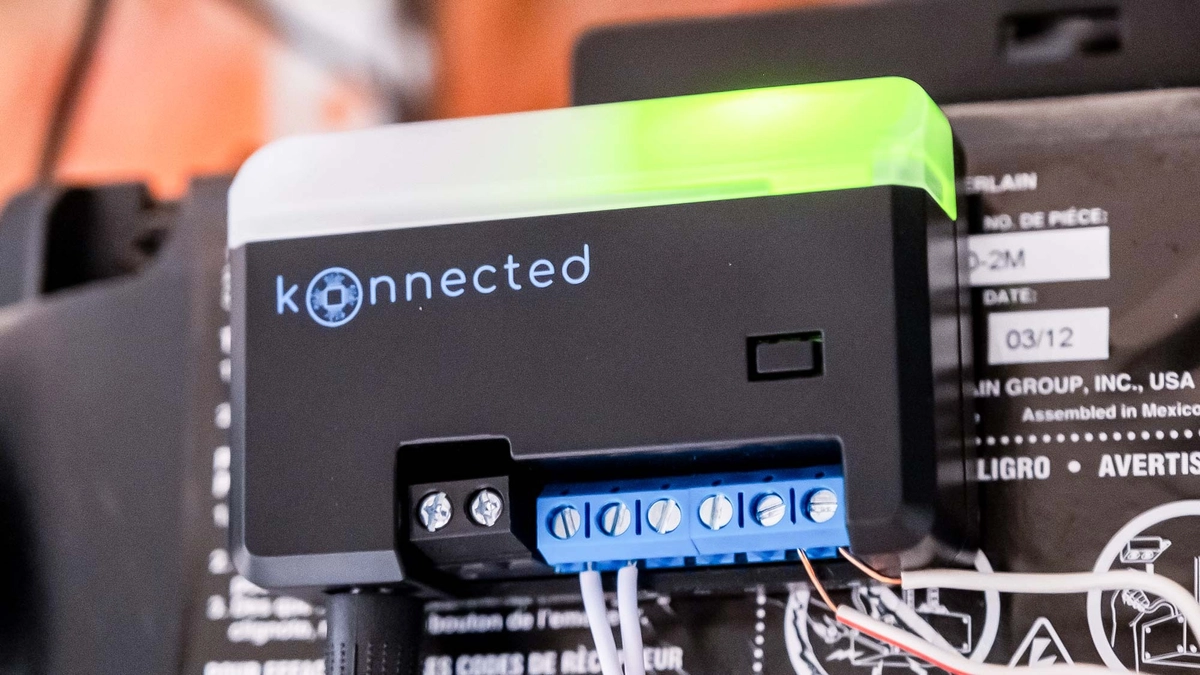
Konnected Smart Garage Door Opener blaQ The Konnected Smart Garage Door Opener blaQ

For anyone new to the Works With Home Assistant program, it’s a way for us to formally certify devices that have been tested by our team, and help you know what works great out of the box with Home Assistant. Any company joining also commits to providing long-term support and firmware updates. Works With Home Assistant is operated by the Open Home Foundation, and the support of Home Assistant Cloud subscribers funds this work. These items were all tested by members of the ESPHome team to see exactly how they function in their own homes.

The Konnected certified devices are listed below:

Let’s Konnect

A nice benefit of retrofitting your old wired security system is not needing to maintain loads of battery-powered sensors 🪫. The Alarm Panel Pro has the ability to connect 12 zones (security speak for individual or joined up sensors), it also allows you to connect keypads and sirens, and includes 12V power for the devices that need that. It’s highly customizable, and there’s also plenty of support available if you need help with installation. You can power it using 12V or Power-over-Ethernet, or both! The Alarm Panel Pro is designed to be always-on, and they’ve designed it to consume very little power. This also allows it to easily run for hours on their backup battery.

You’ll also probably be wondering why there are two different variants of the garage door openers, and that’s because each supports a different set of manufacturers. There is a wizard to help you figure out which variant will work with your opener. Between the Konnected GDO blaQ and White, you get support for some of the biggest manufacturers out there, including Chamberlain, LiftMaster, Craftsman, Merlin, Genie, Stanley, and more.

Even with the Konnected controlling your garage door opener, you’re still able to use the included remote or the original manufacturer’s app (if you like that kind of torture). The GDO White features a built-in optical laser sensor that detects whether your garage door is open or closed. The GDO blaQ offers control over the opener’s light and lock, and can even partially open the door (for openers that support these features).

As we mentioned at the top, it’s great to have more products added to the program that help people get the most out of the things they already own. A big part of the Open Home Foundation’s mission is sustainability in the smart home, and Konnected are helping our community get longer lasting use of their existing security and garage door systems.

FAQs

Q: If I have a device that is not listed under ‘Works with Home Assistant does this mean it’s not supported?

A: No! It just means that it hasn’t gone through a testing schedule with our team or doesn’t fit the requirements of the program. It might function perfectly well, but has not yet been added to the testing schedule, or it might work under a different connectivity type that we don’t currently test under the program.

Q: Ok, so what’s the point of the Works with program?

A: It highlights the devices we know work well with Home Assistant and the brands that make a long-term commitment to keeping support for these devices going. The certification agreement specifies that the devices must have full functionality within Home Assistant, operate locally without the need for cloud and will continue to do so long-term.

Q: How were these devices tested?

A: All devices in this list were tested using a standard Home Assistant Green Hub with the ESPHome integration. If you have another set-up that’s not a problem, but we test against these as they are the most effective way for our team to certify within our ecosystem.

Q: Will you be adding more Konnected devices to the program?

A: Why not! Konnected are also looking to do some exciting things with Matter soon, so we’re excited to work together on any upcoming releases or add in further products that are not yet listed here.

  •  

2025.10: Undo, redo, and draw me too

Boo! 👻

We just celebrated our birthday 🥳, which means it is time for spooky season; get ready for Halloween! And, hello to the October release of Home Assistant 2025.10! 🎃

This release iterates on some of the features we introduced in the last couple of releases, but also introduces some brand-new ones!

The highlight of this release is definitely the iterations of the automation editor, which gained a sidebar last release, and now has gained undo/redo functionality, a resizable sidebar, improved copy/paste, and more! Thanks for all the feedback you provided on the previous release; it made a massive difference in this release.

Using multiple wake words for voice assistants is now possible, which opens up a lot of possibilities, especially for dual-language households (like mine 😉). Dashboards get more intelligent by suggesting entities based on your usage patterns, and the AI Task can now generate images, which I’m curious to see what the community will do with it!

Enjoy the release!

../Frenck

A huge thank you to all the contributors who made this release possible! And a special shout-out to @JLo, @laupalombi, and @piitaya who helped write the release notes this release. Also, @googanhiem, @SeraphicRav, @tronikos, and @richardpolzer for putting effort into tweaking its contents. Thanks to them, these release notes are in great shape. ❤️

Automation editor

In the last release, we introduced a new layout for the automation editor, and your feedback has been invaluable in helping us refine it!

This release fixes a few of the most common issues we managed to gather from all of you. Thanks for all the feedback! ❤️

The sidebar is resizable

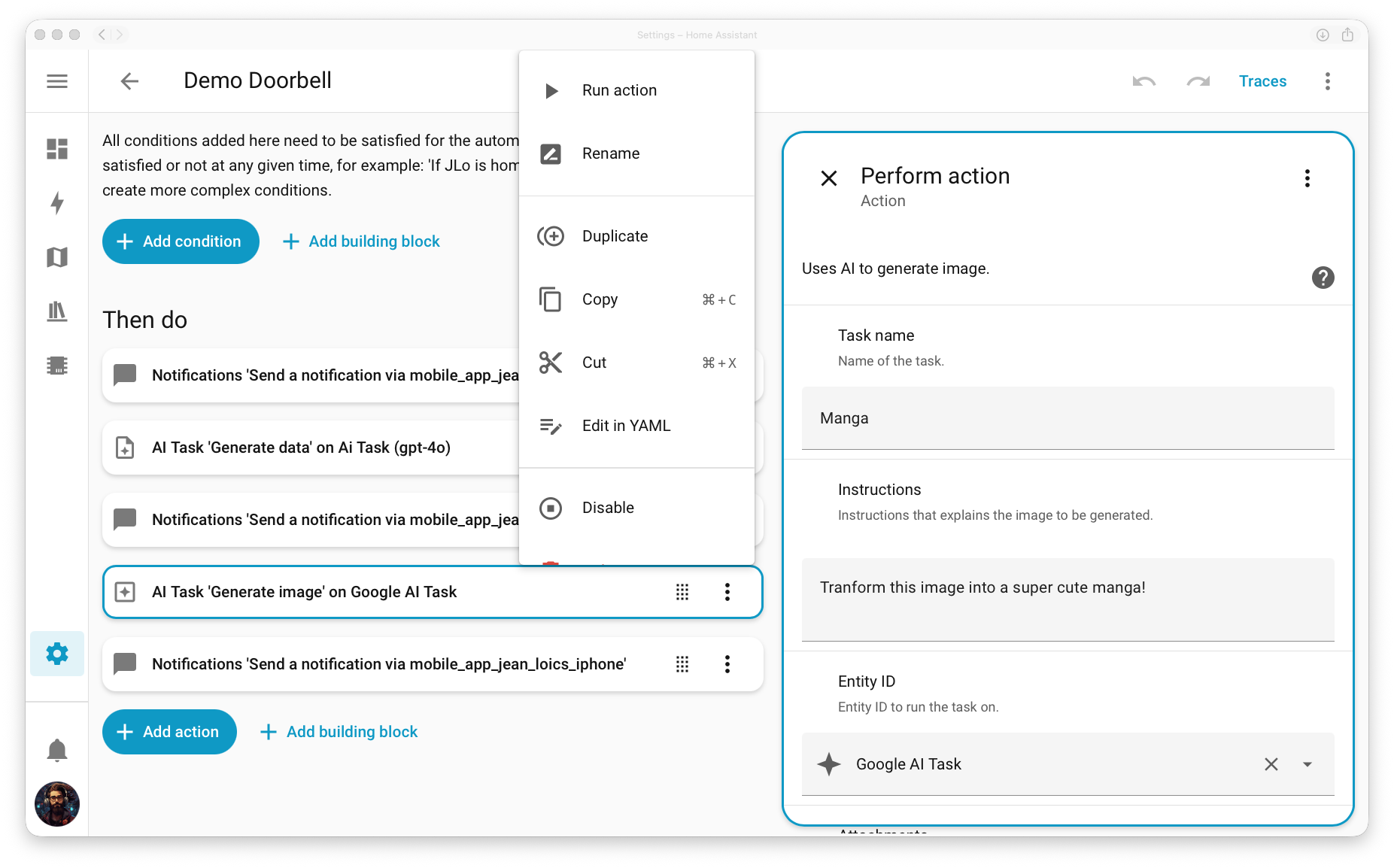
Working on an action that is too complex for a small sidebar? Maybe one with a few YAML fields? You can now resize the sidebar to adapt the layout to your current task!

Screenshot showing the automation editor with the sidebar expanded on the right. The sidebar is larger in this screenshot, as it can now be resized.

CTRL+V

We previously introduced keyboard shortcuts to copy and cut.

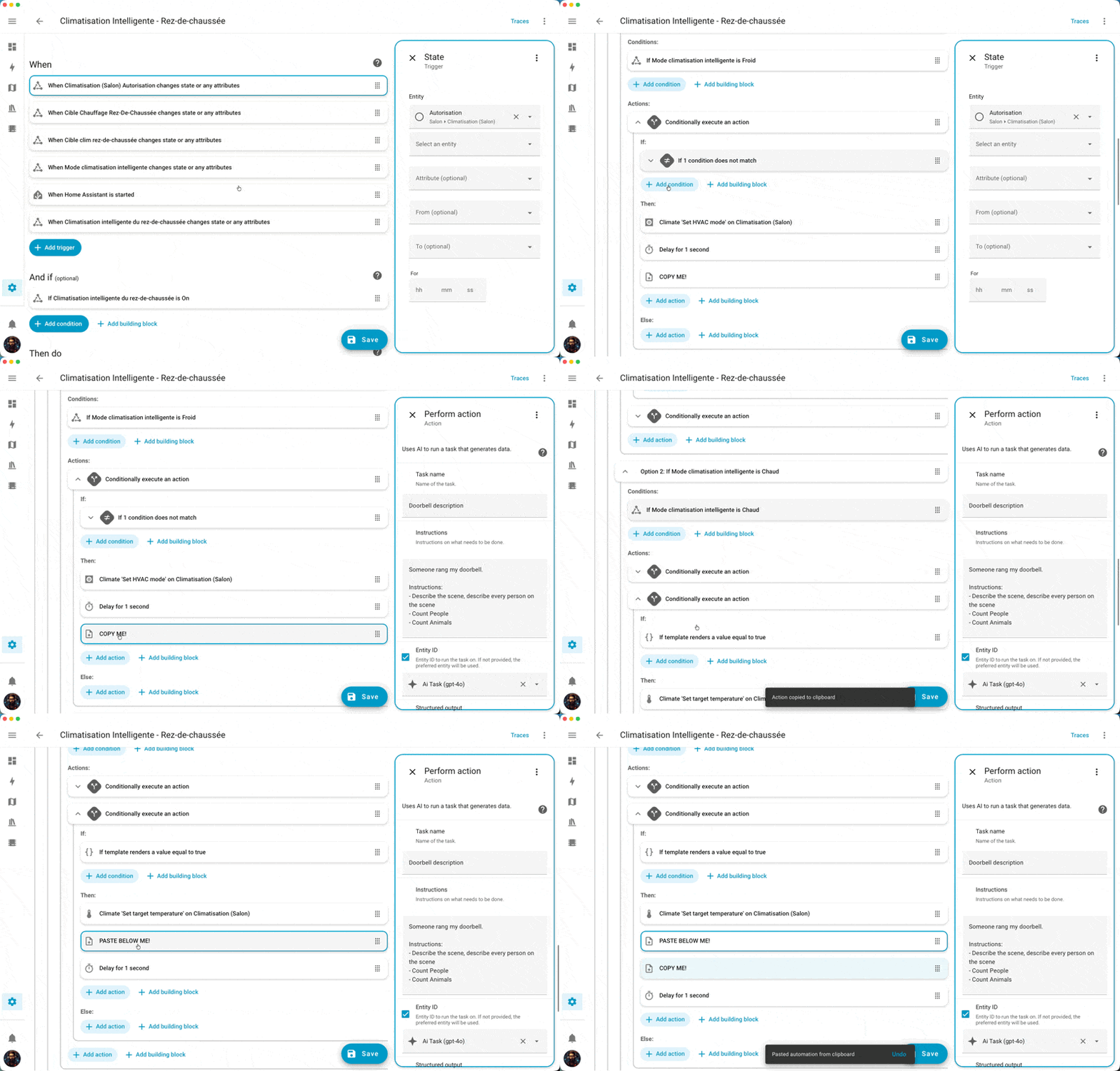
Pasting was more complex to bring to life because you can paste a block (trigger, condition, action) in many different locations in your automation. In this release, we introduce a really simple pattern. If you previously copied a block, you can paste it below any block simply by selecting it and pressing CTRL+V.

Another very simple, but very welcome, quality-of-life improvement to the automation editor!

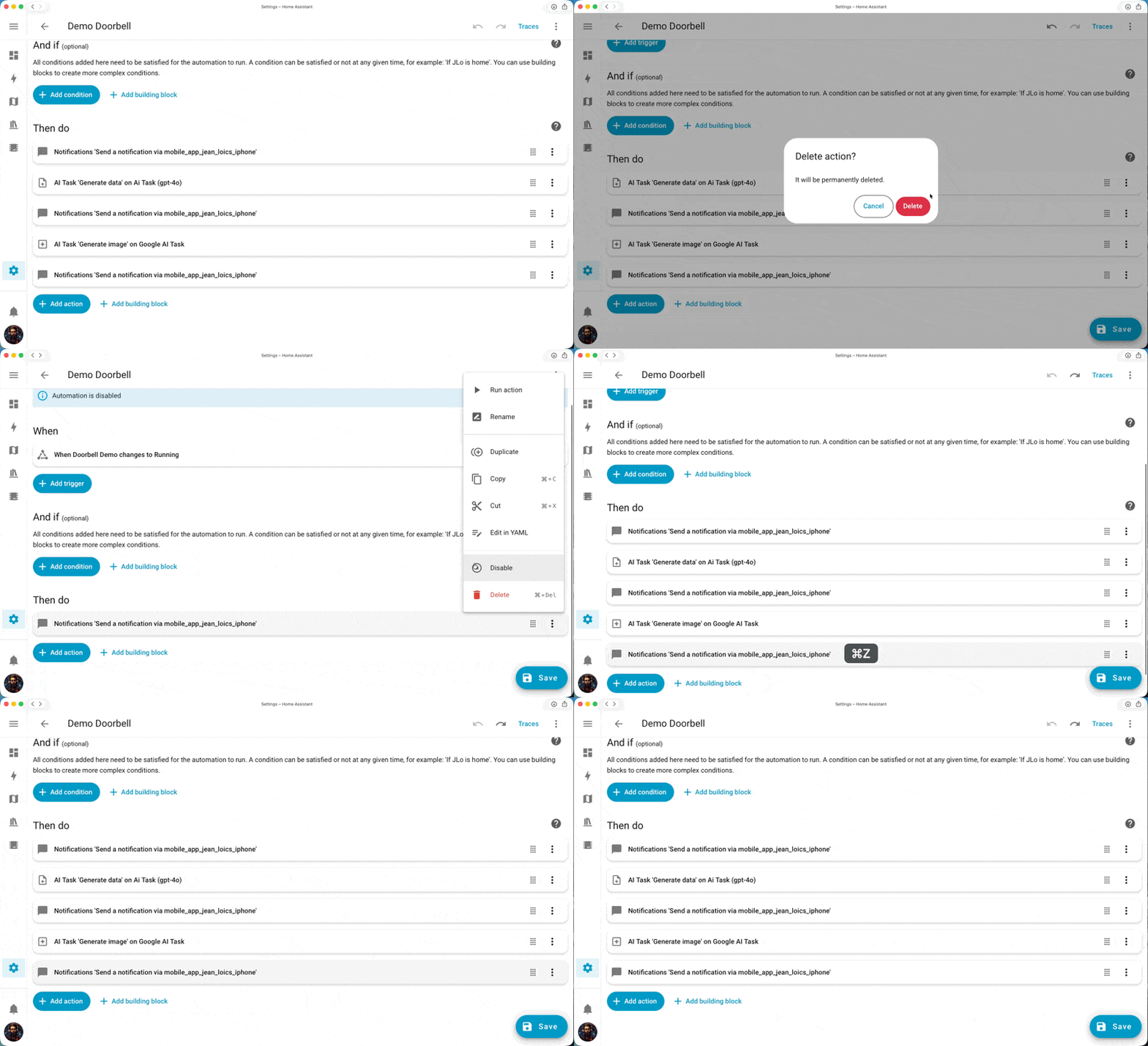
Screen recording showing how to copy and paste blocks in the automation editor; it especially highlights how a pasted block is pasted after the block you've selected.

The overflow menu is back

We initially relocated the overflow menu (the menu that appears when you click the ) with all the options related to a block on the sidebar, thinking this would make the flow cleaner.

Due to popular demand and helpful feedback that some actions were more difficult to reach (such as testing a condition or running an action), we decided to bring it back to the main section of the editor as well.

Screenshot showing the automation editor with the overflow menu open on an item in the automation editor flow. This showcases all items are back, including disabling, copy, and pasting parts.

Undo/Redo

We’ve all been there: you’re building a complex automation, make a mistake, and want to revert it, only to find out that it’s really not simple. Up until now, the only way to revert some unsaved changes made to an automation was to close it and start over again… A very painful workflow.

This release introduces an Undo functionality (and its associated Redo). You can now undo up to 75 steps back in your automation editing history (and redo them if you want). Standard keyboard shortcuts (CTRL+Z and CTRL+Y) are also available! An amazing contribution from @jpbede, thanks!

Screen recording showing how to undo and redo changes in the automation editor with the new back- and forward-arrows that are shown in the top right of the automation editor.

Repeat repeat repeat repeat

Finally, we noticed some unwanted complexity in our “repeat” building block, which allows you to repeat one or multiple actions for as long as you need to.

This complexity stemmed from the fact that we were trying to cover four main use cases in a single block.

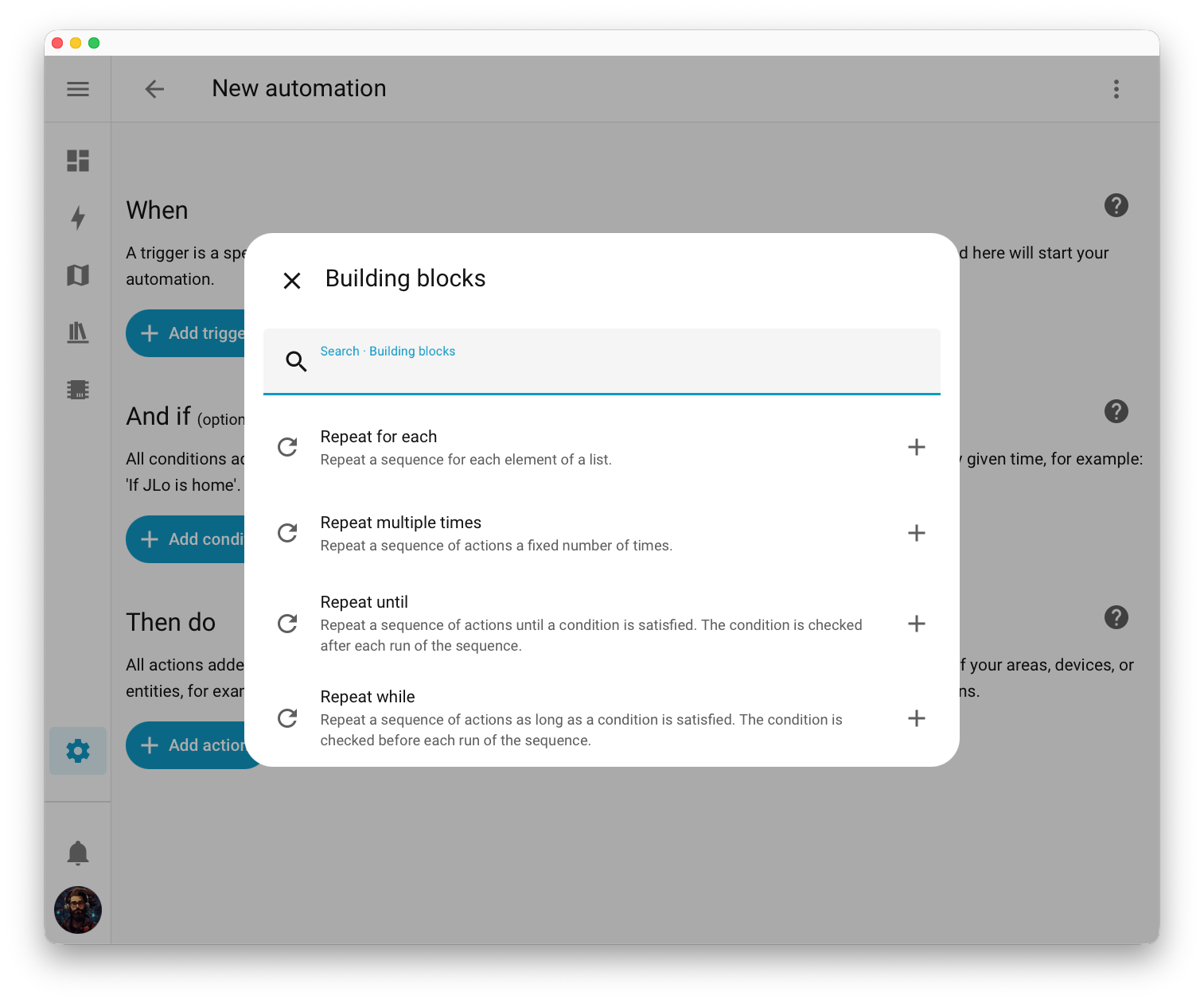
We decided to split this building block into four smaller ones, with simpler descriptions explaining each use case. Nice!

Here’s how they were separated:

  • Repeat multiple times - Repeat a sequence of actions a fixed number of times.
  • Repeat until - Repeat a sequence of actions until a condition is satisfied. The condition is checked after each run of the sequence.
  • Repeat while - Repeat a sequence of actions as long as a condition is satisfied. The condition is checked before each run of the sequence.
  • Repeat for each - Repeat a sequence for each element of a list.
Screenshot showing the repeat building block, now consisting of four distinct blocks for each use case.

Note

For our advanced users: This evolution is only cosmetic. The YAML format of the repeat block does not change; this means your existing automations will not be affected by this change.

Automation editor feedback

Tip

One of Home Assistant’s greatest strengths is our community. We’re building this automation editor together, and your input will shape where it goes next. There are two ways to get involved:

AI Task - Draw me a sheep

In 2025.8, we introduced a way to generate data using the LLM of your choice, paving the way to more AI-driven automations, dashboards, and other smart home interactions.

In this release, we introduce a way to generate images!

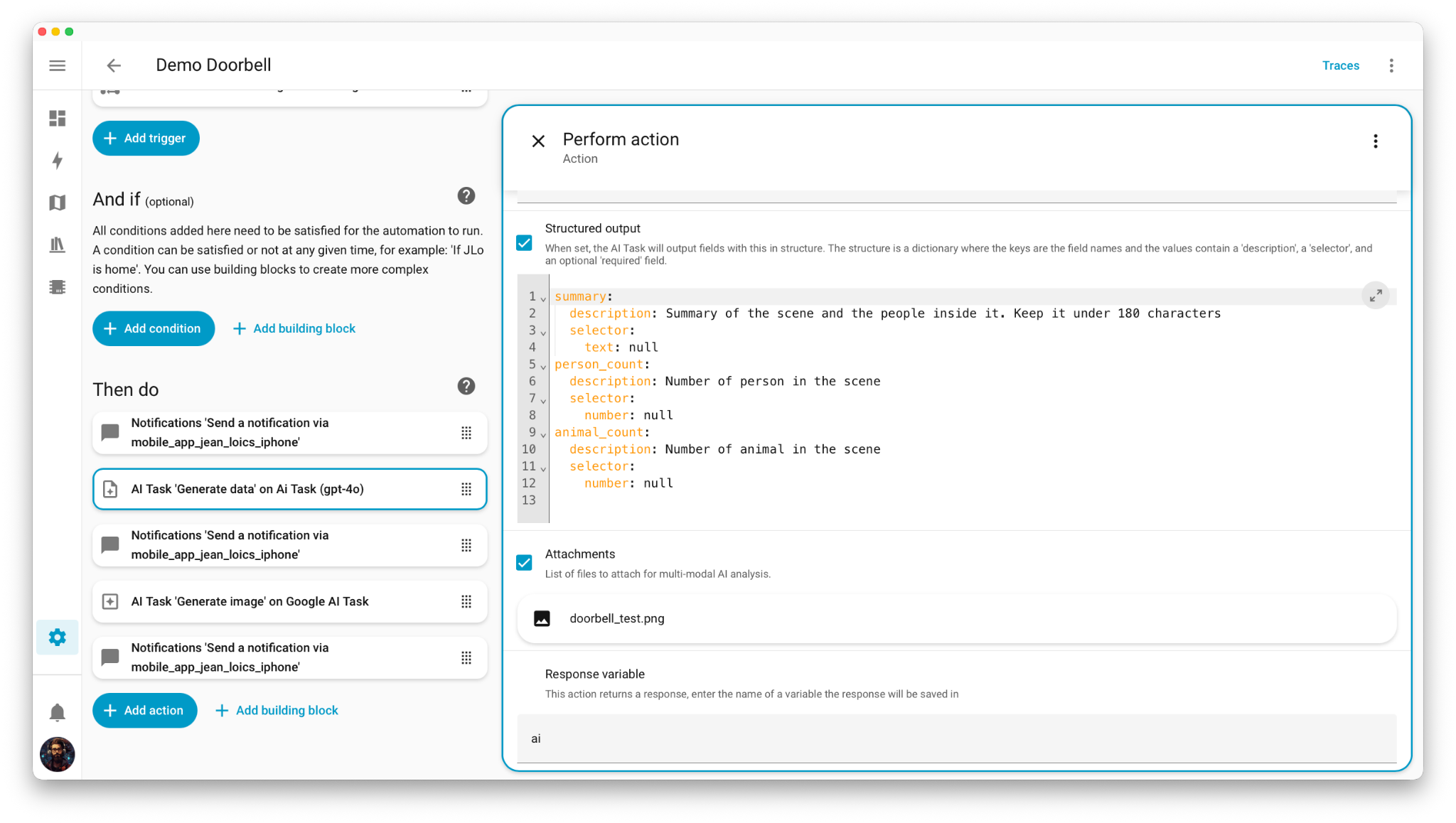
Now every time someone rings your doorbell, you can receive a notification with a cartoon version of the doorbell snapshot. @JLo has made this example a reality, and here’s his demo with the associated automation!

Automation details
alias: Demo Doorbell
triggers:
  - trigger: state
    entity_id:
      - binary_sensor.doorbell_demo
    to: "on"
actions:
  - action: notify.mobile_app_iphone
    data:
      title: "🔔 Doorbell "
      message: Processing image ...
      data:
        tag: doorbell
  - action: ai_task.generate_data
    data:
      task_name: Doorbell description
      instructions: |-
        Someone rang my doorbell.

        Instructions:
        - Describe the scene, describe every person on the scene
        - Count People
        - Count Animals
      entity_id: ai_task.ai_task_gpt_4o
      structure:
        summary:
          description: >-
            Summary of the scene and the people inside it. Keep it under 180
            characters
          selector:
            text: null
        person_count:
          description: Number of person in the scene
          selector:
            number: null
        animal_count:
          description: Number of animal in the scene
          selector:
            number: null
      attachments:
        media_content_id: media-source://media_source/local/doorbell_test.png
        media_content_type: image/png
        metadata:
          title: doorbell_test.png
          thumbnail: null
          media_class: image
          children_media_class: null
          navigateIds:
            - {}
            - media_content_type: app
              media_content_id: media-source://media_source
    response_variable: ai
  - action: notify.mobile_app_iphone
    data:
      title: >-
        🔔 Doorbell ({{ai.data.person_count}} 🧑🏻‍🦱 / {{ai.data.animal_count}}
        🐊)
      message: "{{ai.data.summary}}"
      data:
        tag: doorbell
  - action: ai_task.generate_image
    data:
      task_name: Manga
      instructions: Transform this image into a super cute manga!
      entity_id: ai_task.google_ai_task
      attachments:
        media_content_id: media-source://media_source/local/doorbell_test.png
        media_content_type: image/png
        metadata:
          title: doorbell_test.png
          thumbnail: null
          media_class: image
          children_media_class: null
          navigateIds:
            - {}
            - media_content_type: app
              media_content_id: media-source://media_source
    response_variable: ai_image
    enabled: true
  - action: notify.mobile_app_iphone
    data:
      title: >-
        🔔 Doorbell ({{ai.data.person_count}} 🧑🏻‍🦱 / {{ai.data.animal_count}}
        🐊)
      message: "{{ai.data.summary}}"
      data:
        tag: doorbell
        image: http://homeassistant.local:8123{{ai_image.url}}
    enabled: true
mode: single

Image generation is already working great, and we cannot wait to see what you will build with this!

Dashboards get smarter - let your home suggest what to show

In the last release, we introduced the Home dashboard, offering a simpler way to control and monitor your smart home if you don’t have the time, energy, or need to customize your own dashboard in detail.

Now we’ve added a new concept: sections of suggested entities. This follows a basic algorithm that suggests entities you have interacted with the most in the past. It then shows these entities based on the hour of the day, with only relevant controls being suggested.

Screenshot showing the new prediction entities that are now put onto the experimental home dashboard. These are common entities you often interact with.
Adding prediction entities to any dashboard

If you’re creating a manual dashboard with sections, you can integrate these prediction controls directly into it. The setup follows a section-based approach:

  1. Add a new section.
  2. Open and edit the YAML of that section.
  3. Replace the entire section YAML with the following snippet:
strategy:
  type: common-controls
  title: Common controls

Tip

One of Home Assistant’s greatest strengths is our community. We’re building this dashboard together, and your input will shape where it goes next. There are two ways to get involved:

Voice

Hello, hola

For a very long time, ESPHome-based voice assistants (even the tiny Atom Echo) secretly supported multiple wake words under the hood. With this release, we’re finally opening up this feature to you!

You can now define two wake words and two assistants for every voice assistant in your home!

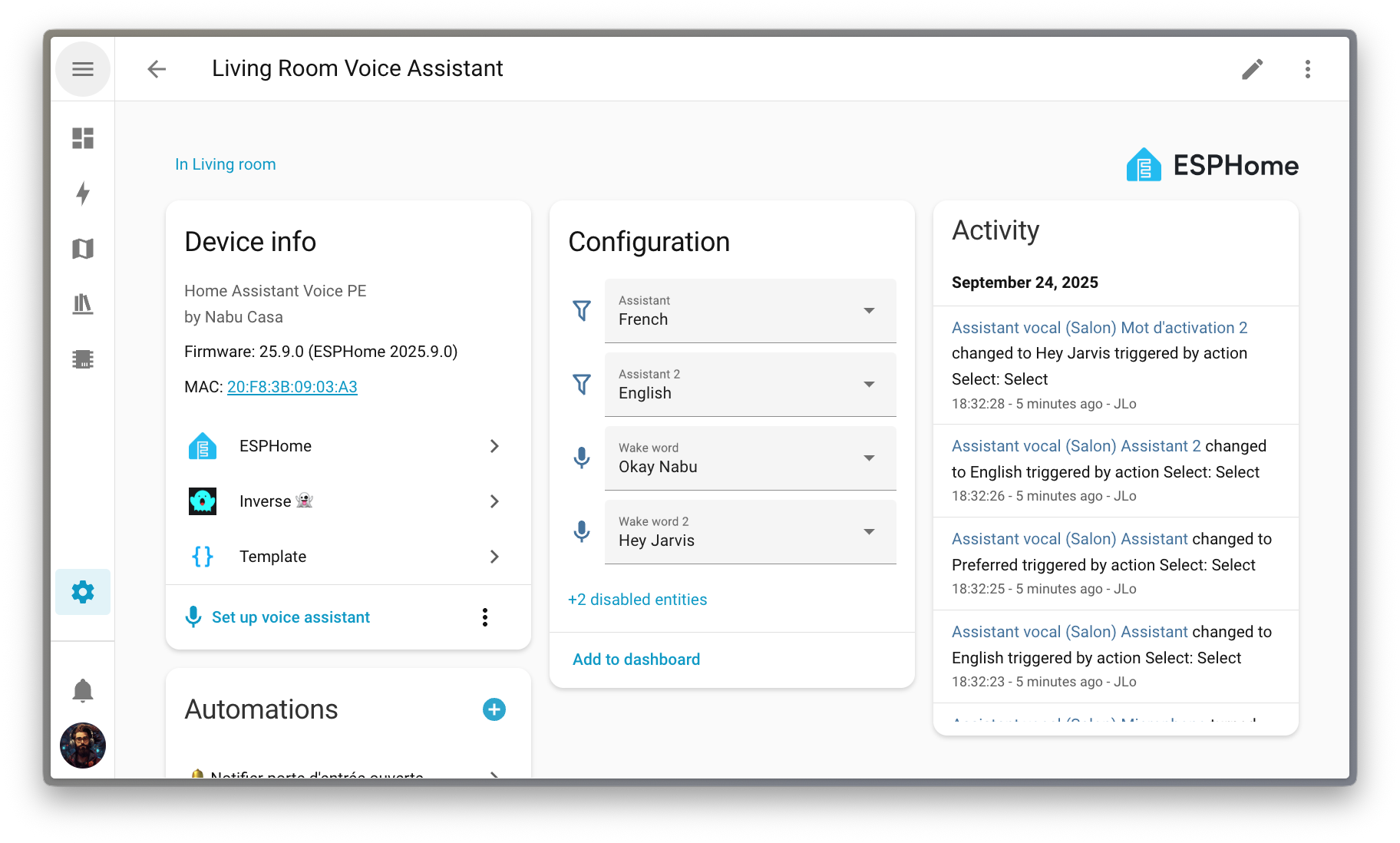
Screenshot showing the device page of a Home Assistant Voice PE, showcasing the new entities for setting the second wake word and voice pipelines associated with it.

This makes it straightforward to support dual-language households by assigning different wake words to different languages. For example, “Okay Nabu” could be used for French, while “Hey Jarvis” is used for English.

Multiple wake words and assistants can be used for other purposes as well. Want to keep your local and cloud-based voice assistants separate? Easy! “Okay Nabu” could be used for a cloud-based assistant while “Hey Jarvis” is used for a local one.

We’d love to hear feedback on how you plan to use multiple wake words in your home!

Beep boop

After a voice command, Assist responds with a short confirmation like “Turned on the lights” or “Brightness set”. This lets you know that it understood your command and took the appropriate actions. However, if you’re in the same room as the voice assistant, this confirmation can feel redundant since you can see or hear that the appropriate actions were taken.

Starting with this release, Assist will detect if your voice command’s actions all took place within the same area as the satellite device. If so, a short confirmation “beep” will be played instead of the full verbal response. Besides being less verbose, this also serves as a quick reminder that your voice command only affected the current area.

Note

This feature does not work for AI-enabled Assistants, as they can generate a wide variety of responses that can’t be replaced with a simple beep.

Integrations

Thanks to our community for keeping pace with the new integrationsIntegrations connect and integrate Home Assistant with your devices, services, and more. [Learn more] and improvements to existing ones! You’re all awesome 🥰

New integrations

We welcome the following new integrations in this release:

  • Compit, added by @Przemko92
    The Compit integration allows you to integrate air conditioning, ventilation, and heating controllers with Home Assistant.
  • Cync, added by @Kinachi249
    Connect your GE Lighting Cync smart devices—including smart lighting (formerly known as C by GE)—with Home Assistant.
  • Droplet, added by @sarahseidman
    Connect your Droplet devices to Home Assistant. Droplet accurately monitors your home’s water usage in real time.
  • ekey bionyx, added by @richardpolzer
    Integrate your ekey bionyx biometric access control systems to receive events for individual finger scans and digital inputs in your smart home.
  • IRM KMI, added by @jdejaegh
    Get accurate weather data from Belgium’s Royal Meteorological Institute (IRM-KMI) for precise regional forecasting.
  • Libre Hardware Monitor, added by @Sab44
    Monitor your computer’s hardware sensors, including CPU temperature, GPU usage, fan speeds, and system performance metrics.
  • Portainer, added by @erwindouna
    Manage and monitor your Docker containers, keeping track of the status of your running containers.
  • Smart Meter B Route, added by @SeraphicRav
    Connect your smart meter via the B Route protocol—designed for the Japanese market—to access real-time energy consumption data.
  • SFTP Storage, added by @maretodoric
    Set up secure remote backup locations using SFTP/SSH protocols for your Home Assistant backups and data storage.
  • Usage Prediction, added by @balloob
    An internal integration that provides predictions of what entities you are most likely to interact with. Used by our new Home dashboard.
  • Victron Remote Monitoring, added by @AndyTempel
    The Victron Remote Monitoring (VRM) integration pulls site statistics and solar production and consumption forecasts from Victron Energy’s VRM portal.

Noteworthy improvements to existing integrations

It is not just new integrationsIntegrations connect and integrate Home Assistant with your devices, services, and more. [Learn more] that have been added; existing integrations are also being constantly improved. Here are some of the noteworthy changes to existing integrations:

  • Philips Hue expanded with support for MotionAware sensors on the new Hue Bridge Pro! Thanks, @marcelveldt!
  • LG added support to the LG ThinQ integration to now provide energy usage sensors for better energy monitoring of your devices! Nice!
  • Amazing work from @natekspencer: Litter-Robot got several enhancements: last feeding sensors, food dispensed today tracking, next feeding sensors, gravity mode switch, and globe light settings for Litter-Robot 4!
  • AccuWeather now provides hourly forecasts, giving you more detailed weather predictions throughout the day! Thanks, @bieniu!
  • The Blue Current integration got a new start charge session action for managing your EV charging! Nice work, @NickKoepr!
  • The Ecowitt integration now supports the LDS01 sensor! Great addition, @GSzabados!
  • Reolink cameras got several new features including encoding select entity, Home Hub siren support, and color temperature support for light entities! Awesome work from @starkillerOG!
  • Geocaching enthusiasts will love the new cache sensors added to the Geocaching integration by @marc7s! Nice if you have hidden one!
  • Lutron Caseta now supports multi-tap actions for more advanced button control! Thanks, @rlopezdiez!
  • Thanks to @alexqzd, SmartThings air conditioners can now control the AC display light!
  • Shelly devices received massive updates including illuminance sensor for Plug US Gen4, presence component entities, virtual buttons support, object-based entities, presence zone component support, and cable unplugged sensor for Flood Gen4! Great work from @chemelli74, @bieniu, and @thecode!
  • The SwitchBot integration expanded device support with Plug Mini EU, RelaySwitch 2PM, and K11+ Vacuum! Thanks, @zerzhang!
  • The SwitchBot Cloud integration got several improvements including AC off support, humidifier platform, Plug-Mini-EU support, and Climate Panel support! Great work from @SeraphicRav and @XiaoLing-git!
  • Thanks to @timmo001, the System Bridge integration now includes a power usage sensor for better system monitoring!
  • Exciting to see that the Tasmota integration now supports camera functionality! Nice addition from @anishsane!
  • Using the Tibber integration? It now provides 15-minute price data, which goes into effect on October 1st. Good timing, @Danielhiversen!
  • The Tuya integration received extensive updates with support for various new device categories and sensors: energy sensors for TDQ devices, power sensors for ZNDB devices, energy sensors for DLQ devices, solar inverter support, energy consumption for several smart switches, PM10 air quality monitoring, motor rotation mode for curtains that support it, charge state for siren alarms, cooking thermometer support, cat toilet support, electric desk support, white noise machine support, and water quality sensor support! What an impressive list! Thanks, @zzysszzy, @rokam, and @mhalano!
  • The Workday integration now has a calendar that you can view from the calendar sidebar! Thanks, @gjohansson-ST!
  • The ntfy integration got a big upgrade! You can now send richer, customizable notifications with tags, icons, URLs, and attachments. Plus, with the new event platform, you can subscribe to topics and trigger automations from incoming messages. Thanks, @tr4nt0r!

Integration quality scale achievements

One thing we are incredibly proud of in Home Assistant is our integration quality scale. This scale helps us and our contributors to ensure integrations are of high quality, maintainable, and provide the best possible user experience.

This release, we celebrate several integrationsIntegrations connect and integrate Home Assistant with your devices, services, and more. [Learn more] that have improved their quality scale:

This is a huge achievement for these integrations and their maintainers. The effort and dedication required to reach these quality levels is significant, as it involves extensive testing, documentation, error handling, and often complete rewrites of parts of the integration.

A big thank you to all the contributors involved! 👏

Now available to set up from the UI

While most integrationsIntegrations connect and integrate Home Assistant with your devices, services, and more. [Learn more] can be set up directly from the Home Assistant user interface, some were only available using YAML configuration. We keep moving more integrations to the UI, making them more accessible for everyone to set up and use.

The following integrations are now available via the Home Assistant UI:

Other noteworthy changes

There are many more improvements in this release; here are some of the other noteworthy changes:

  • The “Logbook” has been renamed to “Activity” in the UI. This better reflects its purpose of showing a timeline of activities and events in your Home Assistant instance.
  • Matter continues to expand with occupancy sensing hold time, climate running state for heat/cool fans, and thermostat outdoor temperature sensors! Great contributions from @lboue and @virtualbitzz!
  • Lawn mower entities now support start mowing and dock intents for better voice control! Thanks, @piitaya!
  • The analog clock we introduced last release got some more options! You can now enable a smooth motion for the seconds hand. Beautiful, @timmo001!
  • Need the version of the Home Assistant Mobile Companion App you are using? If you have installed the latest versions of our apps, the version is now shown on the about page in the settings menu! Nice one, @TimoPtr!
  • The thermostat card now supports water heater entities. Thanks, @karwosts!
  • Thanks to @cr7pt0gr4ph7, the add-on configuration UI has gotten support for more complex configurations; this means you will get a better experience when configuring add-ons with more complex options (like lists or user accounts). Well done!
  • Talking about add-ons, we now include switch entities for those, making it easier to control your add-ons. Thanks, @felipecrs!
  • Using a webhook trigger in your automation? You can now make it even more dynamic by using a template for the webhook_id. Thanks, @RoboMagus!
  • We now have support for MCF (1000 Cubic Feet) as an alternate unit of measure for volume, thanks to @ekobres, @xtimmy86x added m/min for speed sensors, and @pioto added inH₂O pressure unit support. Nice!

New more information dialog for media player entities

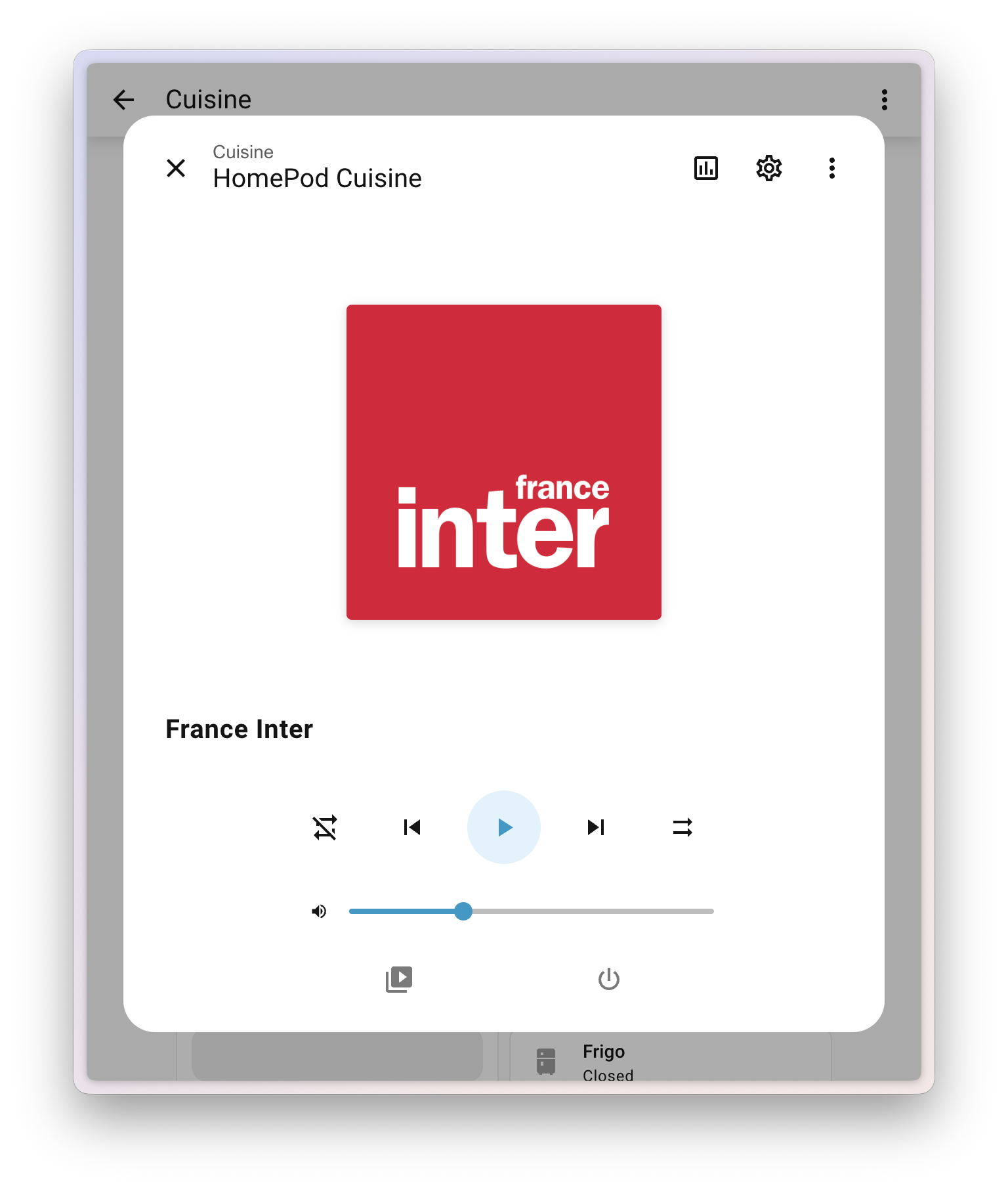
This one, we have @jpbede and @matthiasdebaat to thank for! The ‘more information’ dialogs for media players have a revamped design, offering a cleaner and more intuitive interface.

Screenshot showing the new more information dialog when you click on a media player entity. It now features album art and great controls over your media player.

Sync zooming charts in the history panel

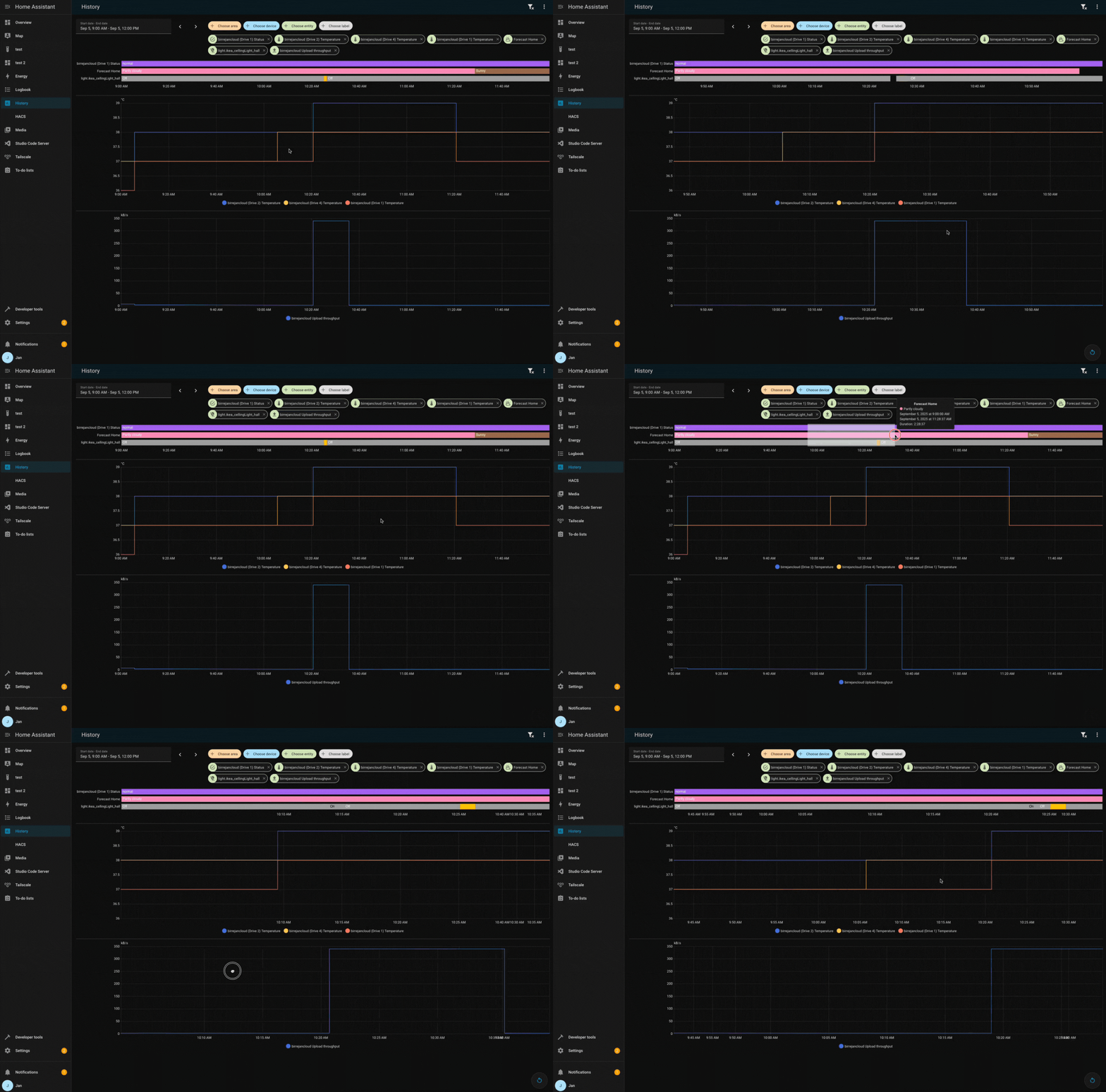
When you have multiple charts in the history panel, zooming in on one chart will now automatically zoom in on all other charts as well. This makes it easier to compare data across different entities. Well done, @birrejan!

Screen recording showing the effect of all charts being in sync when scrolling or zooming. The recording shows how a change in one graph, affects all the others in the same way.

Template & YAML editors get a toolbar

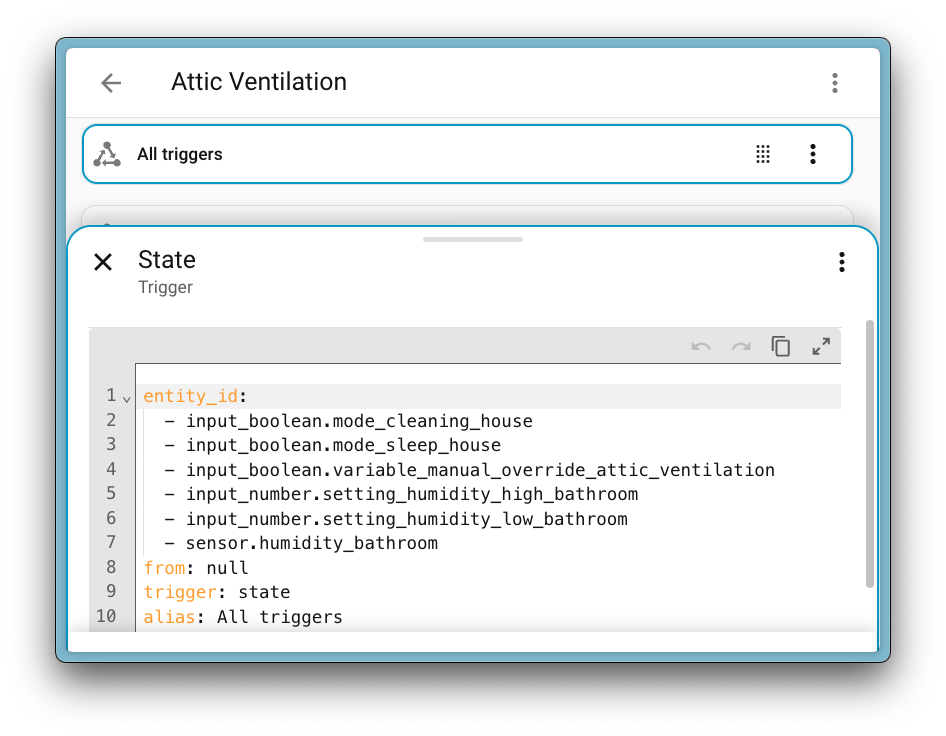
@TCWORLD has contributed a toolbar for the YAML and template code editors in our UI. This solves an issue where the previous floating button would float over the content of the editor and obscure it from view.

The new toolbar also includes undo and redo buttons, bringing the same convenient undo and redo functionality we introduced for the automation editor to these code editors as well. Plus, there’s a nice little copy button to quickly copy your code! Nice!

Screenshot showing a YAML editor in our UI with the brand new toolbar that now additionally provides undo, redo, and copy buttons!

Patch releases

We will also release patch releases for Home Assistant 2025.10 in October. These patch releases only contain bug fixes. Our goal is to release a patch release once a week, aiming for Friday.

2025.10.1 - October 3

2025.10.2 - October 10

2025.10.3 - October 17

2025.10.4 - October 24

Need help? Join the community

Home Assistant has a great community of users who are all more than willing to help each other out. So, join us!

Our very active Discord chat server is an excellent place to be, and don’t forget to join our amazing forums.

Found a bug or issue? Please report it in our issue tracker to get it fixed! Or check our help page for guidance on more places you can go.

Are you more into email? Sign up for the Open Home Foundation Newsletter to get the latest news about features, things happening in our community, and other projects that support the Open Home straight into your inbox.

Backward-incompatible changes

We do our best to avoid making changes to existing functionality that might unexpectedly impact your Home Assistant installation. Unfortunately, sometimes, it is inevitable.

We always make sure to document these changes to make the transition as easy as possible for you. This release has the following backward-incompatible changes:

Targeting labels in automations and scripts

Configuration and diagnostic entities with a label assigned to them will now be targeted/affected by service actions targeting that label. Previously, those entity categories were ignored on service action calls targeting labels.

If you have an automation or script with an action targeting a label, make sure that only entities that should be affected have that label assigned, even if they are config or diagnostic entities.

(@abmantis - #149309) (labels docs)

HERE Travel Time

HERE deprecated the previous free tier. The new Base Plan has 5000 free requests per month. The automatic update interval of the HERE Travel Time integration changed from 5 minutes to 30 minutes, so one route can be supported without costs.

(@eifinger - #147222) (here_travel_time docs)

Home Connect

The Home Connect Alarm clock entity has been removed from the time platform, please use the number entity instead.

(@Diegorro98 - #152188) (home_connect docs)

Shelly

Removed previously deprecated extra attributes, please review your automations.

Shelly Gas:

  • The Detected attribute of the Gas entity has been removed, the Gas detected entity should be used instead.
  • The Self test attribute of the Operation entity has been removed, the Self test entity should be used instead.

Shelly Air:

  • The Operational hours of the Lamp Life entity has been removed, if you still want that info please use a template entity.

(@chemelli74 - #140386) (shelly docs)

Slide Local

The effect of the property “invert position” is extended from the position itself to the status (open or closed). With this adjustment, it is no longer necessary to use cover templates to invert the position to correct the status. If you have covers with inverted position and are using the state in automations, you must adjust the automations accordingly.

(@dontinelli - #150418) (slide_local docs)

SmartThings

The windFree preset mode for the air conditioner has been renamed to wind_free to allow translation to happen. Please adapt automations accordingly.

(@joostlek - #152833) (smartthings docs)

Tibber

Switch Tibber electricity pricing to 15-minute intervals.

  • The tibber.get_prices action now returns 15-minute data instead of hourly.
  • The price_level attribute is removed and no longer supported.
  • The intraday_price_ranking attribute is now scaled to (0,1) to better support 15-minute prices.

(@Danielhiversen - #151881) (tibber docs)

Zabbix

We removed official support for Zabbix 5.0 from the integration. While this does not directly break connections to Zabbix 5.0, future updates will not check for compatibility with this version. Note that Zabbix 5 LTS left its support window in May of 2025.

(@nolsto - #149450) (zabbix docs)

ZHA

Removes the extra ZHA specific cover entity attributes, their values were no longer populated.

  • target_lift_position
  • target_tilt_position

(@jeverley - #142534) (zha docs)

ZhongHong

ZhongHong’s climate entities set_fan_mode action behavior has changed.

The fan mode values are now converted to lowercase instead of uppercase to ensure compliance with the standard convention.

If you have automations relying on uppercase fan mode values, you will need to update them to use lowercase values instead.

(@Blear - #151559) (zhong_hong docs)

If you are a custom integration developer and want to learn about changes and new features available for your integration: Be sure to follow our developer blog. The following changes are the most notable for this release:

All changes

Of course, there is a lot more in this release. You can find a list of all changes made here: Full changelog for Home Assistant Core 2025.10

  •  

Happy 12th Birthday, Home Assistant!

Home Assistant 12th Anniversary

Every September, we celebrate the anniversary of Home Assistant’s first PR in 2013 – for our 12th birthday, we’re going all in on community again. Last month, we asked for submissions on how Home Assistant helps you, and today we will highlight our favorites! We will also take a look at all the cool milestones over the past year in the project, thanks to contributions from you all, and the new things coming up for the community.

It’s a communal effort

When I (Missy Quarry) joined as the Community & Social Media Manager in February 2024, I was still new to how an open source project the size of Home Assistant manages its community. Over the past 18 months, I’ve seen Home Assistant community members from all walks of life — whether DIY tinkerers or people simply looking to make small improvements at home — contribute in their own ways. By sharing your stories and inspiring others, you’ve helped the project grow.  For our 12th birthday, I want to celebrate these contributions, no matter the size or complexity. 😌

Before I jump into celebrating all your amazing contributions and how they shape the projects managed by the Open Home Foundation, I have a couple of birthday presents for you. 🎁

First, I’m thrilled to share our new Community website! Right now, it’s a simple hub to find community information with ease, but we expect to evolve this over the coming months (or so). You’ll find links to our official community platforms, information on events, and details on meetups, including how to get reimbursed for certain fees as a host. In the future, I’d like to include links to regional communities we’re aware of and showcase more of the kinds of stories I’ll be sharing today.

Feel like something’s missing from this new page? Let me know!

Next, we’ve been working hard to do more of our development in the open. Last September, I redesigned the Discord server and in doing so I gated the Developer category behind a role. This has made it more difficult to develop in the open with the channels hidden behind a role, so we’re switching things up.

As of this week, the Developer category is now read-only for every member. Want to take a peek into the future of Home Assistant? Head to the #projects channel and see what contributors are talking about! Want to join in and contribute with either your feedback or skills? I’ve created an info thread for the channel that explains how to assign yourself either the Developer or Designer role and unlock the ability to chat in the threads.

Let’s jump into those submitted stories now… 🤩

Happily ever after

In my opinion, the best thing about Home Assistant is its flexibility - you can integrate such a wide range of devices into it and use their data to build a unique-to-your-home experience. And that’s exactly why I wanted to hear how you, the community, use it in your own home to benefit you. Here are my favorite stories you submitted - I hope one inspires your next project. ✨

  • A coffee automation to improve Home Approval Factor. ☕️ Jordan made a morning automation to avoid having the coffee grinder grind his morning mood.

  • u/katschung helped their girlfriend fully accept Home Assistant by creating a dashboard with a retrogame-style floor plan. 🕹️

  • Sythsaz uses Home Assistant to make sure their pupper is fed. 🐾 “I’ve managed to make it so my dog’s food auto emails the vet then the response to the email gets put on my calendar so I know how long a bag of food lasts as well as adding the receipts to Google Drive.

  • Inspired by PowerDisplayESPHome, JannickBlmndl made an LED matrix that helps their household be more sustainable by being energy flexible. It displays the live energy prices from their energy provider. 📊

  • Tano Spirits in Melbourne, Australia, uses Home Assistant to automate their Japanese Shochu distillery, inspired by a small brewing company in Singapore. 🍻

  • Several years ago, HillPhantom found that Home Assistant wasn’t quite ready for him. Over the past year, though, he’s now got Ollama set up with his Home Assistant Voice Preview Edition and has been building guides on how to make your own mmWave radar sensors in Home Assistant. 👋🏻

  • Over just a few weeks, Pieter van Kampen recently integrated 190 devices that respond to voice control and more than 1200 active entities from his KNX home to create over 30 automations to help with everything from mowing the lawn to controlling shades based on the sun’s location and intensity. 🪟

  • MB used Zigbee buttons to help collect data for their son’s doctor after he developed some trouble sleeping. This gave excellent insight for the doctor to start looking into causes, and they even used the system remotely while doing further evaluation. 📈

  • Graham Hosking took automations to another level (before we did) with his AI Automation Suggester and Automation Inspector. It takes the load off your brain by helping come up with new, clever automations! 🤖

  • Wessam Lauf fell down the rabbit hole that is Home Assistant once he got his setup running. Inspired by the Graphite theme and after some LLM vibe-coding, he wrote a template for his very own theme, Frosted Glass - now available in HACS. 🎨

  • Too many of us anthropomorphize our homes, telling it to chill out when five things break the same day. Biofects took that to heart and created this Home Assistant avatar for his home (here’s a bonus, nightmare fuel first version). 🫣

Developers! 👏🏻 Developers! 👏🏻 Developers! 👏🏻

Our community is more than developers, it’s true. But we wouldn’t be the largest open source project on GitHub if we didn’t have a vibrant and active developer community. This ship sails largely due to their contributions, and we genuinely appreciate all of their efforts.

That’s why we’re eager to interview community members when we open new roles at the foundation. We’ve employed community members like Joostlek (who designed the new Integration Quality Scale and helps onboard new integrations into Core), Timo (who is our first ever Android developer and has focused on polishing the Android app), and Maxim (a talented developer from the Music Assistant community who works on both Music Assistant and ESPHome and is one of our newest additions to the team). Their contributions have helped shape how things work around here, but it was their contributions as community members that helped pave the way for their joining the foundation. These are just a select few of the several new hires at the foundation who were active community members.

(Have you checked our jobs page recently to see what roles are open? 👀)

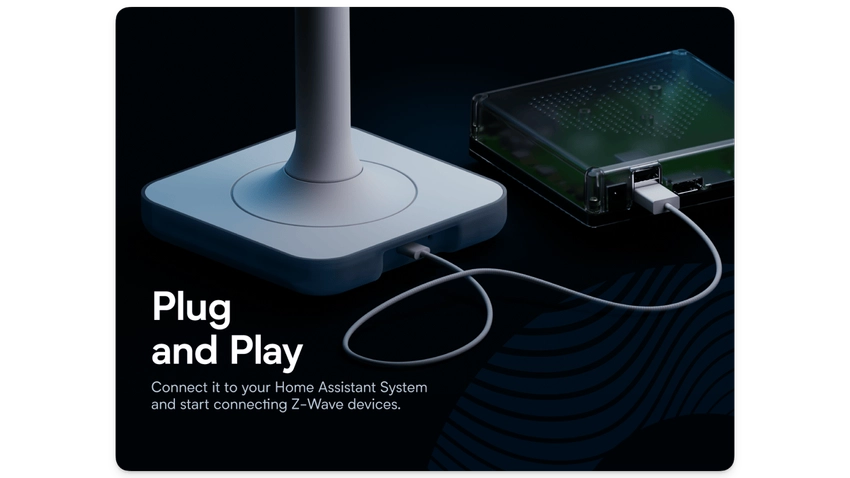
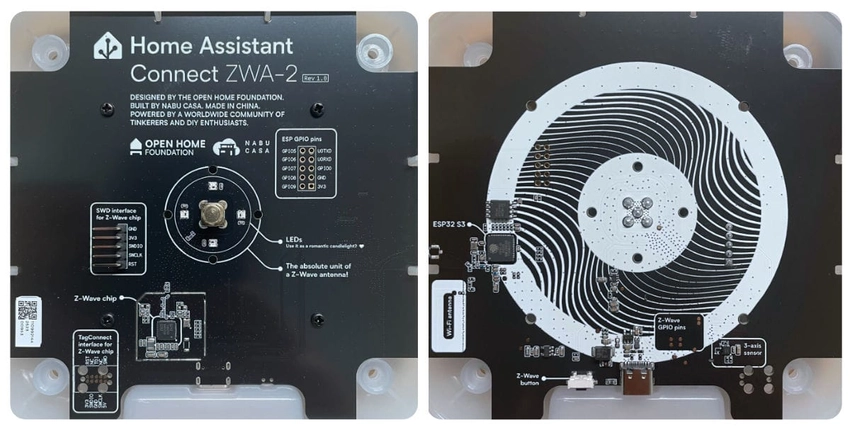
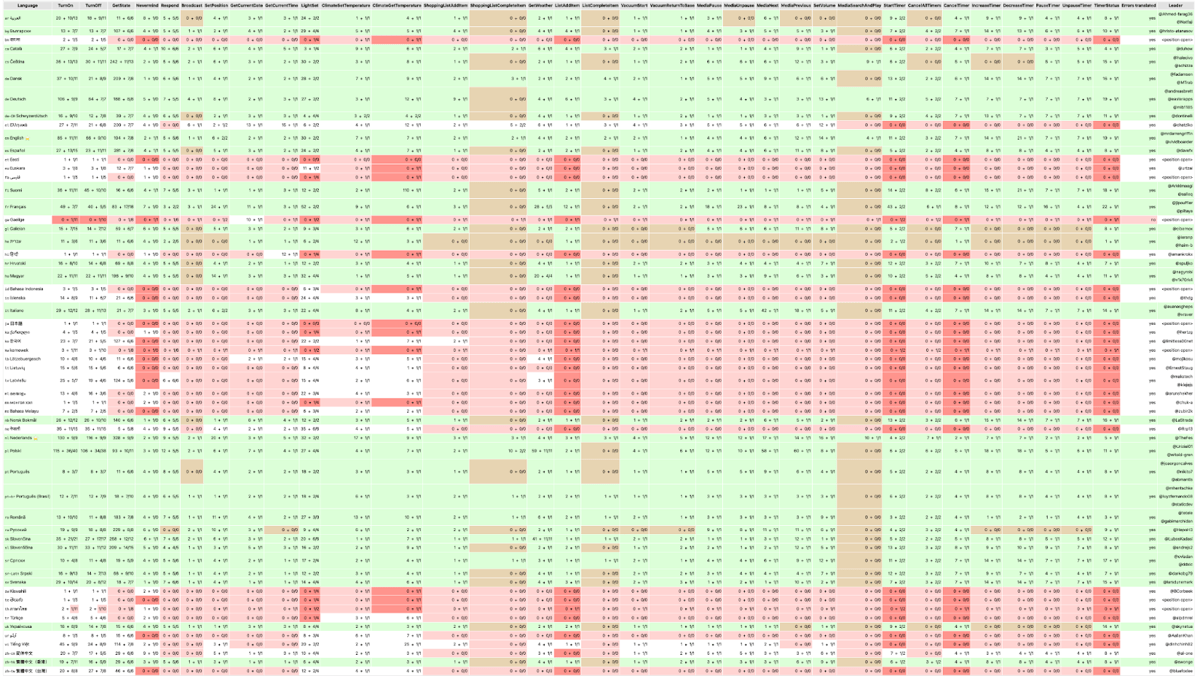
With our community of contributors and working with Nabu Casa on the hardware design, we have successfully launched a few new pieces of hardware. The Home Assistant Voice Preview Edition brought in language experts from every corner of the world to help ensure our language coverage is the most robust in the industry. Thanks to contributors, we support languages like Greek, Icelandic, and more recently Irish Gaeilge! 😎 We had community contributors help make sure the Home Assistant Connect ZWA-2 was prepared for launch last month. Sincerely, we couldn’t be more grateful for your support and efforts in these spaces.

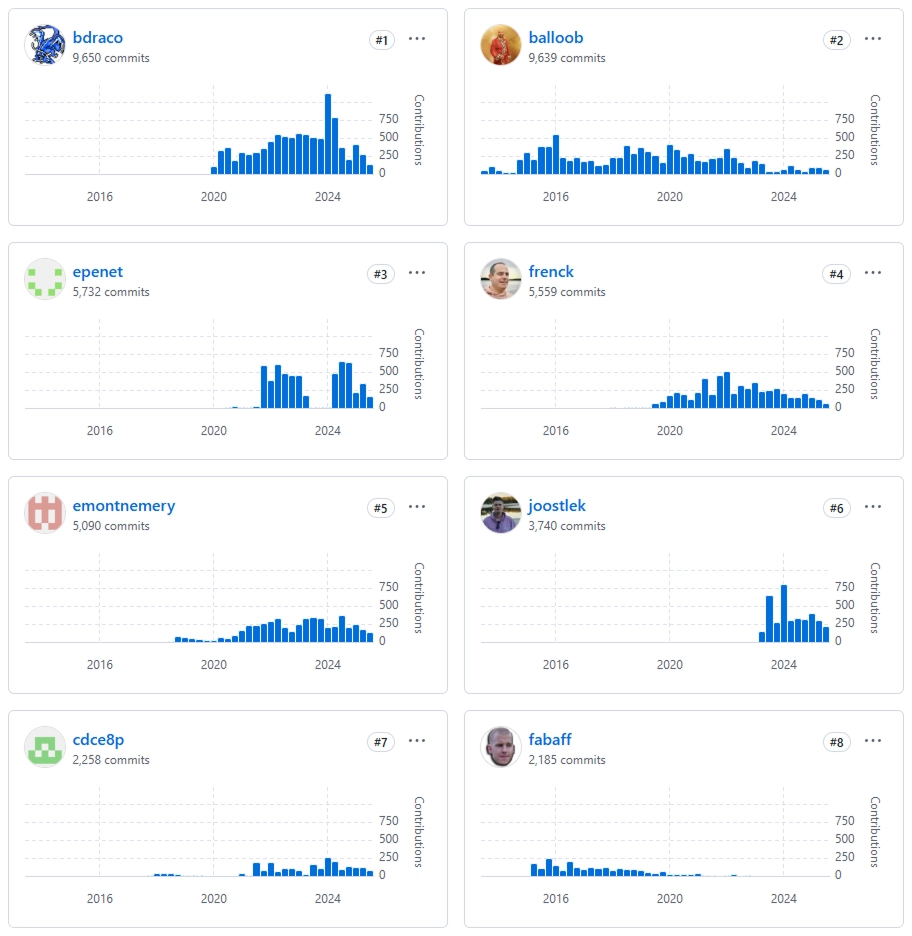
Here are some fun stats from our GitHub contributors (commits on our Core repo):

  • Last 12 months (Sept - Aug) - 14,385
  • Previous 12 months - 14,503

A SPECIAL CONGRATULATIONS to bdraco, who just last week surpassed balloob (the founder of Home Assistant) as the contributor with the most commits!

Top 8 contributors of all time for home-assistant/core The top 8 contributors of all time in home-assistant/core👏🏻

This is just a small peek into all the hard work that goes into maintaining Home Assistant - we have more repositories than just Core, and every single contribution is valued.

Honorable dev mention from the submitted community stories - I couldn’t leave Joostlek’s (joke) submission out. 🤣

  • Our very own Head of Developer Relations (his words), Joost Lekkerkerker, says Home Assistant helps keep him off the street. He’s just launched his new blog that talks about his vision of a smart home, and how he was inspired to not buy Tuya Wi-Fi lights after seeing my experience with some path lights.

Our humble gratitude

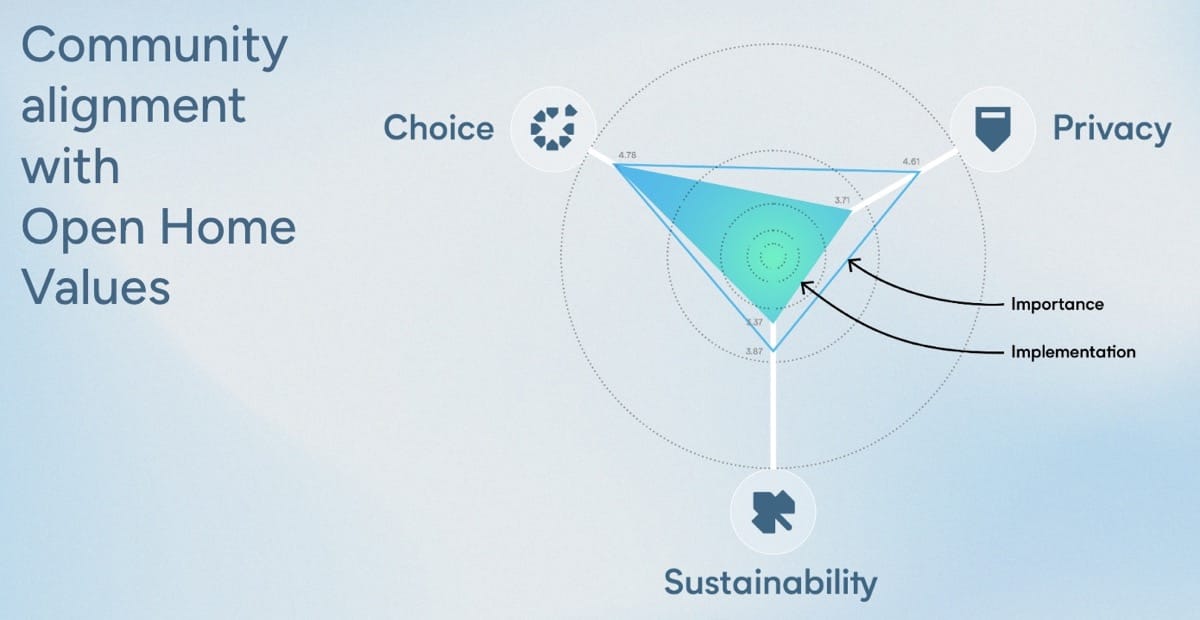
Community is the core of what we do and the heart of Home Assistant. We thrive because you care and contribute your valuable time to support our collective success. Whether you found our platform because you wanted more privacy from big tech, were intrigued by the number of choices implemented into a single app, or needed something to track your sustainability efforts — you support our values every day. Thanks for choosing us, and thank you for all you do to help support the foundation and the projects we maintain.

A very special thanks to all our Home Assistant Cloud subscribers and anyone who has purchased our official Home Assistant hardware. These support the full-time development of Home Assistant (along with ESPHome, Music Assistant, and so much more), and are the easiest way to ensure these projects keep getting cool new features!

We have more things coming down the line for you. In the near future, we plan on announcing a new merch store 👕. In the first half of next year, I’ll announce when Home Assistant Community Day 2026 will be. We’re already working with Nabu Casa on the next exciting hardware announcement (no spoilers…for now). And that’s not even touching the industry events we plan on attending, the State of the Open Home, and so much more. I’m excited to take you all on the journey we’re already working on over the next 12 months, and I’m always looking forward to another year of amazing contributions. 😌

  •  

Building the AI-powered local smart home

Building the AI-powered local smart home

Last year, we laid out our vision for AI in the smart home, which opened up experimentation with AI in Home Assistant. In that update, we made it easier to integrate all sorts of local and cloud AI tools, and provided ways to use them to control and automate your home. A year has passed, a lot has happened in the AI space, and our community has made sure that Home Assistant has stayed at the frontier.

We beat big tech to the punch; we were the first to make AI useful in the home. We did it by giving our community complete control over how and when they use AI, making AI a powerful tool to use in the home. As opposed to something that takes over your home. Our community is taking advantage of AI’s unique abilities (for instance, its image recognition or summarizing skills), while having the ability to exclude it from mission-critical things they’d prefer it not to handle. Best of all, this can all be run locally, without any data leaving your home!

Moreover, if users don’t want AI in their homes, that’s their choice, and they can choose not to enable any of these features. I hope to see big tech take an approach this measured, but judging by their last couple of keynotes, I’m not holding my breath.

Over the past year, we’ve added many new AI features and made them easy to use directly through Home Assistant’s user interface. We have kept up with all the developments in AI land and are using the latest standard to integrate more models and tools than ever before. We’re also continuing to benchmark local and cloud models to give users an idea of what works best. Keep reading to check out everything new, and maybe you can teach your smart home some cool new tricks.

Local AI is making the home very natural to control

Big thanks to our AI community contributor team:
@AllenPorter, @shulyaka, @tronikos, @IvanLH, @Joostlek!

Supercharging voice control with AI

We were doing voice assistants before AI was cool. In 2023, we kicked off our Year of the Voice. Since then, we’ve worked towards our goal of building all the parts needed for a local, open, and private voice assistant. When AI became the rage, we were quick to integrate it.

Today, users can chat with any large language model (LLM) that is integrated into Home Assistant, whether that’s in the cloud or run locally via a service like Ollama. Where Assist, our home-grown (non-AI) voice assistant agent, is focused on a predetermined list of mostly home control commands, AI allows you to ask more open-ended questions. Summarize what’s happening across the smart home sensors you’ve exposed to Assist, or get answers to trivia questions. You can even give your LLM a personality!

Users can also leverage the power of AI to speak the way they speak, as LLMs are much better at understanding the intent behind the words. By default, Assist will handle commands first. Only questions or commands it can’t understand will be sent to the AI you’ve set up. For instance, “Turn on the kitchen light” can be handled by Assist, while “It’s dark in the kitchen, can you help?” could be processed by an AI. This speeds up response times for simple commands and makes for a more sustainable voice assistant.

Another powerful addition from the past year is context sharing between agents. So your Assist agent can share the most recent commands with your chosen AI agent. This shared context lets you say something like “Add milk to my shopping list,” which Assist will act on, and to add more items, just say “Add rice.” The AI agent understands that these commands are connected and can act accordingly.

Here is an excellent walkthrough video of JLo's AI-powered home, showing many of these new features in action

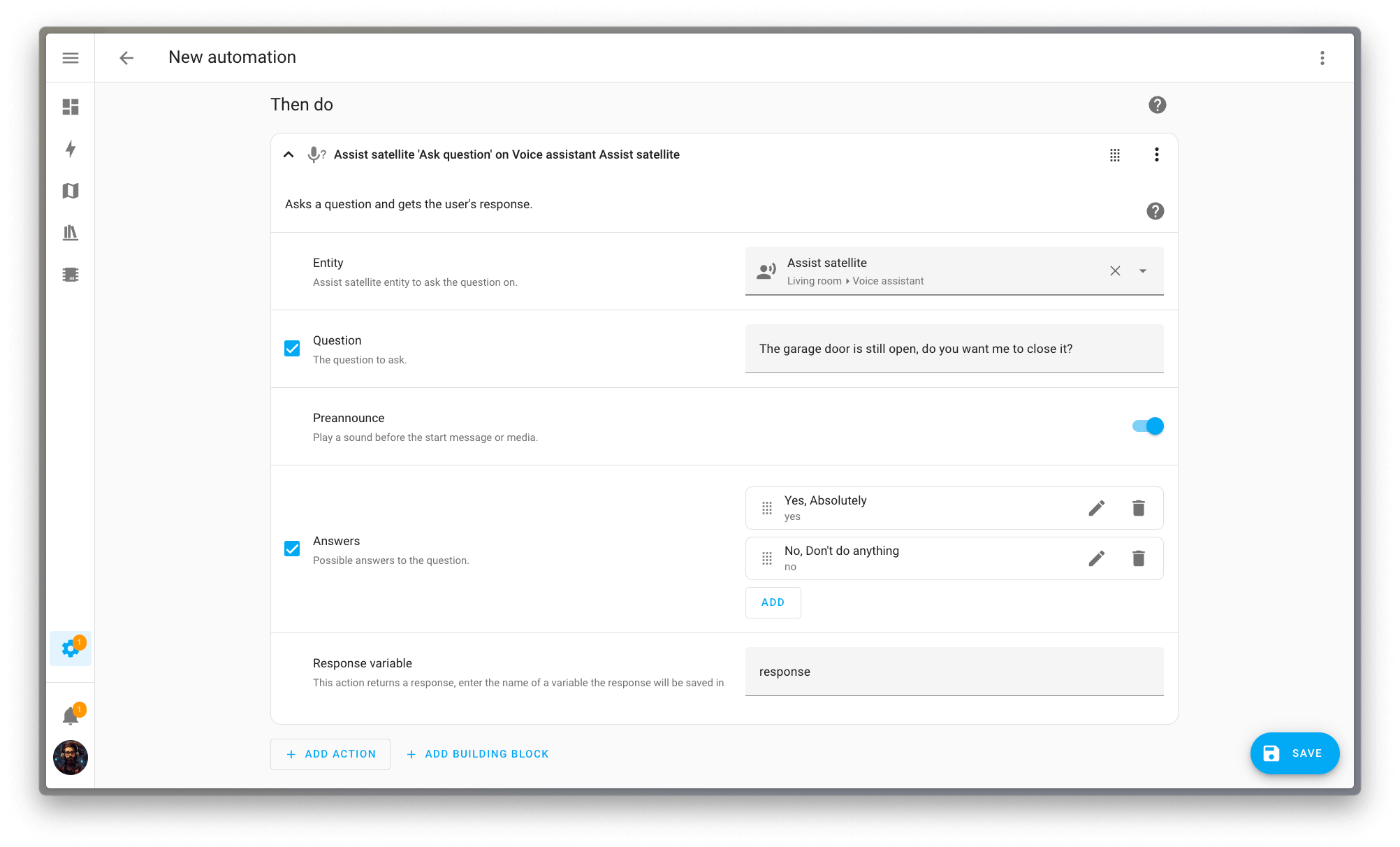
Another helpful addition keeps the conversation going; if the LLM asks you a question, your Assist hardware will listen for your reply. If you say something like “It’s dark”, it might ask whether you’d like to turn on some lights, and you could tell it to proceed. We have taken this even further than other voice assistants, as you can now have Home Assistant initiate conversations. For example, you could set up an automation that detects when the garage door is open and asks if you’d like to close it (though this can also be done without AI with a very clever Blueprint).

AI pushed us to completely revamp our Text-to-Speech (TTS) system to take advantage of streaming responses from LLMs. While local AI models can be slow, we use a simple trick to make the delay almost unnoticeable. Now, both Piper (our local TTS) and Home Assistant Cloud TTS can begin generating audio as soon as the LLM produces the first few words, improving the speed of the spoken response by a factor of ten.

Prompt: “Tell me a long story about a frog”

Setup Time to start speaking
Cloud, non-streaming 6.62 sec
Cloud, streaming 0.51 sec (13x faster)
Piper, non-streaming 5.31 sec
Piper, streaming 0.56 sec (9.5x faster)

Ollama gemma3:4b on an RTX 3090, and Piper on an i5

Great hardware to work with AI

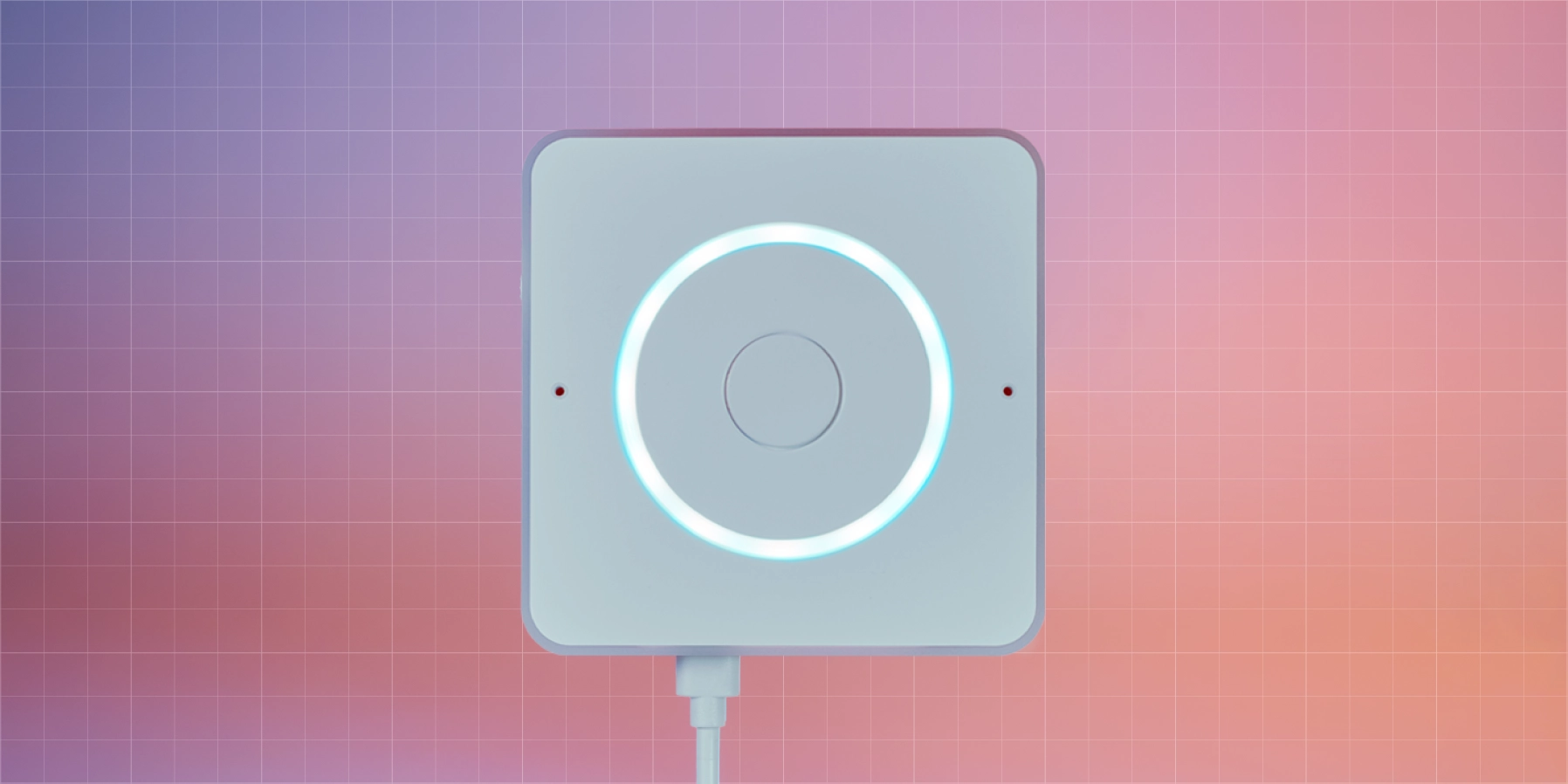
People built some really cool voice hardware, from landline telephones to little talking robots, but the fact that it was so DIY was always a barrier to entry. To make our voice assistant available to everyone, we released the Home Assistant Voice Preview Edition. This is an easy and affordable way to try Home Assistant Voice. It has some seriously powerful audio processing hardware inside its sleek package. If you were on the fence about trying out voice, it really is the best way to get started.

Home Assistant Voice Preview Edition Voice Preview Edition is not only open and powerful, but it looks and feels great too!

It’s now easier than ever to set up your Assist hardware to work with LLMs with our Voice Assistants settings page, and you can even assign a different LLM to each device. The LLM can recognize the room it’s in and the devices within it, making its responses more relevant. Assist was built to be a great way to control devices in your home, but with AI, it becomes so much more.

AI-powered suggestions

Last month, Home Assistant launched a new opt-in feature to leverage the power of AI when automating with Home Assistant. The goal is to shorten the journey from a blank slate to your finished idea.

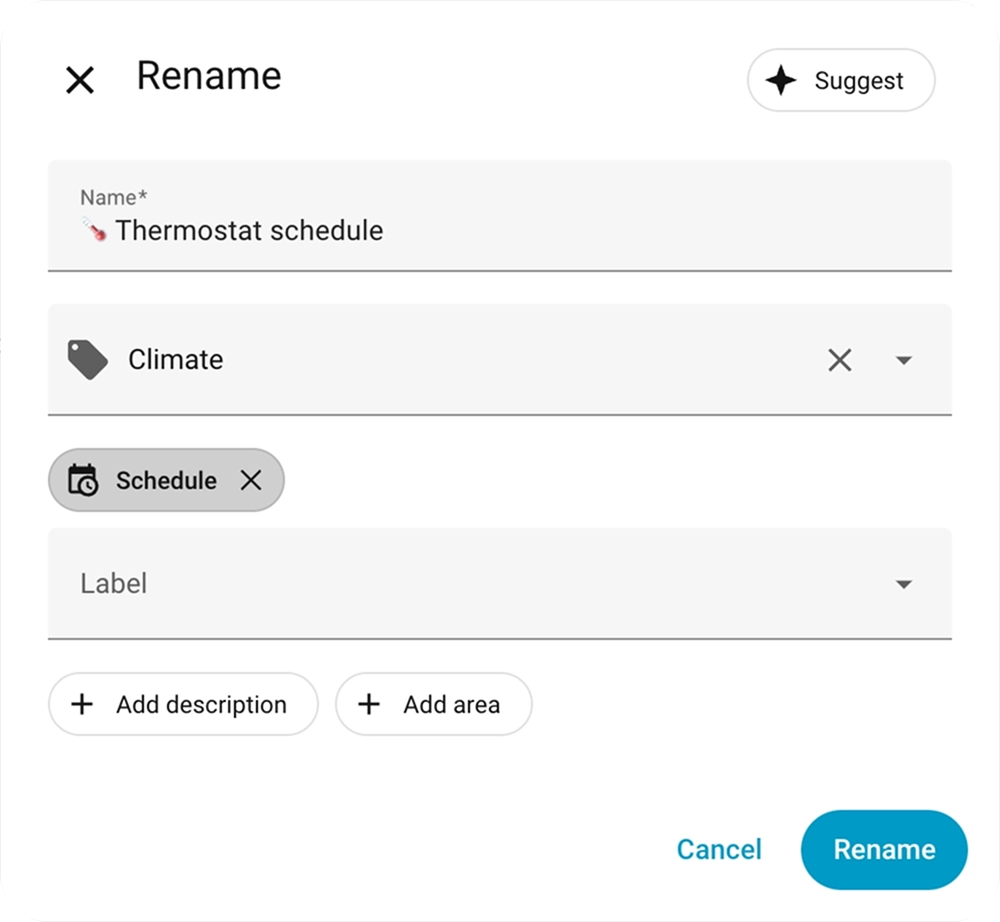
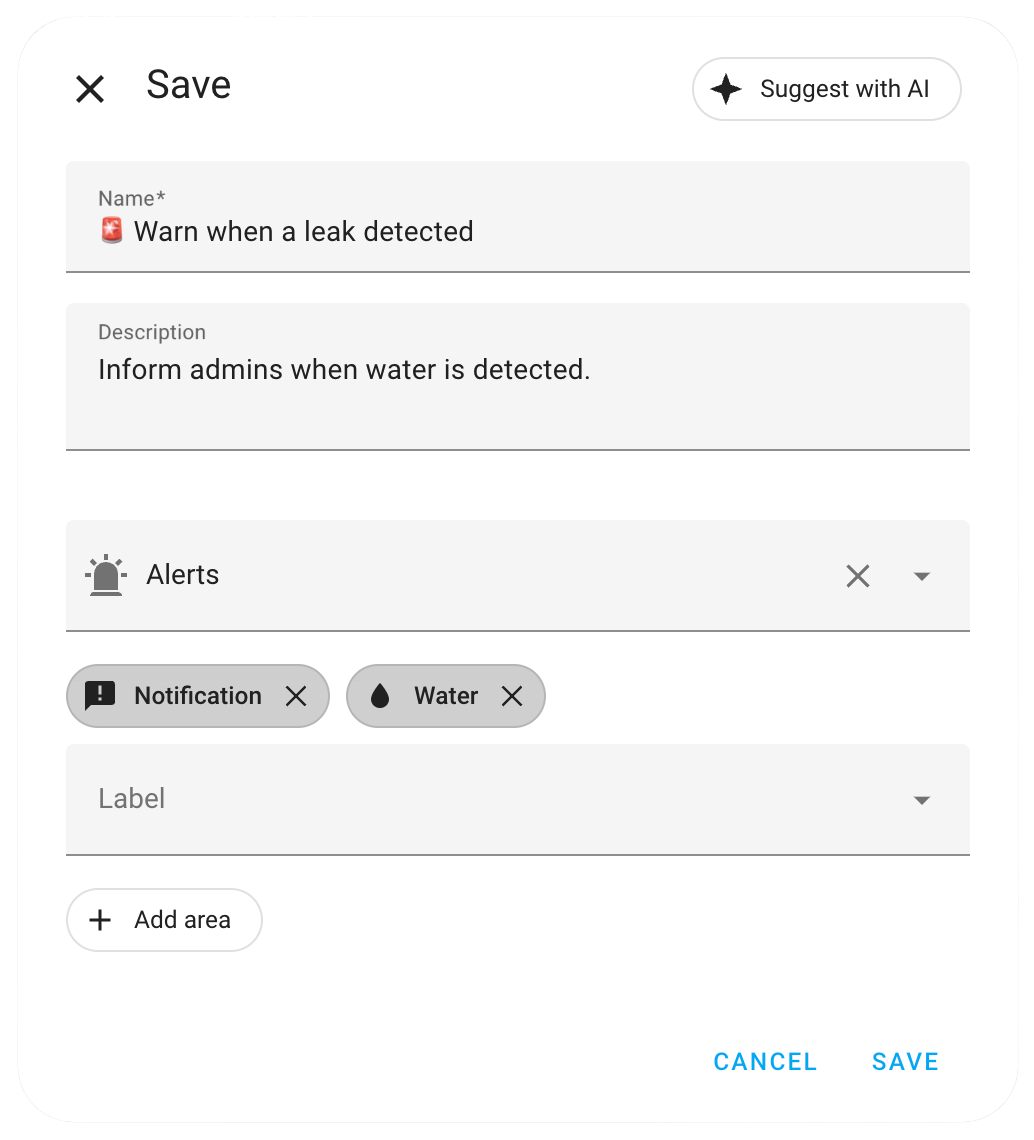
When saving an automation or script, users can now leverage the new Suggest button: When clicked, it will send your automation configuration along with the titles of your existing automations and labels to AI to suggest a name, description, category, and labels for your new automation. Over the coming months, we’re going to explore what other features can benefit from AI suggestions.

A rename modal open with the new Suggest button top right

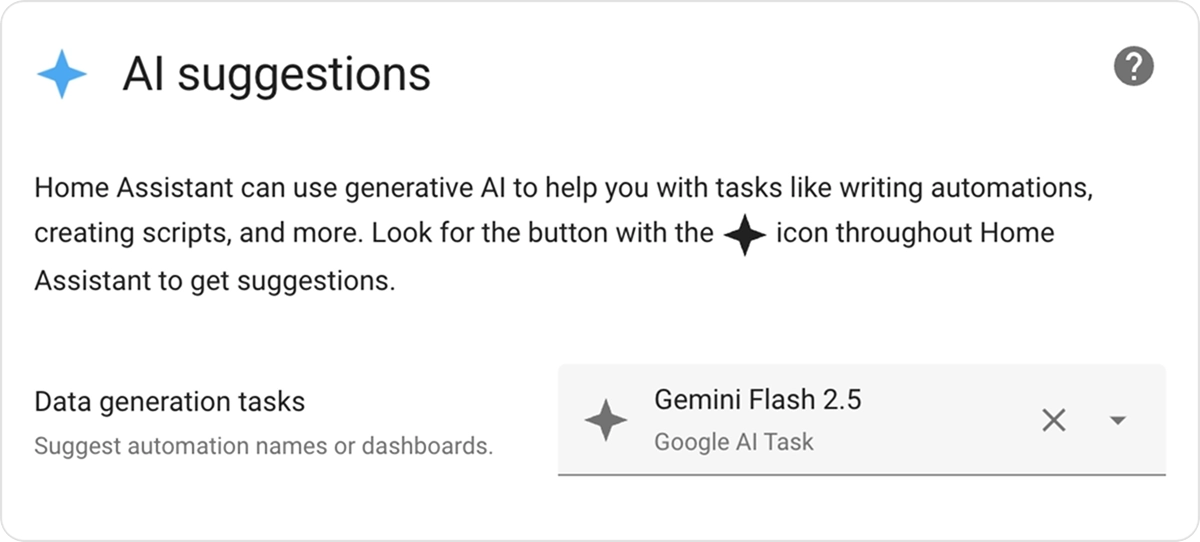
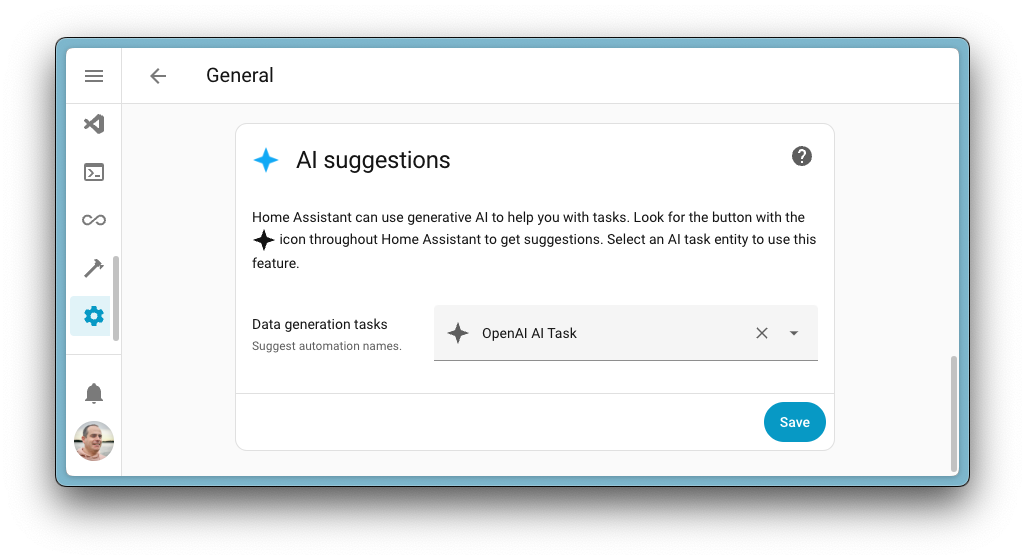
To opt-in to this feature, you need to take two steps. First, you need to configure an integration that provides an AI Tasks entity. For local AI, you can configure Ollama, or you can also leverage cloud-based AI like Google, OpenAI, or Anthropic. Once configured, you need to go to the new AI Task preferences pane under System -> General and pick the AI Task entity to power suggestions in the UI. If you don’t configure an AI Tasks entity, the Suggest button will not be visible.

The AI Suggestions setting within Home Assistant

AI Tasks gets the job done

Enabling AI Tasks does more than quickly label and summarize your automations; its true superpower is making AI easy to use in templates, scripts, and automations. AI Tasks allow other code to leverage AI to generate data, including options to attach files and define how you want that data output (for instance, a JSON schema).

We have all seen those incredible community creations, where a user leverages AI image recognition and analysis to detect available parking spots or count the number of chickens in the chicken coop. It’s likely that AI Tasks can now help you easily do this in Home Assistant, without the need for complex scripts, extra add-ons, or HACS integrations.

Below is a template entity that counts chickens in a video feed, all via a short and simple set of instructions.

template:
 - triggers:
     - trigger: homeassistant
       event: start
     - trigger: time_pattern
       minutes: "/5"
   actions:
     - action: ai_task.generate_data
       data:
         task_name: Count chickens
         instructions: >-
           This is the inside of my coop. How many birds (chickens, geese, and
           ducks) are inside the coop?
         structure:
           birds:
             selector:
               number:
         attachments:
           media_content_id: media-source://camera/camera.chicken_coop
           media_content_type: image/jpeg
       response_variable: result
   sensor:
     - name: "Chickens"
       state: "{{ result.data.birds }}"
       state_class: total

This template sends a snapshot of the camera to the AI, asking it to analyze what is going on. It defines that the output should always be a number, since we want to use that information in Home Assistant. All of this is embedded in a template entity that automatically updates every 5 minutes. An AI Task could also be embedded in an automation, a script, or any other place that can execute actions.

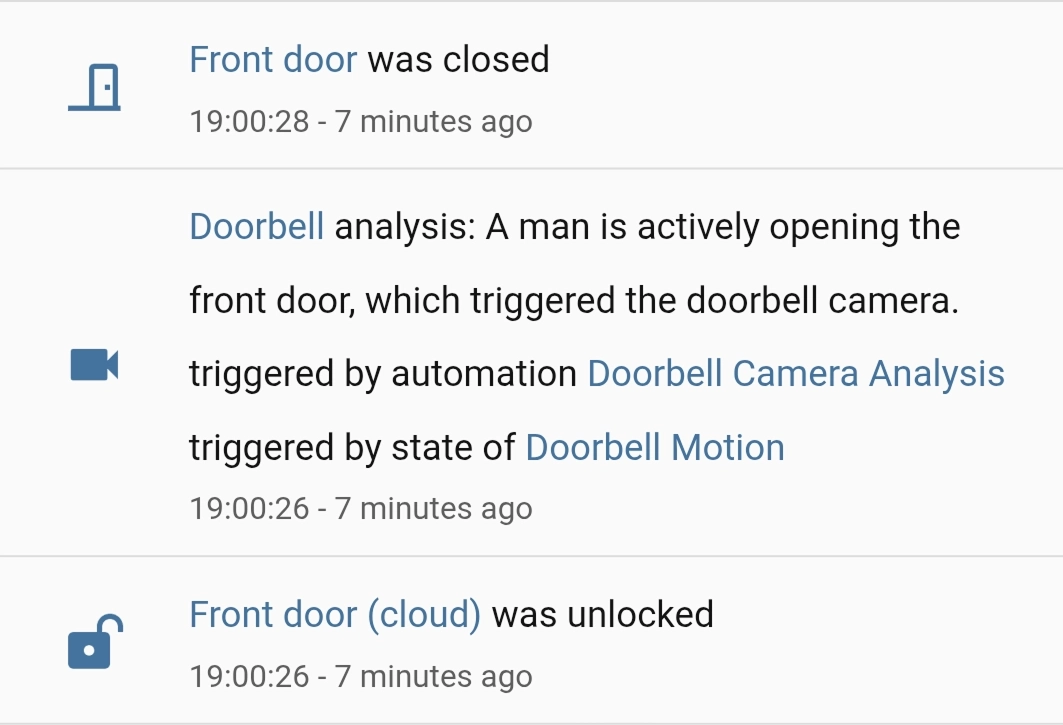
Activity view in Home Assistant of the doorbell image analyzed by AI Tasks An automation triggers an AI Task to identify what caused motion on a camera.

Lastly, users can set a default AI Task entity. This allows users to skip picking an entity ID when creating AI automations. It also lets you migrate everything that uses AI Tasks to the latest model with a single click. This also makes it easy to share blueprints that leverage AI Tasks, like this blueprint that analyzes a camera snapshot when motion is detected:

MCP opens a whole new world

Model Context Protocol (MCP) is a thin layer allowing LLMs to integrate anything. When the specification was announced, we quickly jumped on it and integrated it into Home Assistant. Effectively, these servers give Home Assistant’s Assist conversation agent access to all sorts of new tools. You could connect MCP servers that give Assist access to the latest news stories, your to-do lists, or a server that catalogues your vinyl collection, allowing you to have richer conversations (“Okay Nabu, which Replacements albums do I have, and which aren’t on my Vinyl-to-Purchase list?”).

On the flip side, you can also turn Home Assistant into an MCP server, allowing an AI system to access information about your home. For instance, you could create a local AI that’s great at making Home Assistant automations, and it could include all your entity names or available actions. MCP keeps gaining more support, and there are some great cloud and self-hosted solutions available.

How to pick a model

There are a lot of models available, it’s hard to know where to start. Luckily, Home Assistant’s resident AI guru @AllenPorter is here to help. He has put together an incredibly useful Home LLM Leaderboard. This dataset includes his extensive tests of cloud and local LLM options, and even has tests that give small local LLMs a fighting chance (see assist-mini).

Currently, the charts show the big cloud players’ most recent models ranking pretty close to each other, while recent local models that use 8GB or more of VRAM are nearly keeping up. In the past, there was a big disparity between most models, but now it’s hard to go wrong.

This is especially helpful as the options for LLMs in Home Assistant have just grown exponentially with the addition of OpenRouter, a unified interface for LLMs. With OpenRouter, users can access over 400 new models in Home Assistant, and it supports AI Tasks right from day one. We really are spoiled for choice.

The future is Open, and Open Source

Home Assistant is open. We believe that you should be in control of your data, and your smart home. All of it. Local LLMs and the way we have architected Home Assistant extends this choice to the AI space, all while maintaining your privacy.

Most crucially, we’ve made all of this open source. We are community-driven and work on this together with our community. The Open Home Foundation has no investors and is not beholden to anyone but our users. Our work is funded through hardware purchases and Home Assistant Cloud subscriptions, allowing us to make all the technology we build free and open.

  •  

2025.9: Features for tiles and automations for miles

Home Assistant 2025.9! 🎉

But before we dive into this release: Did you see we launched a new product? 👀

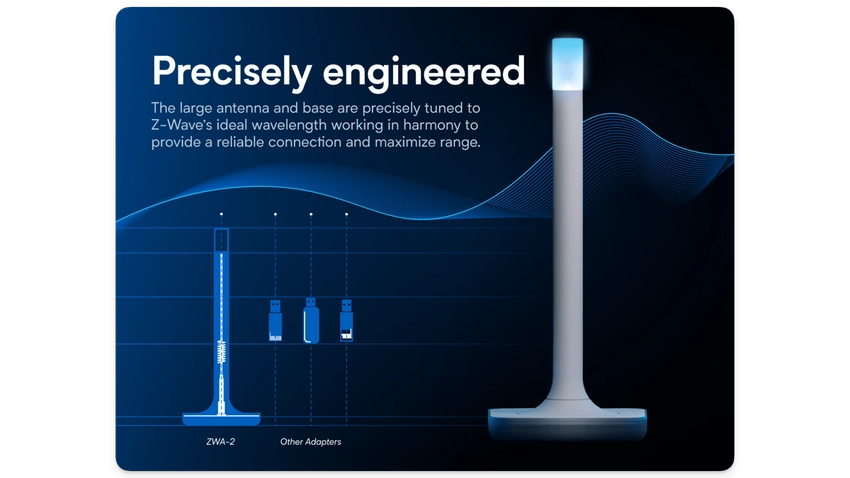
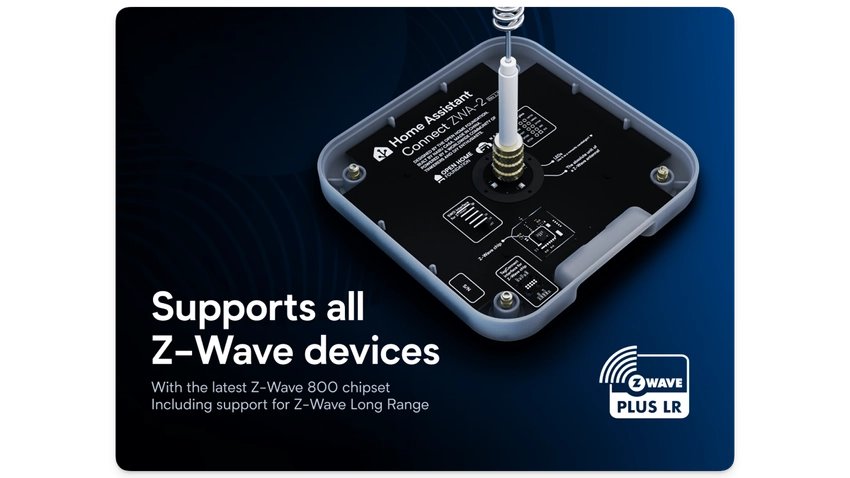
We’ve introduced the Home Assistant Connect ZWA-2, the ultimate way to connect Z-Wave devices to Home Assistant. You can read all about it in our announcement blog 📰 or re-watch the product launch live stream on YouTube 📺.

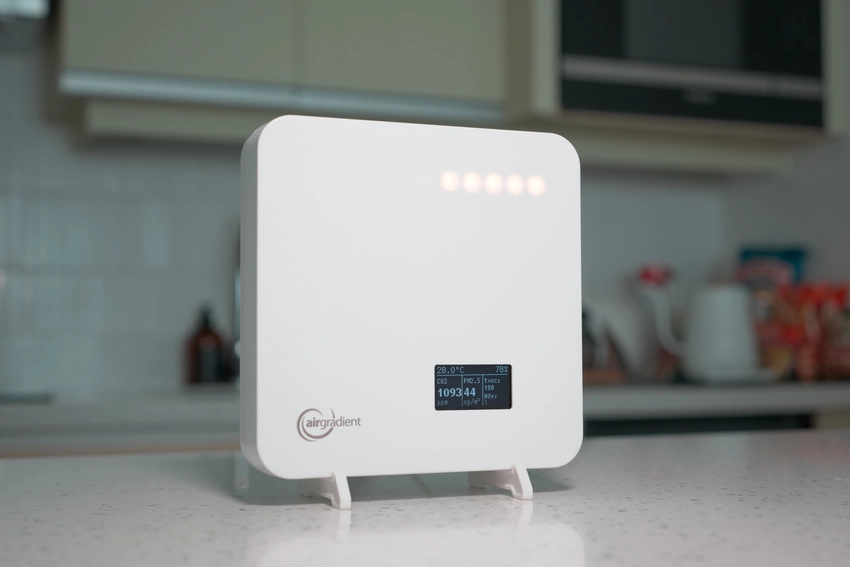
It was a busy month, as we also had two new Works with Home Assistant program partners joining this month as well: AirGradient and Frient! 🎉

While the above was happening this month, as if the project wasn’t already busy enough, we kept on pushing to prepare for this release; and it is an absolute massive one! 🤯

This month introduces a new experimental Home dashboard, which aims to become the new default dashboard for Home Assistant in a future release. A first iteration, of which we love to see your feedback and input on. As you know, we develop and iterate in the open. Give it a shot and let us know what you think!

Talking about dashboards, my personal favorite card is definitely the tile card; it is just so versatile. And this release brings in a staggering amount of new features for it! Most notably, the ability to add a trend graph to the tile card! 📈

I’m the most excited about the visual changes to the automation editor this release brings: a sidebar. It is a huge and very visible change, that just makes so much sense. This release denotes the start of a whole series of improvements to the automation editor in this, and upcoming releases. As automations make a smart home feel magical, I personally can’t wait to see how this evolves. 🤖

Enjoy the release!

../Frenck

Automation editor sidebar

On this year’s Home Assistant roadmap, we have set the goal of making automations easier to create. We have big plans, all based on tons of research, and with this release… we are shipping the first part of all this work, with the intent to gradually add more improvements over multiple releases!

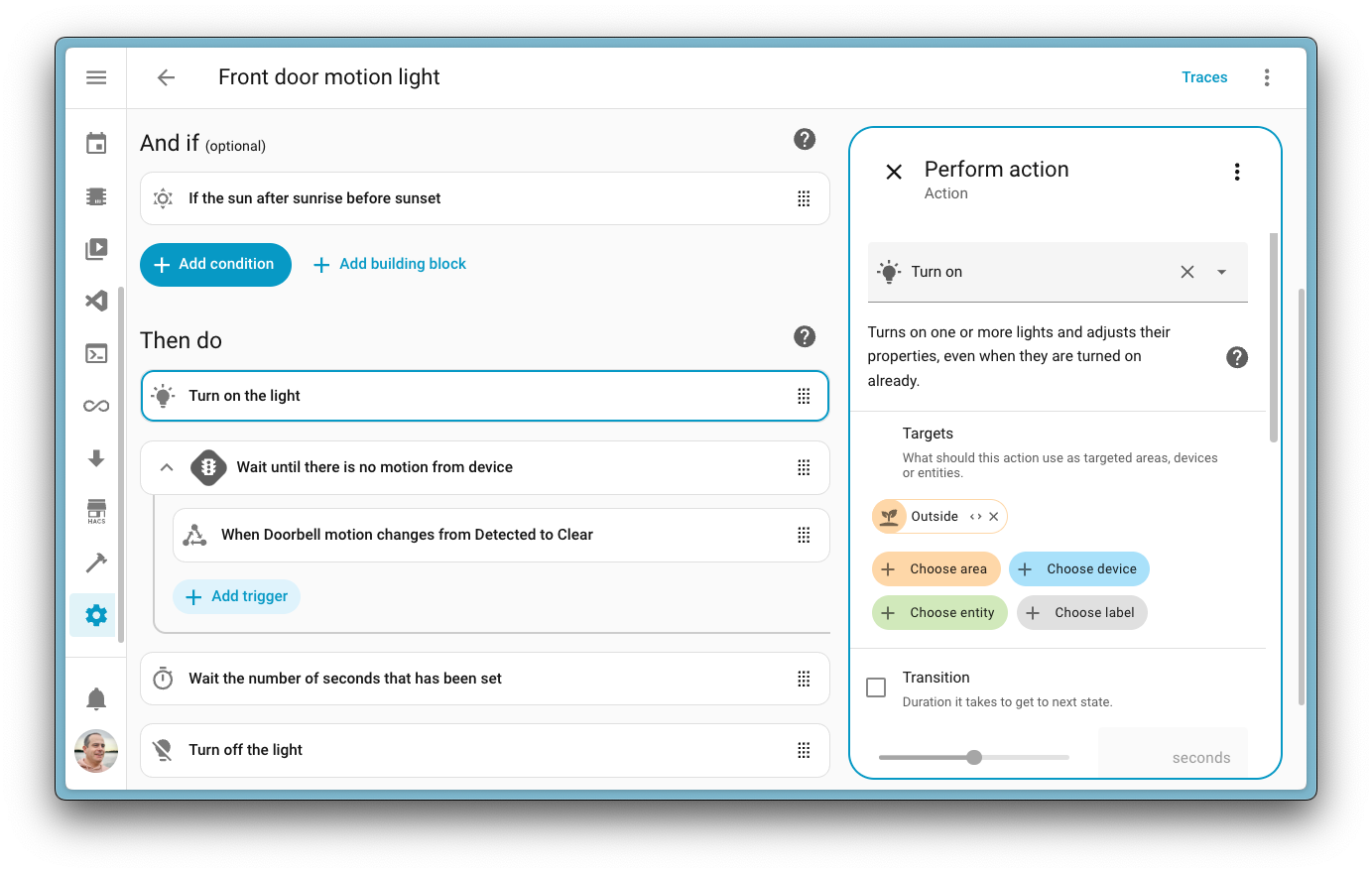
This release tweaks the automation editor user interface experience by introducing a sidebar! If you select an item in your automation, instead of that item expanding, it will open a new sidebar to the right with the settings for that selected item.

Screenshot showcasing a sidebar in our automation editor.

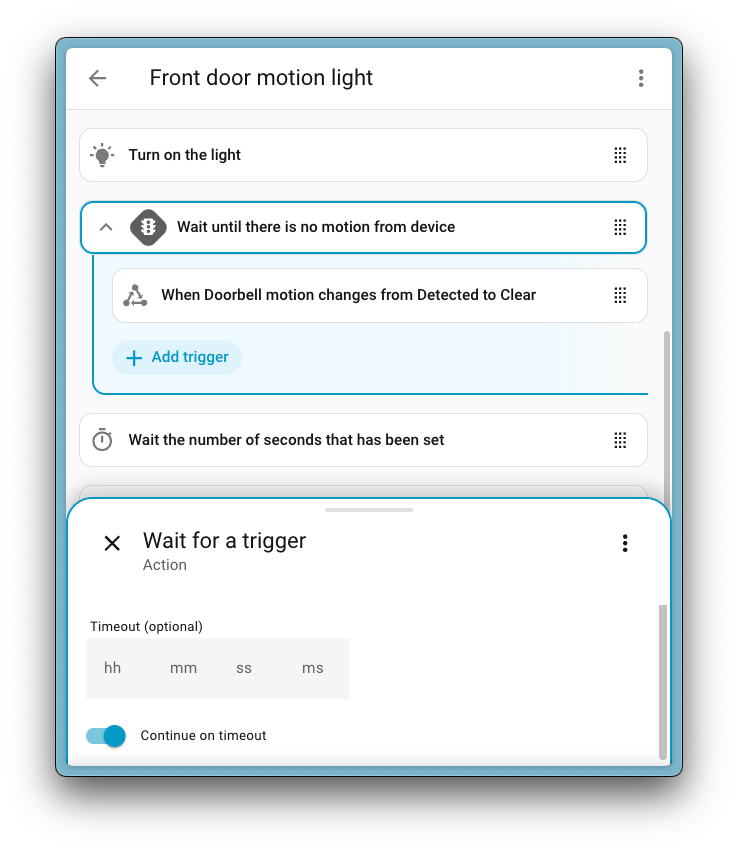
This allows you to keep an overview of your automation on the left side of your screen, while you can tweak its behavior on the right. Of course, we have thought of smaller screens as well. On mobile, instead of the sidebar, a sheet will pop up at the bottom of the screen. This pop-up is also resizable, making it easier than ever to edit an action while reviewing your triggers.

Screenshot showing how on a smaller screen device a sheet is shown from the bottom of the page.

Besides the sidebar, we have made tons of other little improvements as well. Tiny layout and styling changes that you will definitely notice as they really help with the overall readability. For example, small lines and borders around grouped elements have been added, making it easier to distinguish between different parts of your automation. Oh! And drag-and-drop support is now available on mobile! 🎉

Tip

One of Home Assistant’s greatest strengths is our community. We’re building the changes to our automations together, and your input will shape where it goes next. There are two ways to get involved:

Introducing the Home dashboard

Over the past year, we have focused on dashboards and their capabilities a lot. We’ve looked at a lot of your dashboards you’ve shared on socials, and talked to many of you about how you organize all your smart home devices and services. The goal? Making dashboards faster and easier to create, while still making them very customizable.

With this release, we’re introducing a brand-new Home dashboard. The purpose is simple: to give you easy access to the right information at the right time.

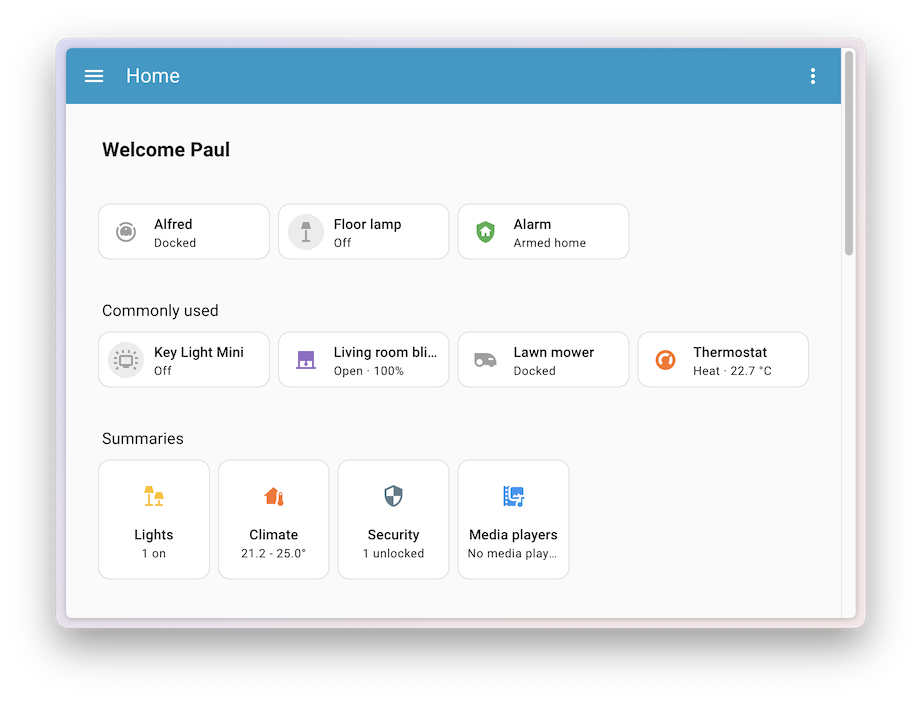
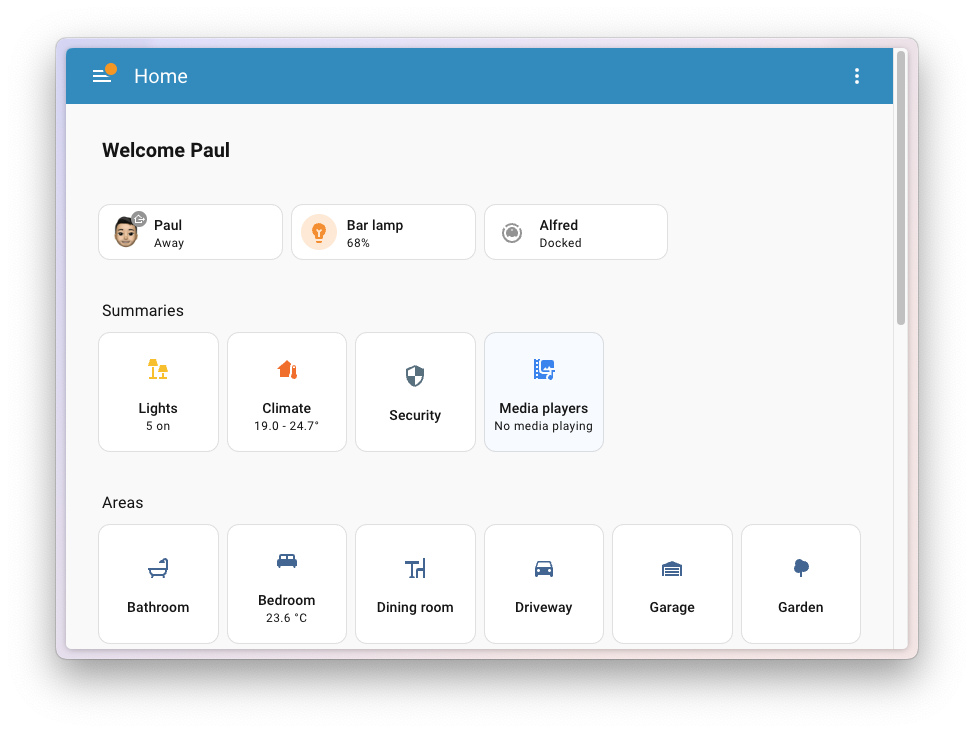
Screenshot of the new Home dashboard

The dashboard adapts to your Home Assistant experience level: powerful enough for advanced users, yet approachable for newcomers. We’re working to have it earn its name, and hope it will eventually become your new Home page. As always, it’s optional; you can always pick your own dashboard. This is the first iteration, and we’ll continue developing it in the open.

When you first open the Home dashboard, it gives you a quick way to navigate to useful summaries for your light, climate, security, and media devices. You can also browse by areas, getting an overview of all the devices and services associated with that part of your home.

We’re also introducing Favorites. You can pin any entity to the top, whether it’s a light, climate, or a person. We’d love to see what you choose (more on this in the future).

The Home dashboard is not just about quick control. It also brings insights and information about your home. This first release includes weather and energy cards. It’s a simple start, and we have a lot of ideas to explore with you. For example, helping you create your first automation, or show discovered devices.

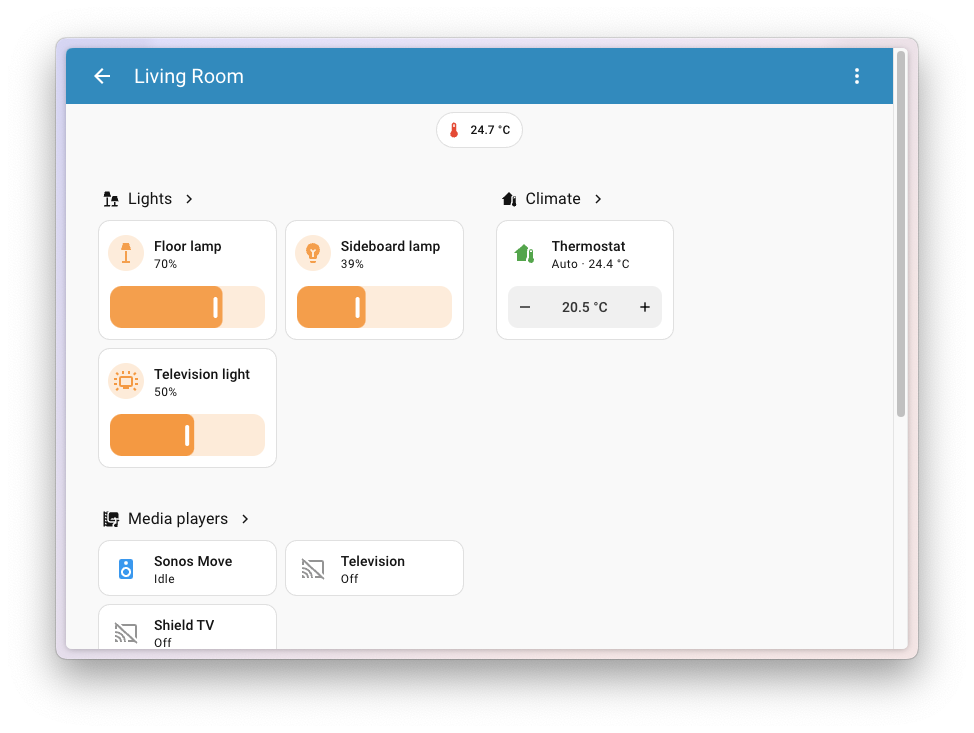
Screenshot of the new Home dashboard viewing the living room area

For now, the Home dashboard is considered experimental. Configuration options are limited, and it’s guaranteed to evolve. It won’t appear automatically, and if you want to try it you’ll need to add it manually in the dashboard settings, by adding a new “Home” dashboard.

Tip

One of Home Assistant’s greatest strengths is our community. We’re building this dashboard together, and your input will shape where it goes next. There are two ways to get involved:

New tile card features

The tile card is the most versatile card we have in our arsenal of cards for our dashboards.

One superpower of the tile card is its “features”, which are small additions where you can add quick interactions to these cards. For example, a slider to control the brightness of a light or buttons for the speed presets of a fan. Features have been extended quite a bit in this release by a dedicated group of community members.

Trend chart

This release, an absolute banger is the addition of the trend chart features for tile cards created by @MindFreeze.

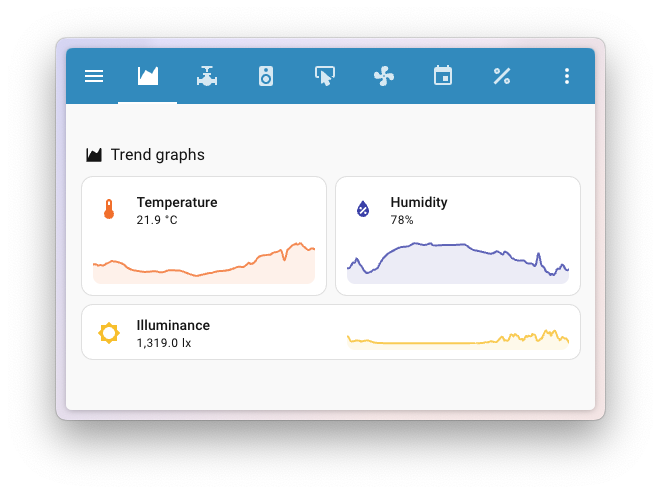
This feature adds a handy quick graph to the tile card, showing the history of a specific entity over time. For this initial version, the time window shown is 24 hours.

Screenshot showing a tile card using the new trend graph feature

Media player controls

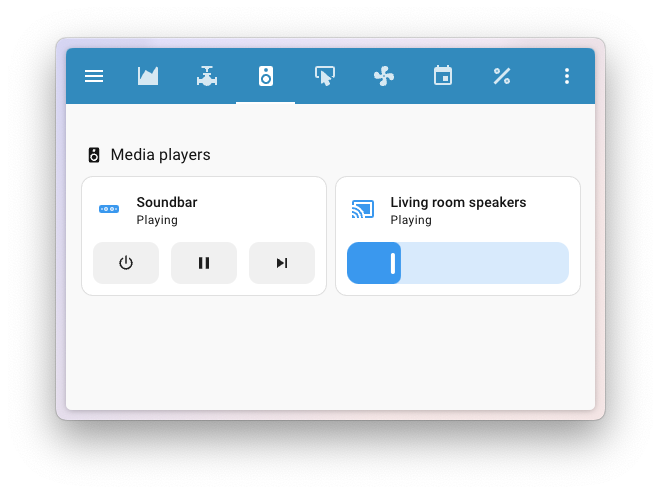
@timmo001, added tile card features for media player controls and volume! This makes the tile card now a viable alternative to the media player card. Awesome!

Screenshot showing a tile card using the new media player features

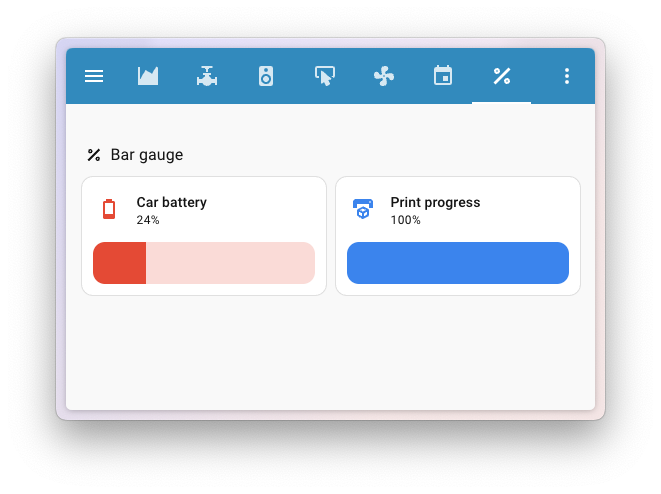
Bar gauge

A new tile card feature, made by @MindFreeze: The bar gauge!

For this initial version, it works with sensors that use a percentage (%) for their unit of measurement. This makes the card great, for example, for a battery overview dashboard. Nice work!

Screenshot showing a tile card using the new bar gauge feature

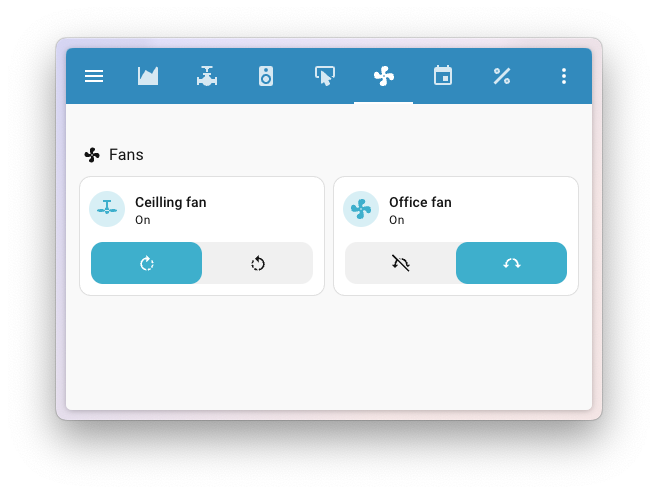
Fan direction and oscillation controls

Thanks to @pcan08 we now have a tile card feature to control fan direction and oscillation!

Screenshot showing a tile card using the new fan direction and oscillation features

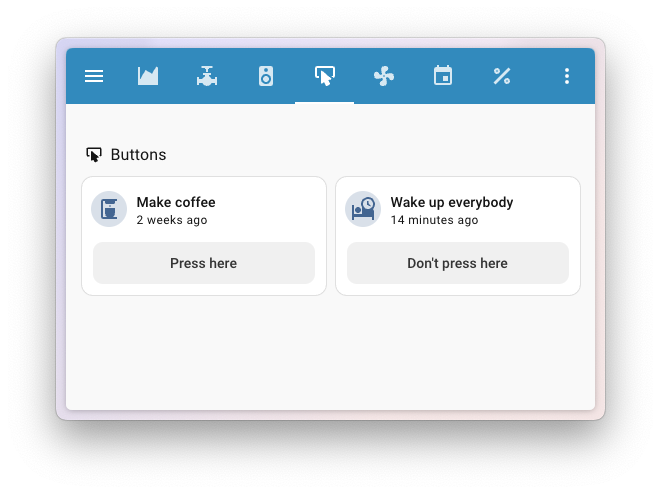
Buttons

Thanks to @dhoeben we now have a tile card feature for buttons! He added these buttons for automation, script, and button entities. The text can be changed to display standard button text or custom text.

Screenshot showing a tile card using the new button feature

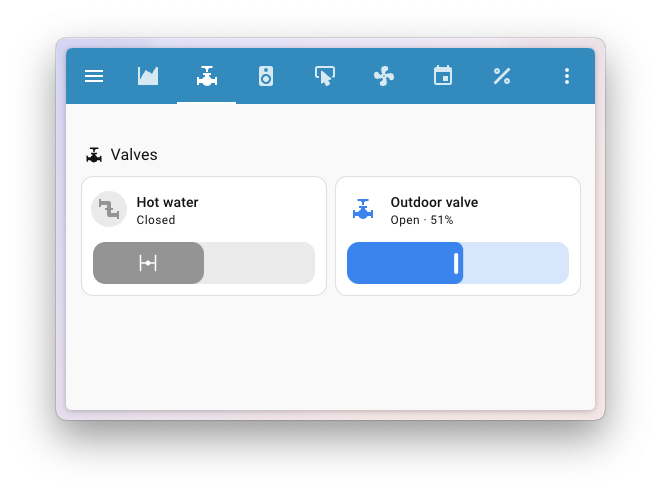
Valve open/close and position controls

Thanks to @timmo001 we now have a tile card feature to control the open/close and the position of valves.

Screenshot showing a tile card using the new open/close and valve position features

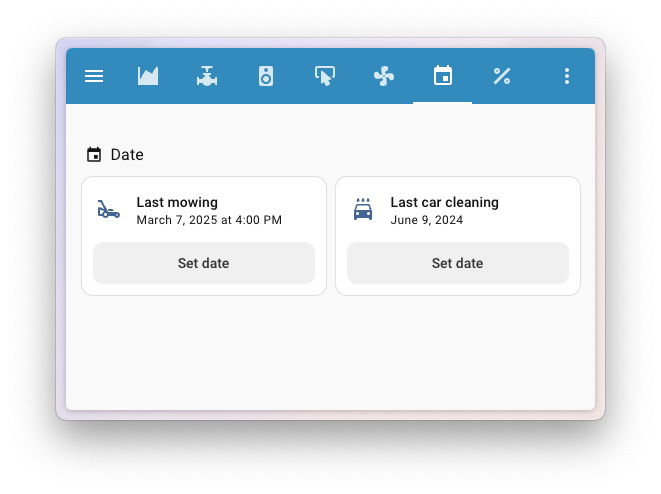
Setting the date

@timmo001 continued and also added a new tile card feature to support date and datetime entities (including the input datetime helpers). It allows you to add a feature that allows for setting a date.

Screenshot showing a tile card using the new date feature

Integrations

Thanks to our community for keeping pace with the new integrationsIntegrations connect and integrate Home Assistant with your devices, services, and more. [Learn more] and improvements to existing ones! You’re all awesome 🥰

New integrations

We welcome the following new integrations in this release:

Noteworthy improvements to existing integrations

It is not just new integrationsIntegrations connect and integrate Home Assistant with your devices, services, and more. [Learn more] that have been added; existing integrations are also being constantly improved. Here are some of the noteworthy changes to existing integrations:

  • Husqvarna Automower got some nice additions from @Thomas55555! You can now reset cutting blade usage time and track error events with a new event entity. Perfect for keeping track of your lawn mowing robot!
  • The Reolink integration now includes speak and doorbell volume controls, plus a chime silent time number entity! Nice @starkillerOG!
  • You can now send notifications with the PlayStation Network integration! Send direct messages to your friends! Thanks, @tr4nt0r!
  • Network admins will love @Tomeroeni bringing individual (enable/disable) switch port control to UniFi switches!
  • The OpenWeatherMap integration now includes a wind gust sensor, thanks to @gjohansson-ST!
  • @kizovinh added support for battery status and online status sensors to the EZVIZ integration, making it easier to monitor your EZVIZ cameras. Nice!
  • If you own a Russound RIO device, you can now browse your device’s saved presets directly from the media browser! Thanks, @noahhusby!
  • @mbo18 added an absolute humidity sensor to the Awair integration. Nice!
  • The Teslemetry integration added charging and preconditioning actions for your Tesla vehicle. Thanks, @Bre77!
  • @catsmanac added IQ Meter Collar and C6 Combiner support to the Enphase Envoy integration. Good work!

Integration quality scale achievements

One thing we are incredibly proud of in Home Assistant is our integration quality scale. This scale helps us and our contributors to ensure integrations are of high quality, maintainable, and provide the best possible user experience.

This release, we celebrate several integrationsIntegrations connect and integrate Home Assistant with your devices, services, and more. [Learn more] that have improved their quality scale:

This is a huge achievement for these integrations and their maintainers. The effort and dedication required to reach these quality levels is significant, as it involves extensive testing, documentation, error handling, and often complete rewrites of parts of the integration.

A big thank you to all the contributors involved! 👏

Now available to set up from the UI

While most integrationsIntegrations connect and integrate Home Assistant with your devices, services, and more. [Learn more] can be set up directly from the Home Assistant user interface, some were only available using YAML configuration. We keep moving more integrations to the UI, making them more accessible for everyone to set up and use.

The following integration is now available via the Home Assistant UI:

Farewell to the following

The following integrationIntegrations connect and integrate Home Assistant with your devices, services, and more. [Learn more] is no longer available as of this release:

  • Uonet+ Vulcan has been removed. Vulcan has changed their API and their policies forbid using the API from unofficial software.

Other noteworthy changes

There are many more improvements in this release; here are some of the other noteworthy changes:

  • Based on feature requests from the community, all modern template entity syntax now supports setting a default entity ID directly in YAML. Thanks @Petro31 for implementing that!
  • @Petro31 also added support for two new entity types to the template integration. You can now create your own templated event entities and update entities. Awesome!
  • Home Assistant now supports m³/min as a volume flow rate unit. Nice addition @fetzerch!
  • Our voice guy @synesthesiam has been busy with some great QoL improvements this release as well.
    • The intent handling for the default agent (non-LLM) now supports fuzzy matching. The technique ensures voice pipelines recognize many more sentences. This improvement is available for English only, while we are looking for ways to extend this to other languages.
    • We now have built-in intents to control the volume of (active) media players! Like the song? Just ask Home Assistant to turn it up a notch!
    • After all that dancing, you might have gotten a little warm. Hence in this release, we now also have intents to control fan speeds. Nice!

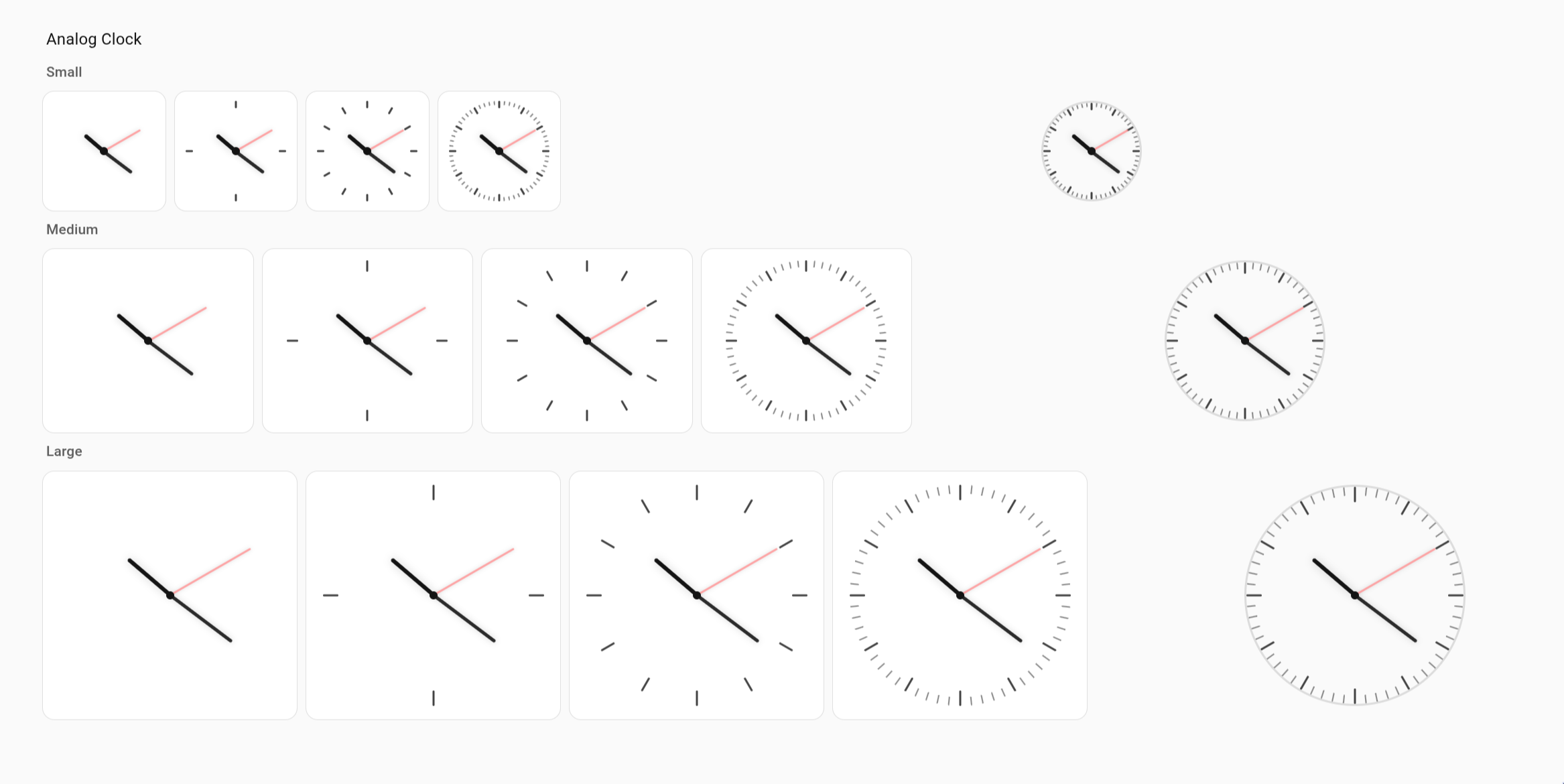
Analog clock

In Home Assistant 2025.4, we introduced the clock card, which provides a digital clock display for your dashboards.

For this release, @timmo001 made this card more feature-rich by adding support for displaying the clock in a customizable analog clock style. Nice!

Screenshot showing multiple analog clocks in different sizes and styles

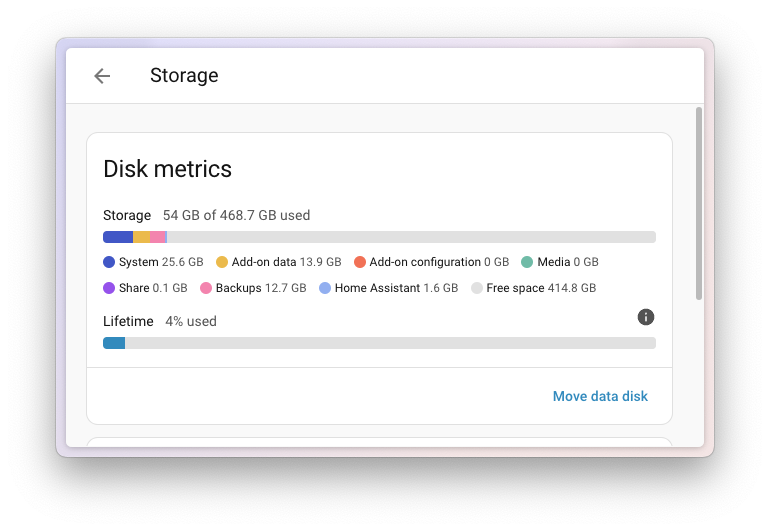
Storage insights

Disk almost full? You might wonder where your storage space has gone…

This release adds disk metrics to the storage configuration panel, letting you see usage at a glance, helping you identify what is taking up space.

Screenshot of the new disk metrics as shown in the storage configuration panel.

You can find these metrics by navigating to Settings > System > Storage, or by selecting the My Home Assistant button down below.

Patch releases

We will also release patch releases for Home Assistant 2025.9 in September. These patch releases only contain bug fixes. Our goal is to release a patch release once a week, aiming for Friday.

2025.9.1 - September 5

2025.9.2 - September 12

2025.9.3 - September 13

2025.9.4 - September 19

Need help? Join the community!

Home Assistant has a great community of users who are all more than willing to help each other out. So, join us!

Our very active Discord chat server is an excellent place to be, and don’t forget to join our amazing forums.

Found a bug or issue? Please report it in our issue tracker to get it fixed! Or check our help page for guidance on more places you can go.

Are you more into email? Sign up for the Open Home Foundation Newsletter to get the latest news about features, things happening in our community, and other projects that support the Open Home straight into your inbox.

Backward-incompatible changes

We do our best to avoid making changes to existing functionality that might unexpectedly impact your Home Assistant installation. Unfortunately, sometimes, it is inevitable.

We always make sure to document these changes to make the transition as easy as possible for you. This release has the following backward-incompatible changes:

Encoding units containing the μ character

The encoding for some units that contain the μ character has been changed. Users that consume state data from sensors that have changed units will be impacted (such as exported state data to InfluxDB). The units with a changed encoding are:

  • μSv/h for the aranet integration as a unit for radiation rate
  • μS/cm for UnitOfConductivity.MICROSIEMENS_PER_CM
  • μV for UnitOfElectricPotential.MICROVOLT
  • μg/ft³ for concentration in micrograms per cubic foot
  • μg/m³ for concentration in micrograms per cubic meter
  • μmol/s⋅m² for the fyta integration as a unit for light
  • μg for UnitOfMass.MICROGRAMS
  • μs for UnitOfTime.MICROSECONDS

(@jbouwh - #144853)

1-Wire

The raw_value attribute was previously deprecated and has now been removed.

(@gjohansson-ST - #150112) (documentation)

Alexa Devices

The sound list has been updated to match the one used by the Alexa Mobile app. The variant parameter is no longer required.

Check your automations to ensure the selected sound is still present.

(@chemelli74 - #151317) (documentation)

Husqvarna Automower BLE

The integration now requires the Automower PIN when being set up. This ensures Home Assistant can communicate with more models of mowers and with higher security levels.

(@alistair23 - #135440) (documentation)

KNX

KNX scene entities now also change their state when a scene was activated externally (from bus). Previously they only updated when activated from within Home Assistant.

(@farmio - #151218) (documentation)

SIA Alarm Systems

SIA alarm status code CF (armed with malfunctions) is now mapped to armed_away instead of to armed_custom_bypass.

(@etnoy - #132628) (documentation)

SwitchBot Bluetooth

The battery property on vacuum entities is being removed in Home Assistant. Therefore, this property is now removed from this integration and is replaced by a battery level sensor.

Please review your automations, scripts, and dashboards using the battery property and update the code to use the battery sensor instead.

(@MartinHjelmare - #150227) (documentation)

Yale August

The August integration now uses OAuth authentication with Yale August’s official API. This is a required one-time breaking change as the unofficial authentication method will stop working soon. This migration helps reduce unnecessary load on Yale August’s servers while ensuring continued access for all users.

When you update Home Assistant, you’ll be prompted to re-authenticate your August account:

  1. Select the notification or go to SettingsDevices & servicesAugust
  2. Select “Reconfigure” and follow the OAuth flow to sign in
  3. Once authenticated, your devices will work exactly as before

We’re grateful to Yale August for officially supporting Home Assistant with dedicated API access!

(@bdraco - #151080) (documentation)

If you are a custom integration developer and want to learn about changes and new features available for your integration: Be sure to follow our developer blog. The following changes are the most notable for this release:

All changes

Of course, there is a lot more in this release. You can find a list of all changes made here: Full changelog for Home Assistant Core 2025.9

  •  

Frient joins Works with Home Assistant

Frient joins Works with Home Assistant

We’re making new frients this week, and they’re bringing an extensive line of Zigbee devices to our Works With Home Assistant program. Each device is tested by our team, ensuring they provide the best experience possible for Home Assistant. Frient is widely available across Europe, and are well-known for their sleek, unobtrusive designs that its customers love for their high Home Approval Factor.

Our newest frient

Based in Denmark, the frient brand was developed by Onics, (formerly Develco Products), and they have years of experience with Zigbee devices. Frient is bringing its proven technology to the Works With Home Assistant program, as well as their Danish design that easily blends into almost any home.

Recent Works With partners have brought Z-Wave, Matter, and even Bluetooth devices to Home Assistant, but it’s been a couple of years 😅 since Zigbee-specific devices have joined the program. Zigbee is one of the most popular open protocols that is used with Home Assistant, with hundreds of thousands of users making use of it today. It’s a proven technology that connects directly to Home Assistant, no cloud or Wi-Fi connection required. Zigbee is a mesh protocol, where some devices act as repeaters, strengthening the network as more are added. It was built from the ground up to power the smart home, and has been optimized to give devices really long (sometimes multi-year) battery life.

"Joining the Works With Home Assistant program is a proud milestone for frient. It reflects our strong commitment to open, user-centric smart home experiences and ensures that our products seamlessly integrate with one of the most trusted platforms in the market. For Home Assistant users, it means more choice and flexibility — and for frient, it strengthens our position as a key player in the connected smart home space."

- Martin Langballe, International Business Development Manager at frient

All you need to get started with Zigbee in Home Assistant is a Zigbee adapter or ‘stick’, such as the Home Assistant Connect ZBT-1 (wow, we released this in 2022, I wonder when we’re finally going to build a successor? 😉). By plugging the adapter into a USB port on your Home Assistant system, it should then discover the device and add the ZHA integration. After that is set up, you can start adding devices to your Zigbee network.  We’ve even added in a cool new visualization so that you can see how your Zigbee devices interact with each other.

ZHA is built with the support of the Open Home Foundation, and it even has a full-time developer (@puddly) dedicated to improving it and helping certify new Works With partner devices. Your support makes this possible, whether through a Home Assistant Cloud subscription or by purchasing official hardware.

Devices

A frient device attached to a energy meter When your energy company won’t provide your raw usage data, there’s always another way 😉

In case you didn’t know, Works With Home Assistant differs from other certification programs as products are rigorously tested in-house to ensure they work seamlessly out of the box with Home Assistant. Any company joining also commits to providing long-term support and firmware updates while being a positive force in the Home Assistant community. Works With Home Assistant is operated by the Open Home Foundation, and the support of Home Assistant Cloud subscribers funds this work.

Our team has worked extensively with frient to ensure that the following items work seamlessly with Home Assistant.

This is a big portion of frient’s product line, and provides energy monitoring, device control, safety, and security sensors. The frient IO Module is the first certified Zigbee module that can be used to turn low-voltage dumb devices like electric blinds or garage doors into devices that can be controlled by Home Assistant.

There are some great devices here for building a more sustainable smart home. The Electricity Meter Interface 2 LED allows you to get the data off your energy meter and record it into Home Assistant. Another win for sustainability is their use of AA and AAA batteries wherever practical, meaning you can use rechargeables instead of constantly buying and recycling coin cells.

I also selfishly love to see some great UK-specific devices being brought into the program with the frient Smart Siren having both UK and EU versions.

Best frients forever

It’s great to see Zigbee get some high-quality certified Works With Home Assistant devices after a multi-year wait. Frient has put a good deal of work into this launch and are big fans of our work and the community. There are more exciting Zigbee developments to come, so stay tuned!

FAQs

Q: If I have a device that is not listed under “Works With Home Assistant” does this mean it’s not supported?

A: No! It just means that it hasn’t gone through a testing schedule with our team or doesn’t fit the requirements of the program. It might function perfectly well but be added to the testing schedule later down the road, or it might work under a different connectivity type that we don’t currently test under the program.

Q: Ok, so what’s the point of the Works With program?

A: It highlights the devices we know work well with Home Assistant and the brands that make a long-term commitment to keeping support for these devices going. The certification agreement specifies that the devices must have full functionality within Home Assistant, operate locally without the need for cloud, and will continue to do so long-term.

Q: How were these devices tested?

A: All devices in this list were tested using a standard HA Green Hub with the ZBT-1 and with the ZHA integration. We haven’t tested these devices with Zigbee2MQTT, so we would recommend checking their device compatibility documentation. If you have another hub, Zigbee adapter, or integration, that’s not a problem, but we test against these as they are the most effective way for our team to certify within our ecosystem.

Q: Will you be adding more frient devices to the program?

A: Why not! We’re thrilled to foster a close relationship with the team at frient to work together on any upcoming releases or add in further products that are not yet listed here.

  •  

AirGradient joins Works with Home Assistant

AirGradient joins Works with Home Assistant

We’re excited to announce that AirGradient is the latest manufacturer to join the fast-growing Works With Home Assistant program! They bring their air quality monitors to the program, with both indoor and outdoor models.

AirGradient is the first partner in the program focused on building advanced indoor and outdoor air quality monitors. They are also well known within our community for their powerful tech, and for their focus on open source and dedication to local air quality projects around the world.

A breath of fresh air

AirGradient is the first partner to join that operates out of Thailand, and they initially started making their air monitors to help their local community. They actively support air quality improvement projects both in Thailand itself, but also globally. AirGradient donates monitors and has partnered with a variety of different organisations and NGOs, including UNICEF. These monitors are often placed in schools, helping young people to better understand and work to protect their air quality.

An Open Air Monitor mounted outdoors in VietnamAn Open Air Monitor in Vietnam

Community is central to our work with AirGradient. Their hardware and software are open source, just like our own. Plus, they’ve taken an active role in integrating into Home Assistant, bringing their local Wi-Fi integration up to not just the gold, but the platinum tier on our integration quality scale. Like all of our Works With partners, the devices work completely locally with no need for a cloud connection. What’s more, they really embrace the DIY aspect of the smart home, with their devices available fully assembled or as a build-it-yourself kit!

AirGradient’s open approach even extends to the data collected by their community of users. Whilst completely optional, users can share their air quality readings with the world (which they visualize into an amazing map). This helpful air quality map grows every time a user opts to share their data, and is a fantastic open resource for climate researchers, students, or anyone concerned about air quality in their local area. If your area is a blank spot on this map, that is all the more reason to buy an AirGradient outdoor monitor.

An online AirGradient air quality map

Each kit comes with a screwdriver and is designed for easy repair. Broken sensor? Swap it out. Firmware update needed? Flash it yourself. Sustainability is one of the core guiding principles of the Open Home Foundation, and we love that repairability is built in. AirGradient also donates at least 1% of annual sales to non-profits and community direct donations. In fact, they asked us to include in this blog an open invitation to our community: If you have a local project that you think would benefit from open source air quality monitors, get in touch through this link.

"We're excited to join the Works With Home Assistant program because it aligns perfectly with our open-source philosophy. Home Assistant represents the same values we believe in - local control, privacy, and community-driven innovation. Together, we're proving that open systems don't just work better for users, they create better outcomes for the planet."

- Achim Haug, Founder and CEO of AirGradient

Certified Devices

In case you’re new to Works With Home Assistant, unlike some certification programs, it’s not just a badge. We rigorously test items in-house and provide feedback to the manufacturers to ensure that products work easily out of the box and provide a seamless experience. The Works With program is operated by the Open Home Foundation and funded by the support of Home Assistant Cloud Subscribers.

AirGradient has certified the following devices with us:  

An AirGradient One sitting on a kitchen counterFinally, a metric to show precisely how badly you burned your dinner

When we talk about sustainability in relation to the smart home, it’s easy to focus on energy management and reducing our carbon impact. However, with AirGradient, you can deep dive into the impacts of the release of CO2 and other air pollutants, better understanding what you, your family, and friends breathe in every day. With an in-house science team of atmospheric chemists and public health experts, they ensure that the monitors are accurate and each of the fully assembled monitors are tested in a dedicated test chamber.

Whether you want to see if your new furniture is putting dangerous VOCs into the air, or if a smelly candle is going to aggravate any allergies, the use cases are endless. The AirGradient One also has a built-in display with both detailed data and a set of LEDs to show general air quality at a glance. Both devices measure carbon dioxide, VOCs, nitrogen oxides, particulate matter, temperature, and humidity. AirGradient also provides helpful documentation on their website that helps you understand these measurements and the impact they can have on your household.

These devices can not only give you in-depth information about the air in and out of your home, but they can also unlock powerful automations. We often see these devices paired with door or window open/close sensors, air purifiers, dehumidifiers, or air conditioners to reduce particulates in the home from pets or carpets.

Clearing the air

We’re so excited to be partnered with AirGradient. Their mission is important, and their open and sustainable approach is precisely what we love to see. Partnerships like this are only possible with the support of Home Assistant Cloud subscribers. Many of us at the Open Home Foundation have picked up AirGradient monitors and are sharing our air quality data today, and we’d love for you to join us on the map!

FAQs

Q: If I have a device that is not listed under Works With Home Assistant, does this mean it’s not supported?

A: No! It just means that it hasn’t gone through a testing schedule with our team or doesn’t fit the requirements of the program. It might function perfectly well, but be added to the testing schedule later down the road, or it might work under a different connectivity type that we don’t currently test under the program.

Q: Ok, so what’s the point of the Works With program?

A: It highlights the devices we know work well with Home Assistant and the brands that make a long-term commitment to keeping support for these devices going. The certification agreement specifies that the devices must have full functionality within Home Assistant, operate locally without the need for cloud and will continue to do so long-term.

Q: How were these devices tested?

A: All devices in this list were tested using a standard HA Green Hub with the local AirGradient integration and a Wi-Fi network. HA will automatically discover them after they join your network (following the device’s instructions to add it to the WiFi). If you have another setup, that’s not a problem, but we test against these as they are the most effective way for our team to certify within our ecosystem.

Q: Will you be adding more AirGradient devices to the program?

A: Why not! We’re thrilled to foster a close relationship with the team at AirGradient to work together on any upcoming releases or add in further products that are not yet listed here.

  •  

Z-Wave reborn - Home Assistant Connect ZWA-2

Z-Wave reborn - Home Assistant Connect ZWA-2

Introducing the Home Assistant Connect ZWA-2, the ultimate way to connect Z-Wave devices to Home Assistant. Between its optimized antenna and seamless integration with Home Assistant, it should be a big upgrade for anyone using Z-Wave today.

If you’re not using Z-Wave, it’s time to take a second look, as Connect ZWA-2 is a different beast. It might be just what you need to reach that tricky spot in your home… or even beyond. Connect ZWA-2 supports Z-Wave Long Range, and this modern take on the standard delivers exceptional reach along with more responsive, battery-efficient devices. Every home is different, but our testers have managed connections in places they once thought impossible.

Join the smart home range revolution for $69 or €59 (that’s the recommended MSRP, and pricing will vary by retailer). For quick details, specs, and where to buy, visit our Home Assistant Connect ZWA-2 page. It’s available for purchase today. Read on to learn what goes into the ultimate Z-Wave upgrade.

Buy the Home Assistant Connect ZWA-2

We love open standards

Open standards let you connect devices directly to Home Assistant for local, private control, and keep working for years, even if the manufacturer disappears. To make connecting these standards as seamless as possible, we like to build our own hardware.

In late 2022, we launched Home Assistant Connect ZBT-1 (formerly SkyConnect), a USB adapter for Zigbee and Thread. It made both protocols much easier to get started with, and sales helped fund Home Assistant development. We knew the next standard to tackle was Z-Wave, and after another couple of hardware launches (Home Assistant Green and Voice Preview Edition), we finally had the time to do it right.

Why Z-Wave?

If you’re new to Z-Wave, its key advantage over other open standards is its use of sub-GHz radio waves, which are better at getting through thick walls and reaching across large households. While Wi-Fi, Bluetooth, Zigbee, and Thread all compete for the same crowded airspace (2.4 GHz), Z-Wave operates in its own much quieter spectrum (865-926 MHz). Z-Wave is great for range, but its new Z-Wave Long Range variant builds even further on this… but more on that later.

As the standard is over two decades old, it’s had a lot of time to iron out any kinks, but it also has over 4,500 certified devices to choose from. Our opt-in stats show over 130,000 Home Assistant households are using Z-Wave today. Several Works with Home Assistant partners are building amazing Z-Wave products, including Zooz, Shelly, Ultraloq, Leviton, and Homeseer. You can also go to any local marketplace and pick up any working Z-Wave smart device, no matter how old, and it will still connect with Home Assistant!

Connect ZWA-2 in-depth

We’ve learned a lot about hardware since the launch of Connect ZBT-1, and we also knew we could breathe some new life into Z-Wave on Home Assistant. Making this device was the start of us leveling up the Connect platform and establishing our second generation, which is all about building the most performant and open design. That is why we jumped straight to two for this Connect ZWA-2!

Go big or go home

To be the most performant, we knew we had to ditch the “stick” form factor. It was never ideal, as USB ports can output a lot of interference. We even shipped a USB extender with Connect ZBT-1, and urged people to use it, as it kept the device away from any noisy components. Instead of building a stick we built an adapter, which includes an optimized standalone antenna and base that connects to your Home Assistant system with a USB cable.

Comparison of the Home Assistant Connect ZWA-2 antenna to other Z-Wave antennas, showing the size difference

We’re not compensating for anything; a big antenna does make a big difference. For starters, you need an antenna that’s the right size for your wavelength. As Z-Wave is in the sub-GHz, this means the antenna has to be longer than your average Wi-Fi antenna (about 33 cm or a foot is the sweet spot).

You need to optimize not just the antenna, but also the base of the device (also known as the ground plane). Our hardware experts really went deep into all the physics involved, and the results speak for themselves. Basically, by choosing the right ratio of antenna to base, the two work in harmony to maximize the range and reliability of the signal.

While some Z-Wave adapters may claim they can hit the maximum transmit levels with their postage-stamp-sized antennas, that can sometimes come with a lot of interference. We’ve engineered away that problem. Connect ZWA-2 can speak loudly and clearly 🗣️, and what’s even more important, it’s a great listener 👂.

Positioning is everything

Having a big optimized antenna is great, but placement is almost as important. Its sturdy base and good-sized USB cable allow it to be placed in the right spot. No more will you have a dangling dongle hidden behind a server cabinet. We even put in an accelerometer to ensure people position the antenna upright, this ensures devices are in the sweet spot of the antenna. If you place it on its side, it will subtly blink the status light at the top.

All the Z-Wave

Inside Connect ZWA-2, we include the latest Z-Wave 800 chip, which supports all Z-Wave devices. We’re also Z-Wave certified, giving you that extra peace of mind. This, combined with Home Assistant’s industry-leading Z-Wave software, means Z-Wave has never been this good. On your certified smart devices, you might see Security 2 (S2), SmartStart, Z-Wave Plus, or Z-Wave Plus V2 — don’t worry, we support it all. One new feature we support that is getting people very excited is Z-Wave Long Range👇.

Go long

Isometric view of the Home Assistant Connect ZWA-2 revealing the internal PCB featuring the Z-Wave 800 chipset

Combining Z-Wave’s natural abilities with an optimized antenna has given us some impressive range, but we took it a few steps further. We added Z-Wave Long Range to Connect ZWA-2, which might be one of the most substantial updates to Z-Wave yet.

Z-Wave Long Range
Long Range doesn’t use mesh, where devices relay messages through each other to reach the hub. Instead, each device talks straight to your hub, which brings some benefits. It runs on the same frequency as regular Z-Wave but at a higher power, and uses new technology that lets it reach farther, handle more devices, respond faster, and save battery. Right now, it is only available in North America and Europe, and the selection of compatible devices is still growing. This is just scratching the surface; for more on this impressive tech, read a full breakdown from our friends at the Z-Wave Alliance.

Z-Wave Long Range is different enough that it needs its own separate network. Connect ZWA-2 can run both Z-Wave and Z-Wave Long Range at the same time. When you add a Long Range capable device to Home Assistant, the setup wizard lets you choose which network to use. This way, you get the best of both worlds: a strong mesh network for your older devices, and the reach of Long Range for the newest devices that include support.

How long?

Dominic with our stick prototype alongside DrZWave with the controller reference design. Uwe is on the other bridge, 0.7 miles away See that bridge in the background? Our prototype connected to a device all the way over there.

People are getting some impressive results with ZWA-2:

  • You might have seen our range testing in a previous blog. Since then, we’ve optimized the design and achieved a line-of-sight range of 1.5 kilometers (0.9 miles) 🤯. This was under less than ideal circumstances (raining and within a car), and we think we could go even further.

  • The certifying engineer said it was “the best range she had ever seen”.

  • Another test had it communicating via Z-Wave Long Range through several floors of concrete.

  • Testers with outdoor lights and internal brick walls have commented on how this is the first time they’ve had reliable connections with devices.

  • Interesting Long Range use cases have included smart mailboxes that notify you when you’ve got mail, or contact sensors on garden gates.

Every home and setup is different, so we can’t definitively say how far your devices will span. What we can say is that nothing else we’ve tested comes close to what Connect ZWA-2 can do.

Built for Home Assistant

Home Assistant Connect ZWA-2 connected to a Home Assistant Green

Whenever we build new hardware, we step up our software development to match. You may have noticed a lot of love going into Z-Wave for Home Assistant. All Z-Wave users benefit from this, and when people buy Connect ZWA-2, they’re helping fund this development.

Connect ZWA-2 is built for Home Assistant, and because of this, it’s super easy to get started with. We’ve built Connect ZWA-2 to support every region, no matter where you buy it from. When you plug in Connect ZWA-2, it automatically detects and sets your region using the location configured in your Home Assistant system.

We’ve built handy wizards to help you set up your first Z-Wave network and to guide you in setting up new devices. A wizard also helps you quickly migrate from most Z-Wave adapters to Connect ZWA-2 in a couple of clicks. We also have the ability to update the firmware of Connect ZWA-2 right from Home Assistant, and update the firmware over-the-air (OTA) of Z-Wave devices in a single click.

ESP inside

Front and back of the PCB outside the shell of the Home Assistant Connect ZWA-2 I’ll save you the time opening it up; here is the front and back of the PCB.

As always, we’ve made Connect ZWA-2 easy to open. Just pop out the rubber feet and remove the four Phillips screws, with no glue or clips to get in the way. If you do open it up, you’ll see a familiar sight, an ESP32-S3. We’re using it as a USB controller, and it’s not running ESPHome. Yes, it does have a “Wi-Fi antenna”, but we’re not using it. We’ve provided a lot of easily accessible pins/pads, open source firmware files, unlocked bootloader, and good documentation, so feel free to tinker. We’ll also provide all the files to allow you to 3D-print the outer casing.

Blending into the home

Home Assistant Connect ZWA-2 sitting on a shelf next to a plant and some books

It’s no small feat to make something 33 cm (1 ft) long look so subtle in the home. We’ve modeled its design after a candle and even used the top of the antenna as a status indicator. Its quality injection-molded exterior has a premium feel and shares many design cues from our sleek-looking Voice Preview Edition.

Join the smart home range revolution

Last year, we proclaimed in a blog that “Z-Wave is not dead”, and this hardware is a testament to that belief. Even with new technologies being released every week, there’s still room to innovate with something tried and tested. We will always support technology that respects your privacy, allows you to control your devices without the cloud, all while keeping the things you already have in your home running for years to come.

After 1600 words on a Z-Wave adapter, we’re obviously very proud of what we’ve built and excited to see what amazing things people will do with this labor of love. So, whether you’re a Z-Wave veteran or just interested in cool new technology, take a look at Home Assistant Connect ZWA-2 today.

  •  

2025.8: The summer of AI ☀️

Home Assistant 2025.8! 🎉

In most parts of the world, summer mode is in full effect! ☀️ Many at the Open Home Foundation and many of our contributors are enjoying a well-deserved break from work and open source. I hope that you are maybe enjoying a well-deserved break as well! 🏖️

Summer breaks or not, we are currently very busy with our next product launch! In case you have missed it, this upcoming Wednesday, August 13 (12:00 PM PT, 3:00 PM ET, 21:00 CEST), we will have an extra live stream to announce the next big thing in the Home Assistant Connect series! Be sure to head over to YouTube to hit the reminder button so you don’t miss it! Z-Wave is not dead! 🌊

Alright, on to the release! We keep moving during summer and are excited to bring you the August release of Home Assistant!

Let’s start with my personal favorite of this release: The improved experience when viewing a group, for example, a group helper with lights. 💡 When viewing such a group entity, you can now control the individual members of that group directly in that dialog. Super useful! I’m pretty sure that will be used a lot in our house.

But as the release title suggests, this release brings in an important foundation for new AI opportunities in Home Assistant: AI Tasks. Think of it as a way to delegate tasks to AI and get back the result of that task in a structured way so it can be used. Sounds vague? Dive into the release notes below!

Enjoy the release!

../Frenck

AI in Home Assistant in 2025

We introduced our first AI integration in Home Assistant 2023.2 where users could let OpenAI handle their interactions with Home Assistant Voice. Since that time, AI has seen a big surge in popularity within the Home Assistant community for all kinds of use cases. Funny notifications when the laundry is done, analyzing what’s happening on a camera or skipping the song when AI determines it’s a country song 😅.

Though AI gets many people excited, there are still people who would prefer not to have this technology in their smart homes. We want to accommodate everyone’s choices, whether that’s to use AI or not. These features won’t appear unless you set up an AI integration and configure some specific settings.

Last year, we sat down to determine how all these use cases, all complicated to achieve, could be made accessible to everyone. The first thing that came out of this was integration sub-entries, which we shipped in the last release. It allows users to configure their Ollama server or API key for OpenAI once, and then create many different agents using different models or configuration underneath. In this release we’re building two new things you can optionally enable via these new sub-entries for AI integrations: AI tasks and Suggest with AI. We’re also introducing a new integration, OpenRouter, which is a unified LLM interface giving access to over 400 extra LLM models.

Big thanks to our AI community contributors: @AllenPorter, @shulyaka, @tronikos, @IvanLH, and @joostlek!

Streaming Text-to-Speech for Home Assistant Cloud

When you use Home Assistant Voice to talk to an AI, you can do a lot more than just control your home. LLMs can summarize the state of your home, and when using LLMs from Google and OpenAI, they can search the web to answer your questions with up-to-date information. This is great, but these answers can become quite long. Previously, voice responses wouldn’t begin until the AI had finished generating the entire answer, so longer replies meant a longer wait before anything was read aloud.

When a user waits for Home Assistant Voice to respond, long wait times really hurt the experience. We have overhauled Home Assistant so our Text-to-Speech system can start generating the response audio before the full response is done generating. Last release we launched this for Piper, our local Text-to-Speech system. In this release we’re making this available to the voices included in Home Assistant Cloud – the best way of supporting the Home Assistant project.

This improvement will especially benefit users who use local AI (which can be slow in generating responses) or users who play long announcements on their speakers.

Integrate AI into your workflow using AI Task

AI Task is a new integration that allows you to generate data using AI. After you add the “AI Task” sub-entry in your AI of choice, the entity will appear in the integration. This allows you to attach files or cameras and ask it what is happening. The output can either be given in text or formatted in a data structure of your choice. This is all accessible from the new ai_task.generate_data action, which can be embedded in automations, scripts, and template entities.

Below is an example of a template entity that updates every five minutes and counts the number of chickens in the coop. Example inspired by this blog post.

template:
  - triggers:
      - trigger: homeassistant
        event: start
      - trigger: time_pattern
        minutes: "/5"
    actions:
      - action: ai_task.generate_data
        data:
          task_name: Count chickens
          instructions: >-
            This is the inside of my goose coop. How many birds (chickens, geese, and
            ducks) are inside the coop?
          structure:
            birds:
              selector:
                number:
          attachments:
            media_content_id: media-source://camera/camera.chicken_coop
            media_content_type: image/jpeg
        response_variable: result
    sensor:
      - name: "Chickens"
        state: "{{ result.data.birds }}"
        state_class: total

To help get started with AI task, we’ve prepared a blueprint to analyze camera footage:

Work faster with Suggest with AI buttons

The AI Task integration has one extra feature under its belt: default entities. You can go to Settings > System > General and configure what AI Task entity you want to use as the default. With a default set, you no longer have to specify an entity when generating data, making it easier to share blueprints.

Screenshot showing the generic setting where you can set the default AI task entity to use

Setting a default also does more: When a default is configured, and only then, a new type of button will start showing up in different places in Home Assistant:

Image of the new Suggest with AI button which you can find in Home Assistant now

This button is not visible by default and will only appear if you enable it in the “AI suggestions” settings. For this release, the button has been added to the save dialog for automations and scripts. It helps users come up with a name, description, category, and label, while taking into account your current labels and other automation/script names. Keep in mind that generating this text sends the full contents of the automation or script, along with the names of your other automations/scripts and labels, to the LLM. So, this may be a task you will want to relegate to your shiny new local LLM.

Screenshot showing the new AI suggestions button in the save automation dialog and the suggestions it made for this automation

Area dashboard improvements

We’ve added a small improvement to the areas dashboard based on your feedback. You can now choose to show the first camera in an area, or its image or icon, in the area dashboard editor. It’s a simple way to make certain area cards stand out a bit more—especially handy if you want quicker visual access to specific spaces.

Screen recording showing the area dashboard editor with options to display camera feeds, images, or icons in area cards

Integrations

Thanks to our community for keeping pace with the new integrationsIntegrations connect and integrate Home Assistant with your devices, services, and more. [Learn more] and improvements to existing ones! You’re all awesome 🥰

New integrations

We welcome the following new integrations in this release:

  • OpenRouter, added by @joostlek
    Access over 400 different large language models through the OpenRouter API, providing a unified interface for AI integrations in your automations.
  • Ubiquiti UISP airOS, added by @CoMPaTech
    Monitor and manage airOS devices through their local API, providing performance metrics and device status information of your wireless point-to-point infrastructure.
  • Uptime Kuma, added by @tr4nt0r
    Monitor the uptime and status of your services and websites with Uptime Kuma, keeping track of your infrastructure health directly in Home Assistant.
  • Volvo, added by @thomasddn
    Connect your Volvo vehicle to Home Assistant for remote monitoring of battery status, location, and other vehicle information.

This release also has new virtual integrations. Virtual integrations are stubs that are handled by other (existing) integrations to help with findability. These ones are new:

Noteworthy improvements to existing integrations

It is not just new integrationsIntegrations connect and integrate Home Assistant with your devices, services, and more. [Learn more] that have been added; existing integrations are also being constantly improved. Here are some of the noteworthy changes to existing integrations:

Integration quality scale achievements

One thing we are incredibly proud of in Home Assistant is our integration quality scale. This scale helps us and our contributors to ensure integrations are of high quality, maintainable, and provide the best possible user experience.

This release, we celebrate several integrationsIntegrations connect and integrate Home Assistant with your devices, services, and more. [Learn more] that have improved their quality scale:

This is a huge achievement for these integrations and their maintainers. The effort and dedication required to reach these quality levels is significant, as it involves extensive testing, documentation, error handling, and often complete rewrites of parts of the integration.

A big thank you to all the contributors involved! 👏

Now available to set up from the UI

While most integrationsIntegrations connect and integrate Home Assistant with your devices, services, and more. [Learn more] can be set up directly from the Home Assistant user interface, some were only available using YAML configuration. We keep moving more integrations to the UI, making them more accessible for everyone to set up and use.

The following integration is now available via the Home Assistant UI:

Other noteworthy changes

There are many more improvements in this release; here are some of the other noteworthy changes:

  • Home Assistant’s interface has received a refresh for better accessibility! The primary color and button colors have been updated to meet WCAG AA accessibility standards, improving contrast and readability throughout the interface. All buttons have been redesigned with distinct styles, sizes, and visual priority variants, making it much easier to distinguish between primary, secondary, and less prominent actions. This marks the beginning of a broader effort to update other UI components for improved accessibility and consistency across Home Assistant.
  • @mib1185 added a new device class for absolute humidity with support for both sensor and number entitiesAn entity represents a sensor, actor, or function in Home Assistant. Entities are used to monitor physical properties or to control other entities. An entity is usually part of a device or a service. [Learn more]. Nice!
  • Group management was improved by @piitaya, who added the ability to reorder members within a group, making it easier to organize your device groups exactly how you want them. Thanks!
  • System diagnostics was extended by @balloob with the addition of a device analytics dump download feature. Awesome!
  • The History Stats integrationIntegrations connect and integrate Home Assistant with your devices, services, and more. [Learn more] now includes a preview in the options flow, thanks to @karwosts. This makes it easier to configure your history statistics.
  • The Template integrationIntegrations connect and integrate Home Assistant with your devices, services, and more. [Learn more] received a massive update from @Petro31! Here’s what’s new:
    • Trigger-based numeric sensors can now be set to unknown state
    • The cover, fan, light, lock, and vacuum platforms are now supported in the UI
    • Availability templates are now supported in the UI for all available platforms
    • Preview entity has been added to the UI for alarm control panel and select platforms
    • Template locks now support the opening state
    • The alarm control panel, fan, light, lock, switch, and vacuum platforms now support all optimistic YAML modes

Control individual members of a group

Groups are a great way to control multiple entitiesAn entity represents a sensor, actor, or function in Home Assistant. Entities are used to monitor physical properties or to control other entities. An entity is usually part of a device or a service. [Learn more] at once, but sometimes you want to control individual members of a group.

So, for this release, @piitaya and @MindFreeze improved the entity information dialog to show the individual members of a light and cover group, allowing you to control them directly from that dialog. Super useful!

Screenshot showing the control of the individual group members when viewing a group helper entity in Home Assistant

Weekdays in time trigger

The time trigger is already very useful, but @hmmbob had a feature request that could improve it even more.

He suggested adding the ability to specify weekdays in the time trigger, allowing users to create automations that only trigger at a specific time on specific days of the week.

Screenshot showing the new weekday option when using the time trigger

This feature has been implemented in this release, allowing you to specify the weekdays in the time trigger. This is especially useful for automations that need to run on specific days, such as weekdays or weekends.

Energy flow on your energy dashboard

The Home Assistant energy dashboard is great, but as of this release it’s even a little better!

Based on the Sankey Chart custom card, @MindFreeze added a new energy flow visualization for the energy dashboard, which shows exactly where your energy is coming from and where it is going to.

Screenshot showing the new energy flow on the Home Assistant energy dashboard

Really cool addition to the energy dashboard @MindFreeze!

Patch releases

We will also release patch releases for Home Assistant 2025.8 in August. These patch releases only contain bug fixes. Our goal is to release a patch release once a week, aiming for Friday.

2025.8.1 - August 11

2025.8.2 - August 15

2025.8.3 - August 21

Need help? Join the community!

Home Assistant has a great community of users who are all more than willing to help each other out. So, join us!

Our very active Discord chat server is an excellent place to be, and don’t forget to join our amazing forums.

Found a bug or issue? Please report it in our issue tracker to get it fixed! Or check our help page for guidance on more places you can go.

Are you more into email? Sign up for the Open Home Foundation Newsletter to get the latest news about features, things happening in our community, and other projects that support the Open Home straight into your inbox.

Backward-incompatible changes

We do our best to avoid making changes to existing functionality that might unexpectedly impact your Home Assistant installation. Unfortunately, sometimes, it is inevitable.

We always make sure to document these changes to make the transition as easy as possible for you. This release has the following backward-incompatible changes:

Android Debug Bridge (ADB)

Android Debug Bridge media players entities now report to be off where they previously reported to be in standby state.

If you have automations or scripts that rely on the Android Debug Bridge media player reporting standby state, you will need to update them to use the new off state.

(@emontnemery - #148130) (documentation)

Apple TV

Apple TV media players entities now report to be off where they previously reported to be in standby state.

If you have automations or scripts that rely on the Apple TV media player reporting standby state, you will need to update them to use the new off state.

(@emontnemery - #148132) (documentation)

Cambridge Audio

Cambridge Audio media players entities now report to be off where they previously reported to be in standby state.

If you have automations or scripts that rely on the Cambridge Audio media player reporting standby state, you will need to update them to use the new off state.

(@emontnemery - #148133) (documentation)

Ecovacs

The battery property on vacuum entities is being removed in Home Assistant. Therefore, this property is now removed from this integration and is replaced by a battery level sensor.

Please review your automations, scripts or cards using the battery property and update the code to use the battery sensor instead.

(@mib1185 - #149084) (@edenhaus - #149581) (documentation)

Husqvarna Automower

The summary field of calendar events provided by the Husqvarna Automower calendar platform has been updated to include the device name as a prefix. This change improves clarity when multiple mowers are used, but may affect automations relying on the previous summary format.

(@Thomas55555 - #147405) (documentation)

LOOKin

LOOKin media players entities now report to be off where they previously reported to be in standby state.

If you have automations or scripts that rely on the LOOKin media player reporting standby state, you will need to update them to use the new off state.

(@emontnemery - #148134) (documentation)

Matter

The battery property on vacuum entities is being removed in Home Assistant. Therefore, this property is now removed from this integration and is replaced by a battery level sensor.

Please review your automations, scripts or cards using the battery property and update the code to use the battery sensor instead.

(@MartinHjelmare - #150061) (documentation)

Mediaroom

Mediaroom media players entities now report to be off where they previously reported to be in standby state.

If you have automations or scripts that rely on the Mediaroom media player reporting standby state, you will need to update them to use the new off state.

(@emontnemery - #148135) (documentation)

Miele

The battery property on vacuum entities is being removed in Home Assistant. Therefore, this property is now removed from this integration and is replaced by a battery level sensor.

Please review your automations, scripts or cards using the battery property and update the code to use the battery sensor instead.

(@astrandb - #148765) (documentation)

Reolink

The Reolink Wi-Fi signal strength sensor has changed from an indicator value between 0 and 4 (amount of bars) to a value in dBm between -85 dBm and -30 dBm.

Note that all values in this range are possible, but roughly the old values can be converted like this:

  • 0 > -85 dBm
  • 1 > -75 dBm
  • 2 > -65 dBm
  • 3 > -55 dBm
  • 4 > -45 dBm

(@starkillerOG - #149191) (documentation)

Roborock

The battery property on vacuum entities is being removed in Home Assistant. Therefore, this property is now removed from this integration and is replaced by a battery level sensor.

Please review your automations, scripts or cards using the battery property and update the code to use the battery sensor instead.

(@luca-angemi - #150126) (documentation)

Roku

Roku media players entities now report to be off where they previously reported to be in standby state.

If you have automations or scripts that rely on the Roku media player reporting standby state, you will need to update them to use the new off state.

(@emontnemery - #148137) (documentation)

Snapcast

Snapcast media players entities now report to be off where they previously reported to be in standby state.

If you have automations or scripts that rely on the Snapcast media player reporting standby state, you will need to update them to use the new off state.

(@emontnemery - #148138) (documentation)

Sony PlayStation 4

Sony PlayStation 4 media players entities now report to be off where they previously reported to be in standby state.

If you have automations or scripts that rely on the Sony PlayStation 4 media player reporting standby state, you will need to update them to use the new off state.

(@emontnemery - #148136) (documentation)

Templates

Returning None from a template binary sensor’s state template is now interpreted as unknown state instead of as off state.

If this behavior is not desired, you need to adjust your templates to return False explicitly.

(@epenet - #128861) (documentation)

Tuya

The battery property on vacuum entities is being removed in Home Assistant. Therefore, this property is now removed from this integration and is replaced by a battery level sensor.

Please review your automations, scripts or cards using the battery property and update the code to use the battery sensor instead.

(@epenet - #150086) (documentation)

UniFi Protect

Support for UniFi Protect installations running on versions below 6.0.0 has been removed.

This change is necessary as we are migrating the Home Assistant integration to use the new UniFi Protect Public API, which is only available in current versions.

If you are running an older version of UniFi Protect, you will need to upgrade to at least version 6.0.0 in order to continue using this integration.

You can read more about the 6.0 release in Ubiquiti’s official blog post: 🔗 Introducing Protect 6.0

Note on future updates: The Public API is still under active development and may change over time. As we continue to migrate more features of the integration to use the Public API, it is likely that the minimum required version of UniFi Protect will increase further in upcoming Home Assistant releases. We will make these changes step by step as the API evolves and new capabilities become available.

What do I need to do?

Upgrade your UniFi Protect installation to version 6.0.0 or later.

Be prepared for possible further minimum version increases in the future.

If you are already using version 6.0.0 or newer, and the user in use has sufficient permissions, the integration will attempt to automatically create a new API key. If this succeeds, no further action is required. If it fails, a reauthentication will be triggered, requiring you to re-enter your password and provide your API key manually.

(@RaHehl - #149126) (documentation)

Whirlpool Appliances

The door state for washer/dryer machines is now reported as a binary sensor instead of being part of the main machine state sensor, which now reports only the cycle states. Users relying on this state in automations or scripts will need to update their configurations to use the new binary sensor.

(@abmantis - #144078) (documentation)

Z-Wave

With this release, you will need to update your zwave-js-server instance. You must use zwave-js-server 3.2.1 or greater (schema 44).

  • If you use the Z-Wave JS add-on, you need at least version 0.20.0.
  • If you use the Z-Wave JS UI add-on, you need at least version 4.8.0.
  • If you use the Z-Wave JS UI Docker container, you need at least version 10.11.0.
  • If you run your own Docker container or some other installation method, you will need to update your zwave-js-server instance to at least 3.2.1.

(@MartinHjelmare - #149616) (documentation)

If you are a custom integration developer and want to learn about changes and new features available for your integration: Be sure to follow our developer blog. The following changes are the most notable for this release:

All changes

Of course, there is a lot more in this release. You can find a list of all changes made here: Full changelog for Home Assistant Core 2025.8

  •  

Shelly joins Works with Home Assistant

Shelly joins Works with Home Assistant

We’re excited to welcome Shelly to the Works with Home Assistant program! Shelly is very well-established in both our ecosystem and the smart home world, so it’s great to formally certify a selection of their Z-Wave devices.

Their retrofit smart switches and relays are amazing for turning all sorts of dumb devices, like light fixtures or ceiling fans, into devices you can easily control in smart new ways. Also, being Works with certified means they have been thoroughly tested, ensuring they give the best possible experience with Home Assistant.

The variety of complex settings and functionality, like energy monitoring, makes them popular with our community doing advanced smart retrofits, like connecting an old garage door or motorized shutters. These are perfect for keeping non-smart devices out of the landfill and working for years to come.

From A to Z-Wave

Shelly, originally launched in Bulgaria in 2017, has been a mainstay in our community for some years. They became known initially for their WiFi smart switches and relays that could be easily used locally, but now offer a wide range of smart devices and ways to connect them. For this first round of Works with Home Assistant certified products, the focus is firmly on the Z-Wave lines.

 If you’re not familiar with Z-Wave, it’s a well-established low-powered wireless technology designed with the smart home in mind. It uses an entirely different bit of radio spectrum than WiFi, meaning it has less chance of experiencing interference. This spectrum makes it better at getting through thick walls and communicating over longer distances — with the recent Long Range iteration of the standard, they can communicate even further.

Given our focus on local control, items that work on Z-Wave are ideal if you want to avoid the cloud. Home Assistant will act as your Z-Wave controller using the Z-Wave JS add-on (another awesome Open Home Foundation project). So, all you need is a Z-Wave adapter to use alongside these devices. If you haven’t purchased one yet, you might want to wait before hitting that buy button 😉.

Shelly shares our focus on interoperability, with items using a variety of protocols, while being available worldwide. These items are also super helpful for the energy-conscious. They have low power consumption, power metering, and can easily blend in with your current home decor, as they sit in the wall behind your existing switches.

Shelly Wave PM Mini in hand showing small sizeMini? This thing is microscopic!

Getting Involved

We’ve been lucky enough to meet the Shelly team on several occasions, and they were kind enough to showcase how the Las Vegas Mob Museum uses Shelly and Home Assistant during our annual ‘State of the Open Home’ event. In May, they went one step further and hosted one of our Community Days in South Florida. It’s really exciting to see that partners who join the ‘Works with’ program don’t just see it as a badge to stick on a box, but a real chance to engage with, and contribute to, this amazing community.

"Many of our users already rely on Home Assistant to power their smart homes, and we’ve seen firsthand how important local control, privacy, and flexibility are to them. By joining the Works with Home Assistant program, we’re reinforcing our commitment to open, reliable smart home solutions. With the upcoming launch of our Shelly Wave Long Range devices—offering wireless coverage of up to 1 kilometer — we’re pushing the boundaries of what smart home technology can do. Combined with Home Assistant’s powerful platform, this will be a market-leading solution, capable of covering use cases no other ecosystem today can reach. Together, we’re building the future of smart homes: open, powerful, and ready for real-world demands."

- Leon Kralj, CTO at Shelly

Devices

In case you didn’t know, Works with Home Assistant differs from other certification programs as products are rigorously tested in-house to ensure they work seamlessly out of the box. Any company joining also commits to providing long-term support and firmware updates while being a positive force in the Home Assistant community. Works with Home Assistant is operated by the Open Home Foundation, and the support of Home Assistant Cloud subscribers funds this work.

What devices have been certified?

Whilst the Shelly Wave Pro 1PM sits in an electrical box, the remaining devices sit behind a standard plug, switch or device. This means they are a super cost-effective way to retrofit devices, which in turn reduces e-waste. The Minis are very small (duh), and so should fit in most tight places around the home, even with low-profile installations. The Shelly Wave 1PM Mini is the world’s smallest Z-Wave smart switch. In some areas of the world, you may need professional installation by a qualified electrician, so be sure to check your region’s regulations. If you’re a confident DIYer, Shelly has a lot of helpful guides on their site to walk you through installing it yourself.

The first of many waves

These devices are the first from Shelly to join the program, but certainly won’t be the last, as we look forward to many exciting developments with Z-Wave Long Range. Keep your eyes peeled for our upcoming hardware announcement that will work perfectly with our Z-Wave partners.

Thanks again for your support (by subscribing to Home Assistant Cloud and buying official hardware), which allows the Open Home Foundation to build these partnerships and certify new devices to join Works with Home Assistant.

FAQs

Q: If I have a device that is not listed under ‘Works with Home Assistant does this mean it’s not supported?

A: No! It just means that it hasn’t gone through a testing schedule with our team yet or doesn’t fit the requirements of the program. It might function well but be added to the testing schedule later down the road, or it might work under a different connectivity type that we don’t currently test under the program. It may also have a feature missing in Home Assistant that we’re working to add.

Q: Ok, so what’s the point of the Works with program?

A: It highlights the devices we know work well with Home Assistant and the brands that make a long-term commitment to keeping support for these devices going. The certification agreement specifies that the devices must work well within Home Assistant, operate locally without the need for cloud and will continue to do so long-term.

Q: How were these devices tested?

A: All devices in this list were tested using a standard HA Green Hub, a Z-Wave adapter and with our Z Wave integration. If you have another hub / adapter / integration that’s not a problem but we test against these as they are the most effective way for our team to certify within our ecosystem.

Q: Will you be adding more Shelly devices to the program?

A: Absolutely. Shelly has a huge number of product lines and will be expanding their Z-Wave Long Range list. We’re sure they’ll keep our testers busy with a steady stream of devices to add.

  •  

Companion app for Android: It’s been a while

Companion app for Android: It’s been a while

The Home Assistant companion app for Android just keeps getting better with every release, and recently, it gained some dedicated support to help accelerate its development. Several months ago, I (Timothy Nibeaudeau, also known as @TimoPtr) joined the Open Home Foundation as our dedicated Android developer 🎉.

It’s been over two years, and hundreds of thousands of installs, since we’ve published a dedicated update for our community on the development of the app, and I’d like to give you a quick update on recent improvements and what’s coming next.

Behind the Screens

In the beginning, all of Home Assistant’s official companion apps were developed by the community in their spare time, with many still being part-time projects. It’s incredible the work they put into building these apps. This gives you not just the ability to view your Home Assistant instance on the go (or around the house) and takes advantage of many of the sensors available on the device while providing rich notifications to users.

Screenshot of Android installation growth over timeVery impressive growth in installs over the years!

The Android app alone has seen over 2,700 contributions! It’s a lot of work keeping up with Android versions, new capabilities of Home Assistant, and bug fixes. This app doesn’t just support Android phones and tablets but also devices they connect to, specifically Android Auto, Android Automotive, and Wear OS.

Progress in the millions

They did all this work while reaching nearly 1.5 million installs, with over 6 million total installs over the years. There are 400,000 daily active users and 1 million monthly active users. The phone app also has a very nice 4.3-star rating on the Play Store and 2,800 stars on GitHub 🤩. This feedback really helps us improve.

It’s been over a year and a half since the Apple companion apps gained a full-time developer with the addition of the amazing Bruno Pantaleão 😎. Around the same time as Bruno was hired, we began looking for an Android developer, and let’s say that took a little longer.

My name is Timothy Nibeaudeau, and as mentioned at the start, I’m your new dedicated Android engineer. As someone who has been using Home Assistant since 2018, I’m passionate about open source and smart home technology. I’ve been working in software development for nearly a decade, developing apps for all sorts of projects from medical-grade IoT products to smart toothbrushes 🪥.

I am committed to bringing my talents to the project, but I cannot do it alone. The community is what makes Home Assistant special, and together, we can achieve even more. Specifically, I’d like to thank @dshokouhi, @jpelgrom, and @JBassett for their years of work making this app what it is today!

I’d also like to thank you! Your support (by subscribing to Home Assistant Cloud and buying official hardware) allows the Open Home Foundation to hire dedicated developers. Dedicated developers keep development focused, helping the community to work together in delivering the feature they’re passionate about.

Since our last blog

Google Play Store screenshot cards for Home Assistant

Like I said at the top, it’s been a long time (over two years 🫢) since we’ve published a blog highlighting the improvements made to the Android app. You’ve probably been enjoying these new features for some time, but in case you missed it, here are some of the biggest improvements made by the community over that time.

  • Health Connect sensors linked to your Android phone have been added, including heart rate, fitness data, and glucose levels (as always, you have complete control over what you share with your Home Assistant instance, and that data stays local).

  • By working with Android natively, Assist can now replace your phone’s (or Wear OS devices’) assistant.

  • You can now set the Home Assistant app as your device’s default launcher, which is great for wall panel setups.

  • We’ve updated our widgets to support some of the new features, like To-do lists.

  • Wear OS has had its Tile capabilities improved and a new thermostat tile was added.

  • There are now more Android Auto sensors, like speed and remaining range.

  • A simpler way to connect Wi-Fi compatible devices to your home network (such as the Home Assistant Voice Preview Edition) using Improv Wi-Fi over Bluetooth (an open standard for connecting devices to Wi-Fi using Bluetooth, built by the Open Home Foundation).

  • The Z-Wave device onboarding experience has been improved with the addition of a QR code scanner.

  • We’ve also improved the speed and stability of the app.

  • It’s now easier than ever for new contributors to jump in and start helping with the app (much more on that below 👇).

For a full list of the app’s capabilities, check out our breakdown of the companion apps from the companion documentation.

What’s next for our Android app

In our latest update of the Android app 2025.7.1, we’ve added a couple of useful features. Including a new basic invite flow, which will be shared between Android and iOS, adding a good layer of consistency between our most-used companion apps. The idea is to make it much more seamless to add new users or set up new devices (no need to type the URL in your Android Automotive device!).

We’ve also made My Links work better. If you’re unfamiliar with My Links, they’re those cool links (that anyone can make) that bring you right to an integration, blueprint, add-on, or settings page. They have always worked great on desktop, but up until recently, they were a bit clunky to use on mobile. Now you can get to the link’s destination with a single click.

Android has many different screen sizes and layouts, and we’re working to better leverage them with edge-to-edge support. Our recent update has edge-to-edge working on Android native UI elements like the settings page, and we’re looking to implement them elsewhere in future updates so we can make the most of your screen real estate.

Important changes for Android users

Pie chart of installations over different Android versions from the Play StoreA huge percentage of our users are on pretty new versions of Android, but we want to support as many older devices as possible.

One significant change on the horizon is ending support for Android 5.0 and 5.1 (also known as Android Lollipop, released in 2014… it had a good run 🫡). Google has announced that starting in June 2025, many AndroidX libraries will require a minimum of Android 6.0 (API 23). Google has already updated Firebase Cloud Messaging to require this as well. This means we will need to stop supporting Android 5.0 and 5.1 (API 21 and 22) to keep up with new features and security updates. Less than 0.3% of installs are on Android versions below API 23 (Android 6.0), and we always work to keep older devices working, but sometimes our hand is forced. If you are using an older device, the app will not be removed, but you will not receive new updates once we make this change. We plan to make one final release for these older versions before support ends. This release is expected before the end of the summer, so you will have the latest updates available for your device before we move on.

Let’s work together

We want to make it easier for you to contribute, whether you are a seasoned developer or just getting started. This includes making the contribution journey smoother and giving people an easy place to start. We’ve even compiled a list of “first issues” to tackle for prospective developers looking to help out. We’ve started work on dedicated Android developer documentation, which will give in-depth information about the inner workings of this app.

We’ve made many behind-the-scenes changes to improve the developer experience (defining best practices, linters for faster/automated feedback, and continuous integration for quicker feedback on PRs). Our focus is always on improving stability, reducing crash rates, and catching issues early. One example of this is our new fail-fast approach, which has already helped us catch and fix issues early.

We want more Android native/exclusive features while also balancing the need to keep parity between the Android and iOS companion apps (the iOS app is excellent, and each app’s community is learning so much from each other).

How you can help

The companion app for Android is a community effort, and your help makes a real difference. Here is how you can get involved:

Thanks again for making all this possible. I look forward to your help making this app even more amazing!

  •  

Zooz joins Works with Home Assistant

Zooz joins Works with Home Assistant

Our Works with Home Assistant program is expanding once again, and this time we’re excited to announce Zooz is joining us! We have tested many new devices of all different types, ensuring they provide the best experience possible with Home Assistant. As well as classic staples for the smart home, they also bring some very cool flood protection devices to help safeguard your home.

These will be the first certified Z-Wave devices added to the program in some time, and are just part of the exciting future the Home Assistant community and Zooz see for this smart home protocol.

Zooz zooms in

Zooz started out not as a manufacturer, but as a retailer of smart devices. They focused so much on customer support that they soon realized they could do a better job than manufacturers already in the market, and so turned instead to creating their own products. They focus on Z-Wave for its interoperability and security, and they include easy-to-understand installation guides with these devices. They also have a wide knowledge base on their website and a very responsive support team.

As Z-Wave experts, they’re members of the Z-Wave Alliance (where Paulus is also a member as the voice of the open source community). While Zooz is based in the USA, many of their products are available worldwide.

It takes Zooz

Zooz has really embraced the Home Assistant community. Agnes, their VP of Brand and Partnership Support, recently spoke to the team over at the Home Assistant podcast about their startup journey. She also came along to our Community Day in Brooklyn, hosted by our very own Product Lead, Madelena. It’s awesome to see manufacturers get out and connect with our community members.

"Zooz has been contributing quality hardware to the smart home community for over 10 years now and our biggest takeaway is that thoughtful integration is key for our customers. We recognize that our devices are part of an ecosystem and that's why we are so excited to partner with Home Assistant, a platform we highly respect for its commitment to making products work together seamlessly. I especially appreciate how quickly Home Assistant embraced Z-Wave Long Range and how easy it is to set up Z-Wave on a brand new system thanks to hardware like Home Assistant Green. We look forward to connecting with the Home Assistant community, learning together, and creating new devices driven by your feedback."

- Agnes Lorenz, VP, Brand and Partnership Support, Zooz.

Devices

In case you didn’t know, Works with Home Assistant differs from other certification programs as products are rigorously tested in-house to ensure they work seamlessly out of the box. Any company joining also commits to providing long-term support and firmware updates while being a positive force in the Home Assistant community. Works with Home Assistant is operated by the Open Home Foundation, and the support of Home Assistant Cloud subscribers funds this work.

Zooz has had a large group of devices certified, one of the largest number of devices we’ve ever certified for a launch into the program. Kudos to the foundation team, and Zooz for making such a great variety of new devices available to our community.

Leak Protection

ZAC36 Titan Water Valve Actuator

Plugs

ZEN04 Smart Plug

ZEN05 Outdoor Plug

Relays

ZEN16 Multi Relay

ZEN51 Dry Contact Relay

ZEN52 Double Relay

ZEN53 DC Motor Controller

Lighting Switches

ZEN30 Double Switch

ZEN32 Scene Controller

ZEN71 On Off Switch

ZEN72 Dimmer

ZEN74 Toggle Dimmer

ZEN76 S2 On Off Switch

ZEN77 S2 Dimmer

Sensors

ZSE11 Q Sensor (4in1)

ZSE18 Motion Sensor

ZSE41 Open / Close XS Sensor

ZSE42 Water Leak XS Sensor

ZSE43 Tilt Shock XS Sensor

ZSE44 Temperature Humidity XS Sensor

ZSE70 Outdoor Motion Sensor

Frequencies and firmware

If you’re based in North America, all new devices will come with Z-Wave Long Range (ZWLR) as standard. If you are based elsewhere, like in Europe, Long Range won’t be enabled quite yet. The reason is that even though the Z-Wave Long Range protocol has been available for some time in North America, it was only released in Europe in April 2025, as certification took a bit longer. The nice thing about Zooz’s North American 700 series and European 800 series Z-Wave, is that ZWLR can be enabled via an over-the-air (OTA) firmware update, so hopefully everyone will be taking part in the Z-Wave Long Range revolution soon. Watch this space for a not-so-secret Home Assistant Z-Wave hardware announcement coming your way…

Z-Wave Long Range opens up a whole new world of options and makes for an even more flexible smart home. Maybe you have a large backyard, or an awkwardly shaped long, but narrow home that is hard to get other protocols to cover adequately. Or perhaps you have devices that are just too far away for other protocols. A common example is wanting a way to get notified when the mailbox at the front of your driveway is opened or closed.

Many of the certified devices can function outdoors or be purchased with accessories to make them waterproof. Speaking on a personal note, we had a leak in our garage a year or so ago after some bad weather. Other protocols couldn’t reach that far, and we had no way to be notified. I cannot wait for an easy way to be notified across that bigger distance, and avoid all the unpleasant clean-up.

It’s great to read stories on social media or our forums where smart home devices have kicked in and saved the day, like getting that all-important notification or cutting off the water supply with something like Zooz’s valve actuator.

Z-Wave, like other open standards we support, works locally, and all of the devices listed above will work locally, without the need for any extra cloud connection or apps. Remember, if you’re also looking for remote access to make sure you don’t miss any critical notifications while you’re away from home, an easy way to get this set up is to subscribe to Home Assistant Cloud. Not only will this help you monitor your smart home remotely, but you’ll also be supporting the development of Home Assistant.

FAQs

Q: If I have a device that is not listed under “Works with Home Assistant” does this mean it’s not supported?

A: No! It just means that it hasn’t gone through a testing schedule with our team or doesn’t fit the requirements of the program. It might function perfectly well, but be added to the testing schedule later down the road, or it might work under a different connectivity type that we don’t currently test under the program.

Q: OK, so what’s the point of the Works with program?

A: It highlights the devices we know work well with Home Assistant and the brands that make a long-term commitment to keeping support for these devices going. The certification agreement specifies that the devices must have the expected functionality within Home Assistant, operate locally without the need for cloud, and will continue to do so long-term.

Q: How were these devices tested?

A: All devices in this list were tested using a standard HA Green Hub with our Z-Wave Integration. If you have another hub integration that’s not a problem, but we test against these as they are the most effective way for our team to certify within our ecosystem.

Q: Will you be adding more Zooz devices to the program?

A: Absolutely! We’re thrilled to foster a close relationship with the team at Zooz to work together on any upcoming releases or add in further products that are not yet listed here.

  •  

Nuki joins Works with Home Assistant

Nuki Joins Works with Home Assistant

We’re thrilled to welcome Nuki to the Works with Home Assistant program! Nuki creates some slick-looking smart locks that you can fit to most doors (or even on top of existing locks). They are constantly pioneering new and exciting features, while also using the open standards we support. Nuki is today bringing three different lock types to the program, all certified by our team to provide the best experience possible with Home Assistant.

Unlocking their origin

Nuki started just over 10 years ago, with their first smart lock that was called the ‘magic black box’. It was this award-winning design that evolved into the sleek Nuki Smart Locks that are available today. Keeping everything in the family, the brand was started by brothers Martin and Jürgen. Frustrated with the hassle of carrying a door key in their sports kit, the brothers launched a successful Kickstarter and have been innovating ever since. They design their smart locks in Austria and manufacture them in Europe. Their locks are available across Europe, and in early July, they launched the Nuki Smart Lock in the U.S.

Nuki devices are certified for use with the Home Assistant Matter integration, which is now officially certified. Like all ‘Works with’ certified devices, Nuki locks prioritize local control, so you can manage your day-to-day home security without relying on a cloud connection.

"Joining the 'Works with Home Assistant' program is a logical step for us. We believe strongly in the power of open ecosystems and giving control to our customers. Home Assistant represents a vibrant community dedicated to innovation and customization, and we are thrilled to align our products with this vision. This integration ensures our customers can build the smart home they want, with the products they trust. The 'Works with Home Assistant' certification provides customers with the confidence that Nuki's products have been tested for compatibility and offer a smooth integration experience."

- Matthias Kerstner, Head of Product at Nuki.

Devices

Smart lock proThis lock is turning heads faster than it turns bolts

In case you didn’t know, Works with Home Assistant differs from other certification programs as products are rigorously tested in-house to ensure they work seamlessly out of the box. Any company joining also commits to providing long-term support and firmware updates while being a positive force in the Home Assistant community. Works with Home Assistant is operated by the Open Home Foundation, and the support of Home Assistant Cloud subscribers funds this work.

Our team has been busy testing the Nuki locks for some time and has certified the following Matter-over-Thread enabled devices. It’s important to note that to set up the lock, calibrate it, and activate Matter you will need to use the Nuki app. However, there is no hard requirement for a cloud account or account registration in order to use these locks. Once the device is active and connected via Matter, you can manage it purely through Home Assistant, and can even delete the app.

Insane speeds, literally

The devices certified include two cylindrical models, the Nuki Smart Lock Pro and the Nuki Smart Lock Ultra, which both feature a brushless motor and three speed settings. The speediest of these is called the ‘Insane’ setting. This ultra-fast setting is ideal for those in a hurry, but you can also pick from ‘standard’ or ‘gentle’ to move at a more leisurely pace. The gentle setting is also perfect for quieter unlocking, so you’re not disturbing others if you’re coming home after a night shift or an early morning jog.

We love that the cylindrical devices come with a rechargeable battery to reduce e-waste. Each cylindrical lock comes with both white and black band options, so you can match your existing hardware or your home’s style. The Nuki Smart Lock Pro can retrofit over a current lock, whereas the Nuki Smart Lock Ultra comes with its own cylinder.

If you’re looking for a solid entry-level choice instead, the Nuki Smart Lock Go is a great option, which uses four AA batteries. Both the Smart Lock Go and Smart Lock Pro can be installed in under five minutes, with no drilling or special tools required, which may mean even if you’re renting you could install a smart lock. Works with Home Assistant is all about providing more choice to the community, and Nuki is expanding the smart lock offerings.

A keyless future

All of the models listed work locally, as this is a requirement of the ‘Works with’ program so that you can ensure you feel safe and secure in your smart home. However, some users may wish to access these devices remotely too, allowing you to unlock the door for guests, contractors, family, or friends. If you’re looking for remote access, this can either be provided by the Nuki App, or via your Home Assistant system with something like Home Assistant Cloud (which supports the development of Home Assistant but also helps bring more ‘Works with’ partners to the program 🤝).

We’re really excited to have Nuki join our certified devices, and see the use cases the community will come up with to integrate their smart locks into the rest of their smart home.

FAQ ON WORKS WITH HOME ASSISTANT

Q: If I have a device that is not listed under ‘Works with Home Assistant’ does this mean it’s not supported?

A: Most Nuki locks will work via Matter with Home Assistant and we have even tried out a couple of older locks with good results. However, we have only officially tested and certified the devices listed above. If there is any other device missing from this list it just means that it hasn’t gone through testing with our team or doesn’t fit the requirements of the program. It might function well, and may be added to the testing schedule later down the road, or it might work under a different connectivity type that we don’t currently test under the program.

Q: Ok, so what’s the point of the Works with program?

A: It highlights the devices we know work well with Home Assistant and the brands that make a long-term commitment to keeping support for these devices going. We look for brands that will bring their key functionality into Home Assistant, operate locally without the need for cloud logins, and continue to do so long-term.

Q: How were these devices tested?

A: All devices in this list were tested using a standard Home Assistant Yellow with the built-in Thread border router and our certified Matter Integration.  If you have another hub, border router setup, or integration, that’s not a problem. We test against these as they are the most effective way for our team to certify within our ecosystem.

Q: Will you be adding more Nuki devices to the program?

A: All of the locks Nuki currently sells are now represented here in the ‘Works with’ program. We’re thrilled to foster a close relationship with the team at Nuki to work together on any upcoming releases or add in further products that are not yet listed here.

  •  

2025.7: That's the question

Home Assistant 2025.7! 🎉

Whew! It’s hot out there! 🌡️ While most of Europe is dealing with a heat wave right now, we’re here to cool things down with an exciting July release that’s packed with features I’m genuinely excited about.

Before we dive in, if you missed it, we recently published Voice Chapter 10 where we explored moving beyond reactive voice assistants that only respond when you talk to them. Instead, we envisioned a future where your voice assistant can be conversational and initiate conversations. Speaking of that, this release delivers on that vision in a big way!

I’m absolutely stoked about the new Ask Question action for Assist! 🗣️ This is something that sets Home Assistant apart from every other voice assistant out there. Finally, your voice assistant can take the initiative and ask you what your smart home should do. No more waiting for wake words, your assistant can start the conversation when it makes sense. It’s the kind of feature that gets me really excited thinking about all the possibilities.

The redesigned Area card is another winner! 🏠 I’ll probably be replacing a few tile cards I’ve been using to navigate to my area dashboards with this new, more flexible version. It integrates beautifully with the Sections dashboard and gives you so many more options for controlling your spaces.

And that’s just the beginning! We’ve got integration sub-entries making integrations even more extensible, full-screen code editors for those lengthy YAML and template edits, and tons of quality-of-life improvements throughout.

Stay cool, and enjoy the release!

../Frenck

Let Assist ask the questions!

In our latest roadmap, we shared our goal to make Assist more conversational. Until now, Assist was mostly transactional, meaning when you would say something, you would get a response or it would perform an action, and that would be the end of it (unless some LLM magic jumped in). With this release, we’re taking a big step forward: meet the new Ask Question action.

This lets you build custom conversations from the comfort of our automation engine. Ask a question, handle the answer, and keep the interaction going.

The new 'Ask Question' action

This action even allows you to define expected answers so that our extremely fast speech engine, Speech-to-Phrase, can train on them. Yes, fully local, custom conversations!

To help you get started, we have provided a blueprint that covers the most common use case — Asking a closed Yes/No question:

This blueprint allows you to focus on what you want to do if you answer positively or negatively to any question that your voice assistant will ask. The blueprint supports 50 different ways of saying “Yes” and “No” (including phrases like “Make it so” and “Let’s not”). Here it is in action!

In case you want to dive deeper into conversation building, here is an example on how to ask a question and process the different answers:

Example YAML automation actions

This example asks the user what kind of music they want to listen to, and then plays the selected genre or artist on a media player.

actions:
  - action: assist_satellite.ask_question
    data:
      entity_id: assist_satellite.living_room_voice_assistant
      preannounce: true   # optional
      preannounce_media_id: media-source://...   # optional
      question: "What kind of music do you want to listen to?"
      answers:
        - id: genre
          sentences:
            - "genre {genre}"
        - id: artist
          sentences:
            - "artist {artist}"
    response_variable: answer
  - choose:
      - conditions: "{{ answer.id == 'genre' }}"
        sequence:
          - action: music_assistant.play_media
            data:
              media_id: "My {{ answer.slots.genre }} playlist"
              media_type: playlist
            target:
              entity_id: media_player.living_room_speakers
      - conditions: "{{ answer.id == 'artist' }}"
        sequence:
          - action: music_assistant.play_media
            data:
              media_id: "{{ answer.slots.artist }}"
              media_type: artist
            target:
              entity_id: media_player.living_room_speakers

Redesigned Area card

Originally introduced a few years ago, the Area card offered a way to display an areaAn area in Home Assistant is a logical grouping of devices and entities that are meant to match areas (or rooms) in the physical world: your home. For example, the living room area groups devices and entities in your living room. [Learn more] overview within the dashboard. However, it wasn’t fully compatible with the Sections dashboard, which limited its practical use in that context.

The card has now been completely redesigned with a look and feel similar to the Tile card. It integrates seamlessly into the Sections dashboard thanks to its flexible layouts. You can choose between a compact version that shows only an icon and the area name, or a more detailed view featuring elements like your camera feed and buttons to toggle your lights or fans.

Screenshot showing multiple configurations of the revamped area card.

The control section itself has also been revamped, allowing you to choose which controls to include and rearrange them as you want. As a result of these changes, if you’re currently using the area cards, you’ll need to reconfigure the controls on them.

Additionally, the card now supports controlling cover entitiesAn entity represents a sensor, actor, or function in Home Assistant. Entities are used to monitor physical properties or to control other entities. An entity is usually part of a device or a service. [Learn more].

Improving the Areas dashboard overview

The April release introduced an experimental Areas dashboard, designed to automatically generate a ready-to-use interface based on the configured areas within the home. However, the preview could become cluttered if you had a lot of devices in a room.

This release introduces an all-new overview that leverages the redesigned Area card, making it easy to view and control your main devices by room with a single click. It also acts as a navigation hub, giving you quick access to detailed views of each area.

Screenshot showing the new area dashboard using the new area cards.

Please note that this is experimental, meaning it is subject to change and may not always work as intended. We would love your feedback if you notice some aspects we can improve. The community’s dashboards, shared over the years, have helped shape this design, and we would love to see how it works with a wide variety of your homes. Even if you already have the perfect dashboard built for your home, try it!

Use this feedback form to let us know your thoughts!

Integration sub-entries

Ever wondered why you had to enter your API keys for every AI agent you created, even though they all used the same key? Or why you had to authenticate for every calendar you added, regardless of the fact that they all shared the same account? Or why you couldn’t add MQTT devices from the UI?

This release solves that with the introduction of integration sub-entries. This allows you to add a sub-entry to an existing integrationIntegrations connect and integrate Home Assistant with your devices, services, and more. [Learn more] entry. In practice, this means that your integrationIntegrations connect and integrate Home Assistant with your devices, services, and more. [Learn more] entry has your credentials, and all the sub-entries use these credentials. In the sub-entry, you can then configure what should be done with these credentials, such as fetching a specific calendar, adding three AI agents with different prompts using the same OpenAI account, or in the case of MQTT, configuring devices that are connected to your MQTT broker.

Screenshot showing how you can now add MQTT devices directly through the user interface.

The following integrationsIntegrations connect and integrate Home Assistant with your devices, services, and more. [Learn more] now support sub-entries as of this release: Anthropic, Google Generative AI, MQTT, Ollama, OpenAI Conversation, and Telegram Bot.

Integration page gets an overhaul

The integrationIntegrations connect and integrate Home Assistant with your devices, services, and more. [Learn more] page got a big overhaul! It now has support for sub-entries, allowing you to easily add a sub-entry to an integrationIntegrations connect and integrate Home Assistant with your devices, services, and more. [Learn more] entry along with being able to see which devices and services belong to which sub-entry.

But we took the opportunity to do more. Instead of just showing your integrationIntegrations connect and integrate Home Assistant with your devices, services, and more. [Learn more] entries, it now also shows the devices and services provided by that configuration entry. This makes it much easier to manage your devices and see the relationship between your devices and their integrationsIntegrations connect and integrate Home Assistant with your devices, services, and more. [Learn more] at a glance.

Screenshot showing the overhauled integration page, showcasing multiple personalities for the OpenAI Conversation integration.

Integrations

Thanks to our community for keeping pace with the new integrationsIntegrations connect and integrate Home Assistant with your devices, services, and more. [Learn more] and improvements to existing ones! You’re all awesome 🥰

New integrations

We welcome the following new integrations in this release:

  • Altruist, added by @LoSk-p
    Monitor air quality and environmental conditions with the Altruist sensor, providing local data for temperature, humidity, PM2.5/PM10, CO2, noise levels, and more.
  • PlayStation Network, added by @JackJPowell
    Integrate with the PlayStation Network to track your currently playing games and display game information on your dashboard.
  • Tilt Pi, added by @michaelheyman
    Monitor your Tilt Pi hydrometer for brewing temperature and specific gravity measurements during your brewing process.
  • VegeHub, added by @Thulrus
    Monitor and control your garden with the Vegetronix VegeHub, gathering sensor data and controlling irrigation relays for automated plant care.

Noteworthy improvements to existing integrations

It is not just new integrationsIntegrations connect and integrate Home Assistant with your devices, services, and more. [Learn more] that have been added; existing integrations are also being constantly improved. Here are some of the noteworthy changes to existing integrations:

  • Love that song? @marcelveldt added a button entityAn entity represents a sensor, actor, or function in Home Assistant. Entities are used to monitor physical properties or to control other entities. An entity is usually part of a device or a service. [Learn more] to Music Assistant that lets you add the currently playing item to your favorites with a single click. It works with queues, external sources, and even radio stations!
  • ESPHome now supports sub-devices! Thanks to @bdraco, you can now represent multiple logical devices with a single ESP device in Home Assistant. This is particularly useful for RF bridges, Modbus gateways, and other devices that can control multiple devices. This feature requires the soon-to-be-released ESPHome 2025.7. Awesome addition!
  • Paperless-ngx now includes an update entityAn entity represents a sensor, actor, or function in Home Assistant. Entities are used to monitor physical properties or to control other entities. An entity is usually part of a device or a service. [Learn more] to keep your document management system up to date. Thanks, @fvgarrel!
  • Battery management control has been added to HomeWizard with @DCSBL implementing battery group mode, allowing you to modify the charging and discharging behavior of your HomeWizard batteries!
  • Reolink cameras received a ton of love (again) from @starkillerOG! New features include IR brightness control, baby cry sensitivity adjustment, privacy mask switches, and full support for both PoE and WiFi floodlights with multiple command ID pushes. Impressive!
  • @mib1185 added an update entityAn entity represents a sensor, actor, or function in Home Assistant. Entities are used to monitor physical properties or to control other entities. An entity is usually part of a device or a service. [Learn more] to the Immich integrationIntegrations connect and integrate Home Assistant with your devices, services, and more. [Learn more]. Nice!
  • The Homee integrationIntegrations connect and integrate Home Assistant with your devices, services, and more. [Learn more] expanded significantly! @Taraman17 added a siren platform for security alerts and support for the HeatIt Thermostat TF056. Nice!
  • Energy monitoring got better in Adax with @parholmdahl adding energy sensors, so you can track your heating consumption!
  • @ViViDboarder made Ollama more flexible by adding a config option for controlling the think parameter. More control over your local AI!
  • Samsung refrigerator owners! @mswilson added ice bites control and water filter replacement/usage sensors to the SmartThings integrationIntegrations connect and integrate Home Assistant with your devices, services, and more. [Learn more].
  • Russound RIO got a major upgrade from @noahhusby, adding sub-device support plus new number and switch entitiesAn entity represents a sensor, actor, or function in Home Assistant. Entities are used to monitor physical properties or to control other entities. An entity is usually part of a device or a service. [Learn more] for enhanced zone control.
  • @chemelli74 expanded Alexa Devices with sensor platforms and additional binary sensors. Now you can get more data from your Echo devices!
  • Matter keeps growing! @lboue added dishwasher alarm support and battery storage capabilities. Thanks!
  • YAML fans will appreciate @frenck adding unique ID support to Trend integrationIntegrations connect and integrate Home Assistant with your devices, services, and more. [Learn more] configuration.
  • The LaMetric Time got an update entityAn entity represents a sensor, actor, or function in Home Assistant. Entities are used to monitor physical properties or to control other entities. An entity is usually part of a device or a service. [Learn more] as well, thanks @joostlek!
  • Google Generative AI now defaults to the newer, faster Gemini 2.5 Flash model. A noteworthy performance boost by @tronikos!
  • Google Generative AI now supports text-to-speech (TTS) with 30 voices and 24 languages. It supports fine-grained control over style and sound, for example, “Say cheerfully: Have a wonderful day!”. Thanks @lanthaler!
  • Enphase Envoy users get detailed DC voltage and current readings from their solar panels thanks to @Bidski. This is perfect for monitoring individual panel health and optimizing production!
  • @zerzhang brought evaporative humidifier support to SwitchBot, expanding your climate control options.

Integration quality scale achievements

One thing we are incredibly proud of in Home Assistant is our integration quality scale. This scale helps us and our contributors to ensure integrations are of high quality, maintainable, and provide the best possible user experience.

This release, we celebrate several integrationsIntegrations connect and integrate Home Assistant with your devices, services, and more. [Learn more] that have improved their quality scale:

This is a huge achievement for these integrations and their maintainers. The effort and dedication required to reach these quality levels is significant, as it involves extensive testing, documentation, error handling, and often complete rewrites of parts of the integration.

A big thank you to all the contributors involved! 👏

Now available to set up from the UI

While most integrationsIntegrations connect and integrate Home Assistant with your devices, services, and more. [Learn more] can be set up directly from the Home Assistant user interface, some were only available using YAML configuration. We keep moving more integrations to the UI, making them more accessible for everyone to set up and use.

The following integration is now available via the Home Assistant UI:

Farewell to the following

The following integrationsIntegrations connect and integrate Home Assistant with your devices, services, and more. [Learn more] are also no longer available as of this release:

  • JuiceNet has been removed as they shut down their API services.

Other noteworthy changes

There are many more improvements in this release; here are some of the other noteworthy changes:

  • Shopping list now has a complete intent function that allows you to check off or mark items on your shopping list as completed, making it easier to interact with your shopping lists using voice commands. Thanks, @Lesekater!
  • Device and entityAn entity represents a sensor, actor, or function in Home Assistant. Entities are used to monitor physical properties or to control other entities. An entity is usually part of a device or a service. [Learn more] management got better! @emontnemery made it so Home Assistant now restores user customizations when you re-add deleted devices or entitiesAn entity represents a sensor, actor, or function in Home Assistant. Entities are used to monitor physical properties or to control other entities. An entity is usually part of a device or a service. [Learn more]. No more losing your carefully crafted names and settings!
  • The Template integrationIntegrations connect and integrate Home Assistant with your devices, services, and more. [Learn more] received a major boost from @Petro31! You can now use variables, icons, and pictures across all compatible template platforms, create trigger-based template alarm control panels, locks, vacuum entitiesAn entity represents a sensor, actor, or function in Home Assistant. Entities are used to monitor physical properties or to control other entities. An entity is usually part of a device or a service. [Learn more], and fans. Plus, there’s a new label_description template method that allows you to dynamically fetch the description you’ve added to a label from your templates. This is a noteworthy enhancement for better template organization.
  • Camera snapshots just got better! @edenhaus added support for taking snapshots via go2rtc. There is nothing for you to do on this one, it works out of the box, but it is nice to know snapshots are now faster and take fewer resources from your system.
  • Object selectors now support fields and multiple selections, thanks to @piitaya. These additions are particularly interesting for integrationIntegrations connect and integrate Home Assistant with your devices, services, and more. [Learn more] and blueprint developers, as they provide much more flexibility in your UI representations.
  • Wind direction sensors got a visual upgrade with @edenhaus adding range icons for the wind_direction sensor device class. Different icons are now shown depending on the state of wind direction sensors, which is indeed a nice visual upgrade!

Full-screen code editors

Working with snippets of YAML or templates in Home Assistant just got a BIG improvement! We’ve added a new full-screen mode for all code editors throughout the interface.

Whether you’re editing automations, scripts, templates, or any other YAML configuration, you can now expand the code editor to take up your entire screen. This is especially helpful when working with longer configurations or when you need more space to see your code clearly.

Simply click the maximize button in the top-right corner of any code editor to enter full screen mode. Press the button again to return to the normal view.

This makes building a more complex and advanced smart home more comfortable and productive, especially on smaller mobile or tablet screens where every pixel of editing space counts!

Improved dashboard creation experience

The dialog for adding a new dashboard has been redesigned with a cleaner interface that matches recent redesigns we’ve seen to other dialogs. This improvement was designed by @marcinbauer85 and implemented by @quinnter. Great teamwork!

Screenshot showing the new and improved add dashboard dialog

Patch releases

We will also release patch releases for Home Assistant 2025.7 in July. These patch releases only contain bug fixes. Our goal is to release a patch release every Friday.

2025.7.1 - July 4

Happy Fourth of July! 🇺🇸

2025.7.2 - July 14

2025.7.3 - July 18

2025.7.4 - July 28

Need help? Join the community!

Home Assistant has a great community of users who are all more than willing to help each other out. So, join us!

Our very active Discord chat server is an excellent place to be, and don’t forget to join our amazing forums.

Found a bug or issue? Please report it in our issue tracker to get it fixed! Or check our help page for guidance on more places you can go.

Are you more into email? Sign up for the Open Home Foundation Newsletter to get the latest news about features, things happening in our community, and other projects that support the Open Home straight into your inbox.

Backward-incompatible changes

We do our best to avoid making changes to existing functionality that might unexpectedly impact your Home Assistant installation. Unfortunately, sometimes, it is inevitable.

We always make sure to document these changes to make the transition as easy as possible for you. This release has the following backward-incompatible changes:

Google Calendar

The previously deprecated Google Calendar add_event actionActions are used in several places in Home Assistant. As part of a script or automation, actions define what is going to happen once a trigger is activated. In scripts, an action is called sequence. [Learn more] has been removed and replaced by the create_event entity-based actionActions are used in several places in Home Assistant. As part of a script or automation, actions define what is going to happen once a trigger is activated. In scripts, an action is called sequence. [Learn more].

If you use the add_event actionActions are used in several places in Home Assistant. As part of a script or automation, actions define what is going to happen once a trigger is activated. In scripts, an action is called sequence. [Learn more] in your automations or scripts, you will need to update them to use the new create_event actionActions are used in several places in Home Assistant. As part of a script or automation, actions define what is going to happen once a trigger is activated. In scripts, an action is called sequence. [Learn more] instead.

(@epenet - #146432) (google docs)

Meater

The states of the Meater probe cook state have been changed to support translations and make them more consistent with other integrations.

The following states have been changed:

  • Not Started -> not_started
  • Configured -> configured
  • Started -> started
  • Ready For Resting -> ready_for_resting
  • Resting -> resting
  • Slightly Underdone -> slightly_underdone
  • Finished -> finished
  • Slightly Overdone -> slightly_overdone
  • OVERCOOK! -> overcooked

If you use these states in your automations or scripts, you will need to update them to use the new state values.

(@joostlek - #146958) (meater docs)

Miele

The internal representation of states for hob plates has changed. This is a breaking change when these states are used in automations or templates.

No user action is needed if these hob state sensors are used for visual display only.

Please review and update applicable automations and templates according to the following state changes:

  • 0 -> plate_step_0
  • 1 -> plate_step_1
  • 18 -> plate_step_18
  • 110 -> plate_step_warm
  • 117 -> plate_step_boost
  • 118 -> plate_step_boost
  • 217 -> plate_step_boost
  • 220 -> plate_step_warm

If you use these states in your automations or scripts, you will need to update them to use the new state values.

(@astrandb - #144992) (miele docs)

Plex Media Server

The previously deprecated plex.scan_for_clients actionActions are used in several places in Home Assistant. As part of a script or automation, actions define what is going to happen once a trigger is activated. In scripts, an action is called sequence. [Learn more] has been removed in favor of the “Scan Clients” button entityAn entity represents a sensor, actor, or function in Home Assistant. Entities are used to monitor physical properties or to control other entities. An entity is usually part of a device or a service. [Learn more]. If you use this actionActions are used in several places in Home Assistant. As part of a script or automation, actions define what is going to happen once a trigger is activated. In scripts, an action is called sequence. [Learn more] in your automations or scripts, you will need to update them to use the new entityAn entity represents a sensor, actor, or function in Home Assistant. Entities are used to monitor physical properties or to control other entities. An entity is usually part of a device or a service. [Learn more] instead.

(@epenet - #146608) (plex docs)

If you are a custom integration developer and want to learn about changes and new features available for your integration: Be sure to follow our developer blog.

All changes

Of course, there is a lot more in this release. You can find a list of all changes made here: Full changelog for Home Assistant Core 2025.7

  •  

SwitchBot joins Works with Home Assistant

SwitchBot Joins Works with Home Assistant

Please welcome the latest addition to the Works with Home Assistant program, SwitchBot! This year has seen a lot of ‘firsts’ within the program, and this launch certainly keeps up this trend. Read on to see the first Air Purifiers and Vacuums / Cleaning Robots! What’s more, SwitchBot is bringing this first set of devices into the program with multiple connectivity options. Pick from their Bluetooth integration, Matter via a hub, or standalone Matter devices as well. All this gives you even more choice in how you set up your smart home, while providing the best experience with Home Assistant.

Making the Switch…Bot

SwitchBot quickly gained traction in the smart home industry with their original finger bots, which sit over non-smart switches and physically press them down on your behalf. Since then, they’ve expanded to include many other smart home devices like curtain robots, hubs, air purifiers, and cleaning robots. We were excited to see these new products in person at CES earlier this year and meet up with their team.

SwitchBot even got involved with Community Day, hosting a meet-up in Shenzhen, China. We love that the ‘Works with’ partners show that they’re passionate about engaging with our community, taking the partnership much further than just a label on a box.

"At SwitchBot, we're committed to empowering users with seamless and intelligent home automation. By collaborating with Home Assistant's passionate, tech-savvy community, we're able to push boundaries and deliver more integrated, intuitive experiences. Together, we aim to expand what's possible, offering users greater flexibility to connect, control, optimize their homes, and to make it simple."

- Richard Mou - Co-Founder, SwitchBot

Devices

In case you didn’t know, Works with Home Assistant differs from other certification programs as products are rigorously tested in-house to ensure they work seamlessly out of the box with Home Assistant. Any company joining also commits to providing long-term support and firmware updates while being a positive force in the Home Assistant community. Works with Home Assistant is operated by the Open Home Foundation, and the support of Home Assistant Cloud subscribers funds this work.

The SwitchBot team have put special focus on integrating specifically for Home Assistant and have been working hard on their Bluetooth integration. Though the community played a central role in the development of the integration, and SwitchBot is very thankful for this work, they took a more active role in its development.

One of the terms of the ‘Works with’ program is that Bluetooth devices must connect over an integration that is kept up to a certain code quality (we call this our ‘Gold tier’ on our quality scale). It also must be maintained by the manufacturers themselves, rather than overly relying on community members to do the hard work. This puts the responsibility on the shoulders of the manufacturers to make sure they’re responding to bugs and keeping the integration up long term. If you’re interested in SwitchBot’s Bluetooth products but your Home Assistant system doesn’t have built-in Bluetooth, the easiest way to connect them is by using a Bluetooth Proxy.

If you prefer Matter, SwitchBot also has devices that are certified for use with one of their Matter hubs: either the SwitchBot Hub 2 or the Hub 3. There are also some that can work via Matter-over-WiFi as standalone devices. We are currently testing even more of SwitchBot’s Matter devices for the program.

Bluetooth

Matter-Over-WiFi (standalone, without requiring a hub)

Note: Home Assistant Container does not support Matter, and requires Home Assistant OS.

A smart home is a clean home

SwitchBot's cleaning robot with an air purifierEat your heart out Wall-E

SwitchBot’s K20 is the first cleaning robot in the Works with Home Assistant program as well as the world’s first multi-tasking household robot. This wacky robot can be paired with lots of other items in the range, including the certified air purifiers, to make some really cool Home Assistant use cases. Just imagine, you’re making some delicious dinner, but oh no, you’ve left a pan alone for too long and it starts to smell and burn. You could summon the K20 with an air purifier on top using the Home Assistant Voice Preview Edition. A few moments later, it’s found its way to you and gets started on clearing the air in your kitchen. Plus, as these can both work via Matter, there’s no need for cloud involvement. Some of the items also come with a table top so this device has some great applications for anyone with limited mobility.

Bot to the future

These devices are the first certified items, but SwitchBot is working to get many more tested and fully feature-rich with Home Assistant. We’re excited to keep expanding this list over time, but if you can’t wait (and this work is only possible with the support of our Home Assistant Cloud subscribers), you can see the list of the other devices they are working on here.

FAQs

Q: If I have a device that is not listed under ‘Works with Home Assistant’ does this mean it’s not supported?

A: No! It just means that it hasn’t gone through a testing schedule with our team or doesn’t fit the requirements of the program. It might work fine and be added to our testing later down the road. Though it might only have limited functions that are being worked on, or use a connectivity type we don’t currently test for in the program.

Q: Ok, so what’s the point of the Works with program?

A: It highlights the devices we know work well with Home Assistant and the brands that make a long-term commitment to keeping support for these devices going. The certification agreement specifies that the devices must have full functionality within Home Assistant, operate locally without the need for cloud, and will continue to do so long-term.

Q: How were these devices tested?

A: The Bluetooth devices in this list were tested using a standard Home Assistant Green Hub, the SwitchBot Bluetooth Integration, a USB Bluetooth adapter, and an ESPHome Bluetooth Proxy. The Matter-over-WiFi devices were also tested with Home Assistant Green and our certified Matter Integration. If you have another hardware setup or integration, that is often not a problem, but we test against these as they are the most effective way for our team to certify within our ecosystem.

Q: Will you be adding more SwitchBot devices to the program?

A: Absolutely! SwitchBot has a quickly growing set of product lines that we’re working to certify together, subject to the integrations fully covering all the functions.

  •  

Next iteration of our Voice Assistant is here - Voice chapter 10

Chapter 10 of our ongoing voice series

Welcome to Voice chapter 10 🎉, a series where we share all the key developments in Open Voice. This chapter includes improvements across every element of Open Voice. Improvements that allow it to support more languages, be used on more hardware, make it easier to contribute to, all while making it faster and more reliable.

Help steer Open Voice

Before we get going, we just want to say that Voice Chapter 10 isn’t just a broadcast; it’s an invitation ✉️. Our public Voice project board lives on GitHub, and it shows what we’re fixing, currently building, and what we’ll work on next. Every card is open for comments, so please feel free to have a look and participate in the discussion.

👉 Project board: https://github.com/orgs/OHF-Voice/projects/2

ESPHome gains a voice

When we began designing and building the firmware for our open voice assistant hardware, the Home Assistant Voice Preview Edition, we had several specific features in mind:

  1. Run wake words on the device.
  2. Use a fully open-sourced media player platform that can decode music from high-quality sources.
  3. Wake words can be enabled and disabled on the fly; for example, “stop” is only activated when a long-running announcement is playing or when a timer is ringing.
  4. Mix voice assistant announcements on top of reduced volume (a.k.a. “ducked”) music.

These features needed to run within ESPHome, the software that powers the device. In the beginning, ESPHome could only do 1 and 2, but not even at the same time!

To include all these features, we initially built them as external components, allowing us to iterate fast (and of course break many things along the way). We always intended to bring these components into ESPHome, and the process of bringing them in is called upstreaming. This would allow anyone to easily build a voice assistant that includes all the features of Voice Preview Edition, and that’s what we’ve been working on since its launch last December.

S3 Box 3 next to Voice Preview EditionNo device left behind!

ESPHome version 2025.5.0 has all these components included!  We didn’t just spend this time copying the code over, but we also worked hard to improve it by making it more generalizable, easier to configure, and much faster.

As an example of these speed improvements, the highest CPU load on the Voice Preview Edition happens when music is being mixed with a long announcement. In this situation, it is decoding two different FLAC audio streams while also running three microWakeWord models (a Voice Activity Detector, “Okay Nabu”, and “Stop”). With the original December firmware, this used 72% of the CPU 😅. With the new optimizations, which are all now available in ESPHome, the current Voice Preview Edition firmware only uses 35%❗ These improvements even allow the extremely resource-constrained ATOM Echo to support many of these features, including media playback and continuing conversations.

Make your own Voice Preview Edition

Circuit schematics to help display how components work togetherI'll just pretend I understand all this

Speaking of voice hardware becoming more like Voice Preview Edition, why not use that class-leading hardware as the basis for your own creations? We’ve now got the KiCad project files, which include the electrical schematic and circuit board layout, along with other helpful documents available for download on GitHub. Combined with our open source firmware files, this will allow anyone to build on the work we’ve done and make the open voice assistant of their dreams. Bigger speaker, built-in presence sensor, a display featuring a smiling Nabu mascot — the options are nearly endless. Building Voice Preview Edition was always meant to bootstrap an entire ecosystem of voice hardware, and we’re already seeing some amazing creations with this open technology.

Now you’re speaking my language

Speech-to-Phrase gets more fluent

In case you missed it, we built our own locally run speech-to-text (STT) tool that can run fast even on hardware-constrained devices. Speech-to-Phrase works slightly differently from other STT tools, as it only accepts specific predetermined phrases, hence the name. We have been making large strides in making this the best option for local and private voice control in the home.

The sentence format for Speech-to-Phrase is getting an upgrade! Besides making it simpler for community members to contribute, it now allows for more thorough testing to ensure compatibility with existing Home Assistant commands.

We have also begun experimenting with more precise sentence generation, restricting sentences like “set the {light} to red” only to lights that support setting color. Another improvement is making Speech-to-Phrase more careful about combining names and articles in certain languages. For instance, in French, a device or entity that starts with a vowel or an “h” will have an “l” apostrophe at its beginning, such as l’humidificateur or l’entrée. Allowing Speech-to-Phrase to understand this avoids it guessing pronunciations for nonsensical combinations.

Speech-to-Phrase currently supports six languages, namely English, French, German, Dutch, Spanish, and Italian. We are now engaging with language leaders to add support for Russian, Czech, Catalan, Greek, Romanian, Portuguese, Polish, Hindi, Basque, Finnish, Mongolian, Slovenian, Swahili, Thai, and Turkish — this takes our language support to 21 languages 🥳!

These new models were originally trained by community members from the Coqui STT project (which is now defunct, but luckily their work was open source — another example of FOSS saving the day), and we are very grateful for the chance to use them! Performance and accuracy vary heavily by language, and we may need to train our own models based on feedback from our community.

Piper is growing in volume

Piper is another tool we built for local and private voice in the home, and it quickly turns text into natural-sounding speech. Piper is becoming one of the most comprehensive open source text-to-speech options available and has really been building momentum. Recently, we have added support for new languages and provided additional voices for existing ones, including,

  • Dutch - Pim and Ronnie - new voices
  • Portuguese (Brazilian) - Cadu and Jeff - new voices
  • Persian/Farsi - Reza_ibrahim and Ganji - new language
  • Welsh - Bu_tts - new voices
  • Swedish - Lisa - new voices
  • Malayalam - Arjun and Meera - new language
  • Nepali - Chitwan - new voices
  • Latvian - aivar- new voices
  • Slovenian - artur - new voices
  • Slovak - lili - new voices
  • English - Sam (non-binary) and Reza_ibrahim - new voices

This brings Piper’s supported languages and dialects from 34 to now 39 🙌! This allows a nice majority of the world’s population (give or take 3 billion people) the ability to generate speech in their native tongue 😎!

Scoring language support

Scoring table of our supported intents by languageThis is the score sheet for just intents... it can get complicated

Home Assistant users, when starting their voice journey, typically ask one question first: “Is my language supported?” Due to how flexible voice assistants in Home Assistant are, this seemingly simple question is quite complicated to answer! At a high level, a voice assistant needs to convert your spoken audio into text (speech-to-text), figure out what you want it to do (intent recognition), and then respond back to you (text-to-speech). Each part of this pipeline can be mixed and matched, and intent recognition can even be augmented with a fallback to a large language model (LLM), which is great at untangling misunderstood words or complex queries.

Considering the whole pipeline, the question “Is my language supported?” becomes “How well does each part support my language?” For Home Assistant Cloud, which uses Microsoft Azure for voice services, we can be confident that all supported languages work well.

Local options like Whisper (speech-to-text) and, to a lesser extent, Piper (text-to-speech), may technically support a language but perform poorly in practice or within the limits of a user’s hardware. Whisper, for example, has models with different sizes that require more powerful hardware to run as they get larger. A language like French may work well enough with the largest Whisper model (which requires a GPU), but is unusable on a Raspberry Pi or even an N100-class PC.

Our own Speech-to-Phrase system supports French well and runs well on a Raspberry Pi 4 or Home Assistant Green. The trade-off is that only a limited set of pre-defined voice commands are supported, so you can’t use an LLM as a fallback (because unexpected commands can’t be converted into text for the LLM to process).

Finally, of course, not everyone wants to (or can) be reliant on the cloud, and they need a fully local voice assistant. This means that language support depends as much on the user’s preferences as their hardware and the available voice services. For these reasons, we have split out language support into three categories based on specific combinations of services:

  • Cloud - Home Assistant Cloud
  • Focused Local - Speech-to-Phrase and Piper
  • Full Local - Whisper and Piper

Each category is given a score from 0 to 3, with 0 meaning it is unsupported and 3 meaning it is fully supported. Users who choose Home Assistant Cloud can look at the Cloud score to determine the level of language support. For users wanting a local voice assistant, they will need to decide between Focused Local (limited commands for low-powered hardware) and Fully Local (open-ended commands for high-powered hardware). Importantly, these scores take into account the availability of voice commands translated by our language leaders. A language’s score in every category will be lowered if it has minimal coverage of useful voice commands.

With these language scores, we hope users will be able to make informed decisions when starting on their voice journeys in Home Assistant. They’re currently featured in our voice setup wizard in Home Assistant, and on our language support page.

What’s in a name

Voice commands in Home Assistant trigger intents, which are flexible actions that use names instead of IDs. Intents handle things like turning devices on or off, or adjusting the color of lights. Until now, sentence translations focused on whether a language supported an intent (like turning devices on/off) but didn’t clearly show whether the command supported device names, areas names, or both. This can change from language to language, which made gaps hard to spot. We’re switching to a new format that highlights these combinations, making it easier for contributors to see what names are supported, which should make for simpler translations.

Continued conversation updates

Since the last voice chapter, the voice team has worked on making Assist more conversational for LLM-based agents. We started with LLM-based agents because it was simpler to iterate on. If the LLM returns with a question, we will detect that and keep the conversation going, without the need for you to say “Ok Nabu” again.

On top of that, you can now initiate a conversation with a new action called start_conversation directly from an automation, or a dashboard. This provides the full spectrum of conversation to LLM-based agents.

Here is a quick demonstration of two features working hand-in-hand:

Media Search and Play intent

What’s great about Home Assistant and open source is that sometimes the best ideas come from other projects in the community. Early on, many people were interested in driving Music Assistant with voice, but central pieces were missing on Home Assistant, such as the ability to search a media library.

We worked hard on bringing this functionality to the core experience of Home Assistant and created a new intent, the Search and Play intent. You can now speak to your voice assistant and ask it to play music in any room in your home.

The intent can be used by an LLM-based conversation agent, but we also have sentences that work without any LLM magic. You can find the English sentences here. As it’s a new feature, support may vary based on your language, and please be patient while our amazing language leaders make these translations.

Future work - Assist will have something to say

Talking to your home should feel as natural as chatting with a friend across the kitchen counter. Large-language models (LLMs) already prove how smooth that back-and-forth can be, now we want every Home Assistant installation to enjoy the same experience. We’re therefore zeroing in on three key use-cases for the default conversation agent, which include critical confirmations, follow-ups, and custom conversations. Just note these are still at the early stages of development and it may be some time before you see some of these features.

Critical confirmations

Some actions are too important to execute without a quick double-check. Unlocking the front door, closing shutters, or running a “leaving home” script. We want you to be able to mark those entities as protected. Whenever you speak a command that touches one of those entities, Assist will ask for verbal confirmation before acting:

Ok Nabu, unlock the front door
Are you sure?
Yes
Unlocked

Because every household is different, we are thinking about managing these confirmations per entity and making them fully user-configurable.

Follow-up on missing parameters

Sometimes Assist grasps what you want, but needs more detail to carry it out. Instead of failing, we want Assist to ask for the missing piece proactively. Here is an example to illustrate.

Ok Nabu, set a timer
For how long?
15 minutes
Timer started

For now, we are still assessing the relevant sentences for that use case. We’re implementing follow-ups with timers, though finding more is not currently our top priority. We are, however, open to suggestions.

Custom conversations

As with any other part of Home Assistant, we want the conversation aspect of Assist to be personalized. Simple voice transactions can already be created with our automation engine using the conversation trigger and the set_conversation_response action.

We want to bring the same level of customization to conversations, allowing you to create fully local, predefined conversations to be triggered whenever you need them, such as when you enter a room, start your bedtime routine, etc.

We are focusing first on making custom conversations possible, so that you can show us what you are building with this new powerful tool. We will then tackle the critical confirmations use case, and finally, the follow-ups when parameters are missing.

Let’s keep moving Open Voice forward

Only a couple of years ago, voice control was the domain of data-hungry corporations, and basically none of this open technology existed. Now, as a community, we’ve built all the parts needed to have a highly functional voice assistant, which is completely open and free for anyone to use (or even build on top of).
Every chapter, we make steady progress, which is only possible with your support. Whether from those who fund its development by supporting the Open Home Foundation (by subscribing to Home Assistant Cloud, and buying official Home Assistant hardware) or those who contribute their time to improving it. As always, we want to support every language possible, and if you don’t see your native tongue on our supported list, please consider contributing to this project.

  •  

Community Day 2025 Wrap-up

Pictures of multiple community day meetups

Our first Home Assistant Community Day was a humbling success — we knew that the community had a desire to have something coordinated like this, but we really did not expect just how widely this would spread. 💖

So much happened in such a short window of time, so let’s talk about how this year’s event went and what the future looks like for Home Assistant meetups.

It started with a question…

Home Assistant Community Day was born from a conversation last year where we asked, “Would the community even want this?” We dropped hints here and there to test how y’all would react to a worldwide event, and after weeks of planning, the response to the event announcement was overwhelmingly positive. 🤩

First, THANK YOU 🙏🏻 to all the hosts for their local coordination, community members who showed up, and the venues that made all this possible. I learned so much with your help, and it will make next year’s Community Day one to remember.

…that turned into a movement…

When I announced Home Assistant Community Day, I didn’t give hosts a lot to work with. I didn’t want the community to think they had to fit into a specific format, and wanted it to be unique to their region. It became clear pretty quickly what information was missing and what people wanted guidance on. For example, some asked for suggestions on what types of venues to book or which activities could make the event more interactive, such as quizzes or presentations. Your questions helped us make it easier for hosts to build cool events, thank you for those!  

All around the world, everyone came together to talk about Home Assistant (and its related projects). You swapped hardware, you showed off your automations or dashboards, you participated in quizzes, and you formed new bonds with people in your area who share your passion for Home Assistant. Some people had custom swag printed, others received hardware from a couple of our Works With Home Assistant partners, and one group had a Hackathon event the day before! So many great photos were shared from the events that we can’t possibly include them all here! You can find plenty more by searching #HADay2025 on social media or by checking the Discord meetup thread for this event. It was seriously one of the most uplifting things I’ve had the pleasure to not only facilitate, but also witness. 🥰

…but not without complications

Swag was an unexpected complication. When I first announced the day, we planned to have me order the merch and then send it off to the hosts. This would require collecting addresses and sending packages to people around the world, and we realized quickly that the logistics of that would end up a mess.  Instead, we made the sticker designs (along with the Luma calendar invite graphic) publicly available for the hosts to print something locally.

When we did this, we (as the Open Home Foundation) committed to reimbursing the hosts for these swag purchases, along with venue fees or other reasonable expenses they might have on the day. The idea being that no host should be out of pocket for supporting their local Home Assistant community. You support us (by contributing time or by being Home Assistant Cloud subscribers), and we want to give back to the community in any way we can.

I’m excited to share that we plan on using those same guidelines for any community meetup, not just the ones that happen on Community Day! 👏🏻 We’re building a new community page where all of these details will be available, so stay tuned for more information.

Some stats for the nerds

We had 82 events with over 1,600 registered guests, spanning nearly every corner of the globe. The events started in New Zealand and ended on the West Coast of North America. This meant we had meetups held from 10 pm May 23 to midnight May 25 (UTC time), that’s over 26 hours of constant partying! 🥳

We had events in every major region except Australia! Most meetups were in Europe and North America — probably not too surprising for most. The smallest events had 2 registered guests, and the event that had the largest number of registered guests was Utrecht, with 200!

With an average of 20 people attending a meetup, we know that we can advise a lower capacity limit for future events. This will be included as part of the guidelines we’ll have on that new community page I mentioned above.

Keep the fun going!

Many hosts told me that they’ve created a new space for the attendees to chat or that they were going to start doing some regular meetups (some have done both!). Since Luma worked so well for us for Community Day, I’ve created a general calendar for meetups! I also have graphic assets publicly available for your Luma event and any social media you’d like to post your event on — use the 1:1 ratio image for the invite image on Luma. There are two events live there now, way to go Chile (Santiago) and Belgium (Hasselt)! 🤩

While we don’t have a solid date for next year’s Home Assistant Community Day, I can at least let you know that it will not be in May and instead later in the year. I’m aiming to give you at least a two-month heads-up for when it will be this time. We’re planning on doing something bigger and I can’t wait to do it all again with y’all next year. 😌

P.S. - Did you spot our refreshed Creator Network page yet? 👀

  •  

2025.6: Getting picky about Bluetooth

Home Assistant 2025.6! 🎉

We are already half way through 2025, can you believe it? I personally can’t, as it feels like we just started the year. Not just that, there are so many exciting things to still come this year, and I can’t wait to share them with you!

Anyway, the June release is here! A week later than usual, but it also means we had an extra week to polish and beta test this release. Like the previous release, this release is packed with quality-of-life improvements!

Last release my favorite feature was the new entity picker; this release, we improved ALL other pickers! No surprise that this, again, makes it to my top favorite this release. Although the ability to group media players directly from the media player card is a close second. It is so nice to see how Home Assistant keeps getting better and better, and how our community keeps contributing to it. 😍

If you are leveraging Bluetooth in your Home Assistant setup, you will also love the new Bluetooth connection graph that shows how your Bluetooth devices are connected, including Bluetooth proxies. Troubleshooting Bluetooth has become so much easier now!

Enjoy the release!

../Frenck

PS: We will pick up the regular release schedule again now, so expect the next release on the first Wednesday of July (July 2nd).

Improving all the “pickers”

Pickers are those dropdowns you use to select entities, devices, areas, and more. Pickers are everywhere in Home Assistant, being used in automations, scripts, and configuration options.

Last release, we introduced a new entity picker, which was a big hit! This release takes things further by refining the search experience based on your feedback.

Even better, that same improved search experience now comes to the area, category, floor, label, user, and device pickers too! They are consistent, fast, and easy to use, no matter what you’re selecting.

And the device picker? It now has a fresh look to match, complete with manufacturer logos and styling inspired by the entity picker.

Screenshot showing the new device picker, including the area and integration that provides them.

Making sense of Bluetooth

Home Assistant has powerful Bluetooth capabilities, and with the use of something like ESPHome Bluetooth proxies, you can extend your Bluetooth network to cover your entire home. This release brings some improvements to the Bluetooth integration that will help you understand your Bluetooth network better.

The Bluetooth integration now provides a visualization that shows how your Bluetooth devices are connected to your Home Assistant instance, whether that’s directly to your system or through a Bluetooth proxy.

Screenshot showcasing the new Bluetooth connection graph; Even Bluetooth proxies are shown in the map.

It not only shows the actively connected devices, but also the devices that are in range, but not yet known to Home Assistant. This is a great way to see what devices are around you and where they can be potentially connected.

Oh! And now that the Bluetooth integration has a sleek new visualization, the Zigbee integration, which already has a similar feature, has been given a visual update. This makes visualizations consistent across Home Assistant.

Iterations of the experimental area dashboard

In the April release, we introduced a new experimental Areas dashboard, which automatically generates a ready-to-use dashboard based on the areas you’ve set up in your home. It uses sections and tile cards for a modern, clean, and intuitive look — all built for you in a couple of clicks.

As this is experimental, it is being continuously iterated on. This release brings some nice changes, based on your feedback, to subtly refine the experience.

We added a new “Actions” section that includes scripts, automations, and scenes. We also added number entities (and number helpers), button entities (and button helpers), counters, and timer helpers to the “Others” section. This makes it easier to find and manage your automations and scenes in the context of your areas.

Finally, we renamed the “Entertainment” section to “Media players”. This makes it clearer that this section is specifically for your players, and may not include your DIY arcade machine 👾.

Screenshot of the new areas dashboard; showcasing the new Actions section.

Deprecating installation methods and 32-bit architectures

This release introduces important deprecation announcements, and though they only affect a small percentage of users, it is important that they understand the impacts. We’ve written a detailed blog that explains the rationale, timeline, and tips on how to migrate — which I highly suggest reading if you think you’re affected.

  • Installation Methods: The Core and Supervised installation methods are now officially deprecated. These are advanced setups that are only used by a small portion of users, as they involve running Home Assistant in a Python environment or installing the Supervisor on top of your own operating system. Moving forward, we are focusing our support on the more streamlined and maintainable installation methods: Home Assistant OS and Home Assistant Container.

  • 32-bit Architectures: Support for legacy 32-bit CPU architectures (i386, armhf, and armv7) is also being deprecated. These architectures are increasingly uncommon and pose challenges for maintaining compatibility and performance.

To assist you during this transition, Home Assistant will now raise a repair issue after upgrading if your system is affected by these deprecations. This notification will appear in the repair dashboard, providing information about the deprecation along with guidance on how to migrate to a supported setup.

It’s important to note that while these methods and architectures are deprecated, they will continue to receive support for the next six months, until the release of Home Assistant 2025.12. You can continue to use them after this point, but we would highly recommend migrating. After this 6-month period, they will become unsupported, meaning they will no longer receive updates or official assistance.

If you don’t receive this repair message, you’re not affected. However, you can double-check using our guide if you’d like. We also have specific information on what becoming deprecated and unsupported means for your installation. Lastly, we have detailed information on how best to migrate to a supported system.

Integrations

Thanks to our community for keeping pace with the new integrationsIntegrations connect and integrate Home Assistant with your devices, services, and more. [Learn more] and improvements to existing ones! You’re all awesome 🥰

New integrations

We welcome the following new integrations in this release:

This release also has new virtual integrations. Virtual integrations are stubs that are handled by other (existing) integrations to help with findability. These ones are new:

Noteworthy improvements to existing integrations

It is not just new integrationsIntegrations connect and integrate Home Assistant with your devices, services, and more. [Learn more] that have been added; existing integrations are also being constantly improved. Here are some of the noteworthy changes to existing integrations:

  • @bdraco added support for updating ESPHome devices that are in deep sleep. A very welcome improvement for battery-powered devices!
  • The Homee integration now supports fans and provides alarm control panels. Thanks for expanding its capabilities, @Taraman17!
  • Teslemetry keeps getting better—@Bre77 added a hazard lights binary sensor, a valet mode switch, and a credit balance sensor. Nice!
  • @bieniu improved the Shelly integration to use sub-devices for multi-channel devices. A notable change for complex setups!
  • The SmartThings integration saw a huge round of improvements by @joostlek, including: support for cooktops, hobs, water heaters, hood fan speeds, Steam closet modes, freezer and cooler temperatures, washer spin and soil levels, valve positions, heat pump zone climates, and atmospheric pressure. Amazing!
  • Miele keeps on shining with new features from @astrandb, like vacuum support, drying step sensors, washer-dryer program phases, and hob plate sensors. @generically-named added energy and water forecasts too—very cool!
  • @agorecki added a Lux sensor to the Airthings Cloud integration—bright idea!
  • The Squeezebox integration now includes service update entities, thanks to @pssc!
  • @tedvdb added a status sensor to the Whois integration. Simple, but effective.
  • @zerzhang added support for SwitchBot vacuums, and new lock models: the Lock Ultra and Lock Lite!
  • @danielvandenberg95 updated the Sonos integration to show playlists under favorites. A great UX win!
  • The Kostal Plenticore integration now supports installer login. Thanks for that improvement, @Schlauer-Hax!
  • @Shulyaka added support for Anthropic Claude 4. Welcome to the future!
  • And finally, @chemelli74 added preset mode support to the Comelit climate integration. Another nice quality-of-life addition!

Integration quality scale achievements

One thing we are incredibly proud of in Home Assistant is our integration quality scale. This scale helps us and our contributors to ensure integrations are of high quality, maintainable, and provide the best possible user experience.

This release, we celebrate several integrationsIntegrations connect and integrate Home Assistant with your devices, services, and more. [Learn more] that have improved their quality scale:

This is a huge achievement for these integrations and their maintainers. The effort and dedication required to reach these quality levels is significant, as it involves extensive testing, documentation, error handling, and often complete rewrites of parts of the integration.

A big thank you to all the contributors involved! 👏

Farewell to the following

The following integrationsIntegrations connect and integrate Home Assistant with your devices, services, and more. [Learn more] are also no longer available as of this release:

  • RTSPtoWebRTC has been removed as it has been replaced by the go2rtc integration.

Other noteworthy changes

There are many more improvements in this release; here are some of the other noteworthy changes:

  • A small but neat one: @balloob made it so discoveries shown on an integration page are now sorted by title. Helpful!
  • The Home Assistant Cloud integration will now raise a repair issue when your subscription has expired, helping make sure you’re aware and not caught off guard. Nice one, @ludeeus!
  • More backup improvements! 🎉
    • Home Assistant will now raise a repair issue if not all add-ons or folders were successfully backed up. Thanks, @emontnemery!
    • @agners made it so that when an add-on is auto-updated, a backup is now correctly created as an “add-on”-backup. Great!
    • A new automatic backup event entity has been added to track automatic backups made by the system. Great addition by @mib1185!
  • @lboue added support for the Matter pump device type. Another one added to the list—awesome!
  • The Template integration got a big boost!
    • @Petro31 added modern-style YAML support for template fans, locks, alarm control panels, vacuums, and covers. So clean!
    • You can now create trigger-based template covers. Yep, also by @Petro31!
    • The trigger_variables option is now supported when using for in a trigger. A small but powerful feature. Thanks, @Petro31!
    • New template filters! You can now use from_hex, and base64_encode now supports both bytes and strings. Handy additions from @Petro31!
  • New sensor capabilities:
    • @Passific added a new device class and units for reactive energy. Nice!
    • A new unit for energy distance (Wh/km) has been added. Thanks, @frenck!
    • Sensors now support mg/m³ as a concentration unit—another nice addition by @frenck!
    • @Arnie97 added support for liters as a unit for gas sensors. Much appreciated!
  • The new recorder.get_statistics action lets you query statistics directly from the recorder. Powerful stuff, @Hypfer!

Sidebar improvements

If you didn’t know yet, you can actually adjust the contents of your Home Assistant sidebar. You can change the order and show/hide items by pressing and holding the “Home Assistant” text at the top of the sidebar, or by going to your user profile page and selecting “Change the order and hide items from the sidebar”.

This release brings a couple of much-needed improvements to this feature. When you customize the sidebar, it will now bring up a nice and clean dialog that allows you to drag and drop items to change their order, or hide them by clicking the eye icon next to them.

Screenshot of the new dialog that can be used to order or hide the items in the sidebar.

The biggest improvement is actually found somewhere else! Previously, the customization of the sidebar was only applied to the device you made the changes on; and even more annoying, sometimes it would lose the changes, or it would magically forget your settings on our [mobile companion apps] when you switched between your home network (and thus the internal URL). 🥲

In this release, this annoyance has been fixed! The sidebar customization is now stored in your user profile, so your personalized layout follows you across all devices you use with Home Assistant!

Join/unjoin groups of media players

Media players in Home Assistant can provide actions for media players to join or unjoin a group of media players. This is a great way to dynamically control your media players and the groups they are in. However, this feature was somewhat limited, as it could only be used as actions within things like automations or scripts.

Now, @AlexGustafsson changed that! 🎉

You can now use the media player card to join or unjoin groups of media players. This is a great way to control your media players and their groups directly from the UI.

Screenshot of the media player card providing controls to group media player with the current used media player.

Please note that, you can only join or unjoin groups of media players that support this feature. Unfortunately, not all media players support this, so it might not be available for all your media players.

Anyhow, amazing contribution Alex! 👏

Reset/restore entity IDs

You can now restore the ID of an entity to its original value. This is useful if you have renamed an entity and want to revert it back to its original entity ID.

This feature is available in the entity configuration dialog, where you can now find a “Reset” icon on the entity ID field. When clicked, it will restore the entity ID to its original value. Additionally, there is the option called “Recreate entity IDs” in the top right three-dotted menu on the device page, to reset all entity IDs of a device to their original values.

Screenshot showing the reset option of the entity ID in the entity configuration dialog.

Patch releases

We will also release patch releases for Home Assistant 2025.6 in June. These patch releases only contain bug fixes. Our goal is to release a patch release every Friday.

2025.6.1 - June 13

2025.6.2 - June 23

2025.6.3 - June 24

Need help? Join the community!

Home Assistant has a great community of users who are all more than willing to help each other out. So, join us!

Our very active Discord chat server is an excellent place to be at, and don’t forget to join our amazing forums.

Found a bug or issue? Please report it in our issue tracker, to get it fixed! Or, check our help page for guidance for more places you can go.

Are you more into email? Sign-up for our Building the Open Home Newsletter to get the latest news about features, things happening in our community and other news about building an Open Home; straight into your inbox.

Backward-incompatible changes

We do our best to avoid making changes to existing functionality that might unexpectedly impact your Home Assistant installation. Unfortunately, sometimes, it is inevitable.

We always make sure to document these changes to make the transition as easy as possible for you. This release has the following backward-incompatible changes:

Met Office

Met Office deprecated the Datapoint API used by this integration, causing it to stop working. To address this, it is now migrated to DataHub API.

To keep using this integration, you will need to provide a new API key, which can be obtained by signing up for DataHub and subscribing to Global spot dataset. The free subscription provides 360 calls per day, which is enough for this integration to work.

Some sensors have changed due to the new data source:

  • Hourly forecast provided by the weather entity now has actual hourly entries as opposed to 3-hourly in the old version
  • Instead of visibility and visibility_distance sensors showing a range and qualitative description (such as “1-4 km” and “Poor”), the integration now exposes a single visibility sensor with precise visibility distance in meters
  • The integration no longer exposes “daily” and “3-hourly” sensors; there is a single set of them now
  • The integration sensors no longer expose Site ID, Site name and Sensor ID attributes as these don’t provide any additional value

(@avee87 - #131425) (documentation)

If you are a custom integration developer and want to learn about changes and new features available for your integration: Be sure to follow our developer blog. The following changes are the most notable for this release:

All changes

Of course, there is a lot more in this release. You can find a list of all changes made here: Full changelog for Home Assistant Core 2025.6

  •  

Deprecating Core and Supervised installation methods, and 32-bit systems

Deprecating Core and Supervised installation methods, and 32-bit systems

We are today officially deprecating two installation methods and three legacy CPU architectures. We always strive to have Home Assistant run on almost anything, but sometimes we must make difficult decisions to keep the project moving forward. Though these changes will only affect a small percentage of Home Assistant users, we want to do everything in our power to make this easy for those who may need to migrate.

Beginning with Home Assistant 2025.6, affected systems will display a notification after updating, indicating that support will end in six months (with release 2025.12) and include a recommendation to migrate to a supported system. In this post, we’ll go into our thinking on these deprecations and our findings after consulting the community on these changes.

We have deprecated the following installation methods:

  • Home Assistant Core installation method, where you run your system in a Python environment, not to be confused with Container (for example, running your system in Docker).
  • Home Assistant’s Supervised installation method, which involves running your own operating system, then installing the Supervisor and other requirements on top of that.

These are advanced installation methods, with only a small percentage of the community opting to use them. If you are using these methods, you can continue to do so (you can even continue to update your system), but in six months time, you will no longer be supported, which I’ll explain the impacts of in the next section. References to these installation methods will be removed from our documentation after our next release (2025.6). Going forward Home Assistant OS and Home Assistant Container will become the only supported installation methods.

In the future, only the currently supported 64-bit architectures (aarch64 and amd64) will be used. The following legacy architectures are being deprecated:

  • i386 (32-bit x86) is an architecture used by Intel and AMD predominantly before 2003, but some later processors still utilized it (e.g., early Intel Atom models).
  • armhf (32-bit ARM hard-float) was used by very early single-board computers, notably the original Raspberry Pi.
  • armv7 (32-bit ARM) was used by a number of early single-board computers, most notably the Raspberry Pi 2.

If you are one of the few with a system using these architectures, you will receive a notification after updating to 2025.6, and it will describe how to migrate your system. In six months, your system will become unsupported and will no longer receive updates.

Check our guide to see if your current Home Assistant installation is affected.

What does deprecated and unsupported mean

In the simplest terms, deprecation is where you stop recommending a certain feature to users as you intend to remove it soon. As we deprecated the Core and Supervised installations methods today, that means we are now working to remove all references to them from our documentation. The goal is to guide new users towards installation methods we plan to support long term, and discourage the use of those that are being phased out.

Even though they are being deprecated, we are committing to support them for a further six months (until release 2025.12), giving existing users time to migrate to Home Assistant OS or Container. During this time we will ensure these installation types keep functioning as normal during the deprecation period. However, after those six months have elapsed, these methods will become unsupported, which means issue reports will no longer be accepted. As these installation methods are used for the development of Home Assistant, it will still be technically possible to update them. We still would recommend migrating to a supported method, but that’s your choice.

As i386, armhf, and armv7 architectures have also been deprecated, we are currently removing references to them from our documentation. More importantly, they will also be subject to a six-month support window. After that support ends (from release 2025.12 onwards), we will no longer build or release distributions or containers targeting these platforms. This will mean that in six months’ time, there will be no more updates for these systems, and if users encounter issues, they will no longer be able to ask for support from Home Assistant maintainers.

Why we made this decision

Core and Supervised

OS and Container represent the vast majority of installation methodsFrom our opt-in analytics

The Core and Supervised installation methods are not only complex for users to install and maintain — they’re also challenging for the Home Assistant team to support. In the past, there were compelling reasons, outside Home Assistant development, to run these installation methods, but for most people those reasons are disappearing. Home Assistant OS is very capable with a rich ecosystem of add-ons, while also being easy to run in a virtual machine. Container adoption has become mainstream, now being widely available along with systems having more resources to run them. Steadily, we’ve seen year-on-year reductions in the percentage of Core and Supervised installations (currently standing at 2.5% and 3.3% respectively).

As Core and Supervised are more complex to maintain, they generate more issues that are more difficult to solve. This complexity places a disproportionate burden on our community-driven support system, where volunteers generously give their time to help others. It also takes time away from assisting the vast majority of users who are on the simpler to maintain installation methods. Along with this, new users could sometimes be swayed into running Core or Supervised, and have a bad experience that could cause them to give up on the best way to automate their home. By focusing our support and documentation on OS and Container methods, we can greatly improve the onboarding experience and ensure a smoother start for new users.

Legacy 32-bit architectures

Though Home Assistant is very lean and can run great on older or low-spec hardware, the architectures we’re deprecating are definitely on the leaner side of the spectrum. That probably explains why we see such low usage figures, with i386 and armhf architectures representing less than 0.5% of installations each, and armv7 at only 0.95% of installations. More than half of Home Assistant systems using armv7 have hardware that is capable of running 64-bit operating systems, like Raspberry Pi 3 and 4. This hardware can actually upgrade and migrate to a supported 64-bit version of our Home Assistant Operating System

The broader software and hardware industries have also shifted away from these older 32-bit systems. Most have adopted 64-bit architectures such as amd64 and aarch64, and we are seeing more projects we depend on no longer supporting these 32-bit architectures. There have already been several instances where keeping support for these architectures has held back the development of new features.

Your feedback

For any major change, it is our goal to make sure the community guides this decision-making. When our maintainers initially proposed these deprecations, we shared this plan with the community (in our forum, GitHub, Discord, Reddit, and other social channels), using it to gather feedback. It was a constructive, civil discussion, and we learned a couple of interesting things that have helped us move this decision forward.

First, our current wording is confusing to the community. Core and Supervisor are components of Home Assistant OS, but are also similar—or the same—as the names of installation methods, which is not super clear for new users. We also found these installation methods being used in ways we never expected, and there are a good number of people who were already running Home Assistant in custom and unsupported ways, not even realizing they were unsupported.

Many of those impacted asked for better guidance on how to migrate. A good number were unaware of our expansion of backup and restore features to all installation methods, significantly smoothing their transition to a new platform.

Check if you’re affected

what the system information dialog looks likeThe blue arrow shows your installation type, and the red arrow displays the architecture.

If you are unsure which installation method you are running:

  • Select this link OR Navigate to Settings > System > Repairs, select the three-dotted menu in the top right corner, and select System information.
  • Check the Installation type field. If you are running Home Assistant OS, or Container, you are fine as the installation method deprecation doesn’t apply to you.

In this same window, you can find the architecture as well:

  • The CPU architecture field will tell you exactly which architecture you are using. If you are seeing aarch64 or x86_64 here, you are fine as the architecture deprecation doesn’t apply to you.

How to migrate

Installation methods and their functionalityGreen are staying, and red are deprecated.

If it’s been a while since you’ve migrated Home Assistant systems, a lot has improved over the past several years. Switching systems is as easy as making a backup, downloading it, and restoring it during the initialization of your new system (Home Assistant Cloud subscribers using off-site backups can restore with just their password). Every Home Assistant installation method now has backups, and you can restore backups from any method onto another regardless of the differences in architecture. In many cases, very little needs to be done once the restore is successful (to the dismay of tinkerers online). Our documentation has a full list of guides on how to install Home Assistant on different hardware.

Before you think about migrating to a different installation method, you can always choose to stick with what you have. Just because it becomes unsupported by the Home Assistant project, it doesn’t mean you can’t keep running it like you do today. That choice is up to you.

Need Currently using Migrate to
Home Assistant with add-ons Supervised Home Assistant OS
A system without Home Assistant OS support Supervised Container (many add-ons can be run as containers alongside Home Assistant)
Full control of the host system Supervised Run Home Assistant OS in a VM, or Container (alongside add-on containers)
Lightweight solution Core Container

For Home Assistant Core users, the closest alternative is Home Assistant Container, which is most commonly used with Docker. If you can dedicate a device exclusively to Home Assistant, the recommended installation method is Home Assistant OS, which gives an appliance-like setup.

For Home Assistant Supervised users, we recommend migrating to Home Assistant OS—it supports everything Supervised does, including add-ons. If you want more control over the OS, you can also run Home Assistant OS in a virtual machine, like with Proxmox, or go the Home Assistant Container path alternatively.

For deprecated architectures, there is generally no supported migration path using your existing hardware. You will therefore need to find alternative hardware compatible with Home Assistant OS or Container. Second-hand single-board computers and recycled small-form-factor office machines are affordable and sustainable options. In some cases, your system may be running a 32-bit operating system, but is capable of running a 64-bit one (Raspberry Pi 3 and 4 are examples of systems often running a 32-bit OS despite being capable of running 64-bit). In this case, you will need to install a 64-bit capable operating system and restore Home Assistant on that system.

Frequently asked questions

  • If Home Assistant Core is used for development, and part of the developer docs, why not just offer it to end-users?
    This is not just about technical viability, it is also about helping and supporting people with their issues, problems, and questions, in our forums and chat. Having these options available to less technical people leads to support queries, and if they have a bad first experience that reflects poorly on the project. Users are free to continue running their systems the way they would like.

  • No support for Core or Supervised—can I still use them?
    You can still use them even if we no longer support them. There are many users running Home Assistant in all kinds of unofficial ways. This change just means we are removing it from our end-user documentation and will no longer recommend using these installation methods from an official standpoint.

  • Will the developer documentation on these things remain?
    Yes, those will remain. The developer documentation for running Home Assistant’s Core Python application directly in a Python virtual environment will remain. This is how we develop. This proposal is about removing end-user documentation and support.

  • Can I start maintaining these installation methods?
    While maintaining these methods will require effort, the community is free to move documentation and code to new independent projects. Our maintainers will no longer accept issues or provide end-user documentation, but that shouldn’t stop anyone passionate about them from continuing to run them, or helping others to do the same.

  • Can I reproduce any of the installations you offer?
    Yes, of course! All our pipelines are open source and transparent, you can always recreate any of our pipelines and release artifacts; either automated or manual.

  • Is this the first step towards making Home Assistant closed source/proprietary/commercial?
    No, that is impossible. Home Assistant will always remain open source. Home Assistant is owned by the Open Home Foundation, a Swiss non-profit foundation that is audited and governed, and—by law—bound by its mission. This means it will always be open source and cannot be bought or sold.

  •  

Roadmap 2025: A Truly Smart Home through Collective Intelligence

Devices, Automations, Dashboards, Voice & Music, Frontend

It’s been a year since we launched our first roadmap for Home Assistant, which means it’s time to launch this year’s first update! In 2025, we’re building on our direction to make Home Assistant easier to use for everyone in your household, and taking it to the next level by making smart homes more intuitive, proactive, and user-friendly. 🚀

This centers on helping Home Assistant understand devices in their context, and cataloging every device that works with Home Assistant through a new project, Device Database. And we will do this the Home Assistant way — through the power of our community and our collective intelligence. (…but that’s not all! The roadmap also covers many product areas we are aiming to work on from automation to voice to dashboard and more!)

If you’re new to our roadmaps or curious about how they guide the development of Home Assistant, be sure to check out our introduction to Home Assistant roadmaps. As always, your feedback is incredibly valuable, so please give us your thoughts in the comments.

One year on the road

Last year, we introduced our very first roadmap—and it wasn’t just plans on paper. It marked a new chapter for Home Assistant: one where we made our direction clear, set ambitious goals, and invited the whole community along for the ride.

In 2024, we focused on building a smart home that has a high Home Approval Factor: helping both the maintainer and residents of the smart home unlock more value from Home Assistant without needing to be an expert. This was done by improving the touchpoints that all members of the household will interact with, such as automations, dashboards, and voice interactions, while maintaining the power and depth of the platform for our power users and admins.

The real challenge lay in building a roadmap from scratch. That meant not only poring through and prioritizing every single feature request, but also increasing transparency and building trust in the roadmap within our organization and our community as a beacon that can help guide the development of the project. Thanks to the feedback, energy, and contributions from our global community, we’ve made huge strides. In the past year, we tackled some of the biggest pain points, such as drag-and-drop dashboard improvements, automation grouping, standard voice assistant hardware, better automated backups, and more.

Now, in 2025, we are ready to lay the groundwork for the next big step forward: Making Home Assistant truly smart through our collective effort and intelligence.

The smart home administrator as an inventor

Home Approval Factor means that a successful smart home isn’t just great for the person who set it up, but for everyone who lives there. Whether it’s your partner, kids, or roommates, we want Home Assistant to feel intuitive and supportive for the whole household.

In some ways, being a smart home administrator is like being an inventor (or, as we would say, a product manager). To be a great inventor, you need to understand your users. What are their needs? What solutions can you invent to solve their problems? How do you know you solved their problems? Can you improve upon the solution?

Home Assistant provides all the building blocks for our administrators to build whatever they want and let their imaginations run wild, and better yet, it’s easier than ever with the improvements we made last year! However, that’s also the curse of a blank slate. Inventing fun and hyper-personalized solutions for niche problems is a major appeal of Home Assistant, but sometimes, maintenance of a smart home can be a chore — not every single problem requires reinventing the wheel.

The reality today is that, according to our community survey, just 46% of partners and only 27% of children of long-time Home Assistant users are directly interacting with Home Assistant. That’s a big gap, and it highlights a broader challenge: Even the most experienced smart home administrators don’t always have the complete picture of their household’s needs. They may not realize what would help until something goes wrong. And it’s unreasonable to expect everyone to be an expert in everything — from automations to dashboards to onboarding new users.

From shared wisdom to collective intelligence

wisdom spread across social, chats, and videos

Right now, if a smart home admin wants to improve their setup, they have to go hunting—through our community forums, GitHub repos, Reddit threads, YouTube videos, Discord chats… you name it—trying to find tips and tricks that apply to their specific case. You share incredible wisdom with each other every day, but much of it is scattered, short-lived, or hard to apply without lots of customization.

We believe it’s time for a smarter system.

What if Home Assistant could learn from our community’s best ideas and use that knowledge to proactively suggest improvements? What if it could guide users based on what others have done in similar situations? That’s the vision we’re working toward: using collective intelligence to power a truly smart home.

organized shared wisdom is collective intelligence

To get there, Home Assistant needs to understand what’s in the home. Inside each home, there are the people, the spaces, and the devices. This year, we will start with helping Home Assistant understand devices in terms of (1) context: what each device is and how it is used, and (2) information: every device that works with Home Assistant and how it is supported.

Putting Devices in Context

Today, most devices in Home Assistant show up as a bundle of entities: a temperature sensor here, a switch there. This is by design — we want to provide the ultimate flexibility in configuring your system, and will continue to do so. However, it is not without disadvantages.

Fridge as a series of entities

For example, we don’t always know that those entities together form, say, a fridge, which is essentially a mini house of its own: It may have temperature sensors, a door sensor, a light, and so on, but Home Assistant cannot assume them as any other sensors or lights within a room. Without that context, Home Assistant can’t do much beyond letting users build their own dashboards and automations from scratch.

As you add more devices, entities pile up, and Home Assistant starts to lose the thread of what’s actually in the home. Your smart home should become more powerful as you add more devices, but at the cost of the difficulty of maintaining them also increasing exponentially.

When we put devices in context, everything changes. A fridge becomes more than a list of entities — it becomes an actual device that can have a dedicated dashboard, default automations, and contextual voice commands.

Dashboards, Automation and Voice in context

Here’s how context unlocks a more streamlined experience across the platform:

  • Voice: Assist can currently source the right sensor if it knows the area of the device. In the future, we can also intelligently exclude irrelevant sensors from a voice query. For example, “What’s the temperature in the kitchen?” shouldn’t return the freezer’s internal temperature.
  • Dashboards: Integrations can provide customized cards and dashboards right from the start, providing a much more streamlined experience. For example, we can provide a fridge dashboard. It works with other devices, too. Imagine a car dashboard or a 3D printer dashboard.
  • Automations: By understanding what devices a user has and how they are commonly used, we can intelligently suggest automations created by our community. For example, “fridge door left open” or “fridge water leakage” alerts can be provided without building them manually from scratch.

This will be a core architectural change that will be proposed and discussed in the coming months. We’re building on what our contributors already share in integrations: knowledge about how devices are structured and how they should behave. My hope is that this will provide the framework for our contributors to contribute dashboards and automation blueprints to our code in exciting new ways.

Introducing the Device Database

To make all this work, we also need a centralized, structured place to store and share device knowledge. That’s where the Device Database—a brand new project from the Open Home Foundation—comes in.

Think of it as a source of truth created, curated, and validated by the community. A place where we gather everything from metadata (like power usage or infrared codes) to factual information (setup instructions such as how to add or reset a device) to real-world setup insights and community creations (such as automation examples). It will contain information users intentionally submit to the database, nothing will be collected automatically without your explicit consent.

It’s more than just having all device documentation in one place. We want to universalize all our collective experiences about devices in one place, which is more accessible, centralized, and structured than online websites and chat rooms.

With the Device Database, users both old and new can easily make well-informed choices and pick the best Home Assistant-compatible devices for them based on real usage experiences, allowing them to easily make decisions based on open home values — privacy, choice, and sustainability.

The data will be used and cross-referenced in Home Assistant and other Open Home Foundation projects, and acts as the backbone of their integrations. For example, a future infrared integration can hypothetically benefit from having access to readily available infrared codes from the database.

Protocols, device database, feeding choice

This isn’t something we can build alone. We’re relying on the strength of our global community to turn this vision into reality, and we’re backing it up with our infrastructure, engineering efforts, and partnerships:

  • The Open Home Foundation is here to provide the framework to help us collect and collaborate on knowledge easily and safely.
  • We’re working with Nabu Casa—our commercial partner—to create the most reliable hardware antennas that support more open protocols, such as Z-Wave, Zigbee, Bluetooth, and more, to expand the Home Assistant ecosystem.
  • The Works with Home Assistant program is being strengthened to make it easier to find trusted, high-quality devices for the platform, as you may have witnessed with the numerous new partners joining in the past few months.

The result? A system where no admin has to figure everything out in isolation on their own. Home Assistant can suggest, guide, adapt, and point users in the right direction, by drawing from the collective intelligence of the community (instead of scraping user data involuntarily like what Big Tech does).

And that’s not all for this year!

Devices, Automations, Dashboards, Voice & Music, Frontend

While device context and the Device Database are the major themes of this year’s roadmap, it doesn’t mean that we are dropping everything else that does not fit. We’re continuing work on other parts of the product experience:

  • A complete revamp of our automation triggers and conditions to make them both easier to use and more powerful.
  • A navigation and design system overhaul to improve feature discovery.
  • Continued improvements to make dashboards easier to use out of the box, including a new default dashboard and more.
  • Enhanced privacy controls for users, guests, and public access (Yes, I am aware of that.)
  • Easier setup for Music Assistant.
  • Make Assist more conversational, such as the ability to confirm and clarify a query.
  • Continued explorations in using LLMs to improve the overall user experience beyond voice.

In the meantime, we are working on making our roadmap more publicly accessible, so that you can discuss and track our progress with us! Stay tuned.

Laying the Groundwork for a Truly Smart Home

This roadmap isn’t about the flashy latest tech fad (what is it now anyway?) or abstract features. It’s about creating the enduring foundation to allow our community to build something greater than all of us together: a smart home platform that learns, grows, and adapts — with full respect for privacy, choice, and sustainability.

The central theme of the roadmap is that making Home Assistant smarter starts with understanding context, such as knowing what devices are and how they’re used, and we will use this collective intelligence to supercharge the main pillars of the user experience — automations, voice, and dashboards.

We’re making maintenance of a smart home easier, by making it less like a mandatory chore while still keeping the fun of tinkering (say, you wanna go wild on YAML), and by creating tools to help admins solve problems they don’t even know they have yet. We believe that, as our advanced users continue to tinker with their systems, their creations and discoveries will also benefit and elevate every user’s smart home.

We can’t wait to work on these initiatives for the rest of this year! Let’s build it together! 🚀👩🏻‍🚀👩🏼‍🚀👨🏼‍🚀

- Madelena, JLo, & Laura

  •  

2025.5: Two Million Strong and Getting Better

Home Assistant 2025.5! 🎉

It’s time for the May release, and we have a lot to talk about! But before we do, I want to quickly touch on things that happened in the last month that you might have missed…

We recently hosted our State of the Open Home event—a live streamed show where we discussed the current state and future vision of the Open Home Foundation and its projects, including Home Assistant. During this event, we not only revealed our roadmap for the upcoming year but also celebrated a tremendous milestone:

2,000,000 active installations of Home Assistant worldwide! 🎉

Read more about the State of the Open Home in this summarized blog post

A community of 2 million households is something to celebrate! And we are doing that by gathering together in person on Home Assistant Community Day on May 24th 2025; over fifty! meetups are being organized all around the world! Want to learn more? Join a meetup? Or even host one?

Check out the Home Assistant Community Day 2025 blog post for more information!

Ok, the May release, really, I love this one! It is filled to the brim with quality of life improvements that I’m sure you will love. 🥰

The quest for a great backup system is continuing this release, shipping quite the list of improvements, most notably the ability to set a retention policy per backup location! Nabu Casa throws in a whole bunch of new text-to-speech voice variants 🗣️ included in your Home Assistant Cloud subscription, allowing your announcements to sound, for example, sad or happy!

But… there is more! Z-Wave gets Long Range support 📶, you can now copy and paste YAML automation snippets directly in our automation UI, a new tool to monitor the device discovery process in Home Assistant, and–my personal favorite–the improved experience when you pick an entity anywhere in the UI. 🤩

Enjoy the release!

../Frenck

Another iteration of the backup system

In our January release, we did the first overhaul of the backup system. In the February release, we did an iteration based on your feedback. In this release, we dedicated even more time to iterate and improve backups even further.

Let’s dive in!

Per location backup retention policy settings

This release adds a much-requested feature: the ability to set a backup retention policy per location. This is particularly useful if you have multiple backup locations configured in Home Assistant.

Screenshot showing the backup retention policy settings for the Microsoft OneDrive integration.

It might be that one of your backup locations has more storage space than another, or that you want to keep more backups in one location than another. For example, maybe you have space to store the last 3 backups in your Google Drive, but you want to keep 25 backups on your local NAS server.

Backup before upgrading the Home Assistant Operating System

Updating the Home Assistant Operating System is as easy as clicking a button. And while the upgrade process has a fallback mechanism in case the upgrade process fails, it is always a good idea to have a recent backup in multiple locations before you start the upgrade process.

To help you with that, the update dialog for the Home Assistant Operating System now includes the option to create a backup before starting the upgrade process. Selecting this will create a backup that follows the same settings as your automatic backups (and if you don’t have that configured yet, it will just backup your settings, history, and add-ons), uploading this to all enabled backup locations before starting the upgrade process.

Screenshot showing the Home Assistant Operating System update dialog, which has a new toggle that asks you if you want to backup before upgrading.

This way, you can be sure that you have a backup of your system before upgrading, even if something goes wrong beyond the safeguards of the operating system upgrade.

Set the default backup preference for upgrades

The above option to backup before upgrade is great, but the feedback on the toggle to create a backup before upgrade is mixed. Some of you prefer to always backup before upgrading, while others rely on their scheduled backups and don’t want to be bothered with the backup process whenever they upgrade a part of Home Assistant.

To please both groups, we have added a new setting to the backup settings page to set the default behavior for the backup before upgrade toggle.

Screenshot showing the backup before upgrade toggle preference in the backup settings.

When you set the option to “Backup before upgrade”, the toggle will be enabled by default, otherwise it will default to disabled. There is an additional option to set this behavior for add-ons as well, so you can tweak it to your liking.

Waiting for the backup to finish on restarts

Another small but important improvement is that if you initiate a restart of Home Assistant while a backup is in progress, your system will wait for the backup to finish before restarting.

Screenshot showing Home Assistant waiting for backup to finish before restarting.

This prevents the unintended situation where a backup is in progress, and you abort the process by restarting Home Assistant.

Lots of new text-to-speech voice variants for Home Assistant Cloud subscribers

If you are subscribed to Home Assistant Cloud, you not only get backup storage included, but you also get access to the most speedy, super accurate text-to-speech available. If you haven’t tried it yet, now is the perfect time to sign up for the 30-day trial!

This release extends the already staggering number of text-to-speech voices, but also now includes voice variants and styles. This means that you can now choose between different voice styles and tones, such as “friendly”, “angry”, “sad”, “whisper”, etc., allowing you to customize your announcements to fit the mood and context of the situation.

Screenshot showing a glimpse of the new voice variants for available for Home Assistant Cloud subscribers.


Overview of new voice options

We’ve expanded our voice selection dramatically, with some languages seeing huge increases in available options:

Language Old choices New choices
Assamese (India) new 0 2
German (Germany) 15 17
English (United Kingdom) 14 20
English (India) 2 13
English (United States) 25 132
Spanish (Spain) 15 18
Spanish (Mexico) 15 23
French (Canada) 3 4
French (France) 14 22
Hindi (India) 2 12
Italian (Italy) 15 24
Inuktitut (Canadian Aboriginal Syllabics, Canada) new 0 2
Inuktitut (Latin, Canada) new 0 2
Japanese (Japan) 7 10
Korean (Korea) 8 10
Oriya (India) new 0 2
Punjabi (India) new 0 2
Portuguese (Brazil) 15 17
Serbian (Latin, Serbia) new 0 2
Chinese (China) 21 142

Picking entities

We are working on improving the context of things shown in the UI. This is to ensure you always know which device or entity you are looking at, no matter where you are in the Home Assistant interface.

In the last release, we already had a small noteworthy change regarding this. We added the device and area to the entity information dialogs, so you always know exactly which entity you are viewing.

In this release, we have improved the context provided within the entity pickers in our UI. This is the dropdown you see when you select an entity in, for example, a card, automation, or script. This picker will now show the device and area name as well!

Screenshot showing the new entity pickers, providing more context and improves search capabilities.

This enhancement gradually eliminates the need for you to manually rename entities or devices to include location information—giving you a much better out-of-the-box experience with less setup work.

Not only has the visual appearance of the picker improved, but the search functionality has been completely overhauled too! 🔎 Finding the exact entity you’re looking for is now significantly easier thanks to a smarter search algorithm and the addition of more contextual information in the matching process.

Tip

You might notice that the entity ID isn’t shown in the picker anymore!

We think we are at a point where you may solely rely on the UI and the entity ID is not needed anymore. However, if you do prefer to see the entity ID in this drop down, you can enable it in your profile settings.

Screenshot showing the improved entity picker with the show entity ID in entity picker option enabled in my user profile.

To do so, select your profile picture in the bottom left corner of the Home Assistant UI, and under User settings enable the Display entity IDs in picker option.

Z-Wave Long Range support and improved Smart Start

We are providing quite a few enhancements to the Z-Wave integration and experience in this release. Our commercial partner Nabu Casa is working on a not-so-secret Z-Wave antenna, and we want to ensure that Home Assistant is ready for it by providing the best user experience possible.

This release, we improved the whole experience in setting up new Z-Wave devices, including improved support for setting up new Z-Wave devices by scanning the Smart Start QR code.

Z-Wave Smart Start QR scanning now works natively in our mobile companion apps, removing browser limitations. Added devices are immediately visible in Home Assistant, even if the device is not yet powered on. Once powered on or rebooted, the device will automatically be added to your Z-Wave network.

The most exciting part of this release is the addition of Z-Wave Long Range support. This is a new Z-Wave technology that allows devices to communicate over much longer distances than traditional Z-Wave devices. This is especially useful if you have a specific device that needs to be placed far away, for example, a contact sensor on a gate or mailbox up your driveway.

Screenshot showing adding a Z-Wave device with Long Range support. You can choose if you want to add the Z-Wave device to the existing mesh network or connect it directly using Long Range.

After scanning the QR code of a Long Range capable device, you will get the option to either add it to the existing mesh network or connect it directly using Long Range. Both have pros and cons, mesh networking is recommended for most devices, but if you have a device that needs to be placed far away, Long Range might be the better option.

Integrations

Thanks to our community for keeping pace with the new integrationsIntegrations connect and integrate Home Assistant with your devices, services, and more. [Learn more] and improvements to existing ones! You’re all awesome 🥰

New integrations

We welcome the following new integrations in this release:

This release also has new virtual integrations. Virtual integrations are stubs that are handled by other (existing) integrations to help with findability. These ones are new:

Noteworthy improvements to existing integrations

It is not just new integrationsIntegrations connect and integrate Home Assistant with your devices, services, and more. [Learn more] that have been added; existing integrations are also being constantly improved. Here are some of the noteworthy changes to existing integrations:

  • The OpenAI Conversation integration now supports PDFs in the openai_conversion.generate_content action, meaning it can now, for example, summarize PDF reports for you. Great work @Shulyaka!
  • @allenporter added a new LLM tool for fetching to-do list items, enabling you to interact with the contents of your to-do lists via voice or chat assistants. Awesome!
  • The HomeKit Bridge integration now has support for air purifiers! Thanks @MaartenStaa!
  • @frenck extended the YouTube integration, allowing you to monitor your own YouTube channel 📺. Nice!
  • The HEOS integration received multiple improvements from @andrewsayre, including the ability to add items to the play queue and remove queued items.
  • Thanks to @Danielhiversen, the Mill integration now includes statistics, making it possible to track your heating energy usage over time. Great!
  • The Xiaomi BLE integration now supports the Body Composition Scale S400, thanks @zry98!
  • SwitchBot now supports Roller Shade and HubMini Matter devices. Nice job @zerzhang!
  • @lezmaka worked on the Synology DSM integration, which now includes support for external USB drives, allowing you to monitor external storage. Nice!
  • The La Marzocco integration has been extended with additional sensors and statistic entities, providing better insights into your coffee machine’s performance. Great additions @zweckj!

Integration quality scale achievements

One thing we are incredibly proud of in Home Assistant is our integration quality scale. This scale helps us and our contributors to ensure integrations are of high quality, maintainable, and provide the best possible user experience.

This release, we celebrate several integrationsIntegrations connect and integrate Home Assistant with your devices, services, and more. [Learn more] that have improved their quality scale:

This is a huge achievement for these integrations and their maintainers. The effort and dedication required to reach these quality levels is significant, as it involves extensive testing, documentation, error handling, and often complete rewrites of parts of the integration.

A big thank you to all the contributors involved! 👏

Now available to set up from the UI

While most integrationsIntegrations connect and integrate Home Assistant with your devices, services, and more. [Learn more] can be set up directly from the Home Assistant user interface, some were only available using YAML configuration. We keep moving more integrations to the UI, making them more accessible for everyone to set up and use.

The following integration is now available via the Home Assistant UI:

Farewell to the following

The following integrationsIntegrations connect and integrate Home Assistant with your devices, services, and more. [Learn more] are also no longer available as of this release:

  • Oncue by Kohler has been removed because the app by Kohler has been discontinued.

Other noteworthy changes

There are many more improvements in this release; here are some of the other noteworthy changes this release:

  • Did you know Home Assistant actually has keyboard shortcuts for all kinds of things? No? Well… if you are curious to learn, after upgrading, press ? anywhere in the UI to see a list of all available keyboard shortcuts. Nice addition @jpbede!
  • Support for the Matter 1.4 water heater device type has been added. Thanks, @lboue!
  • When setting up a new device in Home Assistant, you can now directly name it during the setup process. Nice! Thanks, @bramkragten!
  • Media players now have an action to search using the media_player.search_media action. Thanks, @zweckj!
  • @piitaya added a device_name template function to get the name of a device in Home Assistant. Cool!
  • The floor_id and area_id template methods have been enhanced by @formatBCE to also look for floors or area aliases. Awesome!
  • We now have support for trigger-based template entities for switches and lights. Amazing work @Petro31!
  • Support for modern YAML-syntax was also added to the cover template entities by @Petro31. Nice!
  • @frenck added support for detecting Home Assistant Container installation types not running in host networking mode. This is important for Home Assistant to function properly. It raises a repair issue if it detects this.
  • A long-standing issue with iOS and the dropdown items in our user interface has been fixed! No longer will it select the wrong item when you tap on it while the dropdown is open and the keyboard is shown.

Badges on the dashboard can now be wrapped or scrolled

A cool little new feature for dashboards landed this release, which we don’t want to rush past unnoticed. The behavior of the badges in the header of a dashboard view can now be configured to either wrap or scroll.

Wrap was the original and is still the default behavior, but if you have a lot of badges and primarily use a mobile device, scrolling might be a better option for you.

Screenshot showing the behavior options for the badges shown in the header of a dashboard view: Either scroll or wrap.

Improved UI experience when using templates in automations & scripts

If you are a power-user, using templates in your automations and script, you are probably familiar with the fact that the UI falls back to using YAML for any action block that contains a template.

@karwosts to the rescue! He has worked on a solution to improve this experience.

So, instead of falling back to pure YAML for the whole block, it now only falls back to a code editor for fields containing an action template. This means the rest of the UI—for all other action fields—remains intact and you can still use the UI to edit the rest.

As you can see in this screenshot below, the brightness is set using a template, which is no problem, as the rest of the action is still editable in the UI.

Screenshot showing the automation improvements made, when using templates keeping the rest of the UI available in those cases.

This is a great improvement for power users, as it allows you to use the UI for most of the automation or script, while still being able to use templates where needed. It also makes it easier to understand the automation or script, as you can see the context of the template in the UI.

Great improvement there @karwosts! 🙌

Pasting automations and scripts YAML directly into the UI

Found this great automation or script example in our documentation or the community forums, but it is shared in YAML format? No problem! You can now paste the YAML directly into the UI.

When you are editing an automation, you can now simply paste the YAML directly into the UI editor and it will be converted to the UI format. This is regardless of whether the pasted example is a full-blown automation or just a single trigger, condition, or action.

An amazing quality of life improvement, contributed by @jpbede! Thank you! 🙌

Discover what Home Assistant is discovering

Home Assistant is constantly scanning your network for new devices and integrations using all sorts of discovery protocols. This greatly improves your experience, as it allows you to easily add new devices to your Home Assistant installation.

However, sometimes, you might want to know what Home Assistant is seeing or wonder why a certain device is not being discovered. To help with that @bdraco added browsing tools for the DHCP, mDNS/ZeroConf, and UPnP/SSDP that allow you to see what Home Assistant is seeing. It is quite technical, but it is a great way to see what is going on in your network.

Screenshot of the new ZeroConf/mDNS browser, showing the internal the discovery process of Home Assistant.

You can find these new tools in Settings > System > Network. At the bottom of that page, you will find the ability to browse all the things Home Assistant is seeing on your network for each of the discovery protocols.

Patch releases

We will also release patch releases for Home Assistant 2025.5 in May. These patch releases only contain bug fixes. Our goal is to release a patch release every Friday.

2025.5.1 - May 9

2025.5.2 - May 16

2025.5.3 - May 23

Need help? Join the community!

Home Assistant has a great community of users who are all more than willing to help each other out. So, join us!

Our very active Discord chat server is an excellent place to be at, and don’t forget to join our amazing forums.

Found a bug or issue? Please report it in our issue tracker, to get it fixed! Or, check our help page for guidance on more places you can go.

Are you more into email? Sign-up for our Building the Open Home Newsletter to get the latest news about features, things happening in our community and other news about building an Open Home; straight into your inbox.

Backward-incompatible changes

We do our best to avoid making changes to existing functionality that might unexpectedly impact your Home Assistant installation. Unfortunately, sometimes, it is inevitable.

We always make sure to document these changes to make the transition as easy as possible for you. This release has the following backward-incompatible changes:

Theming & Typography

In this release, we’ve made foundational updates to our theming system, which include backwards incompatible changes:

  • Polymer Components Removed: Legacy Polymer-based components have been fully removed. As a result, all related paper-* CSS variables have also been removed.

    • Some variables have been migrated to new theme tokens.
    • Others were outdated and have been removed entirely.
  • New Typography Variables: We’ve introduced a new set of typography CSS variables to lay the groundwork for a more consistent and modern UI.

    • These are part of an ongoing refactor and are not yet in use everywhere. More adoption will follow in future releases.

If you’re maintaining custom cards or themes, please update any usage of the following variables accordingly.


✅ New tokens

--ha-font-family-body
--ha-font-family-heading
--ha-font-family-code
--ha-font-family-longform
--ha-font-size-scale
--ha-font-size-2xs
--ha-font-size-xs
--ha-font-size-s
--ha-font-size-m
--ha-font-size-l
--ha-font-size-xl
--ha-font-size-2xl
--ha-font-size-3xl
--ha-font-size-4xl
--ha-font-weight-light
--ha-font-weight-normal
--ha-font-weight-medium
--ha-font-weight-bold
--ha-font-weight-body
--ha-font-weight-heading
--ha-font-weight-action
--ha-line-height-condensed
--ha-line-height-normal
--ha-line-height-expanded
--ha-font-smoothing

❌ Removed tokens

--paper-font-common-nowrap_-_text-overflow
--paper-font-display1_-_letter-spacing
--paper-font-headline_-_letter-spacing
--paper-font-common-base_-_font-family
--paper-font-common-base_-_-webkit-font-smoothing
--paper-font-common-code_-_font-family
--paper-font-common-code_-_-webkit-font-smoothing
--paper-font-common-nowrap_-_white-space
--paper-font-common-nowrap_-_overflow
--paper-font-title_-_overflow
--paper-font-title_-_text-overflow
--paper-font-title_-_white-space
--paper-item-body-two-line-min-height
--paper-time-input-justify-content
--paper-item-body-three-line-min-height
--paper-item-icon-width
--paper-card-header-color
--paper-dialog-color
--paper-font-headline_-_white-space
--paper-font-headline_-_overflow
--paper-font-headline_-_text-overflow
--paper-font-subhead_-_white-space
--paper-font-subhead_-_overflow
--paper-font-subhead_-_text-overflow
--paper-item-icon-active-color
--paper-listbox-background-color

🔄 Migrated tokens

--code-font-family  --ha-font-family-code
--paper-font-title_-_-webkit-font-smoothing  --ha-font-smoothing
--paper-font-headline_-_-webkit-font-smoothing  --ha-font-smoothing
--paper-font-display1_-_-webkit-font-smoothing  --ha-font-smoothing
--paper-font-subhead_-_-webkit-font-smoothing  --ha-font-smoothing
--paper-font-body1_-_-webkit-font-smoothing  --ha-font-smoothing
--paper-font-display1_-_font-family  --ha-font-family-body
--paper-font-display1_-_font-size  --ha-font-size-4xl
--paper-font-display1_-_font-weight  --ha-font-weight-normal
--paper-font-display1_-_line-height  --ha-line-height-condensed
--paper-font-headline_-_font-family  --ha-font-family-body
--paper-font-headline_-_font-size  --ha-font-size-2xl
--paper-font-headline_-_font-weight  --ha-font-weight-normal
--paper-font-headline_-_line-height  --ha-line-height-condensed
--paper-font-title_-_font-family  --ha-font-family-body
--paper-font-title_-_font-size  --ha-font-size-xl
--paper-font-title_-_font-weight  --ha-font-weight-medium
--paper-font-title_-_line-height  --ha-line-height-normal
--paper-font-subhead_-_font-family  --ha-font-family-body
--paper-font-subhead_-_font-size  --ha-font-size-l
--paper-font-subhead_-_font-weight  --ha-font-weight-normal
--paper-font-subhead_-_line-height  --ha-line-height-normal
--paper-font-body1_-_font-family  --ha-font-family-body
--paper-font-body1_-_font-size  --ha-font-size-m
--paper-font-body1_-_font-weight  --ha-font-weight-normal
--paper-font-body1_-_line-height  --ha-line-height-normal
--paper-item-icon-color  --state-icon-color
17TRACK

The previously deprecated state attributes for the 17TRACK entities have been removed.

If you relied on these attributes in your automations or scripts, you will need to update them to use the dedicated sensors instead.

(@joostlek - #142622) (documentation)

AVM FRITZ!SmartHome

The AVM Fritz!Smarthome has a concept of devices and units. A device can have multiple units with different features. We now merge all units of a device into one entry representing the physical device.

As this might remove existing devices and create new ones, you should check your automations and scripts to see if they need to be adjusted to the new device registry entries.

(@mib1185 - #142845) (documentation)


All the extra state attributes of the climate entity got migrated to their own entities. With this these attributes are deprecated and will be removed in Home Assistant 2025.11.

If you rely on these attributes in your automations or scripts, you will need to update them to use the dedicated sensors instead.

(@mib1185 - #143394) (documentation)

Generic Thermostat

The switch targeted by the Generic Thermostat is now only turned on when the current temperature falls outside the target temperature range (target_temp +- tolerances).

Previously, it would also turn on when the temperature was equal to the limit of the target range.

(@esand - #138209) (documentation)

HomeKit Bridge

The name configured in Home Assistant now takes precedence for the following HomeKit child accessories:

  • Fan presets (switches)
  • Media player sources (switches)
  • Power strips (Input Select, etc) (outlets)
  • Triggers (stateless programmable switches)

This fixes an issue where the name is missing in HomeKit for these child accessories. The downside is that the name provided by Home Assistant has to be changed in Home Assistant (where applicable).

(@bdraco - #142531) (documentation)

Google Maps Travel Time

Google has deprecated the Distance Matrix API. The new Routes API does not provide the state attributes Destination addresses and Origin addresses anymore.

The amount of free requests got halved, resulting in the sensor now refreshing every 10 minutes instead of every 5 minutes.

(@eifinger - #140691) (documentation)

La Marzocco

La Marzocco released the gateway firmware v5 last month, which stopped supporting local communication. We now fully support this firmware; support for older firmware has been dropped.

The following entities and controls are missing, either because they are no longer supported by the app or not part of the new library version yet:

  • Steam & coffee boiler temperatures
  • Shot timer sensor
  • Scale support
  • Steam temperature number
  • Prebrew & Preinfusion numbers

(@zweckj - #142098) (documentation)

Network UPS Tools (NUT)

The status sensor has changed, providing the state from the UPS Display.

Previously, multiple states would be concatenated using a space, which made them harder to read and process. As of this release, multiple statuses are separated using a comma instead.

(@bonanitech - #141335) (documentation)


The scan interval option has been removed from NUT. Scans default to once every 60 seconds. If needed, an integration-independent and common method can be used to set a custom polling interval.

(@tdfountain - #141845) (documentation)

Opower

If you return energy to the grid, you will have to reconfigure your energy dashboard.

For improved experience in the energy dashboard, negative energy consumption/cost values have been separated into two dedicated return/compensation statistics.

Add Opower {utility name} elec {account number} return under Return to grid to see return energy statistics. Track return compensation using Opower {utility name} elec {account number} compensation.

(@parkerbxyz - #135258) (documentation)

Overkiz

Previously, for Atlantic Electrical Towel Dryer devices, the ‘auto’ HVAC mode in Home Assistant was mapped to the ‘prog’ mode in Overkiz.

Now, the ‘auto’ mode in Home Assistant will correspond directly to the ‘auto’ mode in Overkiz, while the ‘prog’ mode can be selected using presets.

(@iMicknl - #143243) (documentation)

Persistent notifications

Persistent notifications are no longer created when devices are discovered.

Automations that trigger on the persistent notification config_entry_discovery should be updated to instead trigger on the event config_entry_discovered.

(@emontnemery - #141546)

Total Connect

The previously deprecated state attributes for the Total Connect alarm control panel have been removed.

If you relied on these attributes in your automations or scripts, you will need to update them to use the dedicated sensors instead.

(@joostlek - #142625) (documentation)

If you are a custom integration developer and want to learn about changes and new features available for your integration: Be sure to follow our developer blog. The following changes are the most notable for this release:

All changes

Of course there is a lot more in this release. You can find a list of all changes made here: Full changelog for Home Assistant Core 2025.5

  •  

Eve Joins Works With Home Assistant

Eve and Home Assistant collaboration banner

We’re thrilled to announce that Eve has joined the Works with Home Assistant program! Eve is at the forefront of the Matter standard and has some great Matter devices focused on local control and privacy in the home. They’re bringing a variety of devices to the program, including a couple of firsts!

Eve of a New Day for the Open Home

Eve, based in Germany and part of ABB, is known for making high-quality smart home devices. They’ve been an early proponent of Matter, as it really aligns with their philosophy of local and private control. In their own words, “No Eve cloud, no registration and no tracking so your data won’t get exposed. Local intelligence and direct communication between Eve devices and smartphones or hubs without cloud dependency.”

Eve has had a wide range of devices Works with Home Assistant certified, all of which connect directly to Home Assistant via Matter. If you’re not aware, Matter is an open smart home standard that allows for local control by directly connecting devices to Home Assistant, keeping your smart home data in your home. In case you missed it, Home Assistant is now Matter Certified!

Eve WeatherBuilt for outdoor weather sensing, Matter, and a cool segmented LCD display---sign me up

Matter can connect to devices over Ethernet and Wi-Fi networks, but it can also use Thread, which every Eve device being certified today uses. Thread devices can be directly connected to Home Assistant using a device like the Connect ZBT-1, or can be connected to Home Assistant via an existing hub (Thread Border Router) you may already have from another smart home ecosystem. Thread was designed around efficiency and is excellent for low-powered or battery-powered devices. Also, if your smart home balloons up to a hundred devices (or more 😅), you won’t overwhelm your Wi-Fi router, as Thread operates independently.

Eve isn’t just a fan of Matter; they’re actively shaping the standard. Their team is deeply involved with the development of Matter and the Connectivity Standards Alliance (CSA), and we were delighted to connect with them at the recent CSA meeting in Chicago. Their commitment runs so deep that Eve licenses its technology to help other manufacturers embrace Matter. In fact, fellow Works with Home Assistant partner Motionblinds uses Eve’s technology, proudly displaying “Powered by Eve” on their certified motors.

"Eve and Home Assistant are the perfect match for a local-first, privacy-centric smart home. With Eve devices featuring Matter, Thread, and absolutely no cloud connection in combination with Home Assistant's extensive, local automation capabilities, now everybody can enjoy the smart home the way it was meant to be: with you in control." -Jerome Gackel, CEO Eve Systems

Certified Devices

In case you didn’t know, Works with Home Assistant differs from other certification programs as products are rigorously tested in-house to ensure they work seamlessly out of the box with Home Assistant. Any company joining also commits to providing long-term support and firmware updates while being a positive force in the Home Assistant community. Works with Home Assistant is operated by the Open Home Foundation, and the support of Home Assistant Cloud subscribers funds this work.

Eve has certified the following Matter-over-Thread enabled devices:

Eve-rything You Need

It is amazing to have Eve in the Works with Home Assistant program, as we’ve been fans of their focus on privacy and local control for years. The list of devices they certified today is really comprehensive, and I dare say you could build a pretty well-rounded smart home just with their devices. There are even a couple of firsts for the program, including their smart radiator valve, outdoor weather sensor, outdoor outlet, and water-resistant motion sensor. Eve is continuously working on transitioning their complete smart home portfolio over to Matter, so if you spot a device that is not Matter-compatible yet - stay tuned.

FAQ on Works with Home Assistant

  • If I have a device that is not listed under ‘Works with Home Assistant’ does this mean it’s not supported? No! It just means that it hasn’t yet gone through testing with our team, either because the brand has not submitted it for testing, or because the device does not fit the program’s requirements (ex. it’s not an end-device or requires cloud connectivity). It may not be the same polished experience you would get from certified devices, but if you’ve been using the device for some time without issue, nothing will change. Our community is quite good at listing the devices they have confirmed to work on the integration page, so this is always worth double-checking if you’re unsure. We may test it down the road, but it’s up to the brand to choose what they submit for testing, so tell them what you want.

  • Ok, so what’s the point of the Works with program? It highlights the devices we know work well with Home Assistant and the brands that make a long-term commitment to keeping support for these devices going. The certification agreement specifies that the devices must have full functionality within Home Assistant, operate locally without the need for cloud connectivity, and will continue to do so long-term. If you already own one of these devices, congrats! You’re safe in the knowledge that the manufacturers are committed long-term to providing Home Assistant support.

  • How were these devices tested? All devices in this list were tested using a standard Home Assistant Green, with the Connect ZBT-1 as the radio for the Thread Border Router, and our certified Matter Integration.  If you have a different hardware configuration that works for you, then great. The above hardware is just what our team uses to ensure consistency across testing.

  • Will you be adding more Eve devices to the program? We are always interested in adding more devices. We’re excited to be working closely with the Eve team and look forward to continuing to bring cool new devices to the program. If there are products you’d like to see certified, feel free to let us know!

  •  

Register today for Community Day 2025

Community Day - May 24th

Our first Home Assistant Community Day will be on May 24th this year 🎉, and with a month to go, here is all the information you need to take part.

The community will be leading meetups across the globe, so find your nearest event and register now! They’re all free and will be full of smart people with smart homes. If you don’t see your city on this list, we’re encouraging the community to host their own meetups, so keep reading to learn more.

Our biggest party yet

I’m sure you’re all wondering, “Missy, what is a Community Day?”. In its simplest form, it’s a single day in which community members around the world set up local meetups with each other. That leaves a lot open, though. Where do you sign up? How do you host your own meetup? How many people should show up? Where’s the best place to hold a meetup? …that’s a lot of questions! 😳 Luckily, I have all the answers 😉.

Locations and registering to attend

To coordinate all these meetups, we are using Luma, a site focused on tech meetups. All the current events can be found below or on our Home Assistant Community Day calendar.

All Community Day events are free, so register before spaces run out! (No worries, there are waitlists!). We also have people who work full-time on Home Assistant attending these events. To find out who you can meet, head over to Luma 😎!

Host your own

Is your city, country, or continent not on the list ⁉️ Time to take matters into your own hands, and create your own meetup.

Example eventExample event page for our London meetup 💂‍♂️🇬🇧

Using Luma, create an account, and navigate to our Home Assistant Community Day event page, select Submit Event > Create New Event (the button is above the calendar on the right). Don’t stress if you don’t have a venue yet—you can add it later! So people know you’re part of the worldwide party, we’ve created an invite graphic you can set as the event image. Make sure you follow this checklist when you create your event:

Event Name = “(city name) meetup”
Time zone = your local time
Date = Saturday, May 24
Time = your choosing! (4 hours max)
Add Event Location = your city (or venue once you have one)
Capacity = 50 max (less if the venue is smaller), and toggle the Waitlist on
Hosts = Add me (Missy Quarry - missy.quarry@openhomefoundation.org) as a host of the event so I can make sure it appears in the main event calendar

Click Create Event once you’ve followed that checklist, then come let everyone know in the Home Assistant Community Day meetup thread on Discord or the Social section of the Community forum! 🎉

Capacity: If you’re wondering why we capped the capacity at 50, this is mostly to ensure that hosts don’t feel overwhelmed with finding a venue big enough. Also, that’s the average number of attendees who have registered for the last couple of events. You may have more people who want to attend your event - that’s where the waitlist comes in handy. 👏🏻

Location: This will depend on the host, but we highly encourage hosts to check out local venues like cafes, community spaces, or bars. Please make sure the venue agrees to you hosting the event there and that it’s an accommodating and welcoming place for everyone in our community. Consider accessibility and the facilities required for large groups (access to transport, food, drink, and washrooms)—this is also why we ask that people not host at their homes. Feel free to consider other public spaces, for instance, I pulled some strings at Microsoft for a cool space on campus to host the Redmond meetup. Just remember, the venue fees are up to the host to pay.

What to provide/organize: These are free events, and hosts are not obligated to provide anything but good conversation. Keep it simple—this is just a chance for people to meet and chat.

Keep attendees informed:  You can always talk it out with your registered attendees via Luma—hosts will have the ability to “Send a Blast” out to their attendees. Also, the Community Day thread on Discord will be a great way to hook up with attendees on that platform. We’ll promote these events on the Home Assistant socials, to ensure we reach the whole community.

Clashes:  If two or more events are requested in the same city, we’ll link up hosts so they can organize things together.

Have more questions for me? Send me a message on Discord (@adorablecyborg) or email— I’m absolutely happy to help you out where I can! 😌

See you soon

Our team has been meeting the community all over the world, and y’all never cease to amaze me. People are doing really cool stuff with Home Assistant, and you’ll leave meetups with new automation ideas, cool DIY plans, and maybe even some new friends. Honestly, if you’re like me, every one of my family members are sick of hearing about my smart home, it’s time to meet some people who only want to talk about that! 🤝

If you can’t make it on May 24th, don’t fret—there’ll be a Community Day next year! Although Community Day will be special, you can always get on the Home Assistant community meetup channel in Discord or the Social section of the forum to set up group meetups throughout the year. 😊

I can’t wait to see all the events added and how many people register for these meetups! 🤩 I’ll share more information as the day approaches, including how you can share your meetup photo 📸, which we’ll feature on our channels. See you on the socials!

  •  

Reolink joins Works with Home Assistant

Reolink + Works with Home Assistant

We’re excited to announce that Reolink is the latest partner to join the Works with Home Assistant program.

Just recently, we had blinds join the program, and now we have Reolink bringing the first certified cameras and doorbells. Reolink has certified a wide range of their devices including battery-powered and wired options, as well as devices with Power-over-Ethernet (PoE) and Wi-Fi connectivity.

When someone in the Home Assistant community asks for camera recommendations, Reolink often tops the list. This strong reputation is well-earned, as they prioritize local control, don’t require cloud connectivity for their advanced features, and support open protocols whenever possible.

Seeing eye-to-eye

Founded in 2009, Reolink has been building video security solutions for nearly any setup—whether you need a monster 10-camera PoE system or just a few Wi-Fi-connected cameras. They’ve done this while closely aligning with the Open Home values of privacy, choice, and sustainability.

First and foremost, they’ve put in great options for maintaining privacy, specifically prioritizing storing video locally, with cloud storage as an optional extra. Files aren’t locked down—wired cameras support multiple streaming protocols, while battery models can send clips to an FTP server—giving users better choice and control.

While other brands lock features like motion detection behind subscriptions, Reolink devices work fully locally—even without internet access, all advertised features will work now and into the future. With support for streaming protocols and fully local use, these cameras are set to work for years, which is a win for the planet 💚.

It’s amazing that there is a security camera brand that respects the Open Home values while supporting all the latest features—like resolutions greater than 4K, long battery life, PoE, solar power, color night vision, advanced motion and object detection.

Picture perfect integration

Another reason these cameras get recommended so often is the platinum-quality Reolink integration. This ensures user-friendly features like automatic device discovery, smooth setup, firmware updates, and detailed documentation. Critically, platinum integrations include exceptionally efficient and well-written code, improving overall system stability and reliability.

All Works with Home Assistant-certified devices feature top-quality integrations, but what makes this one special is that it was built by the Home Assistant community. Huge thanks to the Reolink team and @StarkillerOG for the effort that brought it to the Platinum level late last year.

Reolink is a big fan of our active and engaged community and joined Works with Home Assistant to continue this close connection to them.

"Reolink is thrilled to join Home Assistant's ecosystem to empower users with smarter, more integrated security solutions. Partnering with Home Assistant allows us to align with a community-driven platform that shares our commitment to innovation and accessibility."

-Fabrice Klohoun, Marketing Communications Director at Reolink

Devices

🤖 Security has never looked so friendly... and private.

In case you didn’t know, Works with Home Assistant differs from other certification programs as products are rigorously tested in-house to ensure they work seamlessly out of the box. Any company joining also commits to providing long-term support and firmware updates while being a positive force in the Home Assistant community. Works with Home Assistant is operated by the Open Home Foundation, and the support of Home Assistant Cloud subscribers funds this work. Reolink has certified the following devices:

Video Doorbells

Cameras

Other

Closed circuit

In case you haven’t noticed, Works with Home Assistant has already had a big start to the year (Reolink, Apollo Automations, and Motionblinds), and this is thanks to your support. This momentum is only just building, and we have many more announcements coming! In case you missed it, our State of the Open Home last weekend had many other updates on Works with Home Assistant. Check it out here!

  •  

2 million homes strong - State of the Open Home 2025

The State of the Open Home 2025 has wrapped, and a big thanks to everyone who tuned in to the live stream! If you missed it, please check out the recording, it’s a slick production and definitely the best way to take it all in. For those who would rather read about all the updates and announcements, we’ve also got you covered with this blog.

It was an over 2-hour event, and if you need a shorter summary than this blog, here’s my best attempt 😅:

Summary:
  • Home Assistant doubled its user base to 2M households
  • Open Home Foundation is now tax-exempt
  • The Foundation has taken on 39 full-time project staff
  • Espressif has donated to the Foundation
  • Announced upcoming Works with Home Assistant partners
  • 24 May will be Home Assistant Community Day with many meetups
  • Music Assistant and HACS are now Foundation projects
  • The Community Survey had 8k respondents and interesting results
  • Roadmap 2025 sets out plans for a new device database

For all the juicy details, keep reading!

Open Home Foundation year one

(00:10:10)

State of the Open Home is our annual opportunity to share the latest developments, celebrate community achievements, and outline our vision for the future of the Open Home.

It was at last year’s State of the Open Home that we announced the Open Home Foundation. I donated Home Assistant to the Foundation, and others in the community followed suit by contributing vital projects that form the core of the Open Home ecosystem. That’s also where we set out our mission: to fight for privacy (your data is yours), choice (no vendor lock-in), and sustainability (devices built to last).

The Foundation wasn’t just paperwork—it took us from being “just” a bunch of (very big) open-source GitHub projects to being seen as serious industry players. We’re now recognized as a peer, invited to speak at events like the Connections summit at CES, joining the Z-Wave Alliance board, and even being named by Fast Company as a top innovator—all because we respect user data! People always knew that we were building cool things, but now they understand why we were doing it.

Vergecast talking about realizing that Home Assistant is the real deal!

Powering the Open Home

(00:23:13)

There are now 56 people working full-time to support Open Home projects and the community that surrounds them. These are some of the biggest open source projects in the world, including Home Assistant, ESPHome, Z-Wave JS, Zigpy, Open Home Matter Server, our voice technology, apps, and more. Many of the founders of these Open Home projects now work for the Open Home Foundation, turning their part-time passions into full-time careers - our in-house expertise is truly industry-leading. Supporting all this work requires a steady stream of income.

how we fund our projects

Nabu Casa existed before the Open Home Foundation, and during State of the Open Home 2025, Ben Bangert, Nabu Casa’s co-founder and CTO, explained why and how it was set up,

Our approach at Nabu Casa has always been about sustainable growth. By avoiding the startup model, we can ensure we are under no pressure to compromise on our mission and values. It has driven our ability to hire and expand the company without taking on outside interests that would have goals that don't align with ours.

Nabu Casa builds and maintains the products that make Home Assistant easier to use, like Home Assistant Cloud and hardware. A big chunk of its profit continues to go to projects like Home Assistant, but now it does so via the Open Home Foundation. The Open Home Foundation builds on Nabu Casa’s original intent of removing outside pressures from the projects it funds, allowing them never to be bought or ruined by commercial meddling.

Foundation upgrades

In the year since launching the Foundation, more steps have been taken to protect the Open Home. We chose Switzerland to base the Foundation as it provided the best protection for these projects. We recently transitioned from a Swiss Verein to a more protective Stiftung. We also achieved tax-exempt status, meaning your support can go even further. Where previously, all 56 employees worked for Nabu Casa, now all employees who work directly on Foundation projects work for the Foundation, further enhancing the independence of Foundation projects.

Employees move from Nabu Casa to the FoundationThe Open Home Foundation is growing

A big shout-out to Pascal! He was instrumental in starting the Foundation and has spent the last year fine-tuning its operation.

Donations and Partnerships

(00:26:38)

This year, we received several high-profile donations, and at the State of the Open Home, we announced another considerable donation: Espressif has donated $25,000 to the Foundation! Espressif designs many of the chips that power ESPHome. They are supporting Open Home software development to help drive the DIY sensor and controller revolution forward.

Commercial Partner: Nabu Casa. Donors: DuckDuckGo, Espressif. Supporters: Cloudflare, Ghost, GitHub, Lokalise, Netlify, Sentry.More than donations, we have projects that provide amazing in-kind support

Late last year, we received $25,000 from DuckDuckGo for being part of a better Internet ecosystem. These two sizeable donations make a meaningful impact on our work, and we are incredibly grateful for the support of these two organizations that believe in our mission. We also always try to support the projects that we believe are vital to our work and the broader Open Home ecosystem. That is why this year we started recurring donations to Buildroot, Alpine, and aiohttp.

As we said previously, we want sustainable funding, and small intermittent donations don’t allow us to effectively financially plan. Home Assistant Cloud subscriptions remain the best way for individuals to support us financially.

New Open Home Foundation projects

(00:31:34)

Music Assistant and HACS become OHF projects

The Open Home Foundation owns and governs over 240 open standards, drivers, and libraries that support the realization of the Open Home, and it’s time to add a couple more.

Marcel van der Veldt joined the live stream to announce that he has donated Music Assistant to the Open Home Foundation! Music Assistant has always been deeply entwined with multiple Open Home projects, and we’re excited to see how this extra support will allow more people to take back control of their music, on their players. If you want some interesting insight into Music Assistant, my interview with Marcel during the event is a must-watch.

And there was more! The Home Assistant Community Store (HACS), created by Joakim Sørensen, has also been donated to the Open Home Foundation! HACS is an amazing tool for the community, giving more choice to Home Assistant users and serving as a great starting point for your development journey. These projects are such a fantastic fit for the Foundation—I wouldn’t be surprised if you already thought they were part of it.

Community

(00:49:00)

When asked at a recent event “What is my North Star?”, my answer came quickly, it is the “Community”. Nothing we do would be possible without our contributions, and supporters. Meeting community members during my travels is one of the best parts of this job.

Franck Nijhof, Home Assistant Lead at the Open Home Foundation, took the stage to celebrate the incredible community. He shared some of the biggest community highlights of the year, including becoming the most active open source project on GitHub (21,000+ unique contributors in 2024!) and winning the most welcoming open-source project award. He emphasized that this success belongs to the entire community, which extends far beyond developers, as there are so many ways to contribute including being a translator, designer, tester, forum helper, or content creator.

Our community is doing amazing things with Home Assistant,

Rúnar Björn Herrera using Home Assistant in his homeCheck out how Rúnar Björn Herrera is making his home more accessible and sharing his expertise with the community. (01:03:08)

One big announcement Franck made was that this year we went from 1 million to over 2 million active installations in 2024! The key to harnessing this community power, Franck explained, is actively listening and building with users, not just for them, but with them. Initiatives like the “Month of What The Heck?!” and adapting plans based on feedback (like with backups) demonstrate this commitment to iterating together, even when initial ideas need adjustment.

Home Assistant Community Day will be on May 24th 2025

Looking ahead, the goal is to deepen this collaboration by developing “fully in the open” across all disciplines, fostering a collective intelligence. To further strengthen these connections, Franck announced the first official Home Assistant Community Day on May 24th, 2025 🎉, encouraging users worldwide to organize and attend local meetups.

Research

(01:08:03)

We want the Foundation projects to serve our community, and that’s why we’ve put a bigger focus on research. Annika Schulz is our UX Researcher, and at this year’s State of the Open Home, she gave us a fantastic overview of the privacy-respecting research we’re conducting and the invaluable insights it is bringing.

Home Assistant Community Day will be on May 24th 2025You love choice! but we're still learning what privacy and sustainability mean to you.

Our 2024 Community Survey was a huge success, with over 8,600 responses! We learned so much about who uses Home Assistant. For instance, a big majority of the people who answered the survey are tech-curious, have been using HA for 3+ years, live in households of 2.8 people on average, and have somewhere between 11-100 devices 😎 (watch the whole segment, there are so many interesting results!). We also delved into their motivations and how deeply our values of Choice and Privacy resonate, even if the practical implementation of privacy remains a challenge for many. Annika’s key message – “User research helps remind us… We are not the users.” – we need to challenge our assumptions and personal biases.

Works with Home Assistant

(01:24:13)

Miranda and Paulus talking about Works with Home Assistant

With choice playing such a big part in why our community uses Open Home projects, it’s crucial to ensure users can find great devices that align with our values. Miranda Bishop, our Partnership Manager, joined me to discuss the “Works with Home Assistant” program. Explaining it isn’t about exclusion but about highlighting manufacturers committed to local control. They also sign an agreement to provide long-term support and be a positive force in the community.

We had a couple of our existing partners send us messages about joining the program, and thanks for the warm words. Also teased during the live stream were new partners close to formally joining the program, including Reolink, Eve, and Shelly (but more details on those soon). Miranda stressed that the program isn’t “pay us money and you can have the badge”; it’s about shared ethics of privacy, choice, and sustainability. The goal remains: within 3 years, to offer certified choices for every device type, everywhere, at all budgets. Your feedback helps drive this – keep telling manufacturers you want local control and point them to the Works with Home Assistant program, as we’re here to help.

Video showing the Mob Museum in Las Vegas using Shelly and Home AssistantShelly with Home Assistant helps automate Las Vegas' Mob Museum, including its moonshine production! (01:54:00)

Voice & AI

(01:36:05)

Mike Hansen, our “Voice Guy,” was the next to take the stage. In case you missed it, this year we launched our first voice hardware device, Home Assistant Voice Preview Edition, which pairs incredibly with all the voice software we’ve been developing. To put it mildly, it’s been a pretty big hit! Mike explained how we built it to help push forward open source voice development, and it’s very much succeeding. Before Voice Preview Edition there wasn’t an Icelandic-speaking voice assistant, this is now being developed—all without a single person at the Foundation speaking this language.

JLo's voice AI setup @Jlo's AI-powered home in action (01:42:37)

Mike touched on future plans for more conversational interactions and enhanced integration with Music Assistant. He also addressed AI, explaining how we see Home Assistant as the perfect private playground for users to experiment with AI technologies locally, focusing on utility, not monetization, unlike the big players. A landline phone on set even rang during the segment with an AI-powered notification from my own Home Assistant—apologies, it predates silent mode ☎️.

Living Our Values

(01:57:05)

Paulus, Annika, Franck, and Madelena speaking about values

We wrapped up with a discussion focused on our values with Annika Schulz, Franck Nijhof, and Madelena Mak. We touched on user privacy concerns Annika uncovered, the diverse ways Franck sees ‘choice’ manifesting (beyond just protocols, including local APIs), and how sustainability, as Madelena explained, connects to durability, energy management, and the right to repair.

Finally, together with Madelena Mak, we looked back at our 2024 roadmap – I’m proud we delivered on nearly everything we set out to do, including top community requests. This builds trust. We gave a glimpse into our 2025 Roadmap (02:16:51), including a new focus on harnessing our collective intelligence. This will be driven by a new information architecture that gives context to devices via a device database (expect a detailed post on Roadmap 2025 soon!).

Wrapping Up

Paulus, Franck, and Madelena celebrate the shows finale

The live Q&A session at the end was, as always, a highlight, tackling great questions from the audience.

It was an energizing day, reaffirming my belief in our mission and the incredible power of this community. We’re building something unique and important together. Thank you to everyone who watched, participated, and continuously supports the Open Home. Your belief in this project makes it all possible.

And, of course, a huge thank you to all our Home Assistant Cloud subscribers. Your financial support is the bedrock that allows the Open Home Foundation to thrive and continue driving innovation in the private, open smart home.

  •  

2025.4 Time to continue the dashboards!

Home Assistant 2025.4! 🎉

It’s April 2nd, so this is definitely not an April Fool’s joke! 😃

But before diving into this month’s release, I want to quickly highlight something you might have missed—something I’m extremely excited about:

The State of the Open Home 2025!

Yes, you read that right! On Saturday, April 12th, 2025, we’ll be streaming a big live event on YouTube, sharing our vision for the Open Home Foundation, including the future of Home Assistant. Don’t miss it!

Alright, back to the release! As I was saying, it’s April already, and we have another fantastic release lined up for you.

The big news is the introduction of our new experimental Areas dashboard, which might evolve to become the default dashboard in the future. If you’re like me—not really a UI-oriented person—you’re going to love this one! 🤩

My personal absolute favorite feature this month is something I’ve dreamed of ever since we started working on voice assistants: the ability for your assistant to start a conversation proactively! This is a game changer—no other voice assistant on the market can do this! I’m going to have so much fun with this. 😃

If you’re a power user who loves templates, don’t worry—we’ve got you covered too! This release ships with a bunch of new template functions, making your life a lot easier.

Enjoy the release!

../Frenck

Dashboards

We’re making dashboards smarter—automagically!

Dashboards allow you to monitor and control different aspects of your home. They are one of the main interfaces for interacting with Home Assistant, and a key contributor to what we call the Home Approval Factor—how useful and welcoming your smart home feels to everyone who lives in it.

Over the past year, we have focused on making dashboards easier to create and customize. We introduced the powerful drag-and-drop sections view and plenty of new tile card features.

We’re going a step further by delivering a dashboard that’s immediately relevant, saving you time and effort while still leaving room for personal touches.

A new experimental Areas dashboard

Until now, our default dashboard has served as a simple starting point—a list of entitiesAn entity represents a sensor, actor, or function in Home Assistant. Entities are used to monitor physical properties or to control other entities. An entity is usually part of a device or a service. [Learn more] grouped by areaAn area in Home Assistant is a logical grouping of devices and entities that are meant to match areas (or rooms) in the physical world: your home. For example, the living room area groups devices and entities in your living room. [Learn more] or deviceA device is a model representing a physical or logical unit that contains entities. domainsEach integration in Home Assistant has a unique identifier: The domain. It is often shown as the first part (before the dot) of entity IDs.. While helpful for beginners, it quickly becomes limited as a smart home grows. We’ve learned that while some users enjoy building their own dashboards, many simply want something that works for their household.
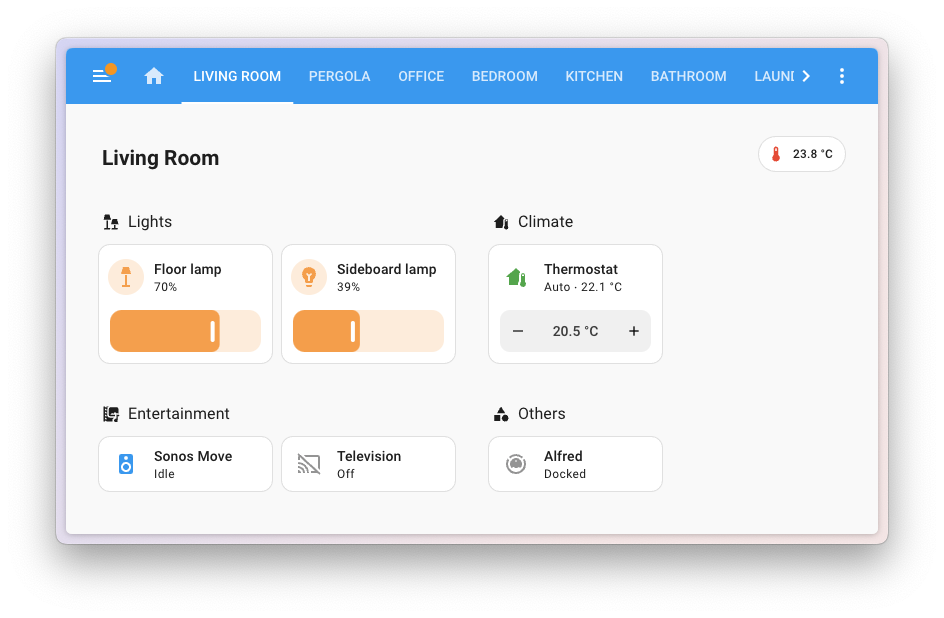
Screenshot viewing an area of the new experimental Areas dashboard

The new experimental Areas dashboard automatically generates a ready-to-use dashboard based on the areas you’ve set up in your home. It uses sections and tile cards for a modern, clean, and intuitive look—instantly. No more starting from a blank slate!

Each area now has its own dedicated page, giving you a clear and organized view of the devices in that space. Entities, such as lights, covers, cameras, and more, are automatically grouped by domain so you can easily locate the ones you need.

Want to tweak it? Yes, you can! You can rearrange, show, or hide entities to suit your preferences. At the top of each area page, temperature and humidity badges quickly indicate room comfort levels, which are configurable in the area’s settings.

On top of all that, the Overview page brings it all together, showing all your areas in one place. Each section corresponds to a room in your home, and just like with the area pages, you can rearrange, show, or hide areas here as well, based on your preferences.
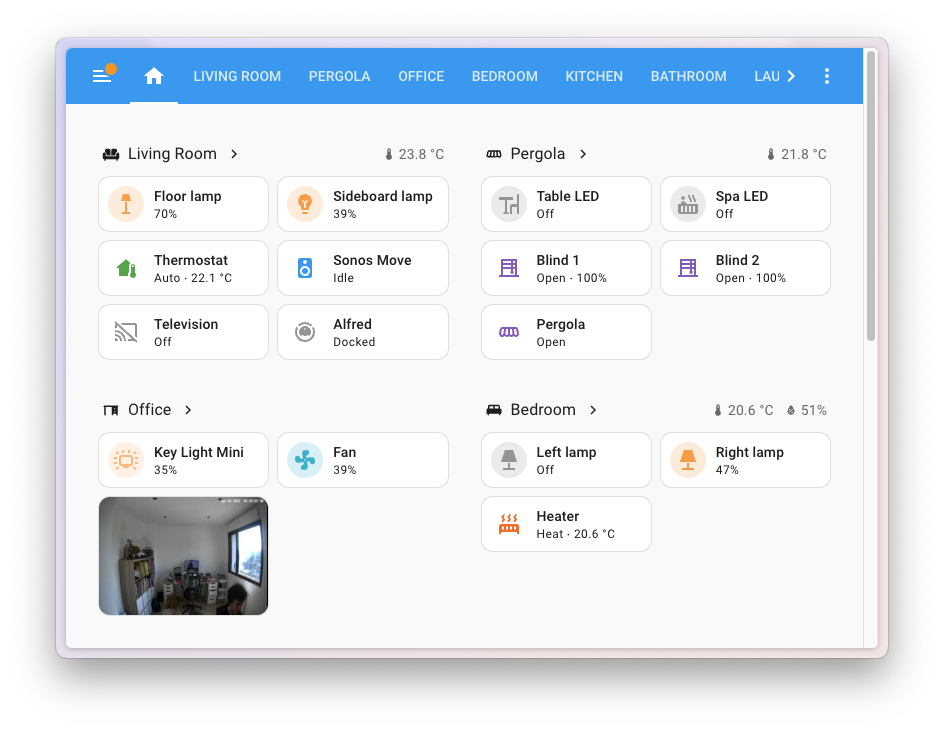
Screenshot showing the overview page of the new Areas dashboard

If you haven’t organized your devices into areas yet, now’s the perfect time to start—it’s key to unlocking this new dashboard experience. To get started with the Areas dashboard, go to Settings > Dashboards, and select Add Dashboard in the bottom right, next select the Areas (experimental) option from the dialog:
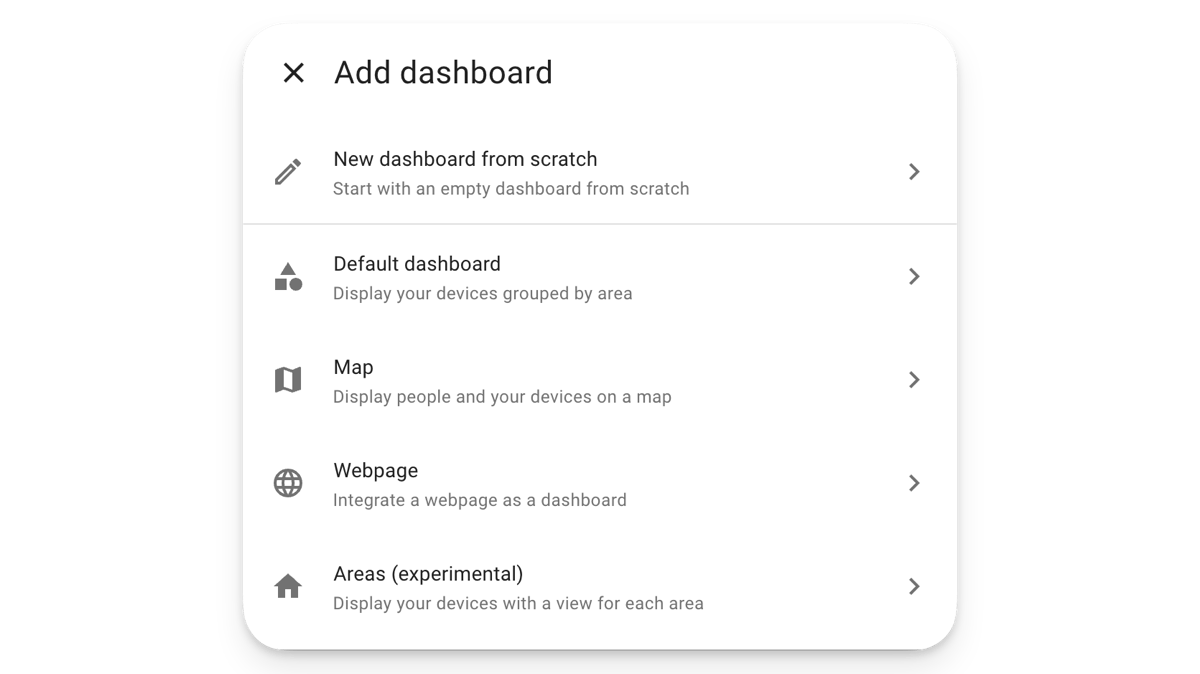
Screenshot of the dialog when adding a new dashboard, showing the new option to add the new experimental Area dashboard

The new experimental Areas dashboard previews what’s to come. We’ve learned from our users that they organize their homes in different ways—by rooms, by function, by device, and more. They often combine all of the above, and therefore, our upcoming default dashboard will accommodate all these methods of organization.

Over time, this foundation will grow into a flexible system that adapts to your priorities, whether that’s keeping an eye on security, managing energy use, going through your family calendar and chores, learning about the weather, or simply watching your pets.

Please note that this is experimental, meaning it is subject to change and may not always work as intended. We would love your feedback if you notice some aspects we can improve. The community’s dashboards, shared over the years, have helped shape this design, and we would love to see how it works with a wide variety of your homes. Even if you already have the perfect dashboard built for your home, try it!

Update: We had a feedback form in the release notes in this spot, but that’s closed now. Thanks for your input!

Time for a new card!

It has been a while since we introduced a new card, but this release, we thought it might be time to add a new one! Thanks to @mrdarrengriffin, Home Assistant now features a Clock card!
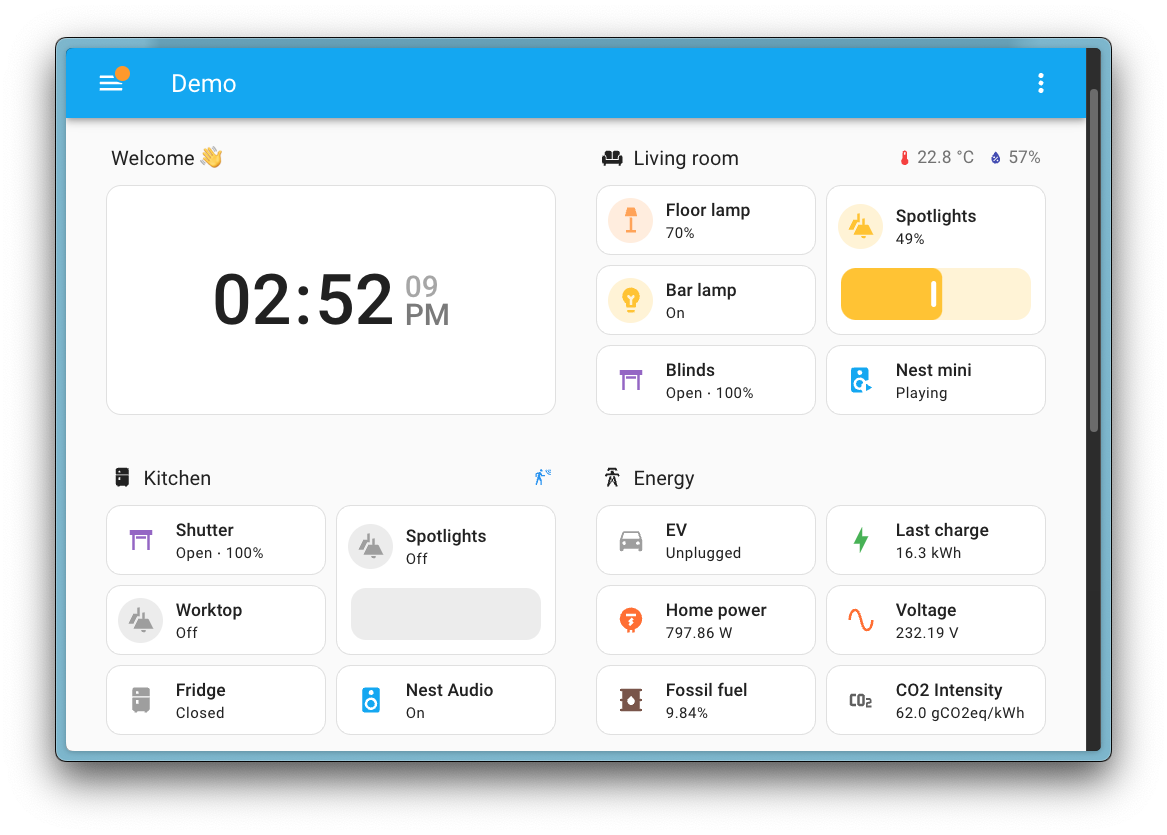
Screenshot showing a dashboard with a large clock card on it, indicating the current time

Yeah, the card is “just” showing the current time, but it is a really nice addition to our card collection. It might be a great card for dashboards you are showing on things like a wall-mounted tablet!

The Clock card offers several customization options, including the ability to adjust the clock size, timezone, display the seconds alongside the hours and minutes, and the ability to choose between a 12-hour or 24-hour format.

For more details, check out the Clock card documentation.

Voice

The “year of the voice” might be behind us, but we keep improving the voice experience in Home Assistant! This release brings several enhancements to make interacting with your smart home even better.

Improved Voice Wizard

If you set up a Home Assistant voice assistant compatible device, like the Home Assistant Voice Preview Edition, you will be guided through setting up your voice assistant, and this experience has been greatly improved in this release.

As our voice experience is offering more choices, including local options like Speech-to-Phrase, we wanted to make sure you are able to make the right choices for your use case.
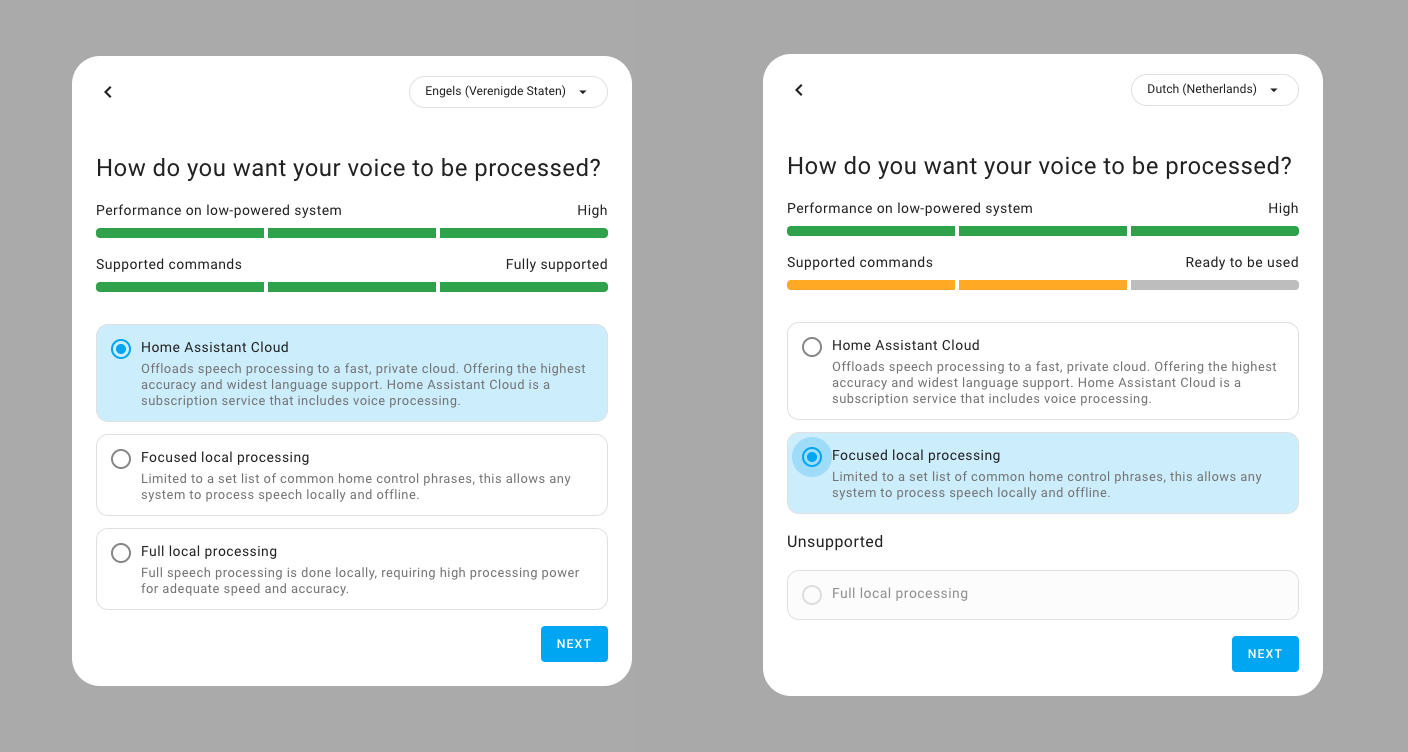
Two screenshots showing the new voice wizard that guides you setting up the best possible voice experience

The wizard will now help you make a more informed decision based on your language, desired functionality, and device capabilities, ensuring you get the best experience with your voice assistant.

Continued conversation with LLMs

Ever tried to have a conversation with your voice assistant that is hooked up to an LLM like ChatGPT? It’s good fun. However, having to say “Ok Nabu”, whenever you answer one of Assist’s questions can really slow things down.

This release introduces the ability to have a continued conversation with LLMs. If the LLM returns with a question, we will detect that and keep the conversation going, without the need for you to say “Ok Nabu” again.

This is a great way to have a more natural conversation with your voice assistants, and it works with all LLMs supported by Home Assistant.

Starting conversations

During Voice chapter 9, we added the ability for Home Assistant to call analog phones to start a conversation. As of this release, this feature is now available for ESPHome-based voice assistants, like the Home Assistant Voice Preview Edition!

This is a fantastic feature, as it allows you to build your own automations that can send out voice prompts from your voice assistant and listen for a response, instead of you having to trigger the conversation by saying the wake word.

Imagine, for example, you have left the garage door open, and a few minutes later, your assistant says:

Hey, I noticed you left the garage door open, do you want me to close it for you?

You simply reply “yes” or “no,” and it handles the rest… 🤯 Or perhaps after a long day at work, you return home, and your assistant greets you warmly:

Welcome home, Frenck! Hope you had a great day. Want to hear the news or maybe enjoy some music?

JLo made a great demo video of this one, involving his oven and the assistant asking if he wants to set a timer:

This opens up a whole new world of possibilities for voice-driven automations. Currently, this capability is only available when using LLM integrations, but we’re exploring more use cases where it would be helpful.

If you listen closely to the demo above, you’ll notice a brief pre-announce sound just before the conversation starts. This little notification prevents your assistant from startling anyone by suddenly speaking out of nowhere and preventing a jump scare! 🫣

You could even use custom sounds based on the scenario—like a doorbell chime for visitors or a train station-style jingle when your morning commute gets delayed, giving you extra time to grab that coffee before heading out. ☕

Onboarding with a Home Assistant Cloud backup

If you are a user of Home Assistant Cloud by Nabu Casa, it means you can safely store a backup of your Home Assistant installation in the cloud as part of your subscription. A really convenient service that ensures you always have a secure and worry-free backup of your Home Assistant installation, no matter what happens.

Now, let’s say something did happen, maybe a hardware failure, or maybe you are migrating to a new Home Assistant Green, as of this release, you can directly restore your backup from the Home Assistant Cloud during the onboarding process of your new Home Assistant installation.

This means you can get up and running with your new Home Assistant installation in no time, with all your settings, automations, and integrations restored from your backup.
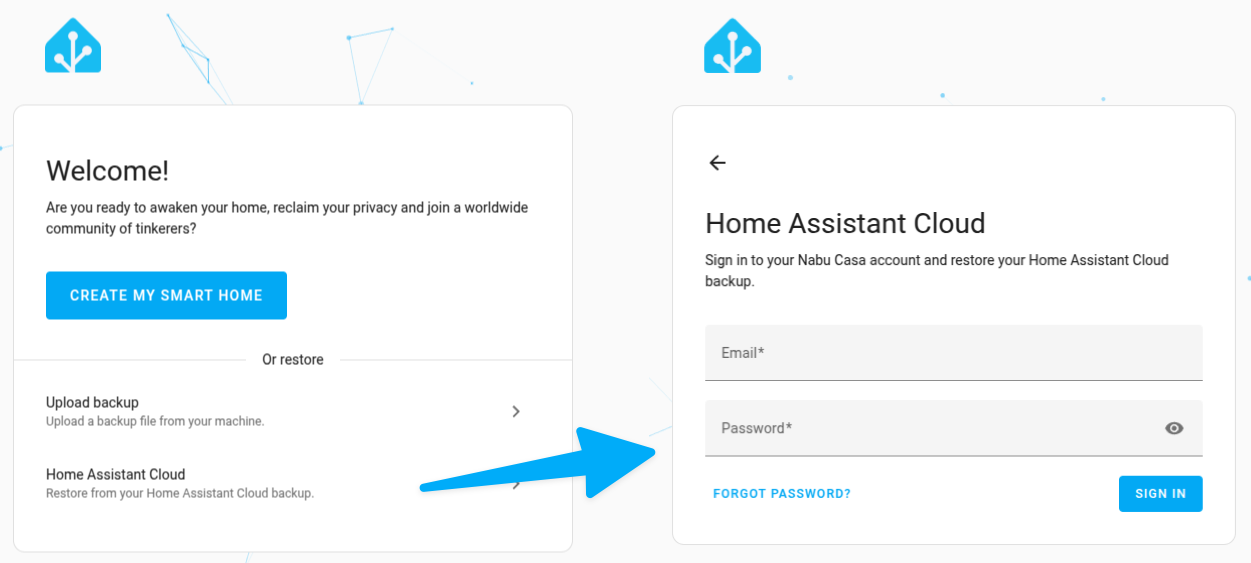
Screenshot showing the restore from Nabu Casa's Home Assistant Cloud during set up

Integrations

Thanks to our community for keeping pace with the new integrationsIntegrations connect and integrate Home Assistant with your devices, services, and more. [Learn more] and improvements to existing ones! You’re all awesome 🥰

New integrations

We welcome the following new integrations in this release:

This release also has new virtual integrations. Virtual integrations are stubs that are handled by other (existing) integrations to help with findability. These ones are new:

Noteworthy improvements to existing integrations

It is not just new integrationsIntegrations connect and integrate Home Assistant with your devices, services, and more. [Learn more] that have been added; existing integrations are also being constantly improved. Here are some of the noteworthy changes to existing integrations:

  • The OpenAI conversation integration has a new action to generate content, thanks to @timlaing, and it can now search the web! Nice @Shulyaka!
  • The Google AI conversation integration also gained the ability to search the web, just like the above OpenAI one. Thanks @tronikos!
  • @joostlek has absolutely been rocking the SmartThings integration! The list of improvements is extremely long, but it includes support for firmware updates through Home Assistant, support for event entities, PM0.1 sensors, washer rinse cycle settings, TV and media player support, and improved device handling. Awesome work there!
  • Not only SmartThings is receiving love, @Diegorro98 has been constantly at work improving and tuning the Home Connect integration. Thank you so much!
  • The Roborock integration has been extended to support dryer controls and button entities to start routines. Thanks @Lash-L and @regevbr!
  • Reolink cannot be left out of this list. This release adds support for their smart AI sensors, and adds a day/night state sensor. Nice work @starkillerOG!
  • @tr4nt0r extended the actions Habitica integration with lots of new and improved actions to manage your habits, rewards, and dailies. Thanks!
  • The Microsoft OneDrive integration has a new action that allows you to upload files to OneDrive. Nice @zweckj!
  • @andrewsayre extended HEOS with support for browsing media, allowing you to browse things like TuneIn and play them on your HEOS devices.

Integration quality scale achievements

One thing we are incredibly proud of in Home Assistant is our integration quality scale. This scale helps us and our contributors to ensure integrations are of high quality, maintainable, and provide the best possible user experience.

This release, we celebrate several integrationsIntegrations connect and integrate Home Assistant with your devices, services, and more. [Learn more] that have improved their quality scale:

This is a huge achievement for these integrations and their maintainers. The effort and dedication required to reach these quality levels is significant, as it involves extensive testing, documentation, error handling, and often complete rewrites of parts of the integration.

A big thank you to all the contributors involved! 👏

Other noteworthy changes

There are many more improvements in this release; here are some of the other noteworthy changes this release:

  • The Home Assistant Yellow Zigbee/Thread chip and Home Assistant ZBT-1 can now be updated directly through Home Assistant update entities. Nice @puddly!
  • When viewing the details of an entity in the entity dialog, we now provide more context about where the entity originates. Like its device and the area it is in. This is a first step in sprinkling more context throughout our UI. Thanks, @piitaya!
  • We now provide sensors about your backups! Providing you information on things like when your last backup ran. Thanks @mib1185!
  • This one is interesting if you make Blueprints. The device selector now supports filtering by model ID. Thanks for this one @karwosts!
  • We now support turning on/off TVs in HomeKit, nice one @bdraco!
  • Thanks to @piitaya, we now support lawn mower devices in Google Assistant and HomeKit!
  • Variables in automations & scripts have been greatly simplified and fixed by @arturpragacz. All variables are now accessible anywhere in the script or automation, greatly simplifying the use of variables. Amazing!
  • We now support adding additional interactions to cards! The hold and double tap actions are now available through the UI. Thanks @piitaya!

Templates

If you are a power user, you probably use templatesA template is an automation definition that can include variables for the action or data from the trigger values. This allows automations to generate dynamic actions. [Learn more] in your automations, scripts, or maybe even your dashboard. This release has a few additions to our template engine that you might find useful.

To start with, in the template integration the light and switch templates have been migrated to support the new and modern YAML style. Thanks @Petro31 for this one!

More noteworthy is the addition of a series of new template functions to make working with data a lot easier:

  • combine – Combine multiple dictionaries.
  • difference – Find elements present in one list but not another.
  • flatten – Flatten a list of lists into a single list.
  • floor_entities – Retrieve entities associated with a specific floor.
  • intersect – Identify common elements between lists.
  • md5, sha1, sha256, sha512 – Perform common hashing operations.
  • shuffle – Randomly shuffle items in a list.
  • symmetric_difference – Find items in either list but not in both.
  • typeof – Determine the type of a variable or object for debugging.
  • union – Merge unique elements from two lists.

Device hierarchy for energy management

This release, @karwosts has introduced an improvement to Home Assistant’s energy management system—one that’s been highly requested by the community.

This means you can now create a device hierarchy within your energy configuration, establishing parent-child relationships between devices.

For example, imagine having a breaker monitoring the total energy consumption of a circuit, but also separately tracking individual devices connected to that circuit. Previously, Home Assistant might double-count this usage. Now, it understands these relationships and accurately shows the individual device usage without duplication.
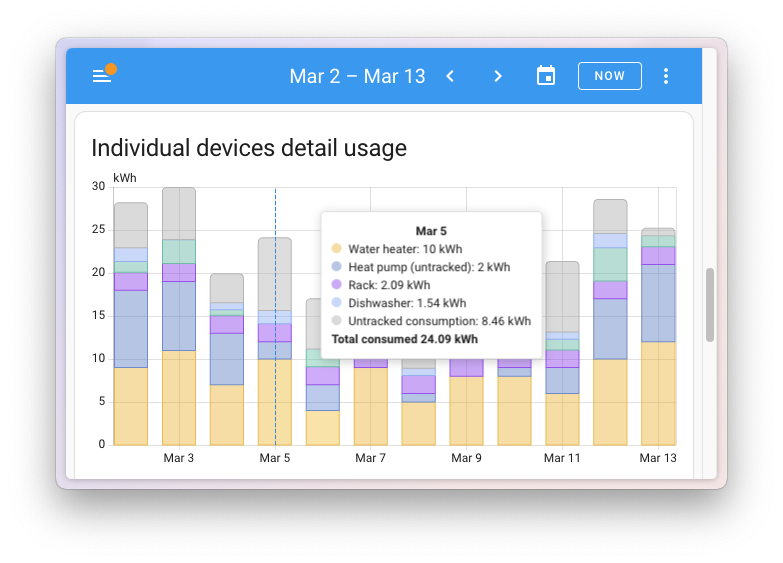
Sreenshot of the individual device usage graph taken from the energy dashboard

In this screenshot, the water heater is a child of the heat pump. Both report energy usage separately, but the water heater’s consumption is also included in the total reported by the heat pump. With device hierarchy enabled, Home Assistant correctly shows the usage of each device.

Awesome addition there @karwosts!

Patch releases

We will also release patch releases for Home Assistant 2025.4 in April. These patch releases only contain bug fixes. Our goal is to release a patch release every Friday.

2025.4.1 - April 4

2025.4.2 - April 12

2025.4.3 - April 19

2025.4.4 - April 25

Need help? Join the community!

Home Assistant has a great community of users who are all more than willing to help each other out. So, join us!

Our very active Discord chat server is an excellent place to be at, and don’t forget to join our amazing forums.

Found a bug or issue? Please report it in our issue tracker, to get it fixed! Or, check our help page for guidance for more places you can go.

Are you more into email? Sign-up for our Building the Open Home Newsletter to get the latest news about features, things happening in our community and other news about building an Open Home; straight into your inbox.

Backward-incompatible changes

We do our best to avoid making changes to existing functionality that might unexpectedly impact your Home Assistant installation. Unfortunately, sometimes, it is inevitable.

We always make sure to document these changes to make the transition as easy as possible for you. This release has the following backward-incompatible changes:

Automation & script variable scopes

The variables action is no longer restricted to local scopes; it can now update the value of a variable also in outer scopes. If the variable was not previously defined, it will be created in the top-level (script run) scope.

actions:
  - variables:
      x: 1
      y: 1
  - sequence:
    - variables:
        y: 2  # Updates y, which exists in the outer scope
        z: 2  # Since z is not defined yet, it is assigned in the top-level scope
  - action: persistent_notification.create
    data:
      message: ", , " # x=1, y=2, z=2
      # Note: previously, it would be: x=1, y=1, z undefined

If you have automations or scripts that use the same variable name in different (previously isolated) scopes, you will need to update them: simply use distinct variable names to prevent any conflicts.

(@arturpragacz - #141114)

Jewish Calendar

Holiday sensor changes:

  • In Israel, “Simchat Torah” is now “Shmini Atzeret, Simchat Torah”
  • In Israel, the 30th of Shvat returns “Family Day, Rosh Chodesh”

Additionally, the type_id has been removed from the state attributes, use the type if needed instead.

(@tsvi - #137247) (documentation)

Persistent notifications

Persistent notifications with notification_id config_entry_reconfigure are no longer created when an integration fails to authenticate. Automations triggering on such persistent notifications will thus no longer work.

(@emontnemery - #140932) (documentation)

Reolink

The Reolink password is now limited to 31 characters. The latest versions of the Reolink app and desktop client also have this 31-character limit. If you configured your Reolink password years ago, it is possible it is longer than 31 characters. In that case you will get a reauthentication flow asking you to change the password. Passwords longer than 31 characters can cause issues in the latest Reolink API.

(@starkillerOG - #140789) (documentation)

If you are a custom integration developer and want to learn about changes and new features available for your integration: Be sure to follow our developer blog. The following changes are the most notable for this release:

All changes

Of course there is a lot more in this release. You can find a list of all changes made here: Full changelog for Home Assistant Core 2025.4

  •  

Motionblinds joins Works with Home Assistant

Motionblinds wwha logo

We’re excited to announce the latest partner to join the Works with Home Assistant program is Motionblinds! And if you’re wondering what type of products they provide, the clue really is in the name!

Motionblinds is the first Works with Home Assistant partner to certify smart window blinds. This brings us closer to a future where you can build a smart home exclusively with certified devices that give the best possible experience with Home Assistant.  Smart blinds integrated with Home Assistant unlock powerful automations, such as blinds opening when you get home, or closing sun-facing blinds on warmer days to keep your home cool.

Shades of innovation

Motionblinds is a brand from Coulisse, a company from the Netherlands, that has been making window coverings for the past 30 years. Motionblinds are available worldwide and are known for their beautiful, customizable designs, coupled with smart technology. They not only provide all-in-one smart blinds, but also upgrade kits for your existing roller blinds, which is great for cutting down on waste.

A window to the future

Motionblinds powered by Eve

Motionblinds are definitely a leader in the smart blinds space and have partnered with Eve Systems, a leading provider of smart home devices, headquartered in Germany and part of ABB. This partnership brings Matter-over-Thread to their motors. Together, we have tested and certified these Matter-certified Eve Motionblinds. It’s easy to tell which are part of Works with Home Assistant, as they’ll include the “powered by Eve” badge.

Motionblinds that use Bluetooth and 433MHz technology will also be getting the ‘Works With Home Assistant’ treatment, as we’re certifying motors that connect via the Motionblinds Matter Bridge (CM-55). This provides an excellent local way to connect this additional range of products to Home Assistant, allowing many more Motionblinds motors to give the best experience with Home Assistant. Check out our Motionblinds integrations page for a full list of the different motors that are certified. Be aware that standalone, Bluetooth-integrated blinds are not currently certified under the ‘Works With’ program.

Motionblinds Matter BridgeMotionblinds Matter Bridge (CM-55)

Home Assistant was recently Matter certified, and with these blinds certified to work with Home Assistant, end-to-end these devices are going to give a seamless experience. Every Works with Home Assistant product is tested by our team, works locally, and the brand promises to provide great long-term support.

Which devices have been certified?

All these devices connect directly to Home Assistant via Matter, provided you pick the “powered by Eve” option, or combine with the Matter bridge. We’re big fans of open standards like Matter, because they bring great benefits when it comes to local control, privacy, and long-term support.

Closing thoughts 🪟

A big thanks to both Coulisse and Eve for putting their time and effort into bringing Motionblinds to the Works with Home Assistant program. This is really plugging a blind spot in our Works with program by covering new ground and opening up some exciting options for our community 😃.

  •  

Announcing State of the Open Home 2025

Update: It happened and was great! Read the biggest highlights here or watch the full recording.

🚨On April 12th, we’re going live with this year’s State of the Open Home - our annual recap of the previous year and look ahead to the next. Just like past years, this live stream will be packed with awesome announcements, updates, and cool community highlights. (Got 11 hours to spare? Check out our last 5 State of live streams!)

This marks a full year since the founding of the Open Home Foundation and Home Assistant becoming part of the foundation. We’ll be taking a look back at what has been a very big year, and using this time to give you some big updates. These will include new projects becoming a part of the foundation 🚀, new supporters 🎉, and what’s in store for our Works with Home Assistant program 🤝.

We’ll also be highlighting some of the big findings of our 2024 Home Assistant survey, where over 8,500 of you told us about yourself, your homes, and how you use Home Assistant. We’ll also announce Home Assistant’s 2025 roadmap, and how your feedback is shaping the future of the Open Home.

🔔 Be sure to click to get notified when it starts (Saturday, April 12 - 18:00 GMT / 20:00 CEST / 14:00 EDT / 11:00 PDT), and we can’t wait to see you in the comments!

  •  
❌