 Log in
macOS 26.3 (25D125)
11 Februari 2026 om 18:00

New uNmINeD development snapshot is available for download!
Changes:
** specially, the pattern foo** means foo or foo_*The Hytale support is still experimental. There may be bugs, crashes, and the map colors are still unfinished.
!!! WARNING !!!
It has not yet been tested whether uNmINeD can be used safely while Hytale is running. Always close Hytale before using uNmINeD to prevent data corruption!
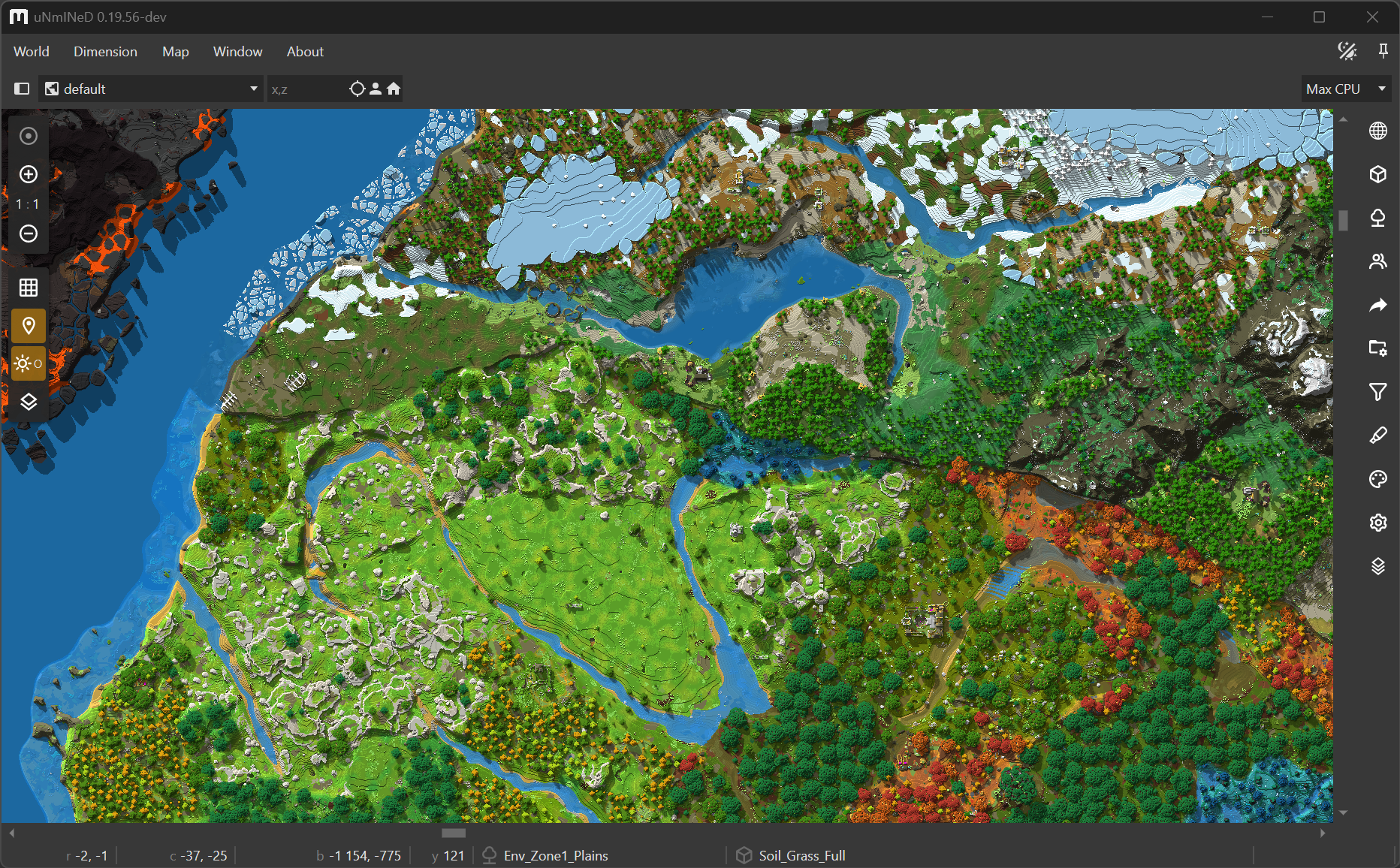
A Hytale world in uNmINeD:
The Extended Stable channel has been updated to 144.0.7559.173 for Windows and Mac which will roll out over the coming days/weeks.
The Chrome team is delighted to announce the promotion of Chrome 145 to the stable channel for Windows, Mac and Linux. This will roll out over the coming days/weeks.
Chrome 145.0.7632.45 (Linux) 145.0.7632.45/46 Windows/Mac contains a number of fixes and improvements -- a list of changes is available in the log. Watch out for upcoming Chrome and Chromium blog posts about new features and big efforts delivered in 145.
Security Fixes and Rewards
Note: Access to bug details and links may be kept restricted until a majority of users are updated with a fix. We will also retain restrictions if the bug exists in a third party library that other projects similarly depend on, but haven’t yet fixed.
This update includes 11 security fixes. Please see the Chrome Security Page for more information.
[$8000][467297219] High CVE-2026-2313: Use after free in CSS. Reported by Han Zheng (HexHive), Wenhao Fang (University of St. Andrews), and Qinying Wang (HexHive) on 2025-12-09
[N/A][478560268] High CVE-2026-2314: Heap buffer overflow in Codecs. Reported by Google on 2026-01-26
[N/A][479242793] High CVE-2026-2315: Inappropriate implementation in WebGPU. Reported by Google on 2026-01-27
[$5000][422531206] Medium CVE-2026-2316: Insufficient policy enforcement in Frames. Reported by Luan Herrera (@lbherrera_) on 2025-06-05
[$2000][464173573] Medium CVE-2026-2317: Inappropriate implementation in Animation. Reported by Brendan Draper on 2025-11-28
[$1000][363930141] Medium CVE-2026-2318: Inappropriate implementation in PictureInPicture. Reported by Shaheen Fazim on 2024-09-02
[$1000][40071155] Medium CVE-2026-2319: Race in DevTools. Reported by Anonymous on 2023-09-01
[TBD][435684924] Medium CVE-2026-2320: Inappropriate implementation in File input. Reported by Alesandro Ortiz on 2025-08-02
[N/A][461877477] Medium CVE-2026-2321: Use after free in Ozone. Reported by Google on 2025-11-18
[$1000][470928605] Low CVE-2026-2322: Inappropriate implementation in File input. Reported by Robbe Van Roey | PinkDraconian on 2025-12-22
[$500][467442136] Low CVE-2026-2323: Inappropriate implementation in Downloads. Reported by Hafiizh on 2025-12-10
We would also like to thank all security researchers that worked with us during the development cycle to prevent security bugs from ever reaching the stable channel.
Many of our security bugs are detected using AddressSanitizer, MemorySanitizer, UndefinedBehaviorSanitizer, Control Flow Integrity, libFuzzer, or AFL.
Interested in switching release channels? Find out how here. If you find a new issue, please let us know by filing a bug. The community help forum is also a great place to reach out for help or learn about common issues.
Srinivas Sista
Google Chrome

New uNmINeD development snapshot is available for download!
Changes:
uNmINeD now can read Hytale worlds. This is an experimental feature under development. Map colors are far from finished, the code is slow, and there may be bugs and crashes.
!!! WARNING !!!
It has not yet been tested whether uNmINeD can be used safely while Hytale is running. Always close Hytale before using uNmINeD to prevent data corruption!
Check your Hytale world in uNmINeD and have fun!
The PostgreSQL Global Development Group has released an update to all supported versions of PostgreSQL, including 18.1, 17.7, 16.11, 15.15, 14.20, and 13.23. This release fixes 2 security vulnerabilities and over 50 bugs reported over the last several months.
For the full list of changes, please review the release notes.
This is the final release of PostgreSQL 13. PostgreSQL 13 is now end-of-life and will no longer receive security and bug fixes. If you are running PostgreSQL 13 in a production environment, we suggest that you make plans to upgrade to a newer, supported version of PostgreSQL. Please see our versioning policy for more information.
CREATE STATISTICS does not check for schema CREATE privilegeCVSS v3.1 Base Score: 3.1
Supported, Vulnerable Versions: 13 - 18.
Missing authorization in PostgreSQL CREATE STATISTICS
command allows a table owner to achieve denial of service against other
CREATE STATISTICS users by creating in any schema. A later CREATE STATISTICS
for the same name, from a user having the CREATE privilege, would then fail.
Versions before PostgreSQL 18.1, 17.7, 16.11, 15.15, 14.20, and 13.23 are
affected.
The PostgreSQL project thanks Jelte Fennema-Nio for reporting this problem.
CVSS v3.1 Base Score: 5.9
Supported, Vulnerable Versions: 13 - 18.
Integer wraparound in multiple PostgreSQL libpq client library functions allows an application input provider or network peer to cause libpq to undersize an allocation and write out-of-bounds by hundreds of megabytes. This results in a segmentation fault for the application using libpq. Versions before PostgreSQL 18.1, 17.7, 16.11, 15.15, 14.20, and 13.23 are affected.
The PostgreSQL project thanks Aleksey Solovev (Positive Technologies) for reporting this problem.
This update fixes over 50 bugs that were reported in the last several months. The issues listed below affect PostgreSQL 18. Some of these issues may also affect other supported versions of PostgreSQL.
DETACH CONCURRENTLY, which previously caused issues during dump/restore or if a parent table is dropped after the DETACH.COPY ... FROM ... WHERE clauses.pg_stat_replication view.synchronized_standby_slots references nonexistent replication slots.GROUP BY DISTINCT in PL/pgSQL assignment statements.NOT NULL constraints on inherited table columns.pg_dump.pgbench error handling and reporting.pg_combinebackup.SELECT privileges on a table to use pg_prewarm to prewarm indexes on that table.All PostgreSQL update releases are cumulative. As with other minor releases,
users are not required to dump and reload their database or use pg_upgrade
in order to apply this update release; you may simply shutdown PostgreSQL and
update its binaries.
Users who have skipped one or more update releases may need to run additional post-update steps; please see the release notes from earlier versions for details.
For more details, please see the release notes.
If you have corrections or suggestions for this release announcement, please send them to the pgsql-www@lists.postgresql.org public mailing list.
The PostgreSQL Global Development Group today announced the release of PostgreSQL 18, the latest version of the world's most advanced open source database. Translations of this press release are available in the PostgreSQL 18 press kit.
PostgreSQL 18 improves performance for workloads of all sizes through a new I/O
subsystem that has demonstrated up to 3× performance improvements when reading
from storage, and also increases the number of queries that can use indexes.
This release makes major-version upgrades less disruptive, accelerating upgrade
times and reducing the time required to reach expected performance after an
upgrade completes. Developers also benefit from PostgreSQL 18 features,
including virtual generated columns that compute values at query time, and the
database-friendly uuidv7() function that provides better indexing and read
performance for UUIDs. PostgreSQL 18 makes it easier to integrate with single-sign
on (SSO) systems with support for OAuth 2.0 authentication.
"The efforts of the global open source community shape every PostgreSQL release and help deliver features that meet users where their data resides," said Jonathan Katz, a member of the PostgreSQL core team. "PostgreSQL 18 builds on the project's long, rich history of delivering a reliable and robust data management experience, while continuing to expand the workloads it can support."
PostgreSQL, an innovative data management system known for its reliability, robustness, and extensibility, benefits from nearly 30 years of open source development from a global developer community and has become the preferred open source relational database for organizations of all sizes.
PostgreSQL previously relied on operating system readahead mechanisms to accelerate data retrieval. However, because operating systems lack insight into database-specific access patterns, they cannot always anticipate what data will be required, leading to suboptimal performance in many workloads.
PostgreSQL 18 introduces a new asynchronous I/O (AIO) subsystem designed to address this limitation. AIO lets PostgreSQL issue multiple I/O requests concurrently instead of waiting for each to finish in sequence. This expands existing readahead and improves overall throughput. AIO operations supported in PostgreSQL 18 include sequential scans, bitmap heap scans, and vacuum. Benchmarking has demonstrated performance gains of up to 3x in certain scenarios.
The new io_method
setting lets you toggle between the AIO methods, including worker and io_uring,
or you can choose to maintain the current PostgreSQL behavior with the sync
setting. There are now more parameters to consider tuning with AIO, which you
can learn more about in the documentation.
A key PostgreSQL feature is the generation and storage of
statistics that help
PostgreSQL select the most efficient query plan. Before PostgreSQL 18, these
statistics didn't carry over on a major version upgrade,
which could cause significant query performance degradations on busy systems
until the ANALYZE
finished running. PostgreSQL 18 introduces the ability to keep planner
statistics through a major version upgrade, which helps an upgraded cluster
reach expected performance more quickly after the upgrade.
Additionally, pg_upgrade,
a utility that performs major version upgrades, includes several enhancements in
PostgreSQL 18, such as faster upgrades when a database contains many objects
like tables and sequences. This release also lets pg_upgrade process its
checks in parallel based on the settings of the --jobs flag, and adds the
--swap flag that swaps upgrade directories instead of copying, cloning, or
linking files.
PostgreSQL 18 further accelerates query performance with features that
automatically make your workloads faster. This release introduces "skip scan"
lookups on multicolumn B-tree indexes
that improve execution time for queries that omit an = condition on one or
more prefix index columns. It can also optimize queries that use OR conditions
in a WHERE to use an index, leading to significantly faster execution. There
are also numerous improvements for how PostgreSQL plans and executes table joins,
from boosting the performance of hash joins to allowing merge joins to use
incremental sorts. PostgreSQL 18 also supports parallel builds for
GIN indexes, joining B-tree and
BRIN indexes in supporting
this capability.
This release also builds on PostgreSQL support for hardware acceleration,
including support for ARM NEON and SVE CPU intrinsics for the popcount
function, which is used by the bit_count
and other internal capabilities.
PostgreSQL 18 introduces virtual generated columns that compute values at query time instead of storing them. This is now the default option for generated columns. Additionally, stored generated columns can now be logically replicated.
This release adds the capability to access both the previous (OLD) and current
(NEW) values in the RETURNING clause
for INSERT, UPDATE, DELETE and MERGE commands. PostgreSQL 18 also adds
UUIDv7 generation through the uuidv7()
function, letting you generate random UUIDs that are timestamp-ordered to
support better caching strategies. PostgreSQL 18 includes
uuidv4()
as an alias for gen_random_uuid().
PostgreSQL 18 adds temporal constraints
-- constraints over ranges -- for both PRIMARY KEY and UNIQUE constraints
using the WITHOUT OVERLAPS clause, and on FOREIGN KEY constraints using the
PERIOD clause.
Finally, PostgreSQL 18 makes it easier to create the schema definition of a
foreign table using the definition of a local table with the
CREATE FOREIGN TABLE ... LIKE
command.
PostgreSQL 18 makes text processing easier and faster with several new
enhancements. This release adds the PG_UNICODE_FAST
collation, which provides full Unicode semantics for case transformations while
helping to accelerate many comparisons. This includes the upper and lower
string comparison functions and the new casefold
function for case-insensitive comparisons. Additionally, PostgreSQL 18 now
supports making LIKE comparisons over text that uses a
nondeterministic collation,
simplifying how you can perform more complex pattern matching. This release also
changes full text search
to use the default collation provider of a cluster instead of always using libc,
which may require you to reindex all
full text search
and pg_trgm
indexes after running pg_upgrade.
PostgreSQL 18 introduces oauth authentication,
which lets users authenticate using OAuth 2.0 mechanisms supported through
PostgreSQL extensions. Additionally, PostgreSQL 18 includes validation for
FIPS mode,
and adds the ssl_tls13_ciphers
parameter for configuring server-side TLS v1.3 cipher suites.
This release deprecates md5 password authentication, which will be removed in
a future release. If you require PostgreSQL password-based authentication, use
SCRAM authentication.
PostgreSQL 18 also supports SCRAM passthrough authentication with both
postgres_fdw and
dblink for authenticating to
remote PostgreSQL instances. Additionally, pgcrypto
now supports SHA-2 encryption for password hashing.
PostgreSQL 18 supports reporting logical replication write conflicts in logs and
in the pg_stat_subscription_stats view. Additionally,
CREATE SUBSCRIPTION
now defaults to using parallel streaming for applying transactions, which can
help improve performance. The
pg_createsubscriber
utility now has an --all flag so you can create logical replicas for all
databases in an instance with a single command. PostgreSQL 18 also lets you
automatically drop idle replication slots to help prevent storing too many
write-ahead log files on a publisher.
PostgreSQL 18 improves its vacuum strategy by proactively freezing more pages during regular vacuums, reducing overhead and helping in situations that require aggressive vacuums.
PostgreSQL 18 adds more details to EXPLAIN,
which provides information about query plan execution, and as of this release
now automatically shows how many buffers (the fundamental unit of data storage)
are accessed when executing EXPLAIN ANALYZE. Additionally, EXPLAIN ANALYZE
now shows how many index lookups occur during an index scan, and EXPLAIN ANALYZE VERBOSE
includes CPU, WAL, and average read statistics. PostgreSQL 18 includes more info
in pg_stat_all_tables
on time spent on vacuum and related operations, as well as per-connection
statistics on I/O and WAL utilization.
Databases initialized with PostgreSQL 18 initdb
now have page checksums enabled by default. This can affect upgrades from
non-checksum enabled clusters, which would require you to create a new
PostgreSQL 18 cluster with the --no-data-checksums option when using
pg_upgrade.
PostgreSQL 18 also introduces a new version (3.2) of the PostgreSQL wire
protocol, the first new protocol version since PostgreSQL 7.4 (2003).
libpq still uses
version 3.0 by default while clients (e.g., drivers, poolers, proxies) add
support for the new protocol version.
Many other new features and improvements have been added to PostgreSQL 18 that may also be helpful for your use cases. Please see the release notes for a complete list of new and changed features.
PostgreSQL is the world's most advanced open source database, with a global community of thousands of users, contributors, companies and organizations. Since its beginnings at the University of California, Berkeley over 40 years ago, PostgreSQL has continued with an unmatched pace of development. PostgreSQL's mature feature set not only matches top proprietary database systems, but exceeds them in advanced database features, extensibility, security, and stability.
The PostgreSQL Global Development Group announces that the first release candidate of PostgreSQL 18 is now available for download. As a release candidate, PostgreSQL 18 RC 1 will be mostly identical to the initial release of PostgreSQL 18, though some more fixes may be applied prior to the general availability of PostgreSQL 18.
The planned date for the general availability of PostgreSQL 18 is September 25, 2025. Please see the "Release Schedule" section for more details.
To upgrade to PostgreSQL 18 RC 1 from earlier versions of PostgreSQL, you will
need to use a major version upgrade strategy, e.g. pg_upgrade or
pg_dump / pg_restore. For more information, please visit the documentation
section on upgrading:
https://www.postgresql.org/docs/18/upgrading.html
Several bug fixes were applied for PostgreSQL 18 during the Beta 3 period. These include:
vacuumdb --missing-stats-only.pg_trgm indexes after using pg_upgrade.For a detailed list of fixes, please visit the open items page.
This is the first release candidate for PostgreSQL 18. Unless an issue is discovered that warrants a delay or to produce an additional release candidate, PostgreSQL 18 should be made generally available on September 25, 2025.
For further information please see the Beta Testing page.
The PostgreSQL Global Development Group has released an update to all supported versions of PostgreSQL, including 17.6, 16.10, 15.14, 14.19, and 13.22, as well as the third beta release of PostgreSQL 18. This release fixes 3 security vulnerabilities and over 55 bugs reported over the last several months.
If you previously created a BRIN index using the numeric_minmax_multi_ops
operator class, please see the "Updating" section for additional instructions
after upgrading your instance.
For the full list of changes, please review the release notes.
PostgreSQL 13 will stop receiving fixes on November 13, 2025. If you are running PostgreSQL 13 in a production environment, we suggest that you make plans to upgrade to a newer, supported version of PostgreSQL. Please see our versioning policy for more information.
CVSS v3.1 Base Score: 3.1
Supported, Vulnerable Versions: 13 - 17.
PostgreSQL optimizer statistics allow a user to read sampled data within a view that the user cannot access. Separately, statistics allow a user to read sampled data that a row security policy intended to hide. PostgreSQL maintains statistics for tables by sampling data available in columns; this data is consulted during the query planning process. Prior to this release, a user could craft a leaky operator that bypassed view access control lists (ACLs) and bypassed row security policies in partitioning or table inheritance hierarchies. Reachable statistics data notably included histograms and most- common-values lists. CVE-2017-7484 and CVE-2019-10130 intended to close this class of vulnerability, but this gap remained. Versions before PostgreSQL 17.6, 16.10, 15.14, 14.19, and 13.22 are affected.
The PostgreSQL project thanks Dean Rasheed for reporting this problem.
pg_dump lets superuser of origin server execute arbitrary code in psql clientCVSS v3.1 Base Score: 8.8
Supported, Vulnerable Versions: 13 - 17.
Untrusted data inclusion in pg_dump in PostgreSQL allows a malicious superuser of the origin server to inject arbitrary code for restore-time execution as the client operating system account running psql to restore the dump, via psql meta-commands. pg_dumpall is also affected. pg_restore is affected when used to generate a plain-format dump. This is similar to MySQL CVE-2024-21096. Versions before PostgreSQL 17.6, 16.10, 15.14, 14.19, and 13.22 are affected.
The PostgreSQL project thanks Martin Rakhmanov, Matthieu Denais, and RyotaK for reporting this problem.
pg_dump newline in object name executes arbitrary code in psql client and in restore target serverCVSS v3.1 Base Score: 8.8
Supported, Vulnerable Versions: 13 - 17.
Improper neutralization of newlines in pg_dump in PostgreSQL allows a user of the origin server to inject arbitrary code for restore-time execution as the client operating system account running psql to restore the dump, via psql meta-commands inside a purpose-crafted object name. The same attacks can achieve SQL injection as a superuser of the restore target server. pg_dumpall, pg_restore, and pg_upgrade are also affected. Versions before PostgreSQL 17.6, 16.10, 15.14, 14.19, and 13.22 are affected. Versions before 11.20 are unaffected. CVE-2012-0868 had fixed this class of problem, but version 11.20 reintroduced it.
The PostgreSQL project thanks Noah Misch for reporting this problem.
This update fixes over 55 bugs that were reported in the last several months. The issues listed below affect PostgreSQL 17. Some of these issues may also affect other supported versions of PostgreSQL.
numeric_minmax_multi_ops operator class that could cause them to become bloated and inefficient. Please see the "Updating" section for instructions on how to fix these indexes.[[:alpha:]%_]) are handled in SIMILAR TO expressions.MERGE, including incorrect query results with concurrency and when targeting a table that is a parent in an inheritance hierarchy.shared_buffers settings.PQcancelCreate().All PostgreSQL update releases are cumulative. As with other minor releases,
users are not required to dump and reload their database or use pg_upgrade
in order to apply this update release; you may simply shutdown PostgreSQL and
update its binaries.
If you have any BRIN indexes that use the numeric_minmax_multi_ops operator
class, it is advisable to REINDEX them after updating to fix any potential
bloating and inefficiency.
Users who have skipped one or more update releases may need to run additional post-update steps; please see the release notes from earlier versions for details.
For more details, please see the release notes.
This release marks the third beta release of PostgreSQL 18 and puts the community one step closer to general availability tentatively around September/October 2025.
In the spirit of the open source PostgreSQL community, we strongly encourage you to test the new features of PostgreSQL 18 on your systems to help us eliminate bugs and other issues. While we do not advise you to run PostgreSQL 18 Beta 3 in production environments, we encourage you to find ways to run your typical application workloads against this beta release.
Your testing and feedback helps the community ensure that PostgreSQL 18 upholds our standards of delivering a stable, reliable release of the world's most advanced open source relational database. Please read more about our beta testing process and how you can contribute:
https://www.postgresql.org/developer/beta/
To upgrade to PostgreSQL 18 Beta 3 from an earlier version of PostgreSQL,
you will need to use a strategy similar to upgrading between major versions of
PostgreSQL (e.g. pg_upgrade or pg_dump / pg_restore). For more
information, please visit the documentation section on
upgrading.
Fixes and changes in PostgreSQL 18 Beta 3 include:
can't get cancellation key error observed with some additional software.pg_dumpall --statistics-only and --no-schema.pg_dumpall non-text output file formats.date_trunc(..., 'infinity'::timestamptz) on 32-bit systems.Please see the release notes for a complete list of new and changed features:
https://www.postgresql.org/docs/18/release-18.html
The stability of each PostgreSQL release greatly depends on you, the community, to test the upcoming version with your workloads and testing tools to find bugs and regressions before the general availability of PostgreSQL 18. As this is a Beta, minor changes to database behaviors, feature details, and APIs are still possible. Your feedback and testing will help determine the final tweaks on the new features, so please test in the near future. The quality of user testing helps determine when we can make a final release.
A list of open issues is publicly available in the PostgreSQL wiki. You can report bugs using this form on the PostgreSQL website:
https://www.postgresql.org/account/submitbug/
This is the third beta release of version 18. The PostgreSQL Project will release one or more release candidates, before the final release around September/October 2025. For further information please see the Beta Testing page.
If you have corrections or suggestions for this release announcement, please send them to the pgsql-www@lists.postgresql.org public mailing list.
The PostgreSQL Global Development Group announces that the second beta release of PostgreSQL 18 is now available for download. This release contains previews of all features when PostgreSQL 18 is made generally available, though some details of the release can change during the beta period.
You can find information about all of the PostgreSQL 18 features and changes in the release notes:
https://www.postgresql.org/docs/18/release-18.html
In the spirit of the open source PostgreSQL community, we strongly encourage you to test the new features of PostgreSQL 18 on your systems to help us eliminate bugs and other issues. While we do not advise you to run PostgreSQL 18 Beta 2 in production environments, we encourage you to find ways to run your typical application workloads against this beta release.
Your testing and feedback helps the community ensure that PostgreSQL 18 upholds our standards of delivering a stable, reliable release of the world's most advanced open source relational database. Please read more about our beta testing process and how you can contribute:
https://www.postgresql.org/developer/beta/
To upgrade to PostgreSQL 18 Beta 2 from an earlier version of PostgreSQL,
you will need to use a strategy similar to upgrading between major versions of
PostgreSQL (e.g. pg_upgrade or pg_dump / pg_restore). For more
information, please visit the documentation section on
upgrading.
Fixes and changes in PostgreSQL 18 Beta 2 include:
pg_get_process_memory_contexts() function.pg_dump for tables with complex names.pg_dump and pg_dumpall default behavior to use --no-statistics.
Leave the default for pg_restore and pg_upgrade to be --with-statistics.LOAD $libdir/ works.PQservice() from libpq.Please see the release notes for a complete list of new and changed features:
https://www.postgresql.org/docs/18/release-18.html
The stability of each PostgreSQL release greatly depends on you, the community, to test the upcoming version with your workloads and testing tools to find bugs and regressions before the general availability of PostgreSQL 18. As this is a Beta, minor changes to database behaviors, feature details, and APIs are still possible. Your feedback and testing will help determine the final tweaks on the new features, so please test in the near future. The quality of user testing helps determine when we can make a final release.
A list of open issues is publicly available in the PostgreSQL wiki. You can report bugs using this form on the PostgreSQL website:
https://www.postgresql.org/account/submitbug/
This is the second beta release of version 18. The PostgreSQL Project will release additional betas as required for testing, followed by one or more release candidates, until the final release around September/October 2025. For further information please see the Beta Testing page.
The PostgreSQL Global Development Group has released an update to all supported versions of PostgreSQL, including 17.5, 16.9, 15.13, 14.18, and 13.21. This release fixes 1 security vulnerability and over 60 bugs reported over the last several months.
For the full list of changes, please review the release notes.
PostgreSQL 13 will stop receiving fixes on November 13, 2025. If you are running PostgreSQL 13 in a production environment, we suggest that you make plans to upgrade to a newer, supported version of PostgreSQL. Please see our versioning policy for more information.
CVSS v3.1 Base Score: 5.9
Supported, Vulnerable Versions: 13 - 17.
A buffer over-read in PostgreSQL GB18030 encoding validation allows a database input provider to achieve temporary denial of service on platforms where a 1-byte over-read can elicit process termination. This affects the database server and also libpq. Versions before PostgreSQL 17.5, 16.9, 15.13, 14.18, and 13.21 are affected.
This update fixes over 60 bugs that were reported in the last several months. The issues listed below affect PostgreSQL 17. Some of these issues may also affect other supported versions of PostgreSQL.
date_bloom_ops operator class).MERGE into a
partitioned table with DO NOTHING actions.INSERT
commands when the table has a GENERATED column
of a domain type
and the domain's constraints disallow NULL values.ALTER TABLE .. ADD COLUMN to correctly handle the case of a domain type that has
its own default value and the DEFAULT for the column is not set.XMLSERIALIZE() so that the INDENT option is correctly dumped out when
it's present in views or rules. This was noticeable on restores.FILTER and either
ORDER BY or DISTINCT clauses that could lead to unnecessary failures.jsonbcol ?| array[...] with tens of thousands of array
elements.synchronous_standby_names immediately
after startup, where a backend might fail to wait for a synchronous commit.scram_iterations
is set to INT_MAX.reindexdb
handles scheduling parallel reindex operations to achieve the expected amount of
parallelism.This release also updates time zone data files to tzdata release 2025b for DST law changes in Chile, plus historical corrections for Iran. Additionally, there is a new time zone America/Coyhaique for Chile's Aysén Region, to account for it changing to UTC-03 year-round, which diverges from America/Santiago.
All PostgreSQL update releases are cumulative. As with other minor releases,
users are not required to dump and reload their database or use pg_upgrade in
order to apply this update release; you may simply shutdown PostgreSQL and
update its binaries.
If you created a self-referential foreign key on a partitioned table, after updating, you should drop and recreate any of these self-referential foreign keys if partitions have been created or attached since the constraint was created. There may be rows in the partition that violate this constraint, in which case recreating the constraint will fail, and you'll need to correct those rows before trying again.
Users who have skipped one or more update releases may need to run additional post-update steps; please see the release notes from earlier versions for details.
For more details, please see the release notes.
If you have corrections or suggestions for this release announcement, please send them to the pgsql-www@lists.postgresql.org public mailing list.
The PostgreSQL Global Development Group announces that the first beta release of PostgreSQL 18 is now available for download. This release contains previews of all features when PostgreSQL 18 is made generally available, though some details of the release can change during the beta period.
You can find information about all of the PostgreSQL 18 features and changes in the release notes:
https://www.postgresql.org/docs/18/release-18.html
In the spirit of the open source PostgreSQL community, we strongly encourage you to test the new features of PostgreSQL 18 on your systems to help us eliminate bugs and other issues. While we do not advise you to run PostgreSQL 18 Beta 1 in production environments, we encourage you to find ways to run your typical application workloads against this beta release.
Your testing and feedback helps the community ensure that PostgreSQL 18 upholds our standards of delivering a stable, reliable release of the world's most advanced open source relational database. Please read more about our beta testing process and how you can contribute:
https://www.postgresql.org/developer/beta/
Below are some of the feature highlights that are planned for PostgreSQL 18. This list is not exhaustive; for the full list of planned features, please see the release notes.
PostgreSQL 18 introduces an asynchronous I/O (AIO) subsystem. This new
subsystem allows to increase I/O throughput and to hide I/O latency. On Linux
io_uring can be used for AIO, a worker based implementation is available on
all platforms. This initial release supporting file system reads such as
sequential scans, bitmap heap scans, and vacuums, with tests showing up to a
2-3x performance improvements.
These performance gains extend to query optimizations and new indexing features. PostgreSQL 18 adds support for using "skip scan" lookups on multicolumn B-tree indexes, which can result in faster execution times for queries that omit a "=" condition on one or more prefix index columns. This release also includes optimizations for WHERE clauses that contain OR and IN (...) statements to better utilize recent indexing improvements which can also result in better query performance. There are also numerous performance improvements for how PostgreSQL plans and executes table joins, from improving the overall performance of hash joins to allowing merge joins to use incremental sorts.
There are a variety of other PostgreSQL 18 features that improve performance for other query and maintenance operations. PostgreSQL 18 now supports parallel builds for GIN indexes, which are commonly used for search over JSON and full-text data. This release also allows you to define partition keys and materialized views with unique indexes which aren't B-trees. PostgreSQL 18 also improves overall locking performance for queries that access many relations, and adds several improvements to queries over partitioned tables, including improved pruning and join support. PostgreSQL 18 also has performance improvements in text processing, including general speedups to the upper/lower functions and a new built-in collation PG_UNICODE_FAST.
Before PostgreSQL 18, an important step after performing a major version upgrade was to run the ANALYZE to generate statistics, which is a critical component of helping PostgreSQL to select the most efficient query plan. Based on the size and overall activity of a PostgreSQL cluster, this could be a time consuming process, and potentially impact query performance until the process completed. PostgreSQL 18 introduces the ability to keep planner statistics through a major version upgrade, which helps an upgraded cluster to get to its expected performance state sooner once it's available.
Additionally, pg_upgrade, the utility used to facilitate a major version upgrade, added several performance enhancements to help accelerate upgrades with many objects, such as tables and sequences. This release also allows pg_upgrade to process its checks in parallel based on the settings of the --jobs flag, and also adds the --swap flag, which swaps upgrade directories instead of copying, cloning, or linking files.
PostgreSQL 18 introduces virtual generated columns that compute the column values just-in-time during query execution, instead of having to store them. This is now the default option for generated columns. Additionally, stored generated columns can now be logically replicated.
This release adds the capability to access both the previous (OLD) and current (NEW) values in the RETURNING clause for INSERT, UPDATE, DELETE and MERGE commands. Additionally, PostgreSQL 18 adds support for UUIDv7 generation through the uuidv7() function, letting you generate random UUIDs that are timestamp-ordered to support better caching strategies (this release also adds uuidv4() as an alias for gen_rand_uuid).
Now in PostgreSQL 18, you can make LIKE comparisons over text that uses a nondeterministic collation, making it simpler to do more complex pattern matching. Additionally, this release introduces the CASEFOLD to help with case-insensitive matches.
This release also adds temporal constraints, or constraints over ranges, for both PRIMARY KEY and UNIQUE constraints using the WITHOUT OVERLAPS clause, and on FOREIGN KEY constraints using the PERIOD clause.
PostgreSQL 18 introduces oauth authentication, which lets users authenticate using OAuth 2.0 mechanisms supported through PostgreSQL extensions. Additionally, PostgreSQL 18 adds several features to validate and enforce FIPS mode behavior, and also adds the ssl_tls13_ciphers to let users configure which TLS v1.3 cipher suites the server can use.
This release deprecates md5 password authentication in favor of using SCRAM authentication that was first added in PostgreSQL 10. md5 authentication will be fully removed in a future major version release. Additionally, PostgreSQL 18 adds support for SCRAM passthrough authentication with both postgres_fdw and dblink when authenticating to remote PostgreSQL instances.
PostgreSQL 18 adds more details to the EXPLAIN utility, which provides information about query plan execution, and as of this release now automatically shows how many buffers (the fundamental unit of data storage) are accessed when executing EXPLAIN ANALYZE. Additionally, EXPLAIN ANALYZE now shows how many index lookups occur during an index scan, and EXPLAIN ANALYZE VERBOSE includes CPU, WAL, and average read statistics. This release also includes information about the total amount of time spent vacuuming and analyzing a table in pg_stat_all_tables, and now shows per-connection statistics on I/O and WAL utilization.
PostgreSQL 18 also provides more insights into write conflicts that occur during logical replication, and surfaces this information both in logs and in the pg_stat_subscription_stats view.
Starting with PostgreSQL 18, data checksums, which are used to validate the integrity of stored data, are now enabled by default on new PostgreSQL clusters. You can choose to disable this behavior using the initdb --no-data-checksums command. Note that this may require changes to your upgrade scripts.
Additionally, there are new behaviors available in several constraint features.
First, both foreign key and check constraints can be set as NOT ENFORCED and
conversely, made enforceable. Additionally, NOT NULL constraints now preserve
their names as required by the SQL standard, support the NOT VALID and
NO INHERIT clauses, and now behave more consistently with inheritance.
pg_createsubscriber now supports an --all flag so you can create logical replicas for all databases in an instance with a single command. Additionally, PostgreSQL 18 lets you create the schema definition of a foreign table using the definition of a local table using the CREATE FOREIGN TABLE ... LIKE command.
PostgreSQL 18 also introduces a new version (3.2) of the PostgreSQL wire protocol, which is the first new protocol version since PostgreSQL 7.4 (2003). libpq still uses version 3.0 by default while clients (e.g., drivers, poolers, proxies) add support for the new protocol version.
Many other new features and improvements have been added to PostgreSQL 18. Many of these may also be helpful for your use cases. Please see the release notes for a complete list of new and changed features:
https://www.postgresql.org/docs/18/release-18.html
The stability of each PostgreSQL release greatly depends on you, the community, to test the upcoming version with your workloads and testing tools to find bugs and regressions before the general availability of PostgreSQL 18. As this is a Beta, minor changes to database behaviors, feature details, and APIs are still possible. Your feedback and testing will help determine the final tweaks on the new features, so please test in the near future. The quality of user testing helps determine when we can make a final release.
A list of open issues is publicly available in the PostgreSQL wiki. You can report bugs using this form on the PostgreSQL website:
https://www.postgresql.org/account/submitbug/
This is the first beta release of version 18. The PostgreSQL Project will release additional betas as required for testing, followed by one or more release candidates, until the final release around September/October 2025. For further information please see the Beta Testing page.
The PostgreSQL Global Development Group has released an update to all supported versions of PostgreSQL, including 17.4, 16.8, 15.12, 14.17, and 13.20.
For the full list of changes, please review the release notes.
The issues listed below affect PostgreSQL 17. Some of these issues may also affect other supported versions of PostgreSQL.
libpq.
The fix for CVE-2025-1094
caused the quoting functions to not honor their string length parameters and, in
some cases, cause crashes. This problem could be noticeable from a PostgreSQL
client library, based on how it is integrated with libpq.pg_createsubscriber.All PostgreSQL update releases are cumulative. As with other minor releases,
users are not required to dump and reload their database or use pg_upgrade in
order to apply this update release; you may simply shutdown PostgreSQL and
update its binaries.
Users who have skipped one or more update releases may need to run additional post-update steps; please see the release notes from earlier versions for details.
For more details, please see the release notes.
If you have corrections or suggestions for this release announcement, please send them to the pgsql-www@lists.postgresql.org public mailing list.
The PostgreSQL Global Development Group is planning for an out-of-cycle release on February 20, 2025 to address a regression that was released as part of the February 13, 2025 update release, which included release 17.3, 16.7, 15.11, 14.16, and 13.19. As part of this release, we will issue fixes for all supported versions (17.4, 16.8, 15.12, 14.17, 13.20). While these fixes may not impact all PostgreSQL users, PostgreSQL Global Development Group determined that it would be better to address these sooner than the next scheduled release on May 8, 2025.
The fix for CVE-2025-1094, which closed a vulnerability in the libpq PostgreSQL client library, introduced a regression related to string handling for non-null terminated strings. The error would be visible based on how a PostgreSQL client implemented this behavior, and may not impact all PostgreSQL drivers. As a precaution, the PostgreSQL Global Development Group opted for a follow up release.
If you are impacted by this issue, we advise to consider waiting for the availability of 17.4, 16.8, 15.12, 14.17, and 13.20 before upgrading.
The PostgreSQL Global Development Group has released an update to all supported versions of PostgreSQL, including 17.3, 16.7, 15.11, 14.16, and 13.19. This release fixes 1 security vulnerability and over 70 bugs reported over the last several months.
For the full list of changes, please review the release notes.
CVSS v3.1 Base Score: 8.1
Supported, Vulnerable Versions: 13 - 17.
Improper neutralization of quoting syntax in PostgreSQL libpq
functions PQescapeLiteral(), PQescapeIdentifier(), PQescapeString(), and
PQescapeStringConn() allows a database input provider to achieve SQL
injection in certain usage patterns. Specifically, SQL injection requires the
application to use the function result to construct input to psql, the
PostgreSQL interactive terminal. Similarly, improper neutralization of quoting
syntax in PostgreSQL command line utility programs allows a source of command
line arguments to achieve SQL injection when client_encoding
is BIG5 and
server_encoding
is one of EUC_TW or MULE_INTERNAL. Versions before PostgreSQL 17.3, 16.7,
15.11, 14.16, and 13.19 are affected.
The PostgreSQL project thanks Stephen Fewer, Principal Security Researcher, Rapid7 for reporting this problem.
This update fixes over 70 bugs that were reported in the last several months. The issues listed below affect PostgreSQL 17. Some of these issues may also affect other supported versions of PostgreSQL.
Lock suffix from LWLock wait event names. FFn (e.g., FF1) format codes for to_timestamp, where an integer format code before the FFn would consume all available digits.XMLTABLE() to double-quote specific entries when
necessary.ldapscheme option in
pg_hba_file_rules().UNION,
including not merging columns with non-compatible collations.COPY (MERGE INTO).pg_controldata
more resilient when displaying info from corruptedpg_control
files.pg_restore
with zstd-compressed data.pg_basebackup
to correctly handle pg_wal.tar files exceeding 2GB on Windows.brin_page_items() function definition is not updated
to the latest version.postgres_fdw
remote query.This release also updates time zone data files to tzdata release 2025a for DST law changes in Paraguay, plus historical corrections for the Philippines.
All PostgreSQL update releases are cumulative. As with other minor releases,
users are not required to dump and reload their database or use pg_upgrade in
order to apply this update release; you may simply shutdown PostgreSQL and
update its binaries.
Users who have skipped one or more update releases may need to run additional post-update steps; please see the release notes from earlier versions for details.
For more details, please see the release notes.
If you have corrections or suggestions for this release announcement, please send them to the pgsql-www@lists.postgresql.org public mailing list.
[An on-line version of this announcement will be available at https://www.postfix.org/announcements/postfix-3.10.7.html]
Fixes for all Postfix 3.* releases:
This patch addresses build errors on recent Linux distributions. With the patch, Postfix builds will run the compiler with a backwards compatibility option that is supported by Gcc and Clang. For other compilers, an error message provides hints.
Background: the build errors are caused by C compilers that by default define a 'bool' type (size=1) that conflicts with Postfix's 'bool' type (an alias for 'int', typically size=4). Postfix 3.11 will support the new bool type, but that change is too large for stable Postfix releases (too many lines in too many files).
This patch will also apply to Postfix 3.6 all the way back to Postfix 3.0 with a simple change: remove the Prereq: line, and remove the part that updates the HISTORY file.
You can find the updated Postfix source code at the mirrors listed at https://www.postfix.org/.
[An on-line version of this announcement will be available at https://www.postfix.org/announcements/postfix-3.10.6.html]
Fixes for Postfix 3.10 only:
Bugfix (defect introduced: Postfix 3.10, date: 20250117). Symptom: warning messages that smtp_tls_wrappermode requires "smtp_tls_security_level = encrypt".
Root cause: Support for "TLS-Required: no" broke client-side TLS wrappermode support, by downgrading a connection to TLS security level 'may'.
The fix changes the downgrade level for wrappermode connections to 'encrypt'. Rationale: by design, TLS can be optional only for connections that use STARTTLS. The downgrade to unauthenticated 'encrypt' allows a sender to avoid an email delivery problem. Problem reported by Joshua Tyler Cochran.
New logging: the Postfix SMTP client will log a warning when an MX hostname does not match STS policy MX patterns, with "smtp_tls_enforce_sts_mx_patterns = yes" in Postfix, and with TLSRPT support enabled in a TLS policy plugin. It will log a successful match only when verbose logging is enabled.
Bugfix (defect introduced: Postfix 3.10, date: 20240902): SMTP client null pointer crash when an STS policy plugin sends no policy_string or no mx_pattern attributes. This can happen only during tests with a fake STS plugin.
Fixes for Postfix 3.10, 3.9, 3.8, 3.7:
Bugfix (defect introduced: Postfix 2.9, date: 20120307): segfault when a duplicate parameter name is given to "postconf -X" or "postconf -#'.
Documentation: removed incorrect text from the parameter description for smtp_cname_overrides_servername. File: proto/postconf.proto.
You can find the updated Postfix source code at the mirrors listed at https://www.postfix.org/.
[An on-line version of this announcement will be available at https://www.postfix.org/announcements/postfix-3.10.5.html]
Fixes for Postfix 3.10 only:
Workaround for an interface mis-match between the Postfix SMTP client and MTA-STS policy plugins.
The existing behavior is to connect to any MX host listed in DNS, and to match the server certificate against any STS policy MX host pattern.
The corrected behavior is to connect to an MX host only if its name matches any STS policy MX host pattern, and to match the server certificate against the MX hostname.
The corrected behavior must be enabled in two places: in Postfix with a new parameter "smtp_tls_enforce_sts_mx_patterns" (default: "yes") and in an MTA-STS plugin by enabling TLSRPT support, so that the plugin forwards STS policy attributes to Postfix. This works even if Postfix TLSRPT support is disabled at build time or at runtime.
TLSRPT Workaround: when a TLSRPT policy-type value is "no-policy-found", pretend that the TLSRPT policy domain value is equal to the recipient domain. This ignores that different policy types (TLSA, STS) use different policy domains. But this is what Microsoft does, and therefore, what other tools expect.
Fixes for Postfix 3.10, 3.9, 3.8, 3.7:
Bugfix (defect introduced: Postfix 3.0): the Postfix SMTP client's connection reuse logic did not distinguish between sessions that require SMTPUTF8 support, and sessions that do not. The solution is 1) to store sessions with different SMTPUTF8 requirements under distinct connection cache storage keys, and 2) to not cache a connection when SMTPUTF8 is required but the server does not support that feature.
Bugfix (defect introduced: Postfix 3.0, date 20140731): the smtpd 'disconnect' command statistics did not count commands with "bad syntax" and "bad UTF-8 syntax" errors.
Bugfix: the August 2025 patch broke DBM library support which is still needed on Solaris; and the same change could result in warnings with "database X is older than source file Y".
Postfix 3.11 forward compatibility: to avoid ugly warnings when Postfix 3.11 is rolled back to an older version, allow a preliminary 'size' record in maildrop queue files created with Postfix 3.11 or later.
Bugfix (defect introduced: Postfix 3.8, date 20220128): non-reproducible build, because the 'postconf -e' output order for new main.cf entries was no longer deterministic. Problem reported by Oleksandr Natalenko, diagnosis by Eray Aslan.
To make builds predictable, add missing meta_directory and shlib_directory settings to the stock main.cf file. Problem diagnosed by Eray Aslan.
Fixes for Postfix 3.10, 3.9, 3.8:
Bugfix (defect introduced: Postfix 3.9, date 20230517): posttls-finger(1) logged an incorrectly-formatted port number. Viktor Dukhovni.
You can find the updated Postfix source code at the mirrors listed at https://www.postfix.org/.
[An on-line version of this announcement will be available at https://www.postfix.org/announcements/postfix-3.10.4.html]
Fixes for Postfix 3.10, 3.9, 3.8, 3.7:
Fixes for postscreen(8):
Bugfix (defect introduced: postfix-2.2, date 20050203): after detecting a lookup table change, and after starting a new postscreen process, the old postscreen process logged an ENOTSOCK error while attempting to accept a connection on a socket that it was no longer listening on. This error was introduced first in the multi_server skeleton code, and was five years later duplicated in the event_server skeleton that was created for postscreen. Problem reported by Florian Piekert.
Bugfix (defect introduced: Postfix 2.8, date 20101230): after detecting a cache table change and before starting a new postscreen process, the old postscreen process did not close the postscreen_cache_map, and therefore kept an exclusive lock that could prevent a new postscreen process from starting. Problem reported by Florian Piekert.
Fixes for tlsproxy(8):
Bugfix (defect introduced: Postfix 3.7): incorrect backwards compatible support for the legacy configuration parameters tlsproxy_client_level and tlsproxy_client_policy. This disabled the tlsproxy TLS client role when a legacy parameter was set (instead of the newer tlsproxy_client_security_level or tlsproxy_client_policy_maps). Reported by John Doe, diagnosed by Viktor Dukhovni.
Bugfix (defect introduced: Postfix 3.4): with the TLS client role disabled by configuration, the tlsproxy daemon dereferenced a null pointer while handling a tlsproxy client request. Reported by John Doe.
Reducing process churn: Postfix daemons no longer automatically restart after a btree:, dbm:, hash:, lmdb:, or sdbm: table file modification time change, when they opened that table for writing.
Portability: deleted an <openssl/engine.h> build dependency, because the feature is being removed from OpenSSL, and Postfix no longer needs it.
Fixes for Postfix 3.10 only:
Cleanup: with "tls_required_enable = yes", the Postfix SMTP client will no longer maintain TLSRPT statistics for messages that contain a "TLS-Required: no" header. This can prevent TLSRPT notifications for TLSRPT notifications.
Bugfix (defect introduced: Postfix 3.6, date 20200710): Postfix TLS client code logged "Untrusted TLS connection" (wrong) instead of "Trusted TLS connection" (right), for a new or resumed TLS session, when a server offered a trusted (valid PKI trust chain) certificate that did not match the expected server name pattern. Fix by Viktor Dukhovni.
You can find the updated Postfix source code at the mirrors listed at https://www.postfix.org/.
[An on-line version of this announcement will be available at https://www.postfix.org/announcements/postfix-3.10.3.html]
This release fixes defects that were introduced in Postfix 3.10. These were fixed first in the Postfix 3.11 unstable release.
The defects exist only with the default configuration "tls_required_enable = yes".
Bugfix (defect introduced: Postfix-3.10, date 20250117): include the current TLS security level in the SMTP connection cache lookup key for lookups by next-hop destination, to avoid reusing the same SMTP connection when sending messages with and without a "TLS-Required: no" header. Likewise, include the current TLS security level in the TLS session lookup key, to avoid reusing the same TLS session info when sending messages with and without a "TLS-Required: no" header.
Bugfix (defect introduced: Postfix-3.10, date 20250117): the Postfix SMTP client attempted to look up TLSA records even with "TLS-Required: no". This could result in unnecessary failures. Fix by Viktor Dukhovni & Wietse.
You can find the updated Postfix source code at the mirrors listed at https://www.postfix.org/.
[An on-line version of this announcement will be available at https://www.postfix.org/announcements/postfix-3.10.2.html]
Fixes for Postfix 3.10, 3.9, 3.8, 3.7:
Bugfix (defect introduced: date 19991116): when appending a setting to a main.cf or master.cf file that did not end in a newline character, the "postconf -e" command did not add an extra newline character before appending the new setting, causing information to become garbled. Fix by Michael Tokarev.
Bugfix (defect introduced: Postfix 2.3, date 20051222): the Dovecot auth client did not attempt to create a new connection after an I/O error on an existing connection. Reported by Oleksandr Kozmenko.
Improved and corrected error messages when converting (host or service) information to (symbolic text, numerical text, or binary) form.
Documentation: updated link to Dovecot documentation.
You can find the updated Postfix source code at the mirrors listed at https://www.postfix.org/.
[An on-line version of this announcement will be available at https://www.postfix.org/announcements/postfix-3.10.1.html]
Fix for Postfix 3.10, 3.9, 3.8, 3.7, 3.6:
Bugfix (defect introduced: 20250210): a recent 'fix' for the default smtp_tls_dane_insecure_mx_policy setting resulted in unnecessary 'dnssec_probe' warnings, on systems that disable DNSSEC lookups (which is the default).
You can find the updated Postfix source code at the mirrors listed at https://www.postfix.org/.
[An updated version of this announcement will be available at https://www.postfix.org/announcements/postfix-3.10.0.html]
Postfix stable release 3.10.0 is available. Postfix 3.6 - 3.9 were updated earlier this week; after that, Postfix 3.6 will no longer be updated.
The main changes are below. See the RELEASE_NOTES file for further details.
Changes that need a restart:
Internal protocol change: Postfix needs "postfix reload" (or "postfix stop" and "postfix start") after upgrade, because of a change in the delivery agent protocol. If this step is skipped, Postfix delivery agents will log a warning:
unexpected attribute smtputf8 from xxx socket (expecting: sendopts)
where xxx is the delivery agent service name.
Changes in TLS support:
Forward compatibility: Support for OpenSSL 3.5 post-quantum cryptography. To manage algorithm selection, OpenSSL introduces new TLS group syntax that Postfix will not attempt to imitate. Instead, Postfix now allows the tls_eecdh_auto_curves and tls_ffdhe_auto_groups parameter values to have an empty value. When both are set empty, the algorithm selection can be managed through OpenSSL configuration. For more, look for "Post-quantum" in the postconf(5) manpage.
Support for the RFC 8689 "TLS-Required: no" message header to request delivery of messages (such as TLSRPT summaries) even if the preferred TLS security policy cannot be enforced. This limits the Postfix SMTP client to "smtp_tls_security_level = may" which does not authenticate server certificates and which allows falling back to plaintext.
Support for the REQUIRETLS SMTP service extension will evolve in Postfix 3.11.
Support for the TLSRPT protocol (defined in RFC 8460). With this, a domain can publish a policy in DNS that requests daily summary reports for successful and failed SMTP-over-TLS connections to that domain's MX hosts. This supports both DANE (built-in) and MTA-STS (via an smtp_tls_policy_maps plugin). The implementation uses a TLSRPT library and reporting infrastructure that are maintained by sys4. For details, see TLSRPT_README.
Miscellaneous changes:
Privacy: With "smtpd_hide_client_session = yes", the Postfix SMTP server generates a Received: header without client session info. This setting may be used with the MUA submission services (port 465 and 587).
Support for RFC 2047 encoding of non-ASCII "full name" information in Postfix-generated From: message headers. Encoding non-ASCII full names can avoid the need to use SMTPUTF8, and therefore can avoid incompatibility with sites that do not support SMTPUTF8. See the full_name_encoding_charset parameter description for details.
Database performance: When mysql: or pgsql: configuration specifies a single host, assume that it is a load balancer and reconnect immediately after a single failure, instead of failing all requests for 60s.
Changes in logging:
The Postfix Milter implementation now logs the reason for a 'quarantine' action, instead of "milter triggers HOLD action".
The SMTP server now logs the queue ID (or "NOQUEUE") when a connection ends abnormally (timeout, lost connection, or too many errors), and the cleanup server now logs "queueid: canceled" when a message transaction is started but not completed. These changes simplify logfile analysis.
Dovecot SASL client logging for "Invalid authentication mechanism" now includes the name of that mechanism.
Postfix SMTP server 'reject' logging now shows the sasl_method, sasl_username, and sasl_sender if available.
You can find the Postfix source code at the mirrors listed at https://www.postfix.org/.
[An on-line version of this announcement will be available at https://www.postfix.org/announcements/postfix-3.9.2.html]
These releases add forward compatibility with upcoming Postfix and OpenSSL versions, improve PostgreSQL and MySQL performance, and fix minor bugs. This will be the last update for Postfix 3.6.
Fixes for Postfix 3.9.2, 3.8.8, 3.7.13, 3.6.17:
Forward compatibility: Support for OpenSSL 3.5 post-quantum cryptography. To manage algorithm selection, OpenSSL introduces new TLS group syntax that Postfix will not attempt to imitate. Instead, Postfix now allows the tls_eecdh_auto_curves and tls_ffdhe_auto_groups parameter values to have an empty value. When both are set empty, the algorithm selection can be managed through OpenSSL configuration. Viktor Dukhovni.
Forward compatibility: ignore new queue file flag bits that may be used with Postfix 3.10 and later. This is a safety in case a Postfix 3.10 upgrade needs to be rolled back, after the new TLS-Required feature has been used.
Performance: when a mysql: or pgsql: configuration specifies a single host, assume that it is a load balancer and reconnect immediately after a single failure, instead of failing all requests for 60s.
Bugfix (defect introduced: Postfix 3.4, date 20181113): a server with multiple TLS certificates could report, for a resumed TLS session, the wrong server-signature and server-digest names in logging and Received: message headers. Viktor Dukhovni.
Bugfix (defect introduced: Postfix 3.3, date 20180107) small memory leak in the cleanup daemon when generating a "From: full-name " message header. The impact is limited because the number of requests is bounded by the "max_use" configuration parameter. Found during code maintenance.
Bugfix (defect introduced: Postfix 3.0): the bounce daemon mangled a non-ASCII address localpart in the "X-Postfix-Sender:" field of a delivery status notification. It backslash-escaped each byte in a multi-byte character. This behavior was implemented in Postfix 2.1 (no support for UTF8 local-parts), but it became incorrect after SMTPUTF8 support was implemented in Postfix 3.0.
Bugfix (defect introduced: Postfix 3.6): Reverted the default smtp_tls_dane_insecure_mx_policy setting to "dane" as of Postfix 3.6.17, 3.7.13, 3.8.8, 3.9.2, and 3.10.0. By mistake the default was dependent on the smtp_tls_security_level setting. Problem reported by Ömer Güven.
Portability: added "include <sys_socket.h>" for a SUNOS5 workaround. Gary R. Schmidt.
You can find the updated Postfix source code at the mirrors listed at https://www.postfix.org/.
