 Log in
miniSIPServer V70 (build 20260225)
25 Februari 2026 om 01:00
Download de Windows-versie voor 5 clients.

The Asterisk Development Team would like to announce
the release of Certified asterisk-22.8-cert1.
The release artifacts are available for immediate download at
https://github.com/asterisk/asterisk/releases/tag/certified-22.8-cert1
and
https://downloads.asterisk.org/pub/telephony/certified-asterisk
Repository: https://github.com/asterisk/asterisk
Tag: certified-22.8-cert1
This release resolves issues reported by the community
and would have not been possible without your participation.
Thank You!

The Asterisk Development Team would like to announce
release candidate 1 of Certified asterisk-22.8-cert1.
The release artifacts are available for immediate download at
https://github.com/asterisk/asterisk/releases/tag/certified-22.8-cert1-rc1
and
https://downloads.asterisk.org/pub/telephony/certified-asterisk
Repository: https://github.com/asterisk/asterisk
Tag: certified-22.8-cert1-rc1
This release resolves issues reported by the community
and would have not been possible without your participation.
Thank You!
ast_debug_tools.conf must be owned by root and not be
writable by other users or groups to be used by ast_coredumper or
by ast_logescalator or ast_loggrabber when run as root.
The category name in the chan_websocket.conf.sample file was
incorrect. It should be "global" instead of "general".
The 'channel request hangup' CLI command now accepts
multiple channel names, POSIX Extended Regular Expressions, glob-like
patterns, or a combination of all of them. See the CLI command 'core
show help channel request hangup' for full details.
The AMI command sorcery memory cache populate will now
return an error if there is an internal error performing the populate.
The CLI command will display an error in this case as well.
Geolocation: Two new optional profile parameters have been added.
pidf_element_id which sets the value of the id attribute on the top-leveldevice, person or tuple elements.device_id which sets the content of the <deviceID> element.A new pjsip endpoint option follow_redirect_methods was added.
This option is a comma-delimited, case-insensitive list of SIP methods
for which SIP 3XX redirect responses are followed. An alembic upgrade
script has been added for adding this new option to the Asterisk
database.
New CLI command has been added -
core show taskprocessor name
A new "enabled" parameter has been added to ccss.conf. It defaults
to "yes" to preserve backwards compatibility but CCSS is rarely used so
setting "enabled = no" in the "general" section can save some unneeded channel
locking operations and log message spam. Disabling ccss will also prevent
the func_callcompletion and chan_dahdi modules from loading.
Try "make module-list-deprecated" to see what modules
are on their way out the door.
This change introduces a new 's()' (skip) option to the MixMonitor
application. Example:
MixMonitor(${UNIQUEID}.wav,s(3))
This skips recording for the first 3 seconds before writing audio to the file.
Existing MixMonitor behavior remains unchanged when the 's' option is not used.
When announce_to_first_user is false, no announcements are played to the head caller
The STIR_SHAKEN_ATTESTATION dialplan function has been added
which will allow suppressing attestation on a call-by-call basis
regardless of the profile attached to the outgoing endpoint.
CHANNEL(adsicpe) can now be read or written to change
the channels' ADSI CPE capability setting.
Added a new option to HANGUPCAUSE to access additional
information about hangup reason. Reason headers from pjsip
could be read using 'tech_extended' cause type.
The DIGIT_SUM function can be used to return the digit sum of
a number.
The 't' option for ReceiveSF now allows for a timer since
the last digit received, in addition to the number-wide timeout.
The answer and progress dial timeouts now have millisecond
precision, instead of having to be whole numbers.
The DAHDI_CHANNEL function allows for getting/setting
certain properties about DAHDI channels from the dialplan.
Add new global option 'log_unpause_on_reason_change' that
is default disabled. When enabled cause addition of UNPAUSE event on
every re-PAUSE with reason changed.
The tone used while waiting for digits in WaitExten
can now be overridden by specifying an argument for the 'd'
option.
The 'e' option for TONE_DETECT now allows detection to
be disabled automatically once the desired number of matches have
been fulfilled, which can help prevent race conditions in the
dialplan, since TONE_DETECT does not need to be disabled after
a hit.
Users relying on Sorcery multiple writable backends configurations
(e.g., astdb + realtime) may now enable update_or_create_on_update_miss = yes
in sorcery.conf to ensure missing objects are recreated after temporary backend
failures. Default behavior remains unchanged unless explicitly enabled.
A new WebSocket channel driver option v has been added to the
Dial application that allows you to specify additional URI parameters on
outgoing connections. Run core show application Dial from the Asterisk CLI
to see how to use it.
ChanSpy and ExtenSpy can now be configured to not
automatically answer the channel by using the 'N' option.
Enabling the tracking of the
STREAM_BEGIN and the STREAM_END event
types in cel.conf will log media files and
music on hold played to each channel.
The STREAM_BEGIN event's extra field will
contain a JSON with the file details (path,
format and language), or the class name, in
case of music on hold is played. The DTMF
event's extra field will contain a JSON with
the digit and the duration in milliseconds.
Options are now available in the menuselect "Resource Modules"
category that allow you to enable the AES_192, AES_256 and AES_GCM
cipher suites in res_srtp. Of course, libsrtp and OpenSSL must support
them but modern versions do. Previously, the only way to enable them was
to set the CFLAGS environment variable when running ./configure.
The default setting is to disable them preserving existing behavior.
A new CDR option "canceldispositionenabled" has been added
that when set to true, the NO ANSWER disposition will be split into
two dispositions: CANCEL and NO ANSWER. The default value is 'no'
The httpauth field in CURLOPT now allows the authentication
methods to be set.
A new channel driver "chan_websocket" is now available. It can
exchange media over both inbound and outbound websockets and will both frame
and re-time the media it receives.
See http://s.asterisk.net/mow for more information.
The ARI channels/externalMedia API now includes support for the
The STIR/SHAKEN verification process will now load a full
certificate chain retrieved via the X5U URL instead of loading only
the end user cert.
A new STIR/SHAKEN verification option "ignore_sip_date_header" has
been added that when set to true, will cause the verification process to
not consider a missing or invalid SIP "Date" header to be a failure. This
will make the IAT the sole "truth" for Date in the verification process.
The option can be set in the "verification" and "profile" sections of
stir_shaken.conf.
Also fixed a bug in the port match logic.
Resolves: #1251
Resolves: #1271
The RECORDING_INFO function can now be used
to retrieve the duration of a recording.
This change introduces QUEUE_RAISE_PENALTY=rN, allowing selective penalty raises
only for members whose current penalty is within the [min_penalty, max_penalty] range.
Members with lower or higher penalties are unaffected.
This behavior is backward-compatible with existing queue rule configurations.
New cache_size option for res_odbc to on a per class basis limit the
number of cached connections. Please reference the sample configuration
for details.
When using res_odbc it should be noted that back-end
connections to the underlying database can now be configured to re-use
the cached connections in a round-robin manner rather than repeatedly
re-using the same connection. This helps to keep connections alive, and
to purge dead connections from the system, thus more dynamically
adjusting to actual load. The downside is that one could keep too many
connections active for a longer time resulting in resource also begin
consumed on the database side.
Asterisk can now establish websocket sessions to your ARI applications
as well as accepting websocket sessions from them.
Full details: http://s.asterisk.net/ari-outbound-ws
A new module "res_websocket_client" and config file
"websocket_client.conf" have been added to support several upcoming new
capabilities that need common websocket client configuration.
A new asterisk.conf option 'disable_remote_console_shell' has
been added that, when set, will prevent remote consoles from executing
shell commands using the '!' prefix.
Resolves: #GHSA-c7p6-7mvq-8jq2
Call Waiting Deluxe can now be enabled for FXS channels
by enabling its corresponding option.
A Dial timeout on POST /channels/{channelId}/dial will now result in a
CANCEL and ChannelDestroyed with cause 19 / User alerting, no answer. Previously
no explicit cause was set, resulting in a cause of 16 / Normal Call Clearing.
Service and timer files for systemd have been added to the
contrib/systemd/ directory. If you are experiencing memory issues,
install these files to have "malloc trim" periodically run on the
system.
This patch adds a global configuration option, log-caller-id-name, to queues.conf
to control whether the Caller ID name is logged as parameter 4 when a call enters a queue.
When log-caller-id-name=yes, the Caller ID name is included in the queue log,
Any '|' characters in the caller ID name will be replaced with '_'.
(provided it’s allowed by the existing log_restricted_caller_id rules).
When log-caller-id-name=no (the default), the Caller ID name is omitted.
In cli.conf, you can now define startup commands that run before
core initialization and before module initialization.
The AudioSocket protocol now forwards DTMF frames with
payload type 0x03. The payload is a 1-byte ascii representing the DTMF
digit (0-9,*,#...).
Call transfers on the PJSIP channel can now be controlled by
ARI. This can be enabled by using the PJSIP_TRANSFER_HANDLING(ari-only)
dialplan function.
Users can now redial the last number
called if the lastnumredial setting is set to yes.
Resolves: #437
The SHA-256 and SHA-512-256 algorithms are now available
for authentication as both a UAS and a UAC.
Bundled pjproject has been upgraded to 2.15.1. For more
information visit pjproject Github page: https://github.com/pjsip/pjproject/releases/tag/2.15.1
The pjsip.conf AOR section now has a "qualify_2xx_only"
option that can be set so that only 2XX responses to OPTIONS requests
used to qualify a contact will mark the contact as available.
use the p option of AddQueueMember() for paused member state.
Optionally, use the r(reason) option to specify a custom reason for the pause.
The current processed call count is now returned as CoreProcessedCalls from the
CoreStatus AMI Action.
The following new configuration options are now available
in the res_curl.conf file, and the CURL() function: 'ssl_verifyhost'
(CURLOPT_SSL_VERIFYHOST), 'ssl_cainfo' (CURLOPT_CAINFO), 'ssl_capath'
(CURLOPT_CAPATH), 'ssl_cert' (CURLOPT_SSLCERT), 'ssl_certtype'
(CURLOPT_SSLCERTTYPE), 'ssl_key' (CURLOPT_SSLKEY), 'ssl_keytype',
(CURLOPT_SSLKEYTYPE) and 'ssl_keypasswd' (CURLOPT_KEYPASSWD). See the
libcurl documentation for more details.
You can now set the "unknown_tn_attest_level" option
in the attestation and/or profile objects in stir_shaken.conf to
enable sending Identity headers for callerid TNs not explicitly
configured.
The ListCategories AMI action now restricts files to the
configured configuration directory.
The new "suppress_moh_on_sendonly" endpoint option
can be used to prevent playing MOH back to a caller if the remote
end sends "sendonly" or "inactive" (hold) to Asterisk in an SDP.
The MixMonitor application now has a new 'D' option which
interleaves the recorded audio in the output frames. This allows for
stereo recording output with one channel being the transmitted audio and
the other being the received audio. The 't' and 't' options are
compatible with this.
The ModuleLoad AMI action now restricts modules to the
configured modules directory.
You can now perform more granular filtering on events
in manager.conf using expressions like
eventfilter(name(Newchannel),header(Channel),method(starts_with)) = PJSIP/
This is much more efficient than
eventfilter = Event: Newchannel.*Channel: PJSIP/
Full syntax guide is in configs/samples/manager.conf.sample.
The ast_db_*() APIs have had the 253 byte limit on
"/family/key" removed and will now accept families and keys with a
total length of up to SQLITE_MAX_LENGTH (currently 1e9!). This
affects the DB* dialplan applications, dialplan functions,
manager actions and databse CLI commands. Since the
media_cache also uses the ast_db_*() APIs, you can now store
resources with URIs longer than 253 bytes.
A new dialplan application PJSIPNotify is now available
which can send SIP NOTIFY requests from the dialplan.
The pjsip send notify CLI command has also been enhanced to allow
sending NOTIFY messages to a specific channel. Syntax:
pjsip send notify channel
tenantid has been added to channels. It can be read in
dialplan via CHANNEL(tenantid), and it can be set using
Set(CHANNEL(tenantid)=My tenant ID). In pjsip.conf, it is recommended to
use the new tenantid option for pjsip endpoints (e.g., tenantid=My
tenant ID) so that it will show up in Newchannel events. You can set it
like any other channel variable using set_var in pjsip.conf as well, but
note that this will NOT show up in Newchannel events. Tenant ID is also
available in CDR and can be accessed with CDR(tenantid). The peer tenant
ID can also be accessed with CDR(peertenantid). CEL includes tenant ID
as well if it has been set.
Setting the TONE_DETECT dialplan function on a channel
in ARI will now cause a ChannelToneDetected ARI event to be raised
when the specified tone is detected.
The res_pjsip_config_wizard.so module can now be reloaded.
This commit adds a new voicemail.conf option
'odbc_audio_on_disk' which when set causes the ODBC variant of
app_voicemail_odbc to leave the message and greeting audio files
on disk and only store the message metadata in the database.
Much more information can be found in the voicemail.conf.sample
file.
Add a Queue option log-restricted-caller-id to control whether the Restricted Caller ID
will be stored in the queue log.
If log-restricted-caller-id=no then the Caller ID will be stripped if the Caller ID is restricted.
The fields width of "core show hints" were increased.
The width of "extension" field to 30 characters and
the width of the "device state id" field to 60 characters.
No change in configuration is required in order to enable this
feature. Endpoints configured to use RFC2833 will automatically have this
enabled. If the endpoint does not support this, it should not include it in
the SDP offer/response.
Resolves: #699
Issuing "pjsip reload" will no longer disable
logging if it was previously enabled from the CLI.
In certain circumstances, modules with dependency relations
can have their dependents automatically recursively unloaded and loaded
again using the "module refresh" CLI command or the ModuleLoad AMI command.
Secure websocket client connections now send SNI in
the TLS client hello.
this new feature let users match endpoints based on the
indound SIP requests' URI. To do so, add 'request_uri' to the
endpoint's 'identify_by' option. The 'match_request_uri' option of
the identify can be an exact match for the entire request uri, or a
regular expression (between slashes). It's quite similar to the
header identifer.
Fixes: #599
the GET_TRANSFERRER_DATA dialplan variable can now be used also in pjsip.
When using the Originate AMI Action, we now can pass the PreDialGoSub parameter, instructing the asterisk to perform an subrouting at channel before call start. With this parameter an call initiated by AMI can request the channel to start the call automaticaly, adding a SIP header to using GoSUB, instructing to autoanswer the channel, and proceeding the outbuound extension executing. Exemple of an context to perform the previus indication:
[addautoanswer]
exten => _s,1,Set(PJSIP_HEADER(add,Call-Info)=answer-after=0)
exten => _s,n,Set(PJSIP_HEADER(add,Alert-Info)=answer-after=0)
exten => _s,n,Return()
The "manager kick session" CLI command now
allows kicking a specified AMI session.
"waitfordialtone" may now be specified for DAHDI
trunk channels on a per-call basis using the CHANNEL function.
Bundled pjproject has been upgraded to 2.14.1. For more
information visit pjproject Github page: https://github.com/pjsip/pjproject/releases/tag/2.14.1
The timeout argument to Dial now allows
specifying the maximum amount of time to dial if
early media is not received.
The leaveurgent mailbox option can now be used to
control whether callers may leave messages marked as 'Urgent'.
Asterisk's stir-shaken feature has been refactored to
correct interoperability, RFC compliance, and performance issues.
See https://docs.asterisk.org/Deployment/STIR-SHAKEN for more
information.
Bundled pjproject has been upgraded to 2.14. For more
information on what all is included in this change, check out the
pjproject Github page: https://github.com/pjsip/pjproject/releases
The SpeechBackground dialplan application now supports a 'p'
option that will return partial results from speech engines that
provide them when a timeout occurs.
PJSIP outbound registrations now support a per-registration
User-Agent header
The ChanSpy application now accepts the 'D' option which
will interleave the spied audio within the outgoing frames. The
purpose of this is to allow the audio to be read as a Dual channel
stream with separate incoming and outgoing audio. Setting both the
'o' option and the 'D' option and results in the 'D' option being
ignored.
The fix requires removing the macrocontext column from the
voicemail_messages table in the voicemail database via alembic upgrade.
The 'dahdi set mwi' now allows MWI on channels
to be manually toggled if needed for troubleshooting.
Resolves: #440
The option "j" is now available for the Dial application which
uses the initial stream topology of the caller to create the outgoing
channels.
The console log can now be filtered by
channels or groups of channels, using the
logger filter CLI commands.
A new dialplan app PJSIPHangup and AMI action allows you
to hang up an unanswered incoming PJSIP call with a specific SIP
response code in the 400 -> 699 range.
The VoicemailPasswordChange event is
now emitted whenever a mailbox password is updated,
containing the mailbox information and the new
password.
Resolves: #398
res_speech now supports translation of an input channel
to a format supported by the speech provider, provided a translation
path is available between the source format and provider capabilites.
With this update, the PJSIP realm lengths have been extended
to support up to 255 characters.
Call setup times should be significantly improved
when using ARI.
You no longer need to select DEBUG_THREADS to use
DETECT_DEADLOCKS. This removes a significant amount of overhead
if you just want to detect possible deadlocks vs needing full
lock tracing.
A new option "sounds_search_custom_dir" has been added to
asterisk.conf that allows asterisk to search
AST_DATA_DIR/sounds/custom for sounds files before searching the
standard AST_DATA_DIR/sounds/ directory.
The "Build Options" entry in the "core show settings"
CLI command has been renamed to "ABI related Build Options" and
a new entry named "All Build Options" has been added that shows
both breaking and non-breaking options.
The dial string option 'g' was added to the UnicastRTP channel
which enables RTP glue and therefore native RTP bridges with those
channels.
Four new dialplan functions have been added.
GLOBAL_DELETE and DELETE have been added which allows
the deletion of global and channel variables.
GLOBAL_EXISTS and VARIABLE_EXISTS have been added
which checks whether a global or channel variable has
been set.
Called Subscriber Held is now supported for analog
FXS channels, using the calledsubscriberheld option. This allows
a station user to go on hook when receiving an incoming call
and resume from another phone on the same line by going on hook,
without disconnecting the call.
The prefix argument to PJSIP_HEADERS is now
optional. If not specified, all header names will be
returned.
There is a new ARI endpoint /endpoints/refer for referring
an endpoint to some URI or endpoint.
The autoreoriginate setting now allows for kewlstart FXS
channels to automatically reoriginate and provide dial tone to the
user again after all calls on the line have cleared. This saves users
from having to manually hang up and pick up the receiver again before
making another call.
The threewaysilenthold option now allows the three-way
dial tone to time out to silence, rather than continuing forever.
res_pjsip now allows TLS v1.3 to be enabled if supported by
the underlying PJSIP library. The bundled version of PJSIP supports
TLS v1.3.
The 'queue priority caller' CLI command and
'QueueChangePriorityCaller' AMI action now have an 'immediate'
argument which allows the caller priority change to be reflected
immediately, causing the position of a caller to move within the
queue depending on the priorities of the other callers.
The following manager actions have been added
VoicemailBoxSummary - Generate message list for a given mailbox
VoicemailRemove - Remove a message from a mailbox folder
VoicemailMove - Move a message from one folder to another within a mailbox
VoicemailForward - Copy a message from one folder in one mailbox
to another folder in another or the same mailbox.
The following CLI commands have been added to app_voicemail
voicemail show mailbox
Show contents of mailbox @
voicemail remove <from_folder>
Remove message from <from_folder> in mailbox @
voicemail move <from_folder> <to_folder>
Move message in mailbox & from <from_folder> to <to_folder>
voicemail forward <from_mailbox> <from_context> <from_folder> <to_mailbox> <to_context> <to_folder>
Forward message in mailbox @ <from_folder> to
mailbox @ <to_folder>
The immediatering option can now be set to no to suppress
the fake audible ringback provided when immediate=yes on FXS channels.
New ParkingSpace parameter has been added to AMI action Park.
The loop_last option in musiconhold.conf now
allows the last file in the directory to be looped once reached.
New AMI action CoreShowChannelMap has been added.
Additional Caller ID properties are now supported on
incoming calls to FXS stations, namely the
redirecting reason and call qualifier.
When creating a bridge using the ARI the 'type' argument now
accepts a new value 'sdp_label' which will configure the bridge to add
labels for each stream in the SDP with the corresponding channel id.
Make paused reason in realtime queues persist an
Asterisk restart. This was fixed for non-realtime
queues in ASTERISK_25732.
The new AST_CEL_LOCAL_OPTIMIZE_BEGIN can be used
by itself or in conert with the existing
AST_CEL_LOCAL_OPTIMIZE to book-end local channel optimizaion.
A "dialmode" option has been added which allows
specifying, on a per-channel basis, what methods of
subscriber dialing (pulse and/or tone) are permitted.
Additionally, this can be changed on a channel
at any point during a call using the CHANNEL
function.
To prevent possible security issues, the /httpstatus page
served by the internal web server is now disabled by default. To explicitly
enable it, set enable_status=yes in http.conf.
Geolocation: In order to correct bugs in both code and
documentation, the following changes to the parameters for GML geolocation
locations are now in effect:
crs (coordinate reference system) element2d3d reference system is to be used. If the crs isn't valid for the shape2d crs. If crs isn't2d for these shapes.3d crs. If crs isn't3d for these shapes.2d3d positions are used, the crs must be explicitly set to 3d.geoloc show gml_shape_defs CLI command has been updated to show whichpos3d element has been removed in favor of allowing the pos element3d. The number of values in the pos2d and 3 if the crs is 3d. An errordegrees. There were someorientation_uom in some documentation but that location_info = shape="Sphere", pos="39.0 -105.0 1620", radius="20"
location_info = shape="Point", crs="3d", pos="39.0 -105.0 1620"
location_info = shape="Point", pos="39.0 -105.0"
location_info = shape=Ellipsoid, pos="39.0 -105.0 1620", semiMajorAxis="20"
semiMinorAxis="10", verticalAxis="0", orientation="25 degrees"
pidf_element_id = ${CHANNEL(name)}-${EXTEN}
device_id = mac:001122334455
Set(GEOLOC_PROFILE(pidf_element_id)=${CHANNEL(name)}/${EXTEN})
In an effort to reduce log spam, two normal progress
"pickup attempted" log messages from app_directed_pickup have been changed
from NOTICE to VERBOSE(3). This puts them on par with other normal
dialplan progress messages.
As part of Asterisk 21, macros were removed from Asterisk.
This resulted in argument order changing for the Queue dialplan
application since the macro argument was removed. Upgrade notice was
missed when this was done, so this upgrade note has been added to
provide a record of such and a notice to users who may have not upgraded
yet.
New audiosocket message types 0x11 - 0x18 has been added
for slin12, slin16, slin24, slin32, slin44, slin48, slin96, and
slin192 audio. External applications using audiosocket may need to be
updated to support these message types if the audiosocket channel is
created with one of these audio formats.
The threadpool_* options in stasis.conf have now been deprecated
though they continue to be read and used. They have been replaced with taskpool
options that give greater control over the underlying taskpool used for stasis.
The safe_asterisk script now checks that, if it was run by the
root user, the /etc/asterisk/startup.d directory and all the files it contains
are owned by root. If the checks fail, safe_asterisk will exit with an error
and Asterisk will not be started. Additionally, the default logging
destination is now stderr instead of tty "9" which probably won't exist
in modern systems.
jansson has been upgraded to 2.14.1. For more
information visit jansson Github page: https://github.com/akheron/jansson/releases/tag/v2.14.1
With this release, you can now select an alternate channel
storage backend based on C++ Maps. Using the new backend may increase
performance and reduce the chances of deadlocks on heavily loaded systems.
For more information, see http://s.asterisk.net/dc679ec3
This commit adds the ability to make ARI REST requests over the same
websocket used to receive events.
See https://docs.asterisk.org/Configuration/Interfaces/Asterisk-REST-Interface-ARI/ARI-REST-over-WebSocket/
Two commits in this release...
'Add SHA-256 and SHA-512-256 as authentication digest algorithms'
'res_pjsip: Add new AOR option "qualify_2xx_only"'
...have modified alembic scripts for the following database tables: ps_aors,
ps_contacts, ps_auths, ps_globals. If you don't use the scripts to update
your database, reads from those tables will succeeed but inserts into the
ps_contacts table by res_pjsip_registrar will fail.
A new versioned struct (ast_channel_initializers) has been
added that gets passed to __ast_channel_alloc_ap. The new function
ast_channel_alloc_with_initializers should be used when creating
channels that require the use of this struct. Currently the only value
in the struct is for tenantid, but now more fields can be added to the
struct as necessary rather than the __ast_channel_alloc_ap function. A
new option (tenantid) has been added to endpoints in pjsip.conf as well.
CEL has had its version bumped to include tenant ID.
Add a new column to the queues table:
queue_log_option_log_restricted ENUM('0','1','off','on','false','true','no','yes')
to control whether the Restricted Caller ID will be stored in the queue log.
The maximum amount of dialplan recursion
using variable substitution (such as by using EVAL_EXTEN)
is capped at 15.
The stir-shaken refactor is a breaking change but since
it's not working now we don't think it matters. The
stir_shaken.conf file has changed significantly which means that
existing ones WILL need to be changed. The stir_shaken.conf.sample
file in configs/samples/ has quite a bit more information. This is
also an ABI breaking change since some of the existing objects
needed to be changed or removed, and new ones added. Additionally,
if res_stir_shaken is enabled in menuselect, you'll need to either
have the development package for libjwt v1.15.3 installed or use
the --with-libjwt-bundled option with ./configure.
The fix requires that the voicemail database be upgraded via
alembic. Upgrading to the latest voicemail database via alembic will
remove the macrocontext column from the voicemail_messages table.
Ampersands in URLs passed to the Playback(),
Background(), SpeechBackground(), Read(), Authenticate(), or
Queue() applications as filename arguments can now be escaped by
single quoting the filename. Additionally, this is also possible when
using the CONFBRIDGE dialplan function, or configuring various
features in confbridge.conf and queues.conf.
The dtls_rekey will be disabled if webrtc support is
requested on an endpoint. A warning will also be emitted.
As part of this update, the maximum allowable length
for PJSIP endpoints and relevant resources has been increased from
40 to 255 characters. To take advantage of this enhancement, it is
recommended to run the necessary procedures (e.g., Alembic) to
update your schemas.
The users.conf config is now deprecated
and will be removed in a future version of Asterisk.
Add a new column to the queue_member table:
reason_paused VARCHAR(80) so the reason can be preserved.
The SLAStation and SLATrunk applications have been moved
from app_meetme to app_sla. If you are using these applications and have
autoload=no, you will need to explicitly load this module in modules.conf.
ast_gethostbyname(). (#79)ast_gethostbyname() has been deprecated and will be removed
in Asterisk 23. New code should use ast_sockaddr_resolve() and
ast_sockaddr_resolve_first_af().
The existing AST_CEL_LOCAL_OPTIMIZE can continue
to be used as-is and the AST_CEL_LOCAL_OPTIMIZE_BEGIN event
can be ignored if desired.
A new API ast_is_cc_enabled() has been added. It should be
used to ensure that CCSS is enabled before making any other ast_cc_* calls.
Apps can now send a MARK_MEDIA command with an optional
correlation_id parameter to chan_websocket which will be placed in the
media frame queue. When that frame is dequeued after all intervening media
has been played to the core, chan_websocket will send a
MEDIA_MARK_PROCESSED event to the app with the same correlation_id
(if any).
The chan_websocket plain-text control and event messages are now
deprecated (but remain the default) in favor of JSON formatted messages.
See https://docs.asterisk.org/Configuration/Channel-Drivers/WebSocket for
more information.
A "transport_data" parameter has been added to the
A "tech_cause" parameter has been added to the
ChannelHangupRequest and ChannelDestroyed ARI event messages and a "TechCause"
parameter has been added to the HangupRequest, SoftHangupRequest and Hangup
AMI event messages. For chan_pjsip, these will be set to the last SIP
response status code for off-nominally terminated calls. The parameter is
suppressed for nominal termination.
The ARI /bridges/play and /bridges/record REST APIs have new
parameters that allow the caller to specify the format to be used on the
"Announcer" and "Recorder" channels respecitvely.
The taskpool API has been added for common usage of a
pool of taskprocessors. It is suggested to use this API instead of the
threadpool+taskprocessor approach.
A new ARI endpoint is available at /channels/{channelId}/progress to indicate progress to a channel.
The 32-bit ast_options has no room left to accomodate new
options and so has been converted to an ast_flags64 structure. All internal
references to ast_options have been updated to use the 64-bit flag
manipulation macros. External module references to the 32-bit ast_options
should continue to work on little-endian systems because the
least-significant bytes of a 64 bit integer will be in the same location as a
32-bit integer. Because that's not the case on big-endian systems, we've
swapped the bytes in the flags manupulation macros on big-endian systems
so external modules should still work however you are encouraged to test.
certified-22.8-cert1-pre1
New uNmINeD development snapshot is available for download!
Changes:
uNmINeD now uses different colors for each Minecraft stone type (basalt, diorite, andesite, etc.), and the color of stone and cobblestone blocks are now darker to better match the in-game color. Many other blocks now have a distinct color (gold, lapis, diamond, etc.). If you want to go back to the previous map colors, turn off the Natural stones, Masonry and Mineral blocks settings on the stylesheet sidebar tab.
Hytale support is still experimental. There may be bugs and crashes.
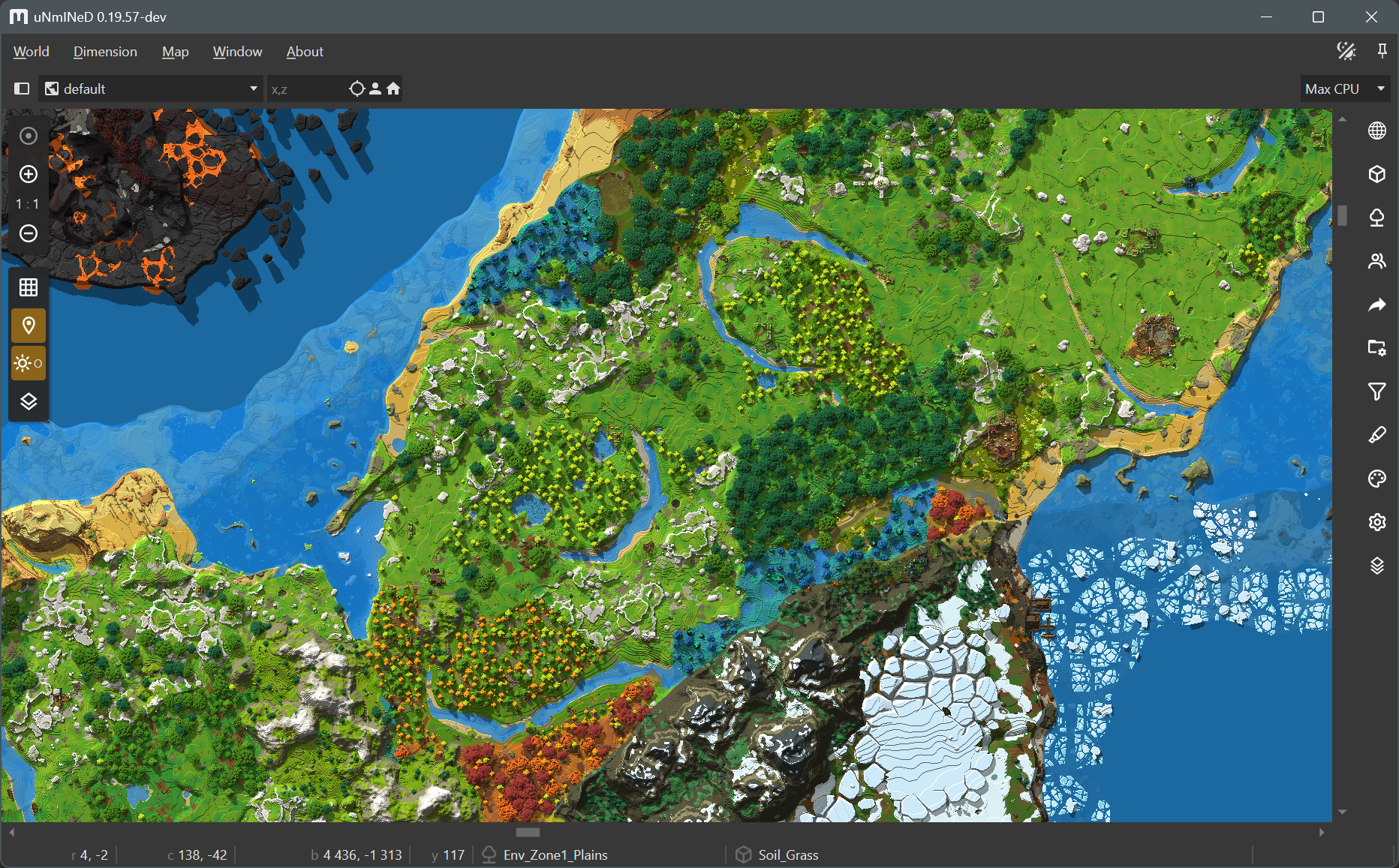
A Hytale world map rendered in uNmINeD:
News from apt.postgresql.org:
apt.postgresql.org now has changelog files in a place where apt can retrieve them automatically, for example
apt changelog postgresql-18
will download the file and display it in a pager. Mind that the files are only present yet for packages updated since last week, the rest will follow over time.
Likewise, package build logs are now also stored along with the packages in .build.xz files in the pool directory. (There is no automated download tool for them, though.)
Work on the upcoming Ubuntu 26.04 "resolute" release has started and packages are available on apt.postgresql.org.
The Ubuntu 25.04 "plucky" release has reached its end of life and has been moved to apt-archive.postgresql.org.
Christoph
[An on-line version of this announcement will be available at https://www.postfix.org/announcements/postfix-3.10.8.html]
Fixes for all supported Postfix releases:
Improved Milter error handling for messages that arrive over a long-lived SMTP connection, by changing the default milter_default_action from "tempfail" to the new "shutdown" action (i.e. disconnect the remote SMTP client).
The problem was that after a single Milter error, Postfix could tempfail all messages that the client sends over a long-lived connection, even if the Milter error was only temporary. This problem was reported by Ankit Kulkarni.
Bugfix (defect introduced: Postfix 2.11): "posttls-finger -v -v -v" terminated with a panic, caused by recursive logging. Reported by Geert Hendrickx, diagnosed by Viktor Dukhovni, and fixed by Wietse.
With one simple change, the patch for Postfix 3.7 should also apply to older Postfix versions, because the patch affects code that has not changed in a decade or so. The simple change is to remove the Prereq: line, and to remove the part that updates the HISTORY file.
You can find the updated Postfix source code at the mirrors listed at https://www.postfix.org/.
The PostgreSQL Global Development Group is planning for an out-of-cycle release on February 26, 2026 due to regressions introduced in the February 12, 2026 update release, which included releases 18.2, 17.8, 16.12, 15.16, and 14.21. This release will provide fixes for all supported versions (18.3, 17.9, 16.13, 15.17, 14.22). While these fixes may not impact all PostgreSQL users, the PostgreSQL Global Development Group wants to address these issues before the next scheduled release on May 14, 2026.
The regressions from this release include:
substring() function raises an error "invalid byte sequence for encoding" on non-ASCII text values if the source of that value is a database column."could not access status of transaction".For the substring() regression, the fix for CVE-2026-2006, which closed a vulnerability in the database server, introduced a regression causing substring() to improperly return an error on multi-byte (non-ASCII) text values if the source of that value was a database column. If you've upgraded to 18.2, 17.8, 16.12, 15.16, or 14.21, and need the fix ahead of the February 26, 2026 release, you should consider manually applying the changes. Release specific information can be found here: https://wiki.postgresql.org/wiki/2026-02_Regression_Fixes.
Ahead of this release, you can find additional information about the regressions and fixes here: https://wiki.postgresql.org/wiki/2026-02_Regression_Fixes.
If you are upgrading from v0.14.x and below, this version includes multiple breaking changes. Please read the upgrading documentation for more information on how to upgrade from previous versions.
If you are upgrading from v0.15.x, replace the binary and update the webadmin.
mail-parser returns cyclical MIME structures (CVE-2026-26312).upToId computation in */queryChanges.Email/queryChanges.
The MariaDB Foundation is pleased to announce the availability of MariaDB 12.3.1, the release candidate (RC) in the new long-term support (LTS) release, and MariaDB 12.2.2, the latest stable rolling release. …
Continue reading \"MariaDB 12.3.1 and 12.2.2 now available\"
The post MariaDB 12.3.1 and 12.2.2 now available appeared first on MariaDB.org.
The PostgreSQL Global Development Group has released an update to all supported versions of PostgreSQL, including 18.2, 17.8, 16.12, 15.16, and 14.21. This release fixes 5 security vulnerabilities and over 65 bugs reported over the last several months.
For the full list of changes, please review the release notes.
oidvector discloses a few bytes of memoryCVSS v3.1 Base Score: 4.3
Supported, Vulnerable Versions: 14 - 18.
Improper validation of type oidvector in PostgreSQL allows a database user to
disclose a few bytes of server memory. We have not ruled out viability of
attacks that arrange for presence of confidential information in disclosed
bytes, but they seem unlikely. Versions before PostgreSQL 18.2, 17.8, 16.12,
15.16, and 14.21 are affected.
The PostgreSQL project thanks Altan Birler for reporting this problem.
intarray missing validation of type of input to selectivity estimator executes arbitrary codeCVSS v3.1 Base Score: 8.8
Supported, Vulnerable Versions: 14 - 18.
Missing validation of type of input in PostgreSQL intarray extension
selectivity estimator function allows an object creator to execute arbitrary
code as the operating system user running the database. Versions before
PostgreSQL 18.2, 17.8, 16.12, 15.16, and 14.21 are affected.
The PostgreSQL project thanks Daniel Firer, as part of zeroday.cloud, for reporting this problem.
pgcrypto heap buffer overflow executes arbitrary codeCVSS v3.1 Base Score: 8.8
Supported, Vulnerable Versions: 14 - 18.
Heap buffer overflow in PostgreSQL pgcrypto allows a ciphertext provider to
execute arbitrary code as the operating system user running the database.
Versions before PostgreSQL 18.2, 17.8, 16.12, 15.16, and 14.21 are affected.
The PostgreSQL project thanks Team Xint Code, as part of zeroday.cloud, for reporting this problem.
CVSS v3.1 Base Score: 8.8
Supported, Vulnerable Versions: 14 - 18.
Missing validation of multibyte character length in PostgreSQL text manipulation allows a database user to issue crafted queries that achieve a buffer overrun. That suffices to execute arbitrary code as the operating system user running the database. Versions before PostgreSQL 18.2, 17.8, 16.12, 15.16, and 14.21 are affected.
The PostgreSQL project thanks Paul Gerste and Moritz Sanft, as part of zeroday.cloud, for reporting this problem.
pg_trgm heap buffer overflow writes pattern onto server memoryCVSS v3.1 Base Score: 8.2
Supported, Vulnerable Versions: 18.
Heap buffer overflow in PostgreSQL pg_trgm allows a database user to achieve
unknown impacts via a crafted input string. The attacker has limited control
over the byte patterns to be written, but we have not ruled out the viability of
attacks that lead to privilege escalation. PostgreSQL 18.1 and 18.0 are affected.
The PostgreSQL project thanks Heikki Linnakangas for reporting this problem.
This update fixes over 65 bugs that were reported in the last several months. The issues listed below affect PostgreSQL 18. Some of these issues may also affect other supported versions of PostgreSQL.
ltree extension. If
you use an index on an ltree column, in some cases you may need perform a
reindex. See the "Updating" section for additional instructions.ALTER TABLE ... ADD CONSTRAINT to add a NOT NULL constraint on
a column that already is marked as NOT NULL now requires the constraint name
to match the existing constraint name.MERGE is executed from a WITH query to include
rows affected by the MERGE.NOTIFY error handling and reporting.ALTER PUBLICATION to ensure event triggers contain all set options.file_extend_method to control use of
posix_fallocate().psql tab completion for the VACUUM command options.pg_dump to handle concurrent sequence drops gracefully and to fail if
the calling user explicitly lacks privileges to read the sequence.amcheck around btree inspection.pg_stat_statements when an IN list contains both constants
and non-constant expressions.This release also updates time zone data files to tzdata release 2025c, which only has a historical data change for pre-1976 timestamps in Baja California.
All PostgreSQL update releases are cumulative. As with other minor releases,
users are not required to dump and reload their database or use pg_upgrade
in order to apply this update release; you may simply shutdown PostgreSQL and
update its binaries.
If you have indexes on ltree columns and do not use the libc collation
provider, after upgrading to the latest version, you must reindex any
ltree column. You can use REINDEX INDEX CONCURRENTLY to minimize the impact
on your system.
Users who have skipped one or more update releases may need to run additional post-update steps; please see the release notes from earlier versions for details.
For more details, please see the release notes.
If you have corrections or suggestions for this release announcement, please send them to the pgsql-www@lists.postgresql.org public mailing list.
New uNmINeD development snapshot is available for download!
Changes:
** specially, the pattern foo** means foo or foo_*The Hytale support is still experimental. There may be bugs, crashes, and the map colors are still unfinished.
!!! WARNING !!!
It has not yet been tested whether uNmINeD can be used safely while Hytale is running. Always close Hytale before using uNmINeD to prevent data corruption!
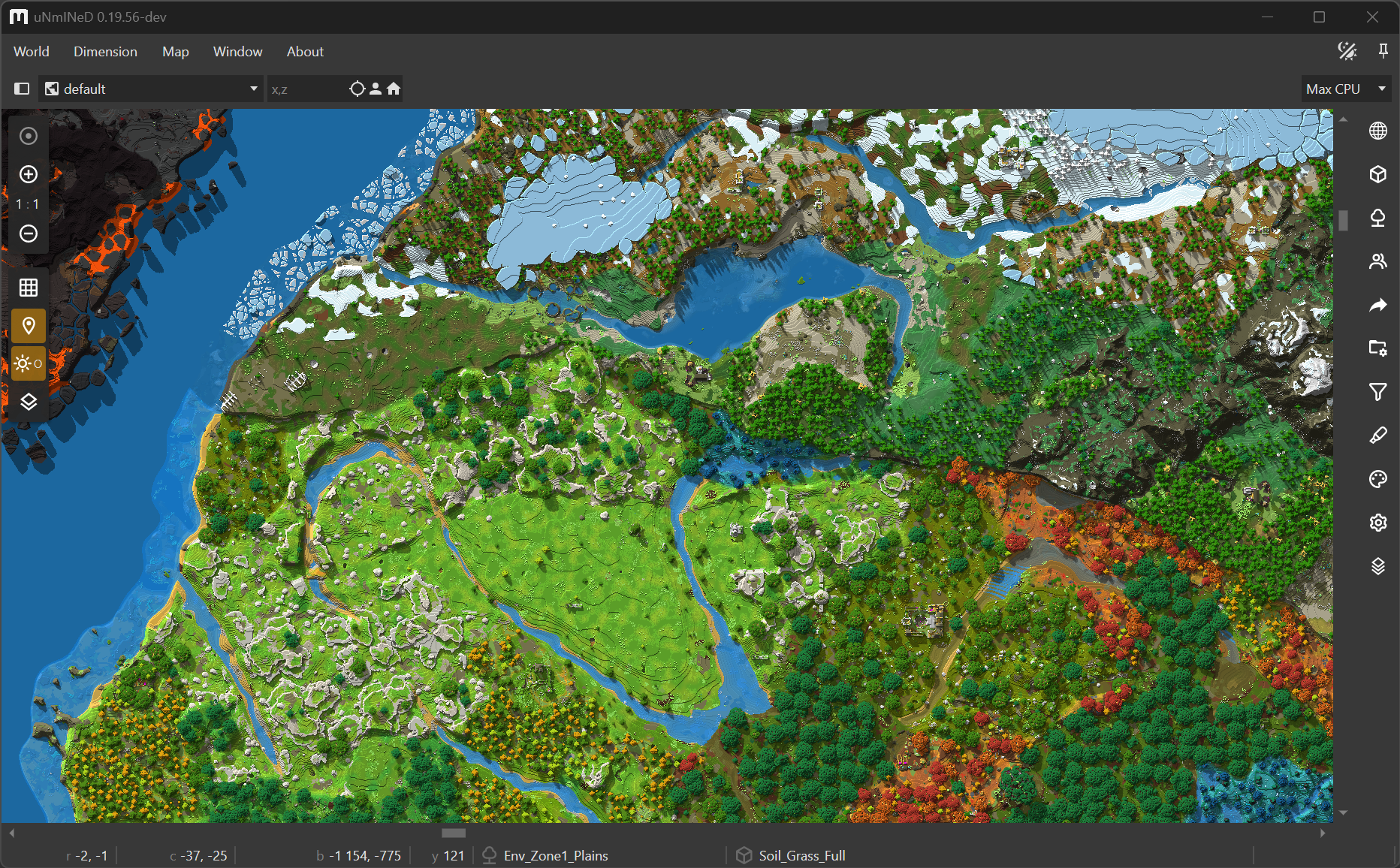
A Hytale world in uNmINeD:
New uNmINeD development snapshot is available for download!
Changes:
uNmINeD now can read Hytale worlds. This is an experimental feature under development. Map colors are far from finished, the code is slow, and there may be bugs and crashes.
!!! WARNING !!!
It has not yet been tested whether uNmINeD can be used safely while Hytale is running. Always close Hytale before using uNmINeD to prevent data corruption!
Check your Hytale world in uNmINeD and have fun!
The PostgreSQL Global Development Group has released an update to all supported versions of PostgreSQL, including 18.1, 17.7, 16.11, 15.15, 14.20, and 13.23. This release fixes 2 security vulnerabilities and over 50 bugs reported over the last several months.
For the full list of changes, please review the release notes.
This is the final release of PostgreSQL 13. PostgreSQL 13 is now end-of-life and will no longer receive security and bug fixes. If you are running PostgreSQL 13 in a production environment, we suggest that you make plans to upgrade to a newer, supported version of PostgreSQL. Please see our versioning policy for more information.
CREATE STATISTICS does not check for schema CREATE privilegeCVSS v3.1 Base Score: 3.1
Supported, Vulnerable Versions: 13 - 18.
Missing authorization in PostgreSQL CREATE STATISTICS
command allows a table owner to achieve denial of service against other
CREATE STATISTICS users by creating in any schema. A later CREATE STATISTICS
for the same name, from a user having the CREATE privilege, would then fail.
Versions before PostgreSQL 18.1, 17.7, 16.11, 15.15, 14.20, and 13.23 are
affected.
The PostgreSQL project thanks Jelte Fennema-Nio for reporting this problem.
CVSS v3.1 Base Score: 5.9
Supported, Vulnerable Versions: 13 - 18.
Integer wraparound in multiple PostgreSQL libpq client library functions allows an application input provider or network peer to cause libpq to undersize an allocation and write out-of-bounds by hundreds of megabytes. This results in a segmentation fault for the application using libpq. Versions before PostgreSQL 18.1, 17.7, 16.11, 15.15, 14.20, and 13.23 are affected.
The PostgreSQL project thanks Aleksey Solovev (Positive Technologies) for reporting this problem.
This update fixes over 50 bugs that were reported in the last several months. The issues listed below affect PostgreSQL 18. Some of these issues may also affect other supported versions of PostgreSQL.
DETACH CONCURRENTLY, which previously caused issues during dump/restore or if a parent table is dropped after the DETACH.COPY ... FROM ... WHERE clauses.pg_stat_replication view.synchronized_standby_slots references nonexistent replication slots.GROUP BY DISTINCT in PL/pgSQL assignment statements.NOT NULL constraints on inherited table columns.pg_dump.pgbench error handling and reporting.pg_combinebackup.SELECT privileges on a table to use pg_prewarm to prewarm indexes on that table.All PostgreSQL update releases are cumulative. As with other minor releases,
users are not required to dump and reload their database or use pg_upgrade
in order to apply this update release; you may simply shutdown PostgreSQL and
update its binaries.
Users who have skipped one or more update releases may need to run additional post-update steps; please see the release notes from earlier versions for details.
For more details, please see the release notes.
If you have corrections or suggestions for this release announcement, please send them to the pgsql-www@lists.postgresql.org public mailing list.
The PostgreSQL Global Development Group today announced the release of PostgreSQL 18, the latest version of the world's most advanced open source database. Translations of this press release are available in the PostgreSQL 18 press kit.
PostgreSQL 18 improves performance for workloads of all sizes through a new I/O
subsystem that has demonstrated up to 3× performance improvements when reading
from storage, and also increases the number of queries that can use indexes.
This release makes major-version upgrades less disruptive, accelerating upgrade
times and reducing the time required to reach expected performance after an
upgrade completes. Developers also benefit from PostgreSQL 18 features,
including virtual generated columns that compute values at query time, and the
database-friendly uuidv7() function that provides better indexing and read
performance for UUIDs. PostgreSQL 18 makes it easier to integrate with single-sign
on (SSO) systems with support for OAuth 2.0 authentication.
"The efforts of the global open source community shape every PostgreSQL release and help deliver features that meet users where their data resides," said Jonathan Katz, a member of the PostgreSQL core team. "PostgreSQL 18 builds on the project's long, rich history of delivering a reliable and robust data management experience, while continuing to expand the workloads it can support."
PostgreSQL, an innovative data management system known for its reliability, robustness, and extensibility, benefits from nearly 30 years of open source development from a global developer community and has become the preferred open source relational database for organizations of all sizes.
PostgreSQL previously relied on operating system readahead mechanisms to accelerate data retrieval. However, because operating systems lack insight into database-specific access patterns, they cannot always anticipate what data will be required, leading to suboptimal performance in many workloads.
PostgreSQL 18 introduces a new asynchronous I/O (AIO) subsystem designed to address this limitation. AIO lets PostgreSQL issue multiple I/O requests concurrently instead of waiting for each to finish in sequence. This expands existing readahead and improves overall throughput. AIO operations supported in PostgreSQL 18 include sequential scans, bitmap heap scans, and vacuum. Benchmarking has demonstrated performance gains of up to 3x in certain scenarios.
The new io_method
setting lets you toggle between the AIO methods, including worker and io_uring,
or you can choose to maintain the current PostgreSQL behavior with the sync
setting. There are now more parameters to consider tuning with AIO, which you
can learn more about in the documentation.
A key PostgreSQL feature is the generation and storage of
statistics that help
PostgreSQL select the most efficient query plan. Before PostgreSQL 18, these
statistics didn't carry over on a major version upgrade,
which could cause significant query performance degradations on busy systems
until the ANALYZE
finished running. PostgreSQL 18 introduces the ability to keep planner
statistics through a major version upgrade, which helps an upgraded cluster
reach expected performance more quickly after the upgrade.
Additionally, pg_upgrade,
a utility that performs major version upgrades, includes several enhancements in
PostgreSQL 18, such as faster upgrades when a database contains many objects
like tables and sequences. This release also lets pg_upgrade process its
checks in parallel based on the settings of the --jobs flag, and adds the
--swap flag that swaps upgrade directories instead of copying, cloning, or
linking files.
PostgreSQL 18 further accelerates query performance with features that
automatically make your workloads faster. This release introduces "skip scan"
lookups on multicolumn B-tree indexes
that improve execution time for queries that omit an = condition on one or
more prefix index columns. It can also optimize queries that use OR conditions
in a WHERE to use an index, leading to significantly faster execution. There
are also numerous improvements for how PostgreSQL plans and executes table joins,
from boosting the performance of hash joins to allowing merge joins to use
incremental sorts. PostgreSQL 18 also supports parallel builds for
GIN indexes, joining B-tree and
BRIN indexes in supporting
this capability.
This release also builds on PostgreSQL support for hardware acceleration,
including support for ARM NEON and SVE CPU intrinsics for the popcount
function, which is used by the bit_count
and other internal capabilities.
PostgreSQL 18 introduces virtual generated columns that compute values at query time instead of storing them. This is now the default option for generated columns. Additionally, stored generated columns can now be logically replicated.
This release adds the capability to access both the previous (OLD) and current
(NEW) values in the RETURNING clause
for INSERT, UPDATE, DELETE and MERGE commands. PostgreSQL 18 also adds
UUIDv7 generation through the uuidv7()
function, letting you generate random UUIDs that are timestamp-ordered to
support better caching strategies. PostgreSQL 18 includes
uuidv4()
as an alias for gen_random_uuid().
PostgreSQL 18 adds temporal constraints
-- constraints over ranges -- for both PRIMARY KEY and UNIQUE constraints
using the WITHOUT OVERLAPS clause, and on FOREIGN KEY constraints using the
PERIOD clause.
Finally, PostgreSQL 18 makes it easier to create the schema definition of a
foreign table using the definition of a local table with the
CREATE FOREIGN TABLE ... LIKE
command.
PostgreSQL 18 makes text processing easier and faster with several new
enhancements. This release adds the PG_UNICODE_FAST
collation, which provides full Unicode semantics for case transformations while
helping to accelerate many comparisons. This includes the upper and lower
string comparison functions and the new casefold
function for case-insensitive comparisons. Additionally, PostgreSQL 18 now
supports making LIKE comparisons over text that uses a
nondeterministic collation,
simplifying how you can perform more complex pattern matching. This release also
changes full text search
to use the default collation provider of a cluster instead of always using libc,
which may require you to reindex all
full text search
and pg_trgm
indexes after running pg_upgrade.
PostgreSQL 18 introduces oauth authentication,
which lets users authenticate using OAuth 2.0 mechanisms supported through
PostgreSQL extensions. Additionally, PostgreSQL 18 includes validation for
FIPS mode,
and adds the ssl_tls13_ciphers
parameter for configuring server-side TLS v1.3 cipher suites.
This release deprecates md5 password authentication, which will be removed in
a future release. If you require PostgreSQL password-based authentication, use
SCRAM authentication.
PostgreSQL 18 also supports SCRAM passthrough authentication with both
postgres_fdw and
dblink for authenticating to
remote PostgreSQL instances. Additionally, pgcrypto
now supports SHA-2 encryption for password hashing.
PostgreSQL 18 supports reporting logical replication write conflicts in logs and
in the pg_stat_subscription_stats view. Additionally,
CREATE SUBSCRIPTION
now defaults to using parallel streaming for applying transactions, which can
help improve performance. The
pg_createsubscriber
utility now has an --all flag so you can create logical replicas for all
databases in an instance with a single command. PostgreSQL 18 also lets you
automatically drop idle replication slots to help prevent storing too many
write-ahead log files on a publisher.
PostgreSQL 18 improves its vacuum strategy by proactively freezing more pages during regular vacuums, reducing overhead and helping in situations that require aggressive vacuums.
PostgreSQL 18 adds more details to EXPLAIN,
which provides information about query plan execution, and as of this release
now automatically shows how many buffers (the fundamental unit of data storage)
are accessed when executing EXPLAIN ANALYZE. Additionally, EXPLAIN ANALYZE
now shows how many index lookups occur during an index scan, and EXPLAIN ANALYZE VERBOSE
includes CPU, WAL, and average read statistics. PostgreSQL 18 includes more info
in pg_stat_all_tables
on time spent on vacuum and related operations, as well as per-connection
statistics on I/O and WAL utilization.
Databases initialized with PostgreSQL 18 initdb
now have page checksums enabled by default. This can affect upgrades from
non-checksum enabled clusters, which would require you to create a new
PostgreSQL 18 cluster with the --no-data-checksums option when using
pg_upgrade.
PostgreSQL 18 also introduces a new version (3.2) of the PostgreSQL wire
protocol, the first new protocol version since PostgreSQL 7.4 (2003).
libpq still uses
version 3.0 by default while clients (e.g., drivers, poolers, proxies) add
support for the new protocol version.
Many other new features and improvements have been added to PostgreSQL 18 that may also be helpful for your use cases. Please see the release notes for a complete list of new and changed features.
PostgreSQL is the world's most advanced open source database, with a global community of thousands of users, contributors, companies and organizations. Since its beginnings at the University of California, Berkeley over 40 years ago, PostgreSQL has continued with an unmatched pace of development. PostgreSQL's mature feature set not only matches top proprietary database systems, but exceeds them in advanced database features, extensibility, security, and stability.
The PostgreSQL Global Development Group announces that the first release candidate of PostgreSQL 18 is now available for download. As a release candidate, PostgreSQL 18 RC 1 will be mostly identical to the initial release of PostgreSQL 18, though some more fixes may be applied prior to the general availability of PostgreSQL 18.
The planned date for the general availability of PostgreSQL 18 is September 25, 2025. Please see the "Release Schedule" section for more details.
To upgrade to PostgreSQL 18 RC 1 from earlier versions of PostgreSQL, you will
need to use a major version upgrade strategy, e.g. pg_upgrade or
pg_dump / pg_restore. For more information, please visit the documentation
section on upgrading:
https://www.postgresql.org/docs/18/upgrading.html
Several bug fixes were applied for PostgreSQL 18 during the Beta 3 period. These include:
vacuumdb --missing-stats-only.pg_trgm indexes after using pg_upgrade.For a detailed list of fixes, please visit the open items page.
This is the first release candidate for PostgreSQL 18. Unless an issue is discovered that warrants a delay or to produce an additional release candidate, PostgreSQL 18 should be made generally available on September 25, 2025.
For further information please see the Beta Testing page.
The PostgreSQL Global Development Group has released an update to all supported versions of PostgreSQL, including 17.6, 16.10, 15.14, 14.19, and 13.22, as well as the third beta release of PostgreSQL 18. This release fixes 3 security vulnerabilities and over 55 bugs reported over the last several months.
If you previously created a BRIN index using the numeric_minmax_multi_ops
operator class, please see the "Updating" section for additional instructions
after upgrading your instance.
For the full list of changes, please review the release notes.
PostgreSQL 13 will stop receiving fixes on November 13, 2025. If you are running PostgreSQL 13 in a production environment, we suggest that you make plans to upgrade to a newer, supported version of PostgreSQL. Please see our versioning policy for more information.
CVSS v3.1 Base Score: 3.1
Supported, Vulnerable Versions: 13 - 17.
PostgreSQL optimizer statistics allow a user to read sampled data within a view that the user cannot access. Separately, statistics allow a user to read sampled data that a row security policy intended to hide. PostgreSQL maintains statistics for tables by sampling data available in columns; this data is consulted during the query planning process. Prior to this release, a user could craft a leaky operator that bypassed view access control lists (ACLs) and bypassed row security policies in partitioning or table inheritance hierarchies. Reachable statistics data notably included histograms and most- common-values lists. CVE-2017-7484 and CVE-2019-10130 intended to close this class of vulnerability, but this gap remained. Versions before PostgreSQL 17.6, 16.10, 15.14, 14.19, and 13.22 are affected.
The PostgreSQL project thanks Dean Rasheed for reporting this problem.
pg_dump lets superuser of origin server execute arbitrary code in psql clientCVSS v3.1 Base Score: 8.8
Supported, Vulnerable Versions: 13 - 17.
Untrusted data inclusion in pg_dump in PostgreSQL allows a malicious superuser of the origin server to inject arbitrary code for restore-time execution as the client operating system account running psql to restore the dump, via psql meta-commands. pg_dumpall is also affected. pg_restore is affected when used to generate a plain-format dump. This is similar to MySQL CVE-2024-21096. Versions before PostgreSQL 17.6, 16.10, 15.14, 14.19, and 13.22 are affected.
The PostgreSQL project thanks Martin Rakhmanov, Matthieu Denais, and RyotaK for reporting this problem.
pg_dump newline in object name executes arbitrary code in psql client and in restore target serverCVSS v3.1 Base Score: 8.8
Supported, Vulnerable Versions: 13 - 17.
Improper neutralization of newlines in pg_dump in PostgreSQL allows a user of the origin server to inject arbitrary code for restore-time execution as the client operating system account running psql to restore the dump, via psql meta-commands inside a purpose-crafted object name. The same attacks can achieve SQL injection as a superuser of the restore target server. pg_dumpall, pg_restore, and pg_upgrade are also affected. Versions before PostgreSQL 17.6, 16.10, 15.14, 14.19, and 13.22 are affected. Versions before 11.20 are unaffected. CVE-2012-0868 had fixed this class of problem, but version 11.20 reintroduced it.
The PostgreSQL project thanks Noah Misch for reporting this problem.
This update fixes over 55 bugs that were reported in the last several months. The issues listed below affect PostgreSQL 17. Some of these issues may also affect other supported versions of PostgreSQL.
numeric_minmax_multi_ops operator class that could cause them to become bloated and inefficient. Please see the "Updating" section for instructions on how to fix these indexes.[[:alpha:]%_]) are handled in SIMILAR TO expressions.MERGE, including incorrect query results with concurrency and when targeting a table that is a parent in an inheritance hierarchy.shared_buffers settings.PQcancelCreate().All PostgreSQL update releases are cumulative. As with other minor releases,
users are not required to dump and reload their database or use pg_upgrade
in order to apply this update release; you may simply shutdown PostgreSQL and
update its binaries.
If you have any BRIN indexes that use the numeric_minmax_multi_ops operator
class, it is advisable to REINDEX them after updating to fix any potential
bloating and inefficiency.
Users who have skipped one or more update releases may need to run additional post-update steps; please see the release notes from earlier versions for details.
For more details, please see the release notes.
This release marks the third beta release of PostgreSQL 18 and puts the community one step closer to general availability tentatively around September/October 2025.
In the spirit of the open source PostgreSQL community, we strongly encourage you to test the new features of PostgreSQL 18 on your systems to help us eliminate bugs and other issues. While we do not advise you to run PostgreSQL 18 Beta 3 in production environments, we encourage you to find ways to run your typical application workloads against this beta release.
Your testing and feedback helps the community ensure that PostgreSQL 18 upholds our standards of delivering a stable, reliable release of the world's most advanced open source relational database. Please read more about our beta testing process and how you can contribute:
https://www.postgresql.org/developer/beta/
To upgrade to PostgreSQL 18 Beta 3 from an earlier version of PostgreSQL,
you will need to use a strategy similar to upgrading between major versions of
PostgreSQL (e.g. pg_upgrade or pg_dump / pg_restore). For more
information, please visit the documentation section on
upgrading.
Fixes and changes in PostgreSQL 18 Beta 3 include:
can't get cancellation key error observed with some additional software.pg_dumpall --statistics-only and --no-schema.pg_dumpall non-text output file formats.date_trunc(..., 'infinity'::timestamptz) on 32-bit systems.Please see the release notes for a complete list of new and changed features:
https://www.postgresql.org/docs/18/release-18.html
The stability of each PostgreSQL release greatly depends on you, the community, to test the upcoming version with your workloads and testing tools to find bugs and regressions before the general availability of PostgreSQL 18. As this is a Beta, minor changes to database behaviors, feature details, and APIs are still possible. Your feedback and testing will help determine the final tweaks on the new features, so please test in the near future. The quality of user testing helps determine when we can make a final release.
A list of open issues is publicly available in the PostgreSQL wiki. You can report bugs using this form on the PostgreSQL website:
https://www.postgresql.org/account/submitbug/
This is the third beta release of version 18. The PostgreSQL Project will release one or more release candidates, before the final release around September/October 2025. For further information please see the Beta Testing page.
If you have corrections or suggestions for this release announcement, please send them to the pgsql-www@lists.postgresql.org public mailing list.
The PostgreSQL Global Development Group announces that the second beta release of PostgreSQL 18 is now available for download. This release contains previews of all features when PostgreSQL 18 is made generally available, though some details of the release can change during the beta period.
You can find information about all of the PostgreSQL 18 features and changes in the release notes:
https://www.postgresql.org/docs/18/release-18.html
In the spirit of the open source PostgreSQL community, we strongly encourage you to test the new features of PostgreSQL 18 on your systems to help us eliminate bugs and other issues. While we do not advise you to run PostgreSQL 18 Beta 2 in production environments, we encourage you to find ways to run your typical application workloads against this beta release.
Your testing and feedback helps the community ensure that PostgreSQL 18 upholds our standards of delivering a stable, reliable release of the world's most advanced open source relational database. Please read more about our beta testing process and how you can contribute:
https://www.postgresql.org/developer/beta/
To upgrade to PostgreSQL 18 Beta 2 from an earlier version of PostgreSQL,
you will need to use a strategy similar to upgrading between major versions of
PostgreSQL (e.g. pg_upgrade or pg_dump / pg_restore). For more
information, please visit the documentation section on
upgrading.
Fixes and changes in PostgreSQL 18 Beta 2 include:
pg_get_process_memory_contexts() function.pg_dump for tables with complex names.pg_dump and pg_dumpall default behavior to use --no-statistics.
Leave the default for pg_restore and pg_upgrade to be --with-statistics.LOAD $libdir/ works.PQservice() from libpq.Please see the release notes for a complete list of new and changed features:
https://www.postgresql.org/docs/18/release-18.html
The stability of each PostgreSQL release greatly depends on you, the community, to test the upcoming version with your workloads and testing tools to find bugs and regressions before the general availability of PostgreSQL 18. As this is a Beta, minor changes to database behaviors, feature details, and APIs are still possible. Your feedback and testing will help determine the final tweaks on the new features, so please test in the near future. The quality of user testing helps determine when we can make a final release.
A list of open issues is publicly available in the PostgreSQL wiki. You can report bugs using this form on the PostgreSQL website:
https://www.postgresql.org/account/submitbug/
This is the second beta release of version 18. The PostgreSQL Project will release additional betas as required for testing, followed by one or more release candidates, until the final release around September/October 2025. For further information please see the Beta Testing page.
The PostgreSQL Global Development Group has released an update to all supported versions of PostgreSQL, including 17.5, 16.9, 15.13, 14.18, and 13.21. This release fixes 1 security vulnerability and over 60 bugs reported over the last several months.
For the full list of changes, please review the release notes.
PostgreSQL 13 will stop receiving fixes on November 13, 2025. If you are running PostgreSQL 13 in a production environment, we suggest that you make plans to upgrade to a newer, supported version of PostgreSQL. Please see our versioning policy for more information.
CVSS v3.1 Base Score: 5.9
Supported, Vulnerable Versions: 13 - 17.
A buffer over-read in PostgreSQL GB18030 encoding validation allows a database input provider to achieve temporary denial of service on platforms where a 1-byte over-read can elicit process termination. This affects the database server and also libpq. Versions before PostgreSQL 17.5, 16.9, 15.13, 14.18, and 13.21 are affected.
This update fixes over 60 bugs that were reported in the last several months. The issues listed below affect PostgreSQL 17. Some of these issues may also affect other supported versions of PostgreSQL.
date_bloom_ops operator class).MERGE into a
partitioned table with DO NOTHING actions.INSERT
commands when the table has a GENERATED column
of a domain type
and the domain's constraints disallow NULL values.ALTER TABLE .. ADD COLUMN to correctly handle the case of a domain type that has
its own default value and the DEFAULT for the column is not set.XMLSERIALIZE() so that the INDENT option is correctly dumped out when
it's present in views or rules. This was noticeable on restores.FILTER and either
ORDER BY or DISTINCT clauses that could lead to unnecessary failures.jsonbcol ?| array[...] with tens of thousands of array
elements.synchronous_standby_names immediately
after startup, where a backend might fail to wait for a synchronous commit.scram_iterations
is set to INT_MAX.reindexdb
handles scheduling parallel reindex operations to achieve the expected amount of
parallelism.This release also updates time zone data files to tzdata release 2025b for DST law changes in Chile, plus historical corrections for Iran. Additionally, there is a new time zone America/Coyhaique for Chile's Aysén Region, to account for it changing to UTC-03 year-round, which diverges from America/Santiago.
All PostgreSQL update releases are cumulative. As with other minor releases,
users are not required to dump and reload their database or use pg_upgrade in
order to apply this update release; you may simply shutdown PostgreSQL and
update its binaries.
If you created a self-referential foreign key on a partitioned table, after updating, you should drop and recreate any of these self-referential foreign keys if partitions have been created or attached since the constraint was created. There may be rows in the partition that violate this constraint, in which case recreating the constraint will fail, and you'll need to correct those rows before trying again.
Users who have skipped one or more update releases may need to run additional post-update steps; please see the release notes from earlier versions for details.
For more details, please see the release notes.
If you have corrections or suggestions for this release announcement, please send them to the pgsql-www@lists.postgresql.org public mailing list.
The PostgreSQL Global Development Group announces that the first beta release of PostgreSQL 18 is now available for download. This release contains previews of all features when PostgreSQL 18 is made generally available, though some details of the release can change during the beta period.
You can find information about all of the PostgreSQL 18 features and changes in the release notes:
https://www.postgresql.org/docs/18/release-18.html
In the spirit of the open source PostgreSQL community, we strongly encourage you to test the new features of PostgreSQL 18 on your systems to help us eliminate bugs and other issues. While we do not advise you to run PostgreSQL 18 Beta 1 in production environments, we encourage you to find ways to run your typical application workloads against this beta release.
Your testing and feedback helps the community ensure that PostgreSQL 18 upholds our standards of delivering a stable, reliable release of the world's most advanced open source relational database. Please read more about our beta testing process and how you can contribute:
https://www.postgresql.org/developer/beta/
Below are some of the feature highlights that are planned for PostgreSQL 18. This list is not exhaustive; for the full list of planned features, please see the release notes.
PostgreSQL 18 introduces an asynchronous I/O (AIO) subsystem. This new
subsystem allows to increase I/O throughput and to hide I/O latency. On Linux
io_uring can be used for AIO, a worker based implementation is available on
all platforms. This initial release supporting file system reads such as
sequential scans, bitmap heap scans, and vacuums, with tests showing up to a
2-3x performance improvements.
These performance gains extend to query optimizations and new indexing features. PostgreSQL 18 adds support for using "skip scan" lookups on multicolumn B-tree indexes, which can result in faster execution times for queries that omit a "=" condition on one or more prefix index columns. This release also includes optimizations for WHERE clauses that contain OR and IN (...) statements to better utilize recent indexing improvements which can also result in better query performance. There are also numerous performance improvements for how PostgreSQL plans and executes table joins, from improving the overall performance of hash joins to allowing merge joins to use incremental sorts.
There are a variety of other PostgreSQL 18 features that improve performance for other query and maintenance operations. PostgreSQL 18 now supports parallel builds for GIN indexes, which are commonly used for search over JSON and full-text data. This release also allows you to define partition keys and materialized views with unique indexes which aren't B-trees. PostgreSQL 18 also improves overall locking performance for queries that access many relations, and adds several improvements to queries over partitioned tables, including improved pruning and join support. PostgreSQL 18 also has performance improvements in text processing, including general speedups to the upper/lower functions and a new built-in collation PG_UNICODE_FAST.
Before PostgreSQL 18, an important step after performing a major version upgrade was to run the ANALYZE to generate statistics, which is a critical component of helping PostgreSQL to select the most efficient query plan. Based on the size and overall activity of a PostgreSQL cluster, this could be a time consuming process, and potentially impact query performance until the process completed. PostgreSQL 18 introduces the ability to keep planner statistics through a major version upgrade, which helps an upgraded cluster to get to its expected performance state sooner once it's available.
Additionally, pg_upgrade, the utility used to facilitate a major version upgrade, added several performance enhancements to help accelerate upgrades with many objects, such as tables and sequences. This release also allows pg_upgrade to process its checks in parallel based on the settings of the --jobs flag, and also adds the --swap flag, which swaps upgrade directories instead of copying, cloning, or linking files.
PostgreSQL 18 introduces virtual generated columns that compute the column values just-in-time during query execution, instead of having to store them. This is now the default option for generated columns. Additionally, stored generated columns can now be logically replicated.
This release adds the capability to access both the previous (OLD) and current (NEW) values in the RETURNING clause for INSERT, UPDATE, DELETE and MERGE commands. Additionally, PostgreSQL 18 adds support for UUIDv7 generation through the uuidv7() function, letting you generate random UUIDs that are timestamp-ordered to support better caching strategies (this release also adds uuidv4() as an alias for gen_rand_uuid).
Now in PostgreSQL 18, you can make LIKE comparisons over text that uses a nondeterministic collation, making it simpler to do more complex pattern matching. Additionally, this release introduces the CASEFOLD to help with case-insensitive matches.
This release also adds temporal constraints, or constraints over ranges, for both PRIMARY KEY and UNIQUE constraints using the WITHOUT OVERLAPS clause, and on FOREIGN KEY constraints using the PERIOD clause.
PostgreSQL 18 introduces oauth authentication, which lets users authenticate using OAuth 2.0 mechanisms supported through PostgreSQL extensions. Additionally, PostgreSQL 18 adds several features to validate and enforce FIPS mode behavior, and also adds the ssl_tls13_ciphers to let users configure which TLS v1.3 cipher suites the server can use.
This release deprecates md5 password authentication in favor of using SCRAM authentication that was first added in PostgreSQL 10. md5 authentication will be fully removed in a future major version release. Additionally, PostgreSQL 18 adds support for SCRAM passthrough authentication with both postgres_fdw and dblink when authenticating to remote PostgreSQL instances.
PostgreSQL 18 adds more details to the EXPLAIN utility, which provides information about query plan execution, and as of this release now automatically shows how many buffers (the fundamental unit of data storage) are accessed when executing EXPLAIN ANALYZE. Additionally, EXPLAIN ANALYZE now shows how many index lookups occur during an index scan, and EXPLAIN ANALYZE VERBOSE includes CPU, WAL, and average read statistics. This release also includes information about the total amount of time spent vacuuming and analyzing a table in pg_stat_all_tables, and now shows per-connection statistics on I/O and WAL utilization.
PostgreSQL 18 also provides more insights into write conflicts that occur during logical replication, and surfaces this information both in logs and in the pg_stat_subscription_stats view.
Starting with PostgreSQL 18, data checksums, which are used to validate the integrity of stored data, are now enabled by default on new PostgreSQL clusters. You can choose to disable this behavior using the initdb --no-data-checksums command. Note that this may require changes to your upgrade scripts.
Additionally, there are new behaviors available in several constraint features.
First, both foreign key and check constraints can be set as NOT ENFORCED and
conversely, made enforceable. Additionally, NOT NULL constraints now preserve
their names as required by the SQL standard, support the NOT VALID and
NO INHERIT clauses, and now behave more consistently with inheritance.
pg_createsubscriber now supports an --all flag so you can create logical replicas for all databases in an instance with a single command. Additionally, PostgreSQL 18 lets you create the schema definition of a foreign table using the definition of a local table using the CREATE FOREIGN TABLE ... LIKE command.
PostgreSQL 18 also introduces a new version (3.2) of the PostgreSQL wire protocol, which is the first new protocol version since PostgreSQL 7.4 (2003). libpq still uses version 3.0 by default while clients (e.g., drivers, poolers, proxies) add support for the new protocol version.
Many other new features and improvements have been added to PostgreSQL 18. Many of these may also be helpful for your use cases. Please see the release notes for a complete list of new and changed features:
https://www.postgresql.org/docs/18/release-18.html
The stability of each PostgreSQL release greatly depends on you, the community, to test the upcoming version with your workloads and testing tools to find bugs and regressions before the general availability of PostgreSQL 18. As this is a Beta, minor changes to database behaviors, feature details, and APIs are still possible. Your feedback and testing will help determine the final tweaks on the new features, so please test in the near future. The quality of user testing helps determine when we can make a final release.
A list of open issues is publicly available in the PostgreSQL wiki. You can report bugs using this form on the PostgreSQL website:
https://www.postgresql.org/account/submitbug/
This is the first beta release of version 18. The PostgreSQL Project will release additional betas as required for testing, followed by one or more release candidates, until the final release around September/October 2025. For further information please see the Beta Testing page.
The PostgreSQL Global Development Group has released an update to all supported versions of PostgreSQL, including 17.4, 16.8, 15.12, 14.17, and 13.20.
For the full list of changes, please review the release notes.
The issues listed below affect PostgreSQL 17. Some of these issues may also affect other supported versions of PostgreSQL.
libpq.
The fix for CVE-2025-1094
caused the quoting functions to not honor their string length parameters and, in
some cases, cause crashes. This problem could be noticeable from a PostgreSQL
client library, based on how it is integrated with libpq.pg_createsubscriber.All PostgreSQL update releases are cumulative. As with other minor releases,
users are not required to dump and reload their database or use pg_upgrade in
order to apply this update release; you may simply shutdown PostgreSQL and
update its binaries.
Users who have skipped one or more update releases may need to run additional post-update steps; please see the release notes from earlier versions for details.
For more details, please see the release notes.
If you have corrections or suggestions for this release announcement, please send them to the pgsql-www@lists.postgresql.org public mailing list.
